
Transportation and Excretion in Plants
Think of a plant not as a static organism, but as a highly dynamic system where substances are constantly moving.
In flowering plants, the following need to be transported → Water, Minerals, Organic nutrients (like sugars), Growth regulators (hormones)
👉 Now, the key idea:
- Short-distance transport → happens at cellular level
- Long-distance transport → happens through vascular tissues
Two Levels of Transport
1. Short-Distance Transport (Cellular Level)
Occurs through → Diffusion, Facilitated diffusion, Active transport
2. Long-Distance Transport (Whole Plant Level)
Occurs via Translocation through vascular system → Xylem, Phloem
Means of Transport
1. Diffusion — The Simplest Mechanism
👉 Definition:
Diffusion is a passive movement of molecules from higher concentration → lower concentration, without energy.
Key Features:
- No ATP required | Slow process
- Works best for → Gases (O₂, CO₂), Small molecules
Where does it occur?
- Within cells | Between cells
- From leaves to atmosphere (gas exchange)
Factors affecting diffusion:
- Concentration gradient, Temperature, Pressure, Membrane permeability
👉 Insight:
Diffusion alone is not sufficient for long-distance transport, because it is too slow.
2. Facilitated Diffusion — Protein-Assisted Transport
👉 Definition:
A passive process where molecules move along the concentration gradient with the help of membrane proteins.
Why is it needed?
Because:
- Cell membrane is selectively permeable
- Hydrophilic molecules cannot pass easily
Key Features:
- No ATP required | Requires specific proteins | Highly selective | Can be inhibited (protein-based)
Types of Protein Channels:
- Channel proteins
Provide passageways | Some always open, some regulated - Porins
Large channels | Allow multiple types of molecules - Aquaporins
Specialized for water transport
Modes of Transport:
| Type | Description |
| Uniport | One molecule moves alone |
| Symport | Two molecules move in same direction |
| Antiport | Two molecules move in opposite directions |
👉 Insight: This is like a controlled gate system, not an open road like diffusion.
3. Active Transport — Energy-Driven Movement
👉 Definition:
Movement of substances against concentration gradient (low → high) using ATP energy.
Key Features:
- Requires energy (ATP) | Uses protein pumps | Highly selective
- Can be saturated (limited number of pumps)
Example:
- Uptake of minerals by roots
👉 Insight: This is like pumping water uphill, which naturally wouldn’t happen.
📊 Comparison
| Property | Simple Diffusion | Facilitated Diffusion | Active Transport |
| Membrane proteins | No | Yes | Yes |
| Selectivity | No | High | High |
| Saturation | No | Yes | Yes |
| Against gradient | No | No | Yes |
| ATP required | No | No | Yes |
💧 Osmosis — Special Case of Water Transport
👉 Definition:
Osmosis is the movement of water across a semi-permeable membrane.
In Plants:
- Controlled by → Cell membrane and Vacuolar membrane (tonoplast)
- Influenced by → Cell sap concentration, Solute potential
Important Concept:
- Cell wall is freely permeable
- It does not restrict movement
👉 Insight: Osmosis is central to → Turgidity (plant rigidity), Water balance
🌳 Bulk Flow (Translocation) — Long-Distance Transport
👉 For long distances, plants use bulk flow, also called translocation.
What drives bulk flow? → Pressure differences
Two Major Pathways:
1. Xylem
- Transports: Water and Minerals
- Direction: Roots → Leaves (upward)
2. Phloem
- Transports: Organic nutrients (mainly sugars)
- Direction: Bidirectional (source → sink)
👉 Insight:
- Xylem = Water pipeline
- Phloem = Food distribution network
💧 Transpiration — The Driving Force
👉 Definition: Loss of water as vapour mainly through stomata
Factors Affecting Transpiration → Temperature, Light, Humidity, Wind, Number of stomata
🔬 Physical Basis
The ascent of xylem sap depends on:
- Cohesion → water molecules stick together
- Adhesion → water sticks to xylem walls
- Surface tension → maintains continuous column
👉 Insight: Water behaves like a continuous rope being pulled upward
🍃 Stomata — Control Gate of Plants
👉 Stomata are microscopic pores in leaf epidermis.
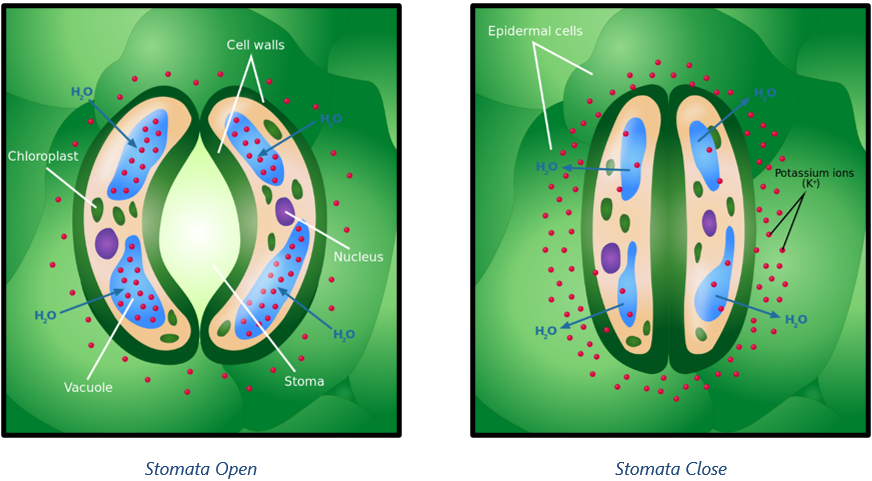
Structure:
- Two guard cells → Bean-shaped (dicots) and Dumbbell-shaped (monocots)
- Contain chloroplasts
Function:
- Gas exchange (O₂, CO₂)
- Regulate transpiration
Mechanism:
- Guard cells turgid (full of water) → stomata open
- Guard cells flaccid (water lost) → stomata close
Distribution:
- Dicots → more on lower surface
- Monocots → equal on both surfaces
Excretion in Plants (Often Overlooked Topic)
Plants don’t have kidneys, but they still remove waste efficiently.
Methods of Excretion
| Method | Type of Waste | Mechanism | Site / Structure Involved | Important Insight |
| Gaseous Waste | Oxygen (photosynthesis), Carbon dioxide (respiration) | Diffusion of gases | Stomata (leaves), Lenticels (stems) | Maintains gaseous balance in plants |
| Water | Excess water | Transpiration | Mainly through stomata | Helps in cooling and maintaining water balance |
| Organic Compounds | Resins, gums, latex, essential oils | Storage and sometimes secretion into soil | Bark, leaves, stems | Waste stored safely to avoid toxicity |
| Leaf Abscission | Accumulated metabolic waste | Shedding of old leaves | Ageing leaves | Efficient removal of waste from plant body |
| Diffusion (Aquatic Plants) | Various metabolic wastes | Direct diffusion into surrounding water | Entire plant surface | Common in aquatic environments due to easy exchange |
Mechanisms of Water and Mineral Absorption and Transport in Plants
Think of a plant root as a highly efficient “absorption hub” working silently beneath the soil. The tiny root hairs act like countless microscopic straws, dramatically increasing the surface area and allowing the plant to draw in water and dissolved minerals from the surrounding soil.
Once inside, this movement follows two distinct pathways.
- The first is the apoplast pathway, where water flows quickly through the cell walls and spaces between cells without crossing any membranes—almost like water moving through gaps in a sponge. However, this fast lane is interrupted at the endodermis by the Casparian strip, which forces water to change its route.
- The second pathway, the symplast, involves movement through the cytoplasm of cells, connected by plasmodesmata. This route is slower but highly selective, ensuring that only required substances enter the plant’s internal system. In reality, most water begins its journey through the apoplast but must eventually shift to the symplast to cross the endodermis before entering the vascular tissues.
Some plants take this efficiency a step further through a fascinating partnership called mycorrhizae, where fungi associate with roots. The fungal hyphae, with their vast surface area, act as an extended absorption network, supplying water and minerals to the plant, while the plant, in return, provides sugars and nitrogen compounds. This mutual relationship is so crucial that certain plants, such as Pinus, depend on it for proper growth.
Once water enters the plant, the next challenge is far more impressive—lifting it upward against gravity. This is achieved through two mechanisms.
- The first is root pressure, where active transport of ions into the xylem creates an osmotic pull, generating a pushing force from below. Though limited in strength, it becomes visible in phenomena like guttation, where droplets of water appear at leaf tips during early morning or high humidity conditions.
- However, the real driving force is transpiration pull. As water evaporates from leaf surfaces, it creates a negative pressure that pulls a continuous column of water upward through the xylem, much like sucking liquid through a straw. This process is incredibly powerful and efficient, capable of lifting water to great heights—even in tall trees—making it the primary mechanism responsible for water transport in plants.
Plant–Water Dynamics
To truly understand how plants manage water, imagine them constantly balancing an invisible “water economy” governed by a concept called water potential. This determines the direction in which water will move. Simply put, water always flows from a region of higher water potential to lower water potential.
Two key factors control this movement.
- The first is solute potential, where dissolved substances like salts or sugars reduce the freedom of water molecules; the more solute present, the lower the water potential.
- The second is pressure potential, which arises from physical pressure—especially when water pushes against the rigid cell wall. Positive pressure (as in a well-filled cell) increases water potential. Pure water, with no solutes and no pressure, has the highest water potential and is taken as zero, serving as the reference point for all comparisons.
Now, how do plant cells behave in different environments? This is where the concept of plasmolysis becomes important.
- If a plant cell is placed in a hypertonic solution (more concentrated than the cell sap), water moves out, causing the cell membrane to shrink away from the cell wall—a condition known as plasmolysis.
- On the other hand, in a hypotonic solution (more dilute), water enters the cell, building turgor pressure that presses the cytoplasm firmly against the cell wall, giving the cell rigidity and strength.
- In an isotonic solution, where concentrations are equal, there is no net movement of water, and the cell becomes flaccid—neither fully swollen nor shrunken. Importantly, plasmolysis is reversible, showing how dynamic and responsive plant cells are to their surroundings.
Another fascinating process is imbibition, a special type of diffusion where solid materials absorb water without dissolving. Think of dry seeds or wooden logs—when they come into contact with water, they swell significantly. This happens because water moves from a region of higher concentration (outside) to lower concentration (inside the dry material), provided the material has an affinity for water.
Imbibition plays a crucial role in nature: it enables seeds to absorb water, swell, and eventually germinate, pushing through the soil as new seedlings. Interestingly, the force generated during imbibition is so strong that ancient humans even used swelling wood to crack rocks.