
Western Europe after Second World War
France
Context: Weak Foundations of the Fourth Republic (1946–58)
After the Second World War, France adopted the Fourth Republic, but its constitutional design proved fundamentally flawed. The president had very limited authority, while the presence of multiple political parties led to unstable coalition governments.
This instability is reflected in a striking fact: 25 governments in just 12 years. Such frequent changes made consistent policymaking almost impossible.
Simultaneously, France faced:
- Industrial recovery, but stagnant agriculture
- Colonial crises (Indo-China, Algeria)
- International humiliation (Suez Crisis)
These crises exposed the structural weakness of the regime.
NOTE: The Fourth Republic in France (1946–1958) was a post-World War II democratic system with a parliamentary constitution.
Turning Point: Rise of Charles de Gaulle and the Fifth Republic
The collapse of the Fourth Republic in 1958 led to the dramatic return of Charles de Gaulle, who reshaped French politics.
He introduced the Fifth Republic, characterized by:
- A strong presidency
- Greater executive stability
- Centralized authority
Key Developments under De Gaulle:
- Granted independence to Algeria
- Built France’s nuclear deterrent
- Asserted independence in foreign policy:
- Withdrew from NATO command
- Criticized US actions in Vietnam
- Vetoed Britain’s entry into the European Community
This marked a shift from weakness to strategic autonomy.
Post-De Gaulle Era: Stability with Underlying Tensions
Subsequent leaders like Georges Pompidou, Valéry Giscard d’Estaing, and François Mitterrand ensured political continuity.
However, by the 1990s, new challenges emerged:
- Economic recession and unemployment
- Unease over European integration (Maastricht Treaty narrowly passed)
- Concerns about German reunification
France’s identity dilemma became evident:
👉 Should it prioritize national sovereignty or European integration?
Crisis of Confidence (1995–2012)
The late 20th and early 21st century saw recurring instability:
- Mass protests against economic reforms (1995)
- Rejection of the European Constitution (2005)
- Urban riots due to unemployment and inequality
Leaders like Jacques Chirac and Nicolas Sarkozy struggled to balance reform with social stability.
The 2008 global financial crisis further weakened the economy, shaping the presidency of François Hollande.
Critical Insight
France’s trajectory highlights a paradox → Politically stable (after 1958), yet socially volatile and economically challenged
Historians often interpret this as a tension between republican ideals and modern economic realities.
Scenario from 2013-25:
👉 Continued political stability under the Fifth Republic, but persistent social unrest, economic pressures, and rising polarization (e.g., protests, pension reforms, and the rise of centrist vs far-right politics under leaders like Emmanuel Macron).
West Germany
Context: Post-War Reconstruction (1949 onwards)
The creation of the Federal Republic of Germany (FRG) in 1949 marked a fresh start after Nazi collapse.
Under Konrad Adenauer, West Germany experienced the famous “economic miracle” (Wirtschaftswunder).
Causes of the Economic Miracle
Several factors combined to produce rapid growth:
(a) External Support
- The Marshall Plan provided capital and technology
(b) Domestic Policies
- Encouragement of reinvestment of profits
- Lower taxation → increased consumer demand
- Removal of wartime controls
(c) Global Context
- Korean War demand boosted exports
(d) Social Discipline
- Strong work ethic and industrial efficiency
By 1960:
- Steel production exceeded pre-war levels
- Unemployment dropped drastically
Political Stability: A Two-Party System
Unlike France or Italy, West Germany developed a stable political structure:
- Christian Democratic Union (CDU)
- Social Democratic Party of Germany (SPD)
This reduced fragmentation and ensured effective governance.
Challenges and Adaptation (1970s–1990s)
Leaders like Willy Brandt and Helmut Schmidt faced → Oil crises, Rising unemployment, Global recession By 1982, economic strain led to political change, bringing Helmut Kohl to power.
Reunification: Opportunity and Burden (1990)
German reunification under Kohl was historic but costly:
- Massive funds required to modernize East Germany
- Rising unemployment and taxation
- Slower-than-expected economic integration
This phase reveals an important insight:
👉 Political success (reunification) created economic strain
21st Century: Stability Amid Crisis
Under Angela Merkel:
- Economic recovery (2006–07)
- Strong leadership during the 2008 financial crisis
Germany emerged as the anchor of the European Union, though challenges like unemployment and fiscal deficits persisted.
Critical Insight
West Germany’s story is often seen as → The most successful model of post-war recovery
However, historians note that:
- It relied heavily on external aid (Marshall Plan)
- It benefited from Cold War geopolitics
Italy
Early Stability and Later Fragmentation
Post-war Italy began with stability under de Gasperi, but soon reverted to chronic instability:
- Multiple parties across ideological spectrum
- Weak coalition governments
Main parties included:
- Italian Communist Party (PCI)
- Christian Democracy (DC)
Structural Problems
Italy’s challenges were deep-rooted:
- Economic Divide → Industrialized North vs backward South
- Crime and Mafia Influence → Expansion into drug trade; Assassination of judges (1992)
- Political Corruption → Major leaders implicated in scandals
- Financial Instability → Huge national debt; Currency devaluation (1992)
Political Transformation (1990s)
The collapse of communism reshaped Italian politics:
- PCI → Democratic Party of the Left
- DC disintegrated
This led to:
- Polarization between left and right
- Decline of centrist politics
Berlusconi Era and Economic Crisis
Silvio Berlusconi dominated early 21st-century politics:
- Promised economic reforms and growth
- Faced repeated corruption allegations
The 2008 eurozone crisis exposed Italy’s fragility → Massive public debt (€1.5 trillion); Economic stagnation
Eventually, Berlusconi resigned amid political and economic turmoil.
Critical Insight
Italy represents a case of → Economic potential undermined by political dysfunction
Historians often describe Italy as a “weak state with a strong society”—where local networks and informal systems compensate for ineffective governance.
Comparative Analysis: A Broader Perspective
| Aspect | France | West Germany | Italy |
| Political Stability | Weak → Strong (post-1958) | Strong | Weak |
| Economic Performance | Moderate | Exceptional | Uneven |
| Key Challenge | Social unrest, EU identity | Reunification cost | Corruption, regional divide |
| Model Type | Centralized state | Social market economy | Fragmented democracy |
Concluding Reflection
The post-war trajectories of these three states reveal three distinct models of recovery and governance:
- France shows how constitutional reform can stabilize politics but not eliminate social tensions.
- West Germany demonstrates the power of economic planning combined with political stability.
- Italy highlights how deep structural issues can persist despite democratic frameworks.
Final Analytical Insight:
These countries collectively shaped the evolution of modern Europe, especially the European Union, yet each carried its own historical burdens. Their experiences underline a key lesson:
👉 Economic growth, political stability, and social cohesion must evolve together—otherwise, progress remains incomplete.
Next, we move to a very important phase in post-war European history—the gradual movement towards unity in Western Europe. This is not just an institutional story; it reflects a deeper transformation in political thinking, economic necessity, and strategic survival.
Let us understand this:
Why Did Western Europe Seek Unity?
1. The Psychological and Material Aftermath of War
Europe in 1945 was not merely destroyed physically—it was psychologically exhausted and politically fragmented. The devastation of two world wars within three decades created a powerful realization:
👉 If Europe continued along the path of nationalism, it would destroy itself again.
Thus, unity was not an idealistic dream—it was a practical necessity for survival.
2. Economic Imperatives: Reconstruction Through Cooperation
The war had shattered industrial bases, infrastructure, and trade networks. Individual European economies were → Too small, too weak, too interdependent
The idea emerged that pooling resources and coordinating economic policies would accelerate recovery.
This logic laid the foundation for later economic integration.
3. Strategic Compulsion: The Cold War Context
The emergence of the two superpowers—United States and Soviet Union—changed the global balance.
Western Europe faced a harsh reality:
- Individually insignificant
- Collectively capable of influence
Unity was seen as essential to:
- Resist the spread of communism
- Maintain political independence in a bipolar world
4. Preventing Future Wars: The Franco-German Question
Historically, France and Germany had been at the heart of European conflicts. Unity offered a radical solution:
👉 Make war not just undesirable, but materially impossible.
Economic and political integration would bind these former enemies into a shared destiny.
5. National Motivations Behind Unity
Interestingly, each country had its own reasons:
- Germany: Wanted quick rehabilitation and international acceptance after Nazism
- France: Sought to control and contain German power through integration
- Britain: Supported cooperation but remained cautious about surrendering sovereignty
6. Ideological Vision: Federalism vs Cooperation
There were two broad schools of thought:
- Federalists: Wanted a “United States of Europe” (a supranational structure like the USA)
- Gradualists: Preferred limited cooperation without losing sovereignty
One of the most influential voices was Winston Churchill, who in 1946 called for a “United States of Europe” led by France and Germany.
First Steps Towards Unity: From Vision to Reality
Despite ambitious ideas, early efforts were pragmatic and limited. Instead of full political union, Europe began with functional cooperation.
1. Economic Cooperation: The OEEC (1948)
The first concrete step was the creation of the Organisation for European Economic Co-operation.
Origins and Purpose
It emerged as a response to the Marshall Plan, where European nations had to coordinate the use of American aid.
Under the leadership of Ernest Bevin, 16 nations formed a committee to manage aid distribution.
NOTE: The Marshall Plan (officially the European Recovery Programme) was a US-sponsored economic aid program launched in 1947 to rebuild war-torn Western European economies and prevent the spread of communism.
Key Functions and Achievements
- Efficient distribution of Marshall Aid
- Reduction of trade barriers among member states
- Promotion of economic cooperation
Supporting mechanisms included:
- General Agreement on Tariffs and Trade → reduction of tariffs
- European Payments Union → simplified trade payments
👉 Result: Trade between member states doubled within six years.
Evolution
In 1961, with the inclusion of the USA and Canada, OEEC became the Organisation for Economic Co-operation and Development, expanding its global role.
2. Military Cooperation: NATO (1949)
The second pillar of unity was security, leading to the formation of North Atlantic Treaty Organization.
Context → The fear of Soviet expansion made collective defence essential.
Key Features
- Mutual defence pact: Attack on one = attack on all
- Inclusion of USA and Canada → transatlantic alliance
The Korean War (1950–53) accelerated military integration:
- Creation of SHAPE (Supreme Headquarters Allied Powers Europe)
- Leadership under Dwight D. Eisenhower
Dwight D. Eisenhower was a senior American general who served as the first Supreme Commander of NATO forces in Europe (SHAPE) and later became the 34th President of the United States.
Limitations and Internal Tensions
Despite its strength:
- France resented American dominance
- Charles de Gaulle withdrew France from NATO command in 1966
Moreover, NATO remained weaker than the Warsaw Pact in conventional forces
Analytical Insight
NATO reflects a key feature of European unity → Dependence on the United States for security
This raises an important historiographical debate → Was European unity autonomous, or US-driven?
3. Political Cooperation: The Council of Europe (1949)
The first attempt at political unity came with the Council of Europe.
Structure
- Based in Strasbourg
- Included foreign ministers + parliamentary assembly
Membership Expansion → Gradually included most Western European states.
Limitations → Despite high expectations, it had no binding powers, only advisory functions. Countries like Britain refused to compromise sovereignty.
Achievements
- Promotion of human rights agreements
- Creation of a forum for dialogue
Critical Evaluation
The Council of Europe was → A symbolic success but a practical disappointment for federalists
👉 It showed that European states were still reluctant to surrender sovereignty.
Larger Interpretation: Nature of Early European Unity
1. Functionalism Over Federalism
Instead of immediate political union, Europe adopted a step-by-step approach:
- Start with economic cooperation
- Gradually deepen integration
This method is known as functionalism.
2. Balance Between Sovereignty and Integration
A constant tension shaped the process → Desire for unity vs Fear of losing national control
This tension continues even today in the European Union.
3. Role of External Pressure
Unity was not purely internal:
- US encouragement (Marshall Plan, NATO)
- Soviet threat
Thus, European integration was partly a Cold War project.
Conclusion: Foundations of Modern Europe
The early steps towards unity may seem limited, but they were historically transformative.
They achieved three crucial things:
- Established habits of cooperation
- Built institutional frameworks
- Created trust among former enemies
👉 Most importantly, they shifted Europe’s mindset:
From conflict → to cooperation
From rivalry → to interdependence
These modest beginnings would eventually evolve into deeper integration, culminating in the European Union.
The Early Evolution of the European Community
The story of the European Community (later the European Union) is not merely about economic cooperation—it is fundamentally about overcoming centuries of conflict, especially between France and Germany, and building a stable, prosperous, and peaceful Europe after the devastation of the Second World War.
To understand this transformation, we must trace the gradual, layered evolution of institutions, ideas, and political will that culminated in the formation of the European Economic Community (EEC) in 1957.
Context: Why Did European Integration Begin?
The backdrop was crucial. Europe had emerged from World War II economically shattered and politically fragile. Two key forces pushed countries toward cooperation:
- The Fear of Future Wars → Repeated conflicts, especially between France and Germany, convinced leaders that economic interdependence could prevent war. The idea was simple yet profound: countries that share resources and industries are less likely to fight.
- The Cold War Pressure → With the emergence of the USA and USSR as superpowers, Western European nations felt the need to unite for economic recovery and political stability, while also countering communist influence.
Economic Reconstruction → The Marshall Plan encouraged cooperation among European nations, reinforcing the belief that collective economic growth was the path forward.
Thus, European integration was both a defensive strategy and a constructive project—to rebuild economies and secure peace.
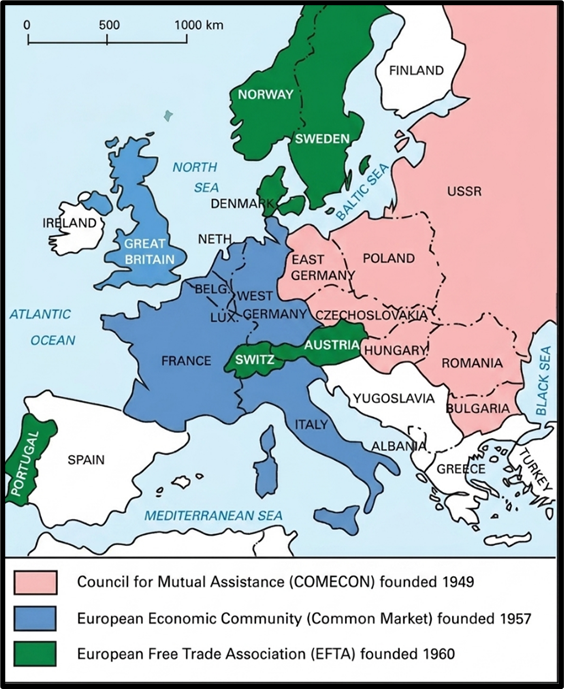
Stages in the Evolution of the European Community
1 Benelux Customs Union (1944–47): The First Experiment
The earliest step toward integration came even before World War II ended. Governments of Belgium, the Netherlands, and Luxembourg, operating in exile in London, decided to form a customs union eliminating tariffs.
This initiative, strongly influenced by Paul-Henri Spaak, demonstrated that regional economic cooperation was both feasible and beneficial. It became a practical model for wider European integration.
Critical Insight: Benelux was small in scale but large in significance—it showed that sovereignty could be partially pooled without losing national identity.
2. Treaty of Brussels (1948): Expanding Cooperation
The next step brought Britain and France into collaboration with the Benelux countries. This treaty emphasized military, economic, social, and cultural cooperation.
While its military dimension eventually contributed to NATO, economically it paved the way for deeper integration.
Interlinkage → This phase reflects how security concerns and economic cooperation evolved together, a pattern that continues even in today’s European Union.
3. European Coal and Steel Community (ECSC), 1951
A decisive breakthrough came with the creation of the ECSC under the leadership of Robert Schuman and visionary planner Jean Monnet.
The idea was revolutionary:
- Pool coal and steel production (key war industries)
- Remove trade barriers
- Establish a supranational authority
Six countries—France, West Germany, Italy, Belgium, Netherlands, Luxembourg—joined.
Why Coal and Steel? Because controlling these industries meant controlling the capacity to wage war. By integrating them, war between France and Germany became practically impossible.
Outcome:
The ECSC was highly successful—steel production rose dramatically, proving that supranational governance could deliver economic benefits.
Critical Perspective: Britain’s refusal to join highlights an early tension between national sovereignty vs. supranational authority, a recurring theme in European history.
4. European Economic Community (EEC), 1957
Encouraged by the ECSC’s success, the six countries expanded cooperation through the Treaty of Rome, creating the EEC (Common Market).
The EEC aimed to:
- Remove tariffs and quotas among members
- Establish a common market
- Promote industrial growth and better living standards
- Foster long-term political unity
Again, leaders like Spaak and Monnet envisioned something beyond economics—a “United States of Europe.”
Result: Within five years, the EEC became:
- The world’s largest exporter
- A major industrial power second only to the USA
Analytical Insight: This phase marks the transition from sectoral integration (coal and steel) to comprehensive economic integration, laying the foundation for political unity.
Institutional Framework: The Machinery of the Community
The success of the EEC depended on strong institutions, reflecting a balance between supranational authority and national interests.
- European Commission → Based in Brussels, it handled day-to-day administration and policy decisions. It represented the supranational principle, often clashing with national governments.
- Council of Ministers → Representing member states, it coordinated national policies and acted as a bridge between national sovereignty and collective goals.
- European Parliament → Initially weak, it could only discuss and recommend. However, the introduction of direct elections in 1979 marked a step toward democratic legitimacy.
- European Court of Justice → Ensured uniform interpretation of laws, reinforcing the rule-based nature of integration.
- EURATOM → Focused on atomic energy cooperation, reflecting the importance of scientific and technological collaboration.
In 1967, these bodies merged to form the European Community (EC), signaling deeper institutional unity.
Britain’s Hesitation: Sovereignty vs. Integration
Despite early advocacy by Winston Churchill, Britain stayed out initially.
Reasons for Refusal:
- Fear of losing economic sovereignty
- Concerns over weakening ties with the Commonwealth
- Desire to maintain the “special relationship” with the USA
- Suspicion that economic unity would lead to political union
Instead, Britain led the formation of European Free Trade Association in 1959, which focused only on free trade without political integration.
Critical Insight: This divergence reflects two competing models:
- EEC model: Deep integration with shared sovereignty
- EFTA model: Loose cooperation preserving national control
Britain’s Policy Shift: From Isolation to Application
By the early 1960s, reality forced a rethink:
- EEC economies (France, West Germany) were growing rapidly
- Britain’s economy lagged behind
- EFTA proved less effective
Prime Minister Harold Macmillan applied for membership in 1961.
However, France’s President Charles de Gaulle vetoed Britain’s entry (1963, again in 1967).
Reasons for French Opposition:
- Fear that Britain would weaken the EEC
- Concern over Britain’s close ties with the USA
- Desire to maintain French dominance in Europe
- Agricultural competition issues
Historiographical Insight: Many historians argue that de Gaulle’s veto was less economic and more strategic—aimed at preserving French leadership and limiting American influence in Europe.
Final Entry: The Six Become the Nine (1973)
After de Gaulle’s resignation, the situation changed. Under Georges Pompidou and British PM Edward Heath, negotiations succeeded.
In 1973, Britain, Ireland, and Denmark joined, expanding the Community from six to nine members.
Significance:
- Marked the end of Britain’s semi-detached position in Europe
- Strengthened the Community economically and politically
- Set the stage for future enlargements
Overall Analysis: What Made the European Community Unique?
- Gradualism → Integration was not sudden—it evolved step by step, from Benelux to ECSC to EEC.
- Supranationalism vs. Sovereignty → A constant tension shaped its development, visible in Britain’s hesitation and France’s assertiveness.
- Economic Foundation of Political Unity →Economic cooperation was used as a tool to achieve political stability and peace.
- Leadership and Vision → Figures like Spaak, Schuman, and Monnet played a decisive role—showing how ideas and individuals shape history.
Conclusion
The early history of the European Community is a powerful example of how pragmatism, vision, and necessity combined to reshape a continent. What began as a modest customs union evolved into a complex supranational system that not only transformed Europe’s economy but also ensured lasting peace.
The European Community from 1973 to Maastricht (1991)
A Phase of Deepening Integration Amid Structural Challenges
Context: From Expansion to Consolidation
After the first major enlargement in 1973 (when the EC became the “Nine”), the European Community entered a new phase. Earlier decades had focused on institution-building and economic cooperation, but now the challenge was different → How to deepen integration while managing diversity among member states?
This period (1973–1991) reflects a tension between two parallel processes:
- Widening (more members joining), and
- Deepening (greater economic, political, and institutional integration)
Addressing Global Responsibility: The Lomé Convention
Why was it needed? (Cause) → The EC was increasingly criticized as a rich, inward-looking bloc, indifferent to the developing world.
What did it do? (Development)
The Lomé Convention (1975), signed in Togo, marked a shift:
- Duty-free access for exports from African, Caribbean, and Pacific (ACP) countries
- Promised economic aid and cooperation
Critical Insight → While symbolically important, critics argued it was insufficient and paternalistic—more about maintaining post-colonial economic influence than genuine development.
Democratising Europe: Direct Elections to the European Parliament (1979)
The Problem → The EC suffered from a “democratic deficit”—ordinary citizens felt disconnected from its institutions.
The Reform
- First direct elections in 1979
- 410 Members of European Parliament (MEPs) elected
- Elections every 5 years
Reality Check
- Low turnout in countries like Britain showed continued public disengagement
- Higher turnout in countries with compulsory voting (e.g., Belgium)
Analytical Perspective → This marked a crucial step toward political legitimacy, but the EC still remained largely elite-driven in decision-making.
Towards Monetary Integration: The Exchange Rate Mechanism (ERM)
Objective → To stabilize exchange rates among member states and reduce currency fluctuations.
How it worked
Currencies were linked within a controlled band:
- Prevented extreme fluctuations
- Encouraged economic discipline
Long-Term Vision → This was an early step toward a single European currency (eventually the euro).
British Miscalculation
Britain joined late (1990), at an unfavorable rate—highlighting:
- Weak economic alignment
- Political hesitation toward integration
Enlargement and Its Contradictions
New Members
- 1981: Greece
- 1986: Spain and Portugal
- 1995: Austria, Finland, Sweden
Structural Impact
- Shift in balance toward less industrialized economies
- Increased demand for regional development and redistribution
Key Tension
The EC now faced a fundamental dilemma → How to balance economic cohesion with expansion
This foreshadows later EU debates on “multi-speed Europe”.
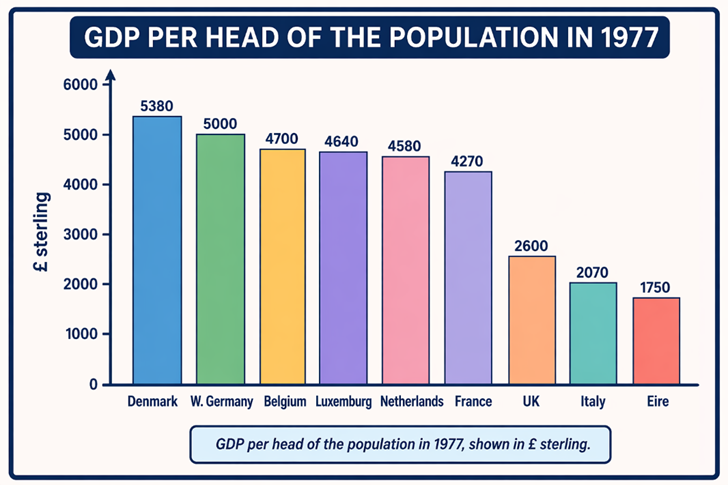
Britain and the Budget Crisis
The Core Issue
Britain’s contribution was disproportionately high due to:
- High imports from outside the EC
- Budget formula based on customs duties
Political Fallout
Prime Minister Margaret Thatcher demanded fairness:
- Famous stance: “I want my money back” (implicit context)
Outcome → Negotiated rebate reduced Britain’s burden
Analytical Insight
This episode reflects:
- Structural inequalities within integration
- Britain’s long-standing skepticism toward the EC
The 1986 Reforms: Toward a Single Market
Major Developments
- Plan for a Single European Market by 1992
- Removal of all internal trade barriers
- Increased cooperation in → Environment, Consumer protection, Technology
Institutional Shift
- Introduction of majority voting
- Increased powers of the European Parliament
Underlying Debate
This triggered a key ideological divide:
- Federalists → Wanted a “United States of Europe”
- Sovereigntists → Feared loss of national control
Britain emerged as a major critic of deeper political union.
Crisis of Success: The Common Agricultural Policy (CAP)
Original Aim → Support farmers, Ensure food security, Stabilize prices
Unexpected Consequence → Overproduction:“Butter mountains”; “Wine lakes”
Economic Burden
- Consumed up to 75% of EC budget
- Led to massive surpluses and wastage
Crisis and Reform
- 1987: Budget crisis
- Introduction of quotas and production limits
Critical Analysis
CAP became a classic case of → Policy success turning into structural inefficiency
It also exposed national interests overriding collective rationality (e.g., France protecting farmers).
The Maastricht Treaty: The Turning Point
Context
End of the Cold War and German reunification created urgency for → Stronger integration, Political stability
Key Provisions
- Creation of the European Union (EU) (from 1992)
- Path toward a single currency (Euro)
- Common foreign and security policy
- Increased powers of European Parliament
British Opposition
Britain resisted → Monetary union, Social Chapter (worker protections)
Result → Opt-outs and compromises
Public Reaction
- Mixed and often skeptical
- Referendums showed narrow support (e.g., France, Denmark)
Historiographical Insight
Scholars interpret Maastricht as → Either a bold leap toward unity, or A technocratic project lacking democratic consent
Overall Assessment: Success with Structural Tensions
By the mid-1990s, the European Community (now EU) had:
Achievements
- Strong economic integration
- Peace and cooperation among historic rivals
- Growing global influence
Persistent Challenges
- Democratic deficit
- National sovereignty vs supranational authority
- Economic disparities among members
- Future enlargement pressures (especially Eastern Europe)
Broader Interlinkages
This phase connects directly to:
- Cold War dynamics → Western Europe consolidating against Soviet bloc
- Post-1991 world → Expansion toward Eastern Europe
- Globalization → EU as a regional economic bloc
Final Conceptual Takeaway
This period represents a transition from an economic community to a political union in the making.
But the deeper question remained unresolved →Can diverse nations integrate deeply without losing their identity?
That tension continues to define the European Union even today.
Timeline of Important Events
| Year/ Period | Event/ Development | Country/ Region | Nature | Significance |
| 1944–47 | Benelux Customs Union | Belgium, Netherlands, Luxembourg | Economic | First experiment in regional economic integration |
| 1946 | Call for “United States of Europe” by Winston Churchill | Europe | Ideological | Intellectual foundation of European unity |
| 1946–58 | Fourth Republic | France | Political | Weak executive, unstable coalition governments (25 governments in 12 years) |
| 1947 | Marshall Plan launched | Western Europe | Economic | US aid for reconstruction; encouraged cooperation |
| 1948 | OEEC formed | Western Europe | Economic | Coordinated Marshall Aid, reduced trade barriers |
| 1948 | Treaty of Brussels | Western Europe | Strategic/ Political | Early step toward military and economic cooperation |
| 1949 | FRG (West Germany) established | Germany | Political | Beginning of democratic reconstruction |
| 1949 | NATO formed | Western Europe + USA | Strategic | Collective defence against Soviet threat |
| 1950–53 | Korean War | Global | Economic/ Strategic | Boosted West German exports |
| 1951 | ECSC established | 6 European nations | Economic/ Political | Integrated coal & steel → made war materially difficult |
| 1957 | Treaty of Rome (EEC) | Western Europe | Economic | Creation of Common Market; deeper integration |
| 1958 | Fifth Republic established under Charles de Gaulle | France | Political | Strong executive → long-term stability |
| 1960 | Peak of Wirtschaftswunder | West Germany | Economic | Rapid industrial growth, low unemployment |
| 1961 | OEEC becomes OECD | Global | Economic | Expansion beyond Europe |
| 1963 & 1967 | Veto of British entry into EEC by de Gaulle | Europe | Political | Sovereignty vs integration conflict |
| 1966 | France withdraws from NATO command | France | Strategic | Assertion of independent foreign policy |
| 1967 | European Community formed (institutional merger) | Europe | Political | Deepening institutional integration |
| 1973 | UK joins EC (with Ireland & Denmark) | Europe | Political/ Economic | Expansion from Six to Nine |
| 1975 | Lomé Convention | EC & ACP countries | Economic | Trade and aid relations with developing world |
| 1979 | Direct elections to European Parliament | Europe | Political | Step toward democratic legitimacy |
| 1981–86 | Enlargement (Greece, Spain, Portugal) | Europe | Political/ Economic | Inclusion of weaker economies → structural strain |
| 1982 | Helmut Kohl comes to power | West Germany | Political | Stability leading to reunification |
| 1986 | Single Market initiative | Europe | Economic | Removal of internal trade barriers |
| 1987 | CAP crisis | Europe | Economic | Overproduction → inefficiency and budget strain |
| 1990 | German reunification | Germany | Political/ Economic | Historic success but heavy economic burden |
| 1990 | UK joins ERM | Europe | Economic | Attempt at currency stability |
| 1991–92 | Maastricht Treaty | Europe | Political/ Economic | Creation of European Union; path to Euro |