
Germany 1918-1945
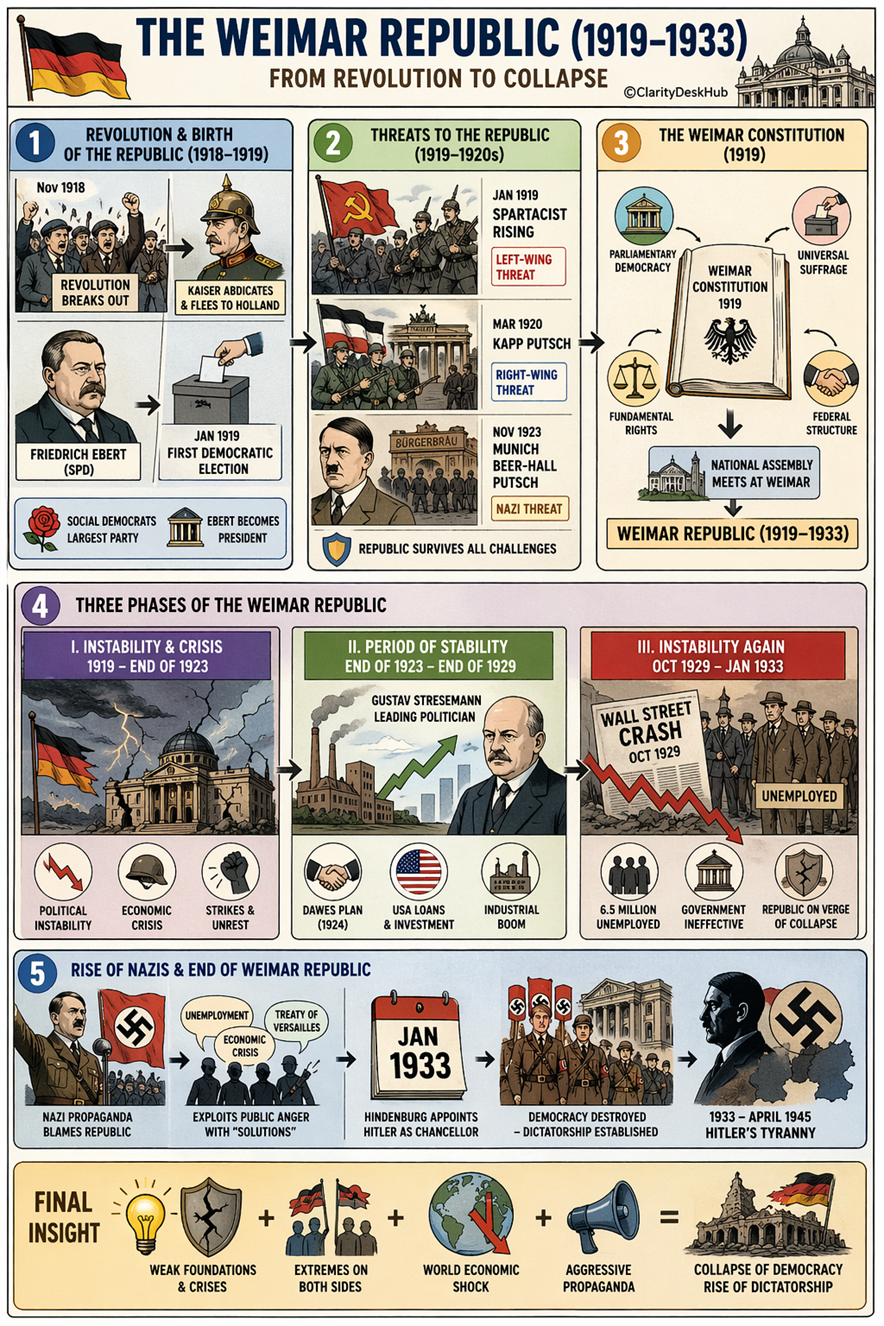
To understand the collapse of the Weimar Republic, we must not look at it as a single event of 1933. Instead, we should view it as a patient who was born with multiple congenital heart defects, was forced to run a marathon in a storm, and was finally ‘treated’ by doctors who actually wanted the patient to die ☹
Let us analyze this tragic chapter of German history through a multidimensional lens, that balances historical facts with deep analytical insight.
Collapse of Weimer Republic
The Burden of Birth: A Republic Born in Defeat
The Weimar Republic did not begin its journey on a bed of roses; it began in the shadows of the First World War. This is what we call the ‘Original Sin’ of the Republic.
When the new government signed the Treaty of Versailles in 1919, it wasn’t just signing a peace treaty; it was signing its own death warrant in the eyes of the German public. The ‘War Guilt Clause’, the massive reparations, and the territorial losses were seen as a ‘Diktat’—a dictated peace. For the German nationalists, the Republic became synonymous with national humiliation.
There is a very famous concept here called the Dolchstoßlegende or the ‘Stab in the Back’ legend. The common people and the army were told that Germany hadn’t been defeated on the battlefield but was betrayed at home by ‘November Criminals’—the socialists, Jews, and democrats.
Even though it was General Ludendorff who had actually insisted on the armistice, the Republic bore the cross of this lie for its entire existence.
Constitutional Fragility: The Structural Fault Lines
If the context of its birth was external, the second cause was internal—the Weimar Constitution itself. While it was one of the most democratic documents of its time, it contained structural flaws that paralyzed governance.
The system of Proportional Representation was a double-edged sword. It ensured that every small group had a voice in the Reichstag, but it made it impossible for any single party to gain a majority.
- Imagine a parliament with eight or nine conflicting parties where no one agrees on anything! This led to a series of weak, short-lived coalition governments.
- When the parties could not learn the ‘art of compromise,’ the government effectively stopped functioning.
Furthermore, the German people had a traditional ‘lack of respect’ for democracy. They were used to the strong, authoritarian leadership of the Kaiser and Bismarck. For many, the chaotic parliament was a sign of weakness, while the ‘Officer Class’ and the army remained the only respected institutions.
The Culture of Violence: Challenges from the Left and Right
A state is defined by its ‘monopoly on the legitimate use of physical force.’ The Weimar Republic never truly achieved this. From its inception, it was rocked by violent attempts to overthrow it.
In 1919, the Spartacist Rising (a communist revolt led by Rosa Luxemburg and Karl Liebknecht) tried to turn Germany into a Soviet-style state. To crush them, President Ebert had to rely on the Freikorps—private, anti-communist paramilitary groups. This was a massive strategic error. By using private armies to save democracy, the government admitted it was too weak to protect itself.
The threat from the Right was equally potent, seen in the Kapp Putsch (1920) and Hitler’s Beer-Hall Putsch (1923).
- Kapp Putsch (1920): A failed right-wing coup led by Wolfgang Kapp and supported by Freikorps forces, which tried to overthrow the Weimar government but collapsed due to a massive general strike.
- Beer Hall Putsch (1923): An unsuccessful coup attempt by Adolf Hitler in Munich, aiming to seize power in Bavaria and then march on Berlin, which ended in his arrest.
While the workers saved the government during the Kapp Putsch through a general strike, the judiciary showed a clear ‘right-wing bias.’
Left-wing rebels were executed, but right-wing conspirators like Hitler received lenient sentences. This ‘judicial blindness’ meant that the Republic’s enemies were sitting inside its own courtrooms and classrooms.
The Economic Catalyst: From Hyperinflation to Depression
Economics is the backbone of politics. The Weimar Republic faced two massive economic heart attacks that destroyed the faith of the middle class.
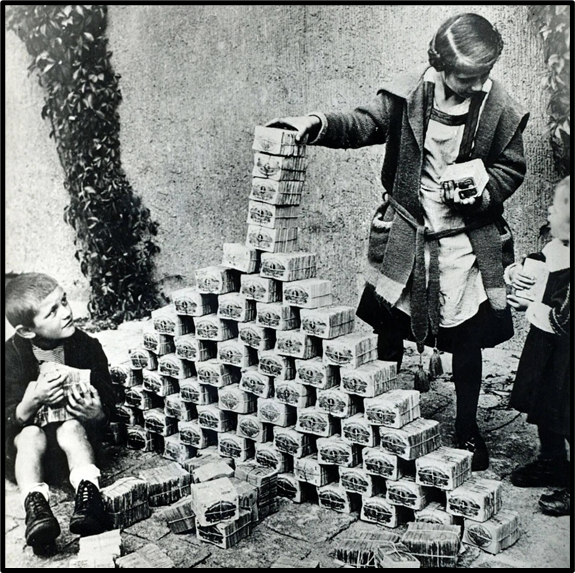
The first was the Hyperinflation of 1923, triggered by the French occupation of the Ruhr. When the government printed money to pay striking workers, the Mark became worthless. We see heart-wrenching images of children playing with stacks of banknotes like building blocks. While the economy stabilized under Gustav Stresemann (the ‘Golden Years’), this prosperity was built on the ‘quicksand’ of American loans.
The final blow was the Wall Street Crash of 1929. When America called back its loans, the German economy collapsed. Unemployment touched 6 million by 1932. This was the ‘tipping point.’ When people are hungry and desperate, they don’t look for democratic debates; they look for a ‘Messiah’ who promises bread and pride.
The Rise of Hitler: The ‘Legal’ Revolution
We must understand that Hitler did not seize power in a vacuum. He offered a ‘structured alternative.’ Through brilliant (though demonic) use of propaganda, he targeted the ‘November Criminals‘ and promised to tear up the Versailles Treaty.
The Nazi party’s popularity was directly proportional to the economic misery. The SA (Brownshirts) provided a sense of order and identity to the unemployed youth. However, historiographical debate is crucial here. Joachim Fest argues that while big business eventually supported Hitler, he wasn’t merely a ‘tool of capitalists’—he was a master of mass psychology who tapped into the deep-seated fears of the middle class.
P.S: November Criminalswas a derogatory term used by German nationalists and Nazis for the politicians who signed the armistice in November 1918 and later accepted the Treaty of Versailles, blaming them for Germany’s defeat and humiliation.
The Final Intrigue: How Democracy Was Handed Over
The most tragic part of this story is that the Republic did not just ‘fall’; it was ‘given away.’ In 1933, Hitler was invited to be Chancellor through a series of political intrigues involving Franz von Papen and General von Schleicher.
These conservative elites made a fatal miscalculation. They believed they could ‘control’ Hitler—that they had ‘pushed him into a corner.’
As the historian Ian Kershaw brilliantly analyzes, there was no ‘inevitability’ about Hitler’s rise. It was a result of political miscalculation by men who wanted to destroy democracy and return to an authoritarian past. They opened the door for a tiger, thinking they could keep it on a leash.
Critical Conclusion
The failure of the Weimar Republic teaches us that democracy is not just a set of rules in a constitution; it is a culture of compromise and economic stability. When the elites of a country lose faith in democratic institutions and the common man loses his livelihood, the path is cleared for demagogues.
As General Ludendorff prophetically warned Hindenburg, by appointing Hitler, they had delivered the Fatherland to one of the greatest demagogues of all time, casting the Reich into an ‘abyss.’
Reich
- Reich (German) means “realm” or “empire”, referring to the German state as a whole.
- Historically, it denotes different phases of German polity:
- First Reich → Holy Roman Empire
- Second Reich → German Empire (1871–1918)
- Third Reich → Nazi regime under Adolf Hitler
👉 In this context, Reich signifies the German nation-state being pushed into crisis and eventual dictatorship.
Now, was the Weimar Republic’s failure inevitable? Perhaps not. But by 1932, with the army, the judiciary, and the economy all working against it, the Republic was a ‘democracy without democrats.’
What do you think was the most critical factor—was it the structural flaws of the constitution, or the external shock of the Great Depression?
Now, let’s move on to understand National Socialism—or Nazism—we must look beyond the surface of its name. It is a common misconception that because the word “socialist” was present, it meant the redistribution of wealth. In reality, Hitler used the term primarily as a tactical lure to bring the German working class into his fold.
Let us analyze the ideological DNA of this movement and how it transformed from a fringe party into a totalitarian regime that reshaped the world.
National Socialism and Consolidation of Power by Hitler
The Ideological Pillars of National Socialism
National Socialism was not merely a political platform; it was a comprehensive Weltanschauung (worldview) that demanded the total reorganization of German life. At its core were following distinct but interconnected principles.
The Concept of Volksgemeinschaft
- The Nazis envisioned a “National Community” where class conflict—the primary concern of Marxists—would be replaced by racial unity.
- Every German was expected to dedicate their life to the rebirth of the nation. However, this unity was defined by exclusion: if you weren’t part of the “correct” community (Aryans), you were an enemy.
- This logic dictated that all other political parties, especially communists who preached class struggle, had to be eliminated.
Totalitarianism and the Supremacy of the State
- In the Nazi system, the individual had no intrinsic value outside of their service to the state. This was a totalitarian model where the government aimed to control every aspect of life—from what people read to how they spent their leisure time.
- This was enforced through a combination of sophisticated propaganda and “ruthlessly efficient” violence. Peace was seen as a temporary state; the interest of the “National Community” always came before the rights of the citizen.
The Biological State: Race Theory
- Perhaps the most distinctive and dangerous element was the Race Theory. To the Nazis, humanity was divided into a hierarchy of value.
- The Aryans (ideally tall, blond, and blue-eyed) were viewed as the “Master Race” (Herrenvolk), destined to rule.
- Everyone else—Slavs, Roma, Black people, and most specifically Jews—were categorized as inferior. Slavs were viewed as a “slave race,” while Jews were characterized as a biological threat to the German body politic.
P.S.: Ancient “Arya” in India denoted a cultural–linguistic identity, whereas the Nazi “Aryan race” was a fabricated biological concept used to justify racial superiority and exclusion. So, Remember this clearly.
The Historiographical Debate: Continuity or Accident?
A major question for historians is whether Nazism was a natural outcome of German history or a sudden “grotesque departure.” This is what we call the Sonderweg (Special Path) debate.
The Argument for Continuity
- Many historians, including Shelley Baranowski, argue that Nazi brutality had roots in earlier Prussian militarism and German colonial practices.
- For example, in the early 1900s, German military doctrine in African colonies like Namibia and Tanganyika already displayed a “genocidal mentality,” where uprisings were met with starvation and mass slaughter.
- In this view, the atrocities in Eastern Europe during WWII were a revival of a pre-existing mindset that viewed “others” as second-class citizens.
The Argument for “Hitler as an Accident”
- Conversely, historians like Gerhard Ritter argue that Nazism was an aberration—a “one-off” event driven by the unique, magnetic personality of Adolf Hitler.
- They suggest that without the specific chaos of the Great Depression and Hitler’s personal abilities, Germany would have followed a more “normal” historical path.
- This perspective often appeals to those who wish to separate the German people’s broader history from the crimes of the Third Reich.
The Synthesis: Ian Kershaw’s Perspective
- Sir Ian Kershaw offers a balanced middle ground. He notes that while the “political culture” that made Hitler possible was uniquely German and had developed over decades, Hitler’s rise was not “inevitable.” He was a product of his time who “exploited the conditions brilliantly.”
The Consolidation of Power (1933): From Chancellor to Dictator
When Hitler became Chancellor in January 1933, he was the head of a coalition, not a dictator. His consolidation of power was a masterclass in using the “apparatus of the state” to dismantle democracy from within.
State-Sponsored Violence and the 1933 Election
- Hitler immediately called for a general election on March 5, 1933. This campaign was not a fair democratic contest; it was a period of state-sanctioned terror. Hermann Goering, as Minister of the Interior for Prussia, turned the police into a tool of the Nazi party.
- He recruited 50,000 “auxiliary policemen” from the SA and SS, giving them a license to use firearms against “enemies of the state.” While Nazi rallies were protected, socialist and communist meetings were violently broken up.
The Reichstag Fire: The Strategic Pretext
- The turning point occurred on February 27, 1923, when the Reichstag building was set ablaze. Whether the young Dutch anarchist Marinus van der Lubbe acted alone or was a pawn, the result was the same: Hitler used the fire to manufacture a national “Red Scare.”
- He convinced President Hindenburg to suspend civil liberties and arrested 4,000 communists. This provided the “emergency” atmosphere needed to suppress opposition.
The Verdict of the People
- Even with the police under their control and the opposition suppressed, the Nazis failed to win an overall majority in the March election. They secured 288 out of 647 seats—roughly 44% of the vote.
- This statistic is crucial; it shows that even at the height of their momentum and terror, a majority of Germans did not vote for the Nazi party in a semi-free election.
- Hitler remained dependent on his nationalist allies, but the stage was set for him to bypass parliament entirely.
This transition from a “coalition partner” to an absolute ruler was not a sudden coup, but a legalistic erosion of institutions, fueled by the fear of communism and the promise of national rebirth.
Do you think the “Race Theory” was the primary driver of Nazi popularity, or was it merely a tool used to justify their desire for territorial expansion?
Now, see! Once a leader reaches the corridors of power, the next big question in political science is not how they got there, but how they managed to stay there. In the case of Adolf Hitler, this wasn’t just about the use of force; it was a complex “alchemy” of legal manipulation, psychological capture of the youth, and an economic “bribe” offered to the common man.
Let us analyze how the Weimar Republic’s fragile democracy was systematically dismantled and replaced by a “Thousand-Year Reich” through a multidimensional lens.
“Thousand-Year Reich” was a Nazi propaganda term projecting Hitler’s regime as a permanent, destined German empire, though in reality it lasted only 12 years.
Hitler in Power
The Legal Foundation of Dictatorship: The Enabling Act (1933)
If you look at the events of March 1933, you will see a very peculiar phenomenon: a dictator using a democratic parliament to kill democracy. Hitler was not satisfied with being a “coalition” leader; he wanted absolute authority. Using the atmosphere of fear created by the Reichstag fire, he introduced the Enabling Law.
The scene was more like a battlefield than a parliament. The Kroll Opera House was surrounded by SS and SA troops chanting for “fire and murder.” Under this immense physical and psychological pressure, the Reichstag passed a law that allowed Hitler to bypass the constitution and make laws on his own for four years.
Friends, this is the “Legal Revolution.” From this moment on, Hitler did not need the Reichstag; his word was the law. The tragic irony is that the Catholic Centre Party voted for it, hoping to “contain” him, while only the Social Democrats had the courage to say “No.”
Gleichschaltung: The Totalitarian “Syncing” of Society
Once the legal hurdle was removed, Hitler began a process called Gleichschaltung or “forcible coordination.” The goal was simple: no organization, no club, and no thought should exist in Germany that was not Nazi.
First, he moved against political pluralism. By July 1933, all parties except the Nazis were banned. He then turned to the Trade Unions, the last bastion of working-class resistance. They were abolished and replaced by the German Labour Front (DAF).
Think about the psychological impact—the worker no longer had a union to fight for him; he only had the state. Even the state parliaments (Länder) were stripped of power, replaced by Nazi commissioners reporting directly to Berlin.
The regime then reached into the most private sphere: the family. The Hitler Youth and the League of German Maidens were created to indoctrinate children from the age of 14.
- Hitler’s strategy was to destroy the traditional bond between parent and child, replacing it with absolute loyalty to the Führer.
- Children were even encouraged to betray their own parents to the Gestapo.
- In Nazi eyes, the youth had to be “swift as a greyhound, tough as leather, and hard as Krupp steel.”
The Orchestration of the Mind: Propaganda and Culture
To stay in power, you must control not just the body, but the mind. Under Dr. Joseph Goebbels, propaganda became a 24/7 industry. The regime utilized the latest technology, making cheap radios (the “People’s Receiver”) available so that Hitler’s voice reached 70% of German households.
There was a violent rejection of “Un-German” thought. On May 10, 1933, thousands of books by Jewish and socialist authors were burnt in university cities. Art was no longer international; it had to be “German.”
Modernism and jazz were labeled “decadent” or “Jewish.” This was not just censorship; it was an attempt to delete the intellectual history of a nation and replace it with a single, militaristic narrative.
Films like Leni Riefenstahl’s Triumph of the Will were used to portray Hitler as a God-like figure, standing alone above the marching masses.
The Economic “Honey-Trap”: Work and Bread
Why did ordinary Germans, who were not necessarily Nazis, support this? The answer lies in the stomach. Hitler understood that if he provided Arbeit und Brot (Work and Bread), the people would overlook the loss of liberty.
Through massive public works (like the Autobahn) and rapid rearmament, unemployment dropped from 6 million in 1933 to almost zero by 1939. This was the “Economic Miracle” that bought the silence of the masses.
Programs like Strength through Joy (KdF) provided subsidized holidays and cheap theatre tickets, making the dictatorship feel “benevolent” to the average worker. For the wealthy industrialists, Hitler was a savior who had destroyed the threat of communism and trade unions.
The Terror State and the “Final Solution”
Behind the parades and the economic success lay a dark, efficient machine of terror. Germany became a Police State. The SS and the Gestapo relied not just on their own agents, but on a culture of denunciation where ordinary people reported their neighbors.
Concentration camps like Dachau were filled with political opponents, priests, and marginalized groups like homosexual men, who were forced to wear pink triangles.
The most horrific dimension was the systematic Anti-Semitism.
- Jews, who made up less than 1% of the population, were used as a “biological scapegoat.”
- The Nuremberg Laws (1935) stripped them of citizenship, and Kristallnacht (1938) signaled the shift from discrimination to state-sponsored violence.
- This path led eventually to the Holocaust, where 5.7 million Jews were murdered in a factory-like system of extermination.
Historians like Gotz Aly argue that ordinary Germans tolerated these crimes partly because they benefited materially from stolen Jewish property.
The Internal Purge: The Night of the Long Knives
Finally, Hitler had to secure the loyalty of the one institution that could actually overthrow him: the Army (Reichswehr). The Army leadership was terrified of the SA (the Brownshirts) and their leader Ernst Röhm, who wanted to merge the army with his 3-million-strong paramilitary force.
In the Röhm Purge or the “Night of the Long Knives” (June 30, 1934), Hitler used the SS to murder Röhm and hundreds of SA leaders. By “beheading” his own private army, Hitler won the absolute gratitude of the regular Army generals.
When President Hindenburg died shortly after, the soldiers took a personal oath of allegiance not to the state, but to Hitler himself. This was the final lock on the door of power.
So, basically:
👉 SA (Brownshirts) were the mass paramilitary force that helped Hitler rise, while SS was the elite, loyal force he used to eliminate rivals and consolidate totalitarian control.
👉 Hitler used the SS to eliminate the SA because the SA’s growing power and ambitions threatened his control and alienated the army, whose support was essential for his dictatorship.
Analytical Summary
Friends, the Weimar Republic failed because it was a “democracy without democrats,” but Hitler stayed in power because he created a “system of mutual interest.” He gave the people jobs, he gave the youth an identity, and he gave the nationalists their pride back—all while systematically murdering or silencing anyone who dared to point out the cost of this “success.”
It was a combination of Totalitarian Syncing (Gleichschaltung), Economic Bribery, and Institutional Terror.
Do you believe that Hitler could have been stopped after 1934, or had the “Personal Oath” of the Army made a counter-revolution impossible?
Now, there is often a great deal of confusion among students and even scholars regarding the terms Nazism and Fascism. While we frequently use them interchangeably, in the realm of political science and history, they are not identical. Think of ‘Fascism’ as a broad genus or category, and ‘Nazism’ as a specific, more virulent species within that category.
Mussolini’s Italy was the original laboratory of fascism, but when Hitler imported these ideas to Germany, he added elements of racial biology and industrial efficiency that changed the character of the movement entirely. Let us analyze this through a comparative and analytical lens.
Nazism and Fascism
The Common Ground: Two Sides of the Same Coin
At their core, both movements were a violent reaction against the two dominant ideologies of the early 20th century: Liberal Democracy and International Communism.
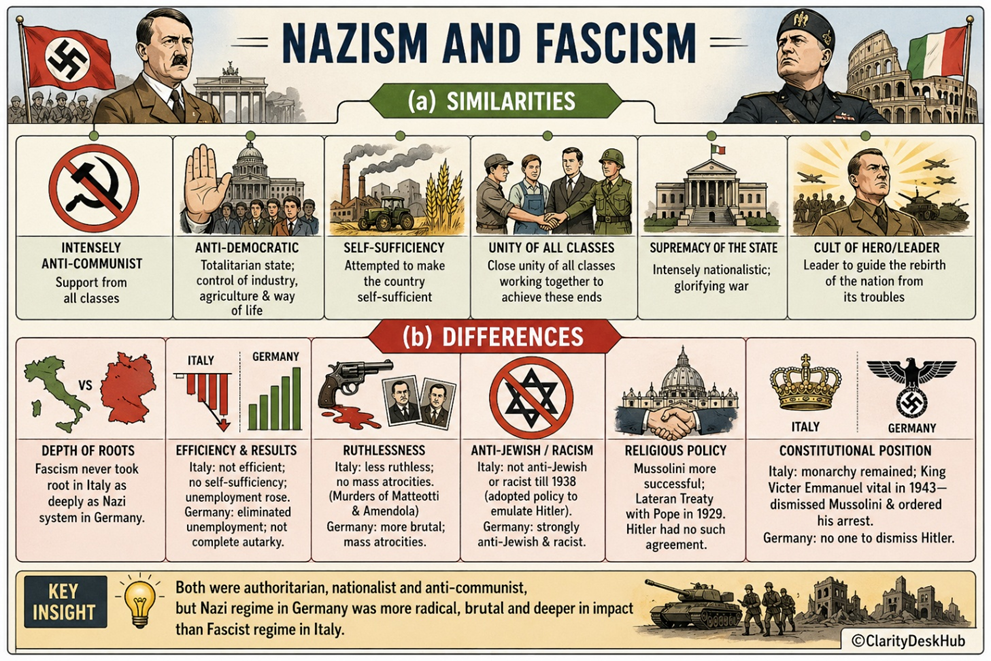
Both Hitler and Mussolini drew their strength from a “fear of the Red peril.” By positioning themselves as the only shield against a communist revolution, they secured support from the middle class, wealthy industrialists, and even a section of the working class. Philosophically, both rejected the individual. They believed in the Supremacy of the State, where the citizen’s only purpose was to serve the nation’s rebirth.
Furthermore, both regimes were built on the “Cult of the Leader” (Il Duce in Italy, Der Führer in Germany). They shared a deep-seated militarism, glorifying war not as a last resort, but as a noble endeavor that tests the spirit of a nation. Economically, both sought Autarky (self-sufficiency), wanting their nations to be independent of the global trade networks that had failed them during the Great Depression.
The Divergence: Why Nazism was “Fascism Plus”
While the skeleton was similar, the flesh and blood were different. The German variant of Fascism—Nazism—was significantly more intense, efficient, and lethal.
Economic Efficiency and Unemployment
- The most striking difference lay in their results. Mussolini talked a great deal about economic reform, but his system was plagued by inefficiency; unemployment in Italy actually rose during parts of his tenure.
- In contrast, the Nazis were remarkably successful in eliminating unemployment. By 1939, while Italy was still struggling, Germany had reached near-full employment. This material success gave Hitler a level of domestic legitimacy that Mussolini never fully commanded.
The Racial Dimension: The Biological Core
- This is the most critical distinction. Original Italian Fascism was not fundamentally anti-Semitic or obsessed with “racial purity.” For Mussolini, the state was the most important thing—”Everything in the State, nothing outside the State.”
- For Hitler, the Race (Volk) was more important than the State. It was only in 1938, under pressure to align with Hitler, that Mussolini adopted anti-Jewish laws.
- Nazism was built on a foundation of “scientific” racism and mass atrocities that were largely absent from the Italian model until the later stages of the war.
Institutional Resistance and the “Check” on Power
One must also look at the constitutional environment in which these two men operated. In Italy, the Monarchy survived. King Victor Emmanuel III remained the formal head of state. Even though Mussolini ignored him for years, the King represented a “dormant” constitutional check. In 1943, when the tide turned, the King was able to dismiss and arrest Mussolini.
In Germany, the story was different. After the death of President Hindenburg in 1934, Hitler merged the offices of Chancellor and President. There was no higher authority—no King, no independent Judiciary, and no President—who could legally stop him. Hitler was the law. This total lack of institutional checks made the Nazi regime much more “totalitarian” than the Italian one.
The Religious Policy: Compromise vs. Conflict
Mussolini was a pragmatist when it came to the Church. Through the Lateran Treaty of 1929, he settled the “Roman Question” and gained the Pope’s recognition, which stabilized his regime in a deeply Catholic country.
Hitler, however, viewed the Church as a rival for the hearts and minds of the youth. Although he signed a Concordat in 1933, he almost immediately began violating it—closing Catholic schools and arresting priests.
While Mussolini co-existed with the Church to a degree, Hitler’s regime was essentially “anti-Christ and anti-Church,” as Pope Pius XI later lamented. This created a persistent, though quiet, layer of religious resistance in Germany that Mussolini largely avoided.
Analytical Summary
To conclude, while Italian Fascism was a “statist” authoritarianism, German Nazism was a “racialist” totalitarianism. Mussolini’s regime was a “softer” dictatorship that left some old structures (like the Monarchy and the Church) intact. Hitler’s regime was a “hard” dictatorship that sought to devour every institution in its path.
As historians often point out, Mussolini was a politician who played at being a revolutionary, but Hitler was a revolutionary who used politics to destroy the existing world order.
Do you think the survival of the Monarchy in Italy suggests that “hybrid” regimes are less likely to commit mass atrocities than “pure” totalitarian ones?
Next, when we evaluate the success of any regime, we must ask ourselves: what is the metric of success? Is it the immediate feeling of prosperity, or is it the long-term survival and moral standing of the nation? In the case of Hitler’s domestic policies, we find a deep chasm between the propaganda of the present and the reality of the future.
Let us analyze this complex topic through the lens of historical debate, moving beyond simple ‘yes’ or ‘no’ answers to a more nuanced understanding.
Hitler’s Success in Domestic Affairs
The Economic Mirage: Miracle or Bankruptcy?
To the average German in 1935, Hitler seemed like a magician. He took a country with 6 million unemployed and, within years, brought that number to almost zero. This is what many call the “Economic Miracle.” However, we must look at the “cost” of this employment.
The success was largely built on a massive rearmament program and a brutal campaign that pushed Jews and political opponents out of the workforce, essentially “vacating” spots for others.
Furthermore, the economy was technically bankrupt. Hitler was spending money Germany didn’t have, creating a massive budget deficit. As historians like Richard J. Evans point out, the standard of living for the middle class didn’t actually improve much.
People were working longer hours for essentially the same pay, and by the mid-1930s, basic food shortages began to appear. The “miracle” was, in reality, a preparation for a war of plunder; without seizing the resources of Poland or Russia, the Nazi economy would have collapsed under its own weight.
The ‘Hitler Myth’ vs. The Reality of Consent
Why did the people stay loyal for so long? This brings us to the fascinating concept of the “Hitler Myth,” a term coined by the great historian Ian Kershaw. Through the genius of Joseph Goebbels, Hitler was portrayed not as a mere politician, but as a charismatic, infallible “Messiah” who stood above the messy day-to-day corruption of the Nazi party.
Even when people hated the local Nazi official, they often still loved Hitler. They saw him as the man who restored “Law and Order.” The propertied classes were so afraid of Communism that they were willing to overlook the horrors of the concentration camps, which propaganda cleverly rebranded as “re-education centers.”
However, we must also acknowledge the role of Fear. As Evans argues, after the initial novelty of the regime wore off, many Germans didn’t necessarily “support” the Nazis; they simply developed survival strategies—keeping their heads down and immersing themselves in family or church life to avoid the Gestapo (official secret police of Nazi Germany)
Structural Analysis: Was Hitler a ‘Weak Dictator’?
In historical circles, there is a very famous debate between the Intentionalists (who see Hitler as the master of everything) and the Structuralists (who see him as a lazy or weak ruler).
Hans Mommsen and Martin Broszat suggested that Hitler was actually a “weak dictator.” He didn’t like making administrative decisions and often let his subordinates fight among themselves.
But Ian Kershaw offers a brilliant middle path with his theory of “Working towards the Führer.” He explains that Hitler didn’t always have to give orders; instead, Nazi officials would guess what Hitler wanted and initiate radical policies to please him.
This “radicalized” the state from within. While Hitler might have been lazy with paperwork, he was the “hammer” when it mattered—crushing the SA in 1934 and making the bold foreign policy moves that led to the peak of his popularity in 1940.
The Moral and Physical Collapse: A Chilling Verdict
Finally, we must look at the consequence. If the purpose of a leader is to protect and elevate his people, Hitler was the greatest failure in history. By 1945, the “Thousand-Year Reich” lay in absolute ruins.
The moral collapse was even more profound than the physical one. Hitler’s regime is responsible for the Holocaust, an industrial-scale genocide that remains a permanent scar on human civilization.
His war led to 50 million deaths and left Germany divided and occupied. The very thing he hated most—Bolshevism—ended up presiding over the ruins of Berlin.
As Kershaw rightly concludes, never in history has such moral and physical ruination been associated with a single name. Hitler’s “success” was a temporary intoxication that led to a permanent catastrophe.
Critical Analysis
When we look at the students of Munich University who issued the White Rose manifesto in 1943, we see the tragic realization of a generation. They realized that the “World War I corporal” had senselessly driven the nation to ruin. The loyalty that remained until the end was often not born of love, but of fatalism and the sheer terror of what would happen if they turned against the regime.
Do you think the “Working towards the Führer” model explains why the Nazi regime became more radical and violent over time, even without direct written orders from Hitler for every atrocity? Think.
One Comment