
History of China from 1900 to 1949
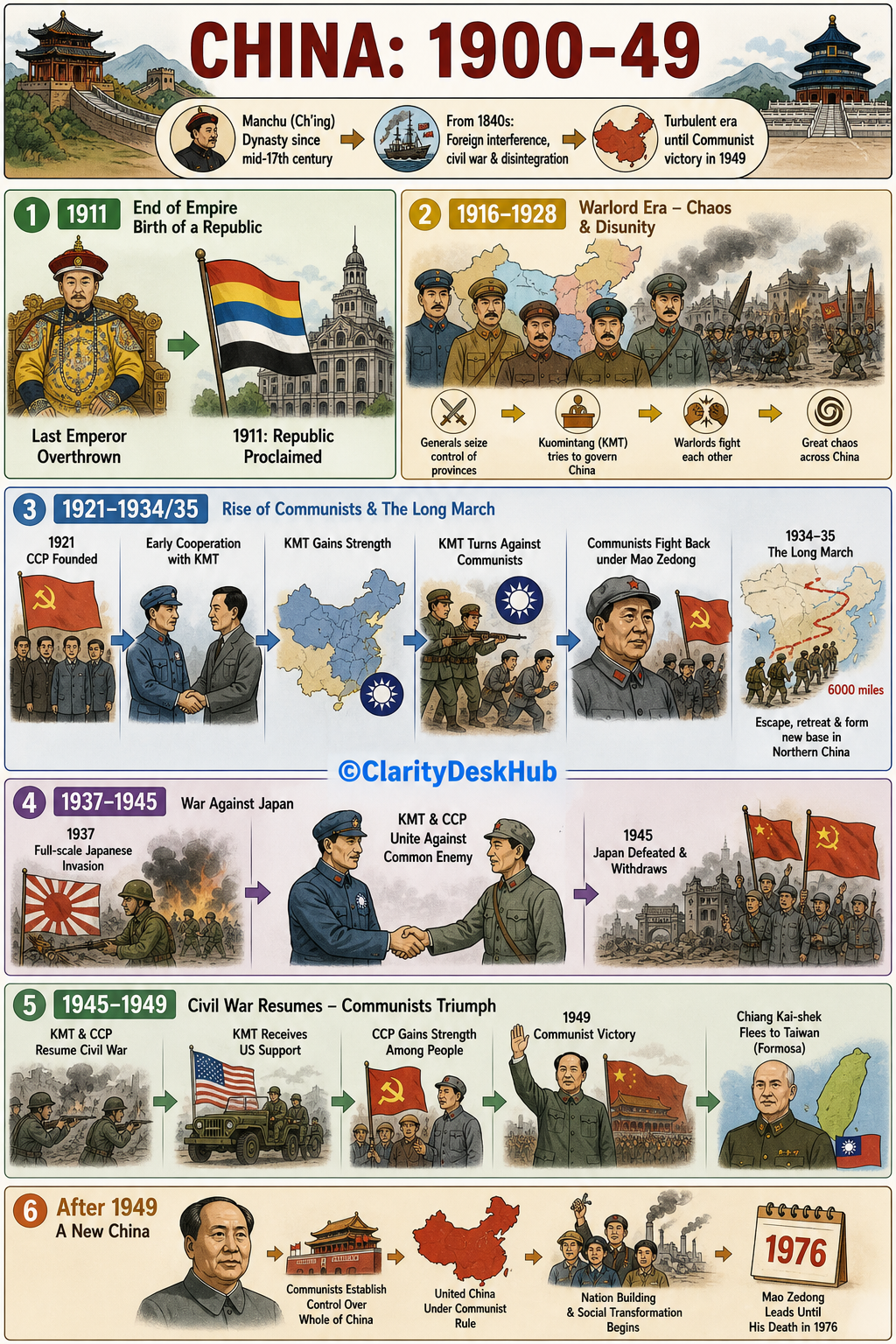
In this section, we shall analyze one of the most tumultuous yet transformative phases of modern world history: the collapse of the oldest continuous imperial system and China’s painful transition into the modern era.
Revolution and the Warlord Era
To understand the Revolution of 1911 and the subsequent Warlord Era, we cannot look at them as isolated political events. We must see them as a culmination of internal decay and external aggression—what many historians call the “Century of Humiliation.”
The Prelude to Collapse: A Dynasty in Decay
For centuries under the Manchu (Qing) Dynasty, China viewed itself as the “Middle Kingdom,” self-sufficient and isolated. However, by the 19th century, this stability was shattered by a “perfect storm” of crises.
A. The Malthusian Trap and Peasant Unrest
One of the most overlooked factors is the demographic explosion. Between 1741 and 1841, China’s population skyrocketed from 140 million to 410 million.
- The Problem: Agricultural technology remained stagnant.
- The Consequence: Not enough food to feed the masses.
- The Result: Widespread poverty led to banditry, robbery, and a total breakdown of law and order in the countryside.
B. The “Barbarians” at the Gate: External Aggression
While China was rotting from within, Western powers were knocking on the door with superior industrial and military might.
- The Opium Wars (1839–42): Britain forced China to open its ports and cede Hong Kong.
- The “Slicing of the Melon”: Following the British, France, Germany, and Russia extracted “concessions” in nearly 80 ports.
- The Psychological Blow: The famous (though perhaps apocryphal) sign in a Shanghai park—“No Dogs or Chinese”—symbolized the deep humiliation felt by the Chinese people in their own land.
C. Internal Rebellions and the Erosion of Authority
The Taiping Rebellion (1850–64) was a turning point. It wasn’t just a revolt; it was a civil war that cost millions of lives.
- The Irony of Survival: The Qing government couldn’t defeat the rebels with its own imperial troops. Instead, it had to rely on regional armies raised by local gentry.
- The Long-term Cost: This saved the dynasty but shifted power from the Center (Beijing) to the Provinces. This was the “DNA” of the future Warlord Era.
The 1911 Revolution: From Empire to Republic
By the early 1900s, a new generation of Chinese intellectuals, educated abroad, realized that “reforms” were no longer enough. They wanted a Republic.
A. The Catalyst: Wuchang Uprising
The revolution wasn’t a grand, planned event. It began almost accidentally with a bomb explosion and a mutiny among soldiers in Wuchang in October 1911. Within weeks, most provinces declared independence from the Qing.
B. The Tragedy of Yuan Shikai
The Qing, in a last-ditch effort, called upon General Yuan Shikai to save them. Yuan, however, was an opportunist. He negotiated with the revolutionaries (led by Dr. Sun Yat-sen):
- The 5-year-old Emperor Puyi would abdicate.
- The Manchu Dynasty would end.
- Yuan Shikai would become the first President of the Republic.
Critical Analysis: The Revolution of 1911 was a “hollow victory.” It removed the Emperor but failed to establish a functioning democracy. The old wine of military autocracy was simply poured into the new bottle of a “Republic.”
The Twenty-One Demands and the Failure of Yuan Shikai
Yuan Shikai soon revealed his true colors by ruling as a military dictator. However, his biggest challenge came from Japan.
Japan’s Ambition
Taking advantage of World War I (when Western powers were busy in Europe), Japan presented China with the Twenty-One Demands in 1915.
- The Goal: To make China a Japanese protectorate.
- The Betrayal: Yuan Shikai accepted most of these demands in exchange for Japanese support for his secret ambition—to crown himself Emperor.
This was a fatal miscalculation. The Chinese people, who had just fought to end a monarchy, were outraged. His own generals abandoned him, and Yuan died in 1916, leaving behind a power vacuum.
The Warlord Era (1916–1928): A Fractured Nation
With no strong central leader, China disintegrated. This era is characterized by:
- Fragmentation: Hundreds of small states ruled by “Warlords” with private armies.
- Peasant Suffering: Constant warfare, heavy taxation, and forced labor.
- Political Chaos: The government in Beijing became a mere puppet, changing hands whenever a different warlord captured the city.
The Silver Lining: The May Fourth Movement (1919)
Amidst the darkness of the Warlord Era, a “New Culture” was born. On May 4, 1919, students in Beijing protested against the Treaty of Versailles, which had handed Chinese territory (Shantung) to Japan.
Why is this movement significant?
- Mass Nationalism: It wasn’t just students; workers and businessmen joined in a nationwide boycott of Japanese goods.
- Cultural Renaissance: Intellectuals began to question Confucianism. They argued that traditional values—loyalty to elders and rulers—had made China weak and submissive. They called for “Mr. Science” and “Mr. Democracy.”
- Political Shift: This movement provided the intellectual energy that would eventually fuel both the Kuomintang (KMT) and the Chinese Communist Party (CCP).
Summary & Conclusion
The period from 1911 to 1928 teaches us a vital lesson in political science: Destruction is easier than Construction.
It was easy to overthrow the Manchu Dynasty, but it was incredibly difficult to build a modern state in its place. The 1911 Revolution was a “truncated revolution”—it changed the head of the state but did not change the socio-economic structure of the village. It would take another several decades of civil war and foreign invasion before China would finally find a unified path.
If we look at this through a historiographical lens, the Warlord Era wasn’t just a “dark age”; it was the painful labor room in which modern Chinese nationalism was born.
As we see the rise of modern China today, we must remember that its roots lie in the anger and aspirations of the students who stood in Tiananmen Square on May 4, 1919.
Considering the failure of the 1911 Revolution to establish a stable democracy, do you think China’s later turn toward a more authoritarian, centralized model was an inevitable reaction to the chaos of the Warlord Era?
We now move from the chaos of the Warlord Era to the rise of a structured political force that sought to rebuild China: the Kuomintang (KMT).
To understand this period, we must look at it through two distinct lenses: the visionary idealism of Dr. Sun Yat-sen and the pragmatic militarism of Chiang Kai-shek.
The Kuomintang
The Kuomintang (KMT) was the Nationalist political party of China that aimed to unify the country and establish a republican government under leaders like Sun Yat-sen and Chiang Kai-shek.
The Visionary: Dr. Sun Yat-sen and the Ideology of Rebirth
Dr. Sun Yat-sen is often called the “Father of the Nation.” He was a doctor, not a soldier, and this is crucial to understanding why his early efforts were high on intellect but low on territorial control.
A. The Ideological Blueprint: The “Three Principles”
Sun Yat-sen realized that a revolution without an ideology is just a riot. He gave China the San-min Chu-i (Three Principles of the People):
- Nationalism (Minzu): Ridding China of foreign “imperialist” shackles and unifying the fragmented provinces.
- Democracy (Minquan): Ending the rule of warlords and transitioning to a government “by the people.” However, Sun was a realist—he believed the people needed a “period of tutelage” (education) before they could handle full democracy.
- Livelihood (Min-sheng): Often called “Land Reform.” This was his most controversial point. He wanted to help the peasants but was hesitant to anger the powerful landlords. He advocated for rent control but stopped short of confiscating land.
B. The Power Paradox
By 1917, Sun had established a government in Canton (Guangzhou). But here is the problem: he had the ideas, but the warlords had the guns. Until 1925, the KMT was a revolutionary party without a revolutionary army. It was a “paper tiger” waiting for a sword.
The Sword: Chiang Kai-shek and the Militarization of Politics
When Sun Yat-sen died in 1925, the leadership passed to Chiang Kai-shek. If Sun was the soul of the KMT, Chiang was its muscle.
A. The Soviet Connection and Whampoa
In a fascinating twist of history, the KMT—a nationalist party—received its early training from the Soviet Union. Chiang spent time in Moscow, and with Russian money and advisors, he headed the Whampoa Military Academy.
- The Goal: To create a professional officer corps that was loyal to the party, not to individual warlords.
- The Conflict: While Chiang used Soviet methods to organize the party, he deeply distrusted Communist ideology. He was a conservative at heart, leaning toward the interests of businessmen and landowners.
The Northern Expedition (1926–1928): Unifying by Force
In 1926, Chiang launched the Northern Expedition, a massive military campaign to destroy the warlords and capture Beijing.
A. The “First United Front”
During this march, the KMT and the Chinese Communist Party (CCP) worked together. It was a marriage of convenience.
- The Communists mobilized the peasants and workers, promising land and better conditions.
- The KMT provided the military hardware.
- The Result: The campaign was a spectacular success. Major cities like Shanghai and Nanking fell, and by 1928, Beijing was captured. On paper, China was unified.
The Bloody Divorce: The Shanghai Massacre (1927)
As the expedition neared its end, the ideological friction reached a breaking point. Chiang saw the rising power of trade unions and peasant movements—organized by Communists like Zhou En-lai—as a threat to the social order and his own authority.
A. The “Purification Movement”
In April 1927, in Shanghai, Chiang turned his guns on his own allies. This was the “White Terror.”
- Thousands of Communists, labor leaders, and students were executed.
- The Consequence: The alliance was shattered. The surviving Communists fled to the countryside (leading to the eventual rise of Mao Zedong), and the KMT became a right-wing, military-dominated regime.
Critical Analysis: The KMT’s “Tragic Success”
By 1928, Chiang was the master of China. But was he a successful leader? Let’s analyze the balance sheet:
- Successes: He achieved Sun’s first principle—Nationalism. He gave China a central government, a national flag, and some modern infrastructure like roads and schools.
- Failures: He failed on Democracy and Livelihood. Because he relied on the support of the elite (landlords and bankers), he could not implement the land reforms the peasants desperately needed.
The Historiographical Perspective: Many historians argue that by massacring the Communists in 1927, Chiang won the battle but lost the war. He alienated the rural masses—the 80% of China—leaving a vacuum that the Communists would eventually fill with their promise of “land to the tiller.”
Summary
The KMT under Chiang Kai-shek brought a semblance of order to China, but it was an order built on the barrel of a gun and the suppression of the left. The “Three Principles” of Sun Yat-sen remained largely unfulfilled, and the “unification” of 1928 was a fragile one, haunted by the ghost of the 1927 massacre.
Given that Chiang Kai-shek successfully unified China militarily but failed to address the economic grievances of the peasants, do you think his focus on military strength over social reform was a necessary survival tactic or the very mistake that ensured his eventual downfall?
Having explored the rise and initial consolidation of the Kuomintang (KMT), we now turn our attention to the other side of the revolutionary coin: Mao Zedong and the Chinese Communist Party (CCP).
To understand modern China, you must understand how a tiny group of intellectuals, hiding in mountains and marching through swamps, eventually displaced a state-backed military machine. This is not just a story of politics; it is a story of strategy, geography, and the pulse of the peasantry.
Mao Zedong and Chinese Communist Party
The Genesis of Maoism: A Strategic Pivot
The CCP was founded in 1921, largely by urban intellectuals inspired by the Russian Revolution. However, the Russian model (where workers in cities lead the revolt) failed miserably in China because Chiang Kai-shek’s KMT held the cities with an iron grip.
The “Peasant Path”
Mao Zedong, the son of a prosperous farmer, brought a unique perspective. While others looked at factories, Mao looked at the villages.
- The Realization: Mao argued that in a country where 80-90% of the population were peasants, they were the “revolutionary fuel.”
- The Shift: After the 1927 massacre in Shanghai, Mao retreated to the countryside (the Jiangxi Soviet) and began organizing “Peasant Associations.”
Survival of the Fittest: The Long March (1934–1935)
By 1934, Chiang Kai-shek had launched five “Extermination Campaigns” to wipe out the communists. Surrounded and facing total annihilation, Mao made a desperate, historic decision: The Long March.
A. The Odyssey
- The Scale: Approximately 100,000 communists set out to find a new base. They traveled 6,000 miles over 368 days.
- The Hardship: They crossed 18 mountain ranges and 24 rivers, often under constant bombardment and pursuit.
- The Result: Only about 20,000 survived to reach Yenan (Shensi province).
Critical Analysis: Was it a victory or a defeat? Militarily, it was a retreat. But politically and psychologically, it was a propaganda masterpiece. It turned Mao into a living legend and forged a “hardened core” of leaders who would eventually rule China for decades.
B. Historiographical Debate
- The Legend: Traditional accounts (like Edgar Snow’s) portray it as a heroic epic of survival.
- The Revisionists: Writers like Jung Chang and Jon Halliday argue the march was “permitted” by Chiang for his own political maneuvers.
- The Balanced View: Most historians today acknowledge that while some details were romanticized for propaganda, the sheer endurance required remains an undeniable feat of human willpower.
Why the Tide Turned: Analyzing the Communist Ascent
Why did the people choose the CCP over the KMT? We can categorize this into five dimensions:
1. KMT Inefficiency vs. CCP Discipline
The KMT government became synonymous with corruption. Officials grew wealthy while the state crumbled. In contrast, the CCP maintained a reputation for strict discipline and personal austerity, which deeply impressed the common man.
2. The Industrial Vacuum
Under Chiang, factory laws (like banning child labor) existed only on paper. Because Chiang relied on the support of industrialists, he refused to enforce regulations. This left urban workers feeling betrayed and abandoned.
3. The Rural Revolution (Land Reform)
This was the CCP’s “Trump Card.”
- KMT Policy: Ignored peasant poverty to keep landlords happy.
- CCP Policy: In their “Soviet” areas, they restricted rents and redistributed land. Even their “moderate” policy (rent reduction) was revolutionary for a peasant who had been exploited for generations.
4. The Cultural Mismatch: The “New Life Movement”
Chiang tried to revive China through the New Life Movement (1934)—a mix of Confucianism and modern hygiene (e.g., “don’t spit in the street”).
- The Critique: As historian Rana Mitter notes, these were “trivial” prescriptions compared to the massive hunger and chaos facing the nation. It felt like a “backward step” to the intellectuals of the May Fourth Movement.
5. The Nationalistic Litmus Test: Resistance to Japan
This was the most crucial factor. When Japan invaded Manchuria in 1931, Chiang’s slogan was: “Internal pacification before external resistance” (i.e., kill the communists first, then fight Japan).
- The Sian Incident (1936): Chiang was kidnapped by his own generals who were furious at his refusal to fight Japan. Only after CCP intervention (Zhou En-lai) was a Second United Front formed.
- The Consequence: The CCP used the war to present themselves as the “true patriots” of China, while the KMT bore the brunt of the heavy Japanese conventional attacks and retreated.
Historiography: Was Chiang Unfairly Judged?
Historians like Jay Taylor have offered a “rehabilitation” of Chiang Kai-shek’s image.
- The Argument: Chiang faced “impossible” problems—warlords, communists, and a Japanese superpower—simultaneously.
- The Verdict: While he was brutal and made errors, he may have been a more capable administrator than Western “advisers” (who nicknamed him “Peanut”) gave him credit for.
Summary
The rise of Mao and the CCP was not inevitable. It was the result of the KMT’s inability to address the two most pressing needs of the Chinese people: Economic dignity for the peasant and National pride against the invader. Mao didn’t just win a war; he won the argument that he represented the “soul” of a new China.
If the Japanese had never invaded in 1937, do you think Chiang Kai-shek would have eventually succeeded in his “extermination campaigns,” or was the KMT’s internal corruption so deep that a communist uprising was bound to happen anyway?
Now, we arrive at the final chapter of this epic struggle—the year 1949. In the study of history, we often look for “turning points,” and 1949 is perhaps the most significant one for Asia in the 20th century.
Let us analyze how the “Sick Man of Asia” finally stood up, and why the seemingly powerful Nationalist government collapsed like a house of cards.
The Communist Victory, 1949
The Crucible of World War II (1937–1945)
To understand the Communist victory, we must first look at the impact of the Second Sino-Japanese War, which merged into World War II.
A. Chiang’s Strategic Dilemma
Chiang Kai-shek was in a peculiar position. While fighting Japan, he secretly admired the German military model. It was only when the tide turned at Stalingrad (1943) that he fully committed to the Allied cause.
- The Diplomatic Gain: In 1943, the West finally treated China as an equal. The US and Britain renounced their “unequal treaties.” China was even promised a permanent seat on the UN Security Council.
- The Irony: On paper, China was a “Great Power.” On the ground, Japanese troops were still occupying its heartland.
B. The Internal Rot Revealed
In 1944, Japan launched a massive offensive striking south from the Yangtze Valley.
- KMT Failure: The Nationalist armies were disorganized and retreated. This showed the Chinese people that despite billions in American aid, Chiang’s government could not protect them.
- CCP Strategy: Meanwhile, the Communists stayed “bogged down” in the north, using guerrilla tactics. They didn’t win major battles, but they won the hearts and minds of the rural population by being the only ones consistently resisting the “invader.”
The Final Struggle (1945–1949): Why Victory Wasn’t Inevitable
When Japan surrendered in August 1945, many assumed Chiang Kai-shek would easily take control. He had the planes, the tanks, and the American backing.
A. The Geopolitical Chessboard
- The US Role: The Americans airlifted KMT troops to take over Japanese-occupied cities.
- The Soviet Factor: The USSR occupied Manchuria (the industrial heart of China). While they didn’t officially hand it to Mao, they “obstructed” the KMT and allowed the CCP to move in and seize Japanese weapons.
- The Shift: By 1948, the Red Army (now the People’s Liberation Army) had grown so strong that they stopped running. They switched from Guerrilla Warfare to Conventional Warfare.
The Anatomy of Collapse: Why the KMT Lost
If you are writing an answer on this, you must look at this multidimensionally. It wasn’t just a military defeat; it was a moral and economic bankruptcy.
1. The Economic Death Spiral (Hyperinflation)
The KMT tried to fund their wars by printing money. The result? Galloping inflation.
- Social Impact: The middle class—the very people who supported Chiang—saw their life savings vanish. When a bag of rice costs a mountain of cash, a government loses its “Mandate of Heaven.”
2. The Discipline Gap
- KMT Armies: Poorly paid, they often looted the very peasants they were supposed to protect. This “alienated” the masses.
- CCP Armies: They followed Mao’s “Eight Points of Attention” (e.g., don’t take even a needle or thread from the people). They were seen as “the people’s army.”
3. The Tactical Blunders of Chiang
Like many autocrats, Chiang suffered from a “No Retreat” complex.
- The Error: He ordered his troops to hold onto cities even when they were surrounded. Entire divisions were trapped and surrendered without a fight.
- The Leadership: In contrast, Mao and Zhou En-lai were shrewd strategists. Generals like Lin Biao and Chu Teh proved to be master tacticians, outmaneuvering their KMT counterparts at every turn.
The Proclamation: “China Has Stood Up”
By January 1949, the CCP captured Beijing. Chiang Kai-shek and the remnants of the KMT fled to the island of Taiwan (Formosa).
On October 1, 1949, Mao Zedong stood at Tiananmen Gate and proclaimed the People’s Republic of China (PRC).
Critical Analysis: The victory of 1949 was not just a military win for the CCP; it was a total rejection of the old order. The KMT’s corruption and its inability to solve the “Peasant Question” created a vacuum that only a highly disciplined, ideologically driven force like the CCP could fill.
Summary and Final Thought
The journey from the Opium Wars of the 1840s to the Proclamation of 1949 took a century. It was a century of humiliation, failed reforms, and blood-soaked revolutions.
In the end, Mao’s success lay in his ability to synchronize Marxism with the Chinese Peasantry. He didn’t wait for an urban revolution; he built one in the mountains.
Looking at the rapid collapse of the KMT despite their superior American weaponry, do you think the “soft power” of ideology and discipline is ultimately more decisive in a civil war than the “hard power” of military hardware?