
History of USA before Second World War
The American System of Government.
To understand the United States, one must look beyond the skyscrapers and the economy. We must look at the “Grammar of its Politics”—the Constitution of 1787. Imagine a group of people, the ‘Founding Fathers,’ sitting in Philadelphia, trying to solve a riddle: How do we create a government strong enough to maintain order, but weak enough to not become a tyranny?
The Genesis: The Constitution and its Evolution
The American Constitution was drawn up in 1787. It is one of the shortest and oldest working written constitutions in the world. But do not think of it as a frozen document. It is a “living organism.”
- The Original Vision: It established the ground rules for the new republic.
- The Amendments: Since its inception, 26 “points” or Amendments have been added. This shows the flexibility of the system. For instance, the last significant change in 1971 lowered the voting age to 18. It reflects how the law evolves with the changing social consciousness of the people.
The Federal Architecture: A Union of States
The USA is a Federal System. Now, what does “Federal” mean in simple terms? It means a “division of labor” between the Center and the States.
- Growth and Expansion: In the beginning, there were only 13 states (mostly on the East Coast). As the “frontier” moved westward, more states were carved out. By 1900, there were 45. Eventually, with the addition of Alaska and Hawaii in 1959, we reached the current number of 50.
- Dual Sovereignty: Every state has its own capital, its own Governor, and its own laws. They share power with the Federal Government sitting in Washington, D.C.
The Pillars of Power: The Three Branches
The American system is built on the “Separation of Powers.” This isn’t just a technical term; it is a philosophy to prevent the concentration of power in one hand.
(A) The Legislature: Congress
The Congress is the “Law-making” body. It doesn’t consist of one house, but two—a Bicameral system.
- The House of Representatives: 435 members. This is the “People’s House,” where representation is based on population. They are elected for a short term of 2 years, keeping them on their toes.
- The Senate: 100 members (2 from each state, regardless of size). This represents the “Principle of Equality” between states. Whether you are a giant like California or a small state like Rhode Island, you get 2 Senators. They have a 6-year term, providing stability.
Analytical Note: Congress isn’t just for laws; it controls the “Power of the Purse” (taxation) and the “Power of the Sword” (declaring war).
(B) The Executive: The President
The President is the face of the nation, elected for a 4-year term.
- Roles: He is the Commander-in-Chief, the chief diplomat, and the head of the civil service.
- The Veto: The President can say “No” to a law passed by Congress. This is a massive power, but as we shall see, it is not absolute.
(C) The Judiciary: The Supreme Court
Think of the Supreme Court as the “Referee” of the system.
- It consists of 9 judges appointed for life. Why for life? To ensure they are not afraid of politicians.
- Their job is to interpret the Constitution. If the President or Congress does something that violates the Constitution, the Court can declare it “Unconstitutional.”
The Political Landscape: Two Parties, Many Shades
Unlike some countries with dozens of parties, the US is dominated by two:
- The Republicans: Traditionally “Conservative.” They favor Laissez-faire (minimum government interference in business) and high tariffs to protect domestic industry. Think of Presidents like Hoover.
- The Democrats: Traditionally “Progressive.” They believe the government should play an active role in social welfare. Think of FDR’s “New Deal” or JFK’s reforms.
A Critical Distinction: Unlike the British Parliamentary system, American parties are not “rigid.” A Democrat might vote with Republicans on certain issues and vice-versa. There is room for “Dissent” within the party, which is a hallmark of their political culture.
The Masterstroke: Checks and Balances
This is the most intellectually enriching part of the system. The “Founding Fathers” were suspicious of human nature. They believed that “Power corrupts.” So, they created a system where each branch “checks” the other.
- Congress vs. President: The President can veto a law, but if Congress is determined, they can override the veto with a two-thirds majority.
- The Threat of Impeachment: If a President commits a “high crime,” Congress can remove him. Remember Richard Nixon? He had to resign in 1974 because the threat of impeachment over the Watergate scandal was very real.
- The Court’s Watchful Eye: Even if the President and Congress agree on a law, the Supreme Court can strike it down if it’s illegal.
Final Analytical Reflection
So, what is the “essence” of the American System?
It is a System of Friction. It was designed not to be efficient, but to be safe. It forces different branches to talk, to compromise, and to persuade each other. As the text suggests, a President’s success depends not on his “commands,” but on his “skill at persuasion.”
It is a system that values the Rule of Law over the Rule of Men. While it has its flaws—like gridlock when parties don’t agree—it has provided a stable framework for over two centuries, allowing a small collection of 13 colonies to transform into a global superpower.
Next, we move to one of the most vibrant, complex, and emotionally charged chapters in American history: The Era of Mass Immigration.
If the Constitution was the “skeleton” of the USA, the immigrants were its “blood and muscle.” To understand modern America, you must understand this concept of the “Melting Pot.” Let us analyze this phenomenon.
The Era of Immigration
The Great Deluge: Context and Scale
There is a difference between “migration” and a “wave.” What happened in the late 19th century was a tidal wave.
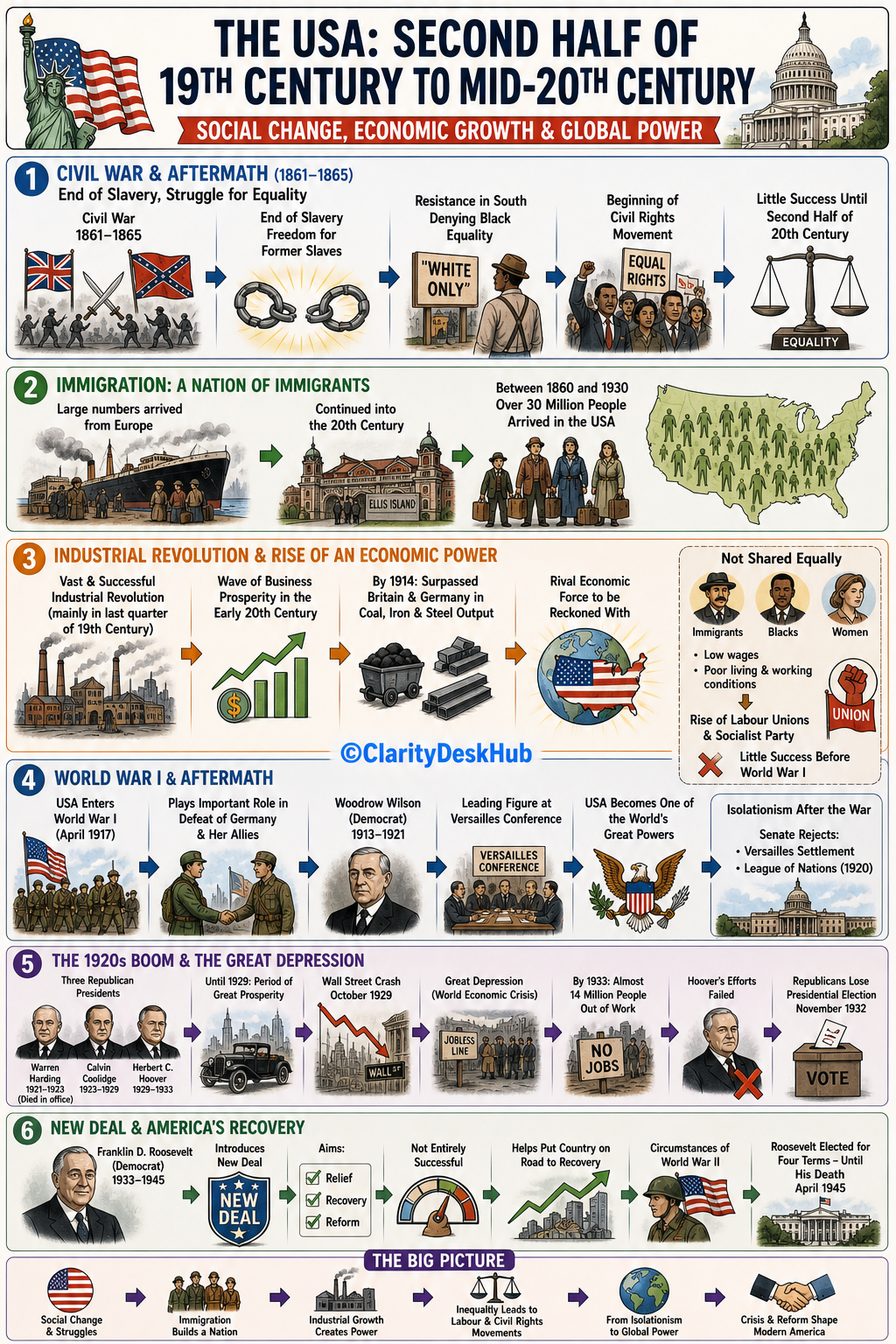
- The Quantitative Shift: Looking at the numbers—they are staggering. In the entire 18th century, only about 5 lakh (half a million) people arrived. But between 1860 and 1930? Over 3 crore (30 million) people!
- The Changing Face of America:
- Phase 1 (Mid-19th Century): Dominated by the Irish (fleeing famine) and Germans.
- Phase 2 (Late 19th to Early 20th Century): A shift toward Southern and Eastern Europe—Italians, Poles, and Russians.
- The “Golden Door”: This was the nickname for the entry point (like Ellis Island). For millions, it represented the transition from despair to hope.
The “Push” and “Pull” Factors: Why did they come?
In migration studies, we always look at two forces: what pushes you out of your home, and what pulls you toward a new one.
- The Pull (Economic Aspirations): The American Dream. The promise of jobs, land in the West, and a life away from hereditary poverty.
- The Push (Persecution and Pain): This is the darker side. Millions of Jews fled Russia and Eastern Europe to escape Pogroms (organized massacres). For them, America wasn’t just a land of wealth; it was a land of Survival.
The Internal Migration: Moving West
The story didn’t end at the ports of New York. There was a “second migration.”
- Groups like Germans and Scandinavians (Swedes, Norwegians) didn’t like the crowded cities. They moved to the Midwest—states like Minnesota, Wisconsin, and Illinois—to farm.
- The Result: The population west of the Mississippi jumped from 5 million to 30 million in just fifty years. The “Frontier” was being conquered by the sweat of these new arrivals.
Multidimensional Consequences
What happens when you inject 30 million people into a young nation? The impact is felt in every artery of the country.
(A) Economic Transformation
Immigrants were the “engine” of the American Industrial Revolution.
- Labor Force: Without them, the labor force would have been 14% lower. They built the railways, worked the mines, and manned the factories.
- Urbanization: They created the modern American city. In 1880, only New York was a “millionaire city.” By 1910, Chicago and Philadelphia joined the club.
- The Death of the Agrarian Myth: America shifted from a nation of farmers (58% in 1870) to an industrial giant (only 14% in agriculture by 1914).
(B) The Sociological Debate: Melting Pot vs. Salad Bowl
This is a classic historiographical debate.
- The Melting Pot Ideal: The idea that everyone blends together to form a new, unique “American” identity.
- The “Salad Bowl” Reality: Historians like Roger Thompson argue that the ingredients stayed separate. Immigrants lived in “ghettos” (ethnic neighborhoods) and maintained their languages and customs.
- Inter-ethnic Conflict: Successive waves of immigrants often hated each other. The Irish looked down on the Italians; the Italians looked down on the Mexicans. It was a hierarchy of “who arrived first.”
The Backlash: Nativism and the “Closed Door”
Whenever there is rapid change, there is a reaction. This is the “Newton’s Third Law” of politics.
- The WASP Supremacy: The “White Anglo-Saxon Protestants” (WASPs) feared that the “purity” of America was being diluted by Jews, Catholics, and Eastern Europeans.
- Legislative Barriers: This fear led to the Quota System of 1924, which strictly limited immigration to 150,000 a year. The “Golden Door” was effectively bolted shut for decades.
- The Post-War Thaw: It was only after WWII and later in the 1960s/70s that the door cracked open again for refugees from Cuba and Vietnam.
Analytical Summary
So, the history of American immigration is a story of contradiction.
- On one hand, the USA took pride in being a refuge for the “huddled masses.”
- On the other hand, it often met those masses with racism and exclusion.
However, from an analytical standpoint, one cannot deny the result: immigration turned a peripheral collection of states into a multi-ethnic superpower.
It proved that a nation’s greatest “natural resource” isn’t just the gold in its mines, but the grit of the people who arrive at its shores with nothing but a suitcase and a dream.
Do you see how the “Salad Bowl” concept might be more relevant in today’s globalized world than the “Melting Pot”? It’s a thought worth pondering.
We have now reached a turning point where the United States stops being a “promising new nation” and becomes the Economic Titan of the world.
This period, especially the “Roaring Twenties,” is a classic case study of how rapid growth can create a glittering surface that hides deep structural cracks. Let us analyze this “Golden Age” and its darker shadows.
USA becomes Economic Leader of the World
The Ascent: From Rival to Leader
Before 1914, America was already sprinting. By 1900, it had overtaken Britain and Germany in coal, iron, and steel production.
- The “Robber Barons”: This era saw the rise of industrial “Empires.” Men like Andrew Carnegie (Steel) and John D. Rockefeller (Oil) weren’t just businessmen; they were more powerful than many small countries.
- The Catalyst of War: While Europe was busy destroying itself in World War I, American factories were working overtime to supply the world. America entered the war late and emerged as the “Global Creditor”—the world owed her money, not the other way around.
The Great Boom of the 1920s: A Consumer Revolution
The 1920s were called “Roaring” for a reason. It was an explosion of noise, jazz, and machines.
- The Henry Ford Factor: The move to Assembly Line production changed everything. Cars weren’t just for the rich anymore. In 1919, there were 7 million cars; by 1929, there were 24 million.
- A New Lifestyle: This was the birth of the “Consumer Culture.” Radios, vacuum cleaners, and refrigerators became standard. People didn’t just buy what they needed; they bought what they wanted, often using Credit (Buy now, pay later).
- Cultural Exports: Hollywood began its reign. American movies and Jazz music became the world’s first truly “global” culture.
Why did the Boom happen? (The Pillars of Prosperity)
If you are writing an answer on this, focus on these four dimensions:
- Technological: Mass production and “Time and Motion” studies (Taylorism) made factories hyper-efficient.
- Political: Republican governments followed Laissez-faire. They cut income taxes and raised the Fordney-McCumber Tariff (1922) to keep foreign goods out.
- Financial: The rise of Advertising and Hire Purchase (Credit) meant people kept spending even when they didn’t have the cash.
- Infrastructure: The motor car stimulated roads, rubber, glass, and petroleum industries. It was a “multiplier effect.”
The Dark Side: Who was left behind?
Now, this is the most critical part for a balanced analysis. The 1920s was not “Roaring” for everyone. Underneath the jazz and the Gatsby-style parties, there was significant suffering.
(A) The Agricultural Crisis
While the cities were booming, the countryside was bleeding.
- Farmers produced too much food. Prices crashed.
- The Paradox: New technology (tractors) made farmers more productive, but that productivity led to a “surplus” that no one would buy.
- Government Apathy: President Coolidge vetoed bills to help farmers, sticking to his “hands-off” philosophy.
(B) Racial and Social Intolerance
- The Black Experience: Black Americans were the “last hired and first fired.” They faced the terror of the Ku Klux Klan (KKK), which reached 5 million members in 1924.
- The “Red Scare”: Fear of communism led to the arrest and deportation of thousands of immigrants without trial.
- The WASP Anxiety: The 1924 Quota Act was a direct result of racial prejudice against anyone who wasn’t a “White Anglo-Saxon Protestant.”
(C) The Failure of Prohibition (The “Noble Experiment”)
In 1919, the US banned alcohol.
- The Intended Result: A moral, sober, and hard-working society.
- The Actual Result: The rise of Organized Crime. Figures like Al Capone made millions from “Speakeasies” (illegal bars). It led to the St. Valentine’s Day Massacre and corrupted the police and the courts.
Critical Analysis: A “Flawed” Prosperity
If we look at the 1920s analytically, we see a dangerous imbalance:
- Wealth Concentration: The top 5% of corporations took 84% of all income.
- Low Wages: While profits soared, real wages for workers barely moved (only 1.4% growth). 42% of American families lived in poverty.
- Gender Inequality: Women got the vote in 1920, but “Economic Vote” (equal pay) was still a distant dream.
Conclusion
The 1920s was a period of unprecedented growth built on an unstable foundation. The economy was like a high-speed car with no brakes and a starving driver. The Republican belief in “Laissez-faire” meant that the government refused to step in and fix the inequalities.
As we will see next, when the foundation finally cracked in 1929, the entire glittering tower of the “Roaring Twenties” came crashing down.
Does this help you see how “economic growth” is different from “inclusive development”? It is a lesson that remains relevant even today.
We now turn to an episode that is often buried under the glitz of the “Roaring Twenties”—the story of the American Labor Movement and the intense ideological struggle that followed the Russian Revolution.
If the previous discussion was about “Wealth,” the next discussion is about “Justice” and “Identity.” It is a story of how the “American Dream” often became a “Nightmare” for the men and women who actually built the machines.
Socialists, Trade Unions and the impact of War & Russian Revolution
The Labor Movement: A Battle for Dignity
In the late 19th century, American industry was growing, but the workers were suffering.
- The Context of Trauma: Imagine a world with no safety rules, no pensions, and no child labor laws. Diseases like smallpox swept through factory slums. Employers believed in “Rugged Individualism”—if you were poor or injured, it was your own fault.
- The Rise of Unions:
- The Knights of Labor: A peaceful, non-socialist group that grew to 700,000 members but collapsed after being linked to violence.
- The AFL (American Federation of Labor): Led by Samuel Gompers. He wasn’t a radical; he just wanted “more”—higher wages and shorter hours. He worked within the system.
- The IWW (The “Wobblies”): Led by “Big Bill” Haywood. These were the radicals. They wanted “One Big Union” and believed in class warfare to overthrow the capitalist system.
The Ruthless Response: State vs. Worker
Why did these unions fail to achieve much early on? Because the American “Establishment” saw them not as workers, but as Revolutionaries.
- The Haymarket Riot (1886): A peaceful protest in Chicago turned into a bloodbath when a bomb went off. Even though there was no proof, four socialist leaders were hanged. This set the tone: Dissent equals Death.
- The Homestead Strike (1892): Andrew Carnegie’s steel plant used a private army (Pinkertons) and state troops to crush workers.
- The Pullman Strike (1894): Eugene Debs led a railway strike that paralyzed the country. The government used federal troops to break it, claiming it interfered with the mail.
Analytical Perspective: In the USA, the “Middle Class” and the “Press” almost always sided with the employers. They viewed unions as “Un-American” and a threat to individual liberty.
The Great Divergence: Race and Skill
One of the saddest reasons the labor movement remained weak was its internal divisions.
- Skilled vs. Unskilled: Skilled workers (AFL) looked down on the unskilled.
- The Racial Divide: Most unions refused to let Black workers join. In retaliation, Black workers sometimes acted as “strike-breakers.”
- The Immigrant Factor: Each new wave of immigrants provided “cheap labor,” which employers used to undermine the strikes of established workers.
The Impact of World War I and the “Red Scare”
When the Russian Revolution happened in 1917, the American elite became terrified. They feared the “Bolshevik virus” would spread to the US.
- The Espionage Act (1917): Under President Woodrow Wilson, the government used the war as an excuse to crush socialists. Eugene Debs was sentenced to 10 years in prison just for giving an anti-war speech.
- The Palmer Raids: Attorney-General Mitchell Palmer launched a “witch hunt.” He arrested thousands of “aliens” and “radicals,” deporting many to Russia without proper trials.
- The Destruction of the IWW: By 1918, the “Wobblies” were effectively dismantled through mass arrests and trials.
The Sacco and Vanzetti Case: A Global Symbol
The climax of this era of intolerance was the trial of two Italian immigrants, Nicola Sacco and Bartolomeo Vanzetti.
- The Crime: They were accused of a postmaster’s murder.
- The Reality: The evidence was weak. They were really on trial for being Anarchists and Immigrants.
- The Consequence: Despite worldwide protests (even from people like Mussolini and Einstein!), they were executed in 1927.
Historiographical Note: This case proved to the world that the American judicial system was not “blind.” It was deeply influenced by the “Red Scare” and “Nativism” (hatred of foreigners).
Analytical Summary: The Wilsonian Paradox
President Woodrow Wilson is often remembered as a great reformer (his “New Freedom” program banned child labor). However, his legacy is a paradox.
- On one hand, he expanded democracy.
- On the other hand, his administration oversaw some of the most brutal suppressions of civil liberties in American history.
As historian Hugh Brogan noted, Wilson’s achievements were “impressive compared to the past, but trivial compared to what needed to be done.” The 1920s ended with a superficial peace, but the underlying tensions of race, class, and ideology remained a “ticking time bomb.”
We have seen the wealth of the 20s and the struggle of the workers. Next, we shall see what happens when the “Great Boom” finally meets the “Great Depression.”
Now, does this shift your perspective on the “Roaring Twenties”? It wasn’t just jazz and flappers; it was also the smell of gunpowder and the shadow of the electric chair.
Ok, we now come to what is perhaps the most painful yet profound paradox of American history. On one hand, you have the Declaration of Independence stating, “All men are created equal.” On the other hand, for nearly a century, the same nation’s economy was fueled by the labor of millions of enslaved human beings.
Next, we shall analyze how the promise of freedom was given, snatched away, and then fought for again. This is the saga of Racial Discrimination and the Civil Rights Movement.
Racial Discrimination and the Civil Rights Movement.
The Historical Root: A “Birth Defect” in the Union
To understand the problem, we must go back to the 17th century.
- The Plantation Economy: In the South, tobacco, sugar, and cotton required massive labor. Southern whites became economically “addicted” to slavery.
- The Constitutional Silence: In 1787, while the Founding Fathers were busy talking about “Liberty,” they deliberately ignored the issue of slavery to keep the Southern states in the Union.
- The Civil War (1861–65): When Abraham Lincoln was elected, the South feared they would lose their “property” (slaves) and seceded. The war that followed wasn’t just about North vs. South; it was a battle for the soul of the nation.
The False Dawn: “Black Reconstruction”
After the North won, the USA entered a brief but radical period called Reconstruction.
- The Constitutional Shield: Three Amendments (13th, 14th, and 15th) were added. They abolished slavery, gave citizenship, and granted Black men the right to vote.
- A Political Miracle: For a few years, African Americans were elected to high offices. Two were even sent to the Senate! Schools were integrated, and hope was in the air.
- The Tragic Betrayal (1877): In a “shady deal” to settle the disputed 1876 election, the Republican candidate Rutherford B. Hayes agreed to withdraw federal troops from the South. This was the Great Betrayal. The former slaves were abandoned, and the South was handed back to the “White Supremacists.”
The Reign of Terror: KKK and Jim Crow
With federal troops gone, the Southern states unleashed a “legal and extra-legal” war on Black citizens.
(A) The Extra-Legal Weapon: The Ku Klux Klan (KKK)
The Klan used masks, hoods, and burning crosses to create a climate of fear.
- Their Goal: To terrorize Black people so much that they would stop voting or trying to own land.
- The Horror of Lynching: Between 1885 and 1917, over 2,700 African Americans were lynched (publicly murdered by mobs).
(B) The Legal Weapon: Jim Crow Laws
These were state laws that enforced Segregation.
- Separation: “Separate but equal” became the mantra. Different schools, different hospitals, different sections on buses, and even different water fountains.
- Disenfranchisement: States used “literacy tests” and “poll taxes” to stop Black people from voting.
The Intellectual Divide: How to Fight Back?
How do you fight a system that wants to crush you? Two different schools of thought emerged:
- Booker T. Washington (The “Accommodationist”): He argued that Black people should focus on Economic Self-Reliance first. His “Atlanta Compromise” suggested: “Work hard, get an education (at places like the Tuskegee Institute), and eventually, the whites will respect you and give you rights.”
- W. E. B. Du Bois (The “Radical”): The first Black man to get a PhD from Harvard, Du Bois disagreed. He said, “No! We need our political rights now.” He helped found the NAACP in 1910 to fight segregation through the courts.
The Radical Alternative: Marcus Garvey
In the early 20th century, Marcus Garvey brought a different energy.
- Black Pride: He didn’t want to “integrate” into white society. He promoted Black Nationalism.
- The “Back to Africa” Movement: He told Black Americans they would never be treated fairly in a white-supremacist country and suggested they return to Africa to build their own empire. While his business ventures failed, he planted the seeds for later movements like those of Malcolm X.
The 1920s: The Klan’s Resurgence
Even during the “Roaring Twenties,” the KKK saw a massive revival, reaching 5 million members by 1924.
- The Target Expands: Now, they weren’t just against Black people; they were against immigrants, Catholics, and Jews.
- Nativist Success: The Klan claimed credit for the 1924 law that closed the “Golden Door” to immigrants.
Analytical Summary
So, when we look at this history, we see that social change is not a straight line.
- 1865: Total Freedom (on paper).
- 1877: Total Betrayal.
- 1920s: Total Terror.
The African American experience proves that Democracy is a fragile thing. It is not enough to have a good Constitution; you need the “Political Will” to enforce it.
By the end of the 1920s, Black people were still “second-class citizens,” but they had begun to organize. The NAACP was ready, the memory of the “Wobblies” was there, and the Great Depression was about to shake the system to its core.
Any thoughts on why the “Shady Deal” of 1877 is considered one of the darkest moments in American political history? Think.
Ok, we now arrive at one of the most dramatic and tragic chapters in global history: The Great Depression.
If the 1920s was a grand, loud party, then October 1929 was the moment the lights went out and the floor collapsed. To understand this, we must look past the “panic” on the surface and analyze the structural rot that had been hollowed out the American economy for years.
The Great Depression
The Immediate Shock: The Wall Street Crash
In early 1929, Americans were optimistic. President Hoover had just won a landslide victory, promising “permanent prosperity.” But in September, the gears began to grind.
- The Panic: On October 24 (“Black Thursday”) and October 29 (“Black Tuesday”), the stock market didn’t just fall; it evaporated. People rushed to sell their shares, but there were no buyers.
- The Loss: Around $30 billion in value vanished in days. To give you a sense of scale, that was more than the US had spent on the entire First World War.
- The Contagion: This wasn’t just a “rich man’s problem.” Because banks had used people’s savings to gamble on stocks, the crash triggered a Banking Crisis. When the banks failed, the life savings of ordinary families disappeared.
The Root Causes: Why did the Building Collapse?
As I always say, an event is just a symptom; the cause lies deeper. The Crash didn’t cause the Depression; it merely triggered a landslide that was already waiting to happen.
(A) Domestic Overproduction & Under-consumption
Industry was too efficient for its own good. Factories were churning out cars and radios using mass production, but the buying power of the people had plateaued.
- The Vicious Cycle: Once everyone who could afford a car had bought one, stocks piled up. Factories then laid off workers. These unemployed workers now had zero money to buy anything, leading to more factory closures.
(B) The Inequality Gap
This is a crucial point for your analysis. Between 1923 and 1929, industrial profits rose by 72%, but wages rose by only 8%.
- The wealth was at the top. The boom was sustained by Credit (debt), not real income. By 1929, the “Credit bubble” burst.
(C) The Export Crisis
America tried to protect its industry with high tariffs (like the Fordney-McCumber Tariff).
- The Backfire: Since Europe couldn’t sell its goods to America, it had no dollars to buy American goods or pay back war debts. Trade became a one-way street that eventually led to a dead end.
(D) The Madness of Speculation
By 1928, the stock market had become a casino. People were “buying on margin”—borrowing money to buy shares, hoping to sell them a week later for a profit. When prices stopped rising, the whole house of cards came down.
The Human Cost: From “Dream” to “Nightmare”
The statistics are bone-chilling:
- Unemployment: 14 million people (25% of the workforce) were jobless by 1933.
- Banking: Over 10,000 banks closed. Your savings weren’t “safe in the bank”; they were simply gone.
- Hoovervilles: Homeless people built shanty towns made of cardboard and scrap metal, naming them after President Hoover as a sign of their anger.
- Global Impact: America stopped its loans to Europe. Germany, already fragile, collapsed, leading to the rise of right-wing extremism (Hitler). The Depression wasn’t just an American crisis; it was the “World Economic Crisis.”
The Hoover Response: Too Little, Too Late?
Is it fair to blame Herbert Hoover?
- The Philosophy: Hoover was a victim of his own ideology—“Rugged Individualism.” He believed that if the government gave direct “relief” (money) to the poor, it would destroy their character and create a “dependency culture.”
- The Attempts: He did try some things—the RFC (Reconstruction Finance Corporation) lent money to banks and businesses. He called for a moratorium on war debts.
- The Failure: He signed the Smoot-Hawley Tariff, which raised duties even higher. This was a disaster; other countries retaliated, and American exports collapsed to 1/3 of their original value.
Critical Analysis: The End of Laissez-Faire
The Great Depression proved that the “Invisible Hand” of the market could sometimes become a “Strangling Hand.”
Hoover’s failure wasn’t a lack of effort; it was a lack of imagination. He treated a systemic heart attack with a bandage of “voluntary cooperation” from businessmen. By 1932, the American people were finished with “Rugged Individualism.” They wanted a “New Deal.”
They turned to a man who promised that “the only thing we have to fear is fear itself”—Franklin D. Roosevelt.
Now, think about this: In a crisis, is it the government’s job to save the “Economy” (banks and businesses) or to save the “People” (direct relief)? Hoover chose the former, and history—at least in the short term—judged him harshly for it.
Ok, now, we are now at the bedside of a nation in intensive care. The doctor is Franklin D. Roosevelt (FDR), and the medicine is the New Deal.
FDR was a man of immense personal grit. Stricken by polio at 40, he couldn’t walk unaided, yet he promised to make America run again. His approach was not just a policy shift; it was a psychological revolution.
Roosevelt and the New Deal
The Philosophy: The “Three Rs”
FDR abandoned the Republican “Laissez-faire” (leave it alone) approach for a “Hands-on” government. His goals were clear:
- Relief: Immediate bread and butter for the starving.
- Recovery: Restarting the engines of industry and farming.
- Reform: Changing the rules of the game so the 1929 crash would never happen again.
He relied on a “Brain Trust”—a group of brilliant academics—to experiment with new ideas. His motto? “Action, and action now.”
The “Alphabet Agencies”: A Multi-Pronged Attack
FDR created a series of agencies, often known by their initials, to tackle different sectors of the crisis.
(A) Fixing the Money (Finance)
He declared a “Bank Holiday,” temporarily closing banks to stop the panic. The government then guaranteed people’s deposits.
- SEC (1934): This was the “Police of Wall Street,” stopping the wild speculation and credit-buying that caused the crash.
(B) Helping the Farmer (Agriculture)
- AAA (1933): The government actually paid farmers to produce less. Why? To reduce the surplus and drive prices up so farmers could finally make a profit. It worked for owners, though poor tenant farmers often suffered.
(C) Creating Jobs (Industry & Labor)
- CCC (1933): It took 2.5 million young men out of the slums and sent them to the woods to plant trees and build parks. It gave them $30 a month and a sense of purpose.
- PWA & WPA: These were massive “public works” agencies. They built the bridges, schools, and airports you still see in America today.
- NRA: This set codes for fair competition, abolished child labor, and set a minimum wage. Companies that followed these rules displayed a “Blue Eagle” sticker.
(D) The TVA: A Regional Miracle
The Tennessee Valley Authority was the New Deal’s most ambitious project. It built dams across a massive, poverty-stricken region to stop floods and provide cheap electricity. It turned a “dust bowl” area into a modern industrial hub.
The Social Contract: Protecting the Weak
In 1935, the New Deal moved “Left.”
- Social Security Act (1935): For the first time, the US government accepted it was responsible for old-age pensions and unemployment insurance.
- The Wagner Act (1935): This gave Trade Unions the legal right to exist and negotiate. It was the “Magna Carta” of American labor.
The Opposition: Critics from Both Sides
FDR was not a dictator; he faced fierce pushback:
- From the Right: Businessmen called him a “Socialist” and hated the new taxes and unions. The Supreme Court even declared some of his laws “Unconstitutional.”
- From the Left: People like Huey Long (who wanted to “Share Our Wealth”) argued FDR wasn’t doing enough to tax the rich.
- The “Court-Packing” Scandal: When the Supreme Court blocked him, FDR tried to add more judges to the court. This was seen as a threat to the “Separation of Powers” we discussed in the beginning.
Critical Analysis: Did the New Deal Work?
Let us look at this with historiographical balance.
- The “Half-Full” View: It restored hope. It prevented a violent revolution (Fascist or Communist) that many feared. It built lasting infrastructure and created the “Social Safety Net.”
- The “Half-Empty” View: It did not end the depression. In 1938, when FDR cut spending, unemployment spiked again. It didn’t fully help Black Americans or poor migrants in the “Dust Bowl.”
The Ultimate Catalyst: It was not the New Deal, but World War II that finally killed the Depression. When Pearl Harbor was bombed in 1941, America became the “Arsenal of Democracy.” The need for tanks and planes created full employment almost overnight. The GNP doubled. The war did what the New Deal could only attempt: it turned the USA into an undisputed global economic superpower.
Conclusion: The “Middle Way”
So, Roosevelt’s greatest achievement was preserving Democracy at a time when much of the world was falling to Fascism (Hitler/Mussolini) or Totalitarian Communism (Stalin).
He proved that a “Middle Way” was possible—where the government intervenes to save the people, but keeps the market and the ballot box alive. He changed the definition of the “American System” from “Every man for himself” to “We are all in this together.”
One final thought for you: If the New Deal didn’t technically “solve” the economic crisis, does that make it a failure? Or was its success in saving the “Spirit” of the nation more important than the “Balance Sheet”?