
The World in 1914
The opening episode of the First World War sets the tone for the kind of conflict it would become—unexpected, technologically devastating, and psychologically shattering.
In early August 1914, German forces, following their strategic plan, advanced into Belgium expecting swift success. However, at Liège, they encountered fierce resistance from fortified defenses. This was not just a military setback—it symbolized a deeper truth: the war would not be short or easy. The Germans had to deploy heavy artillery, capable of firing shells from immense heights, to crush the forts. Within days, Liège fell, marking the first major engagement of a war that would transform global history.
This episode reflects the transition from 19th-century warfare (mobility, quick victories) to 20th-century industrial warfare (firepower, attrition). The use of heavy artillery foreshadows trench warfare and mass destruction.
World Order in 1914
Europe as the Nerve Centre of Global Power
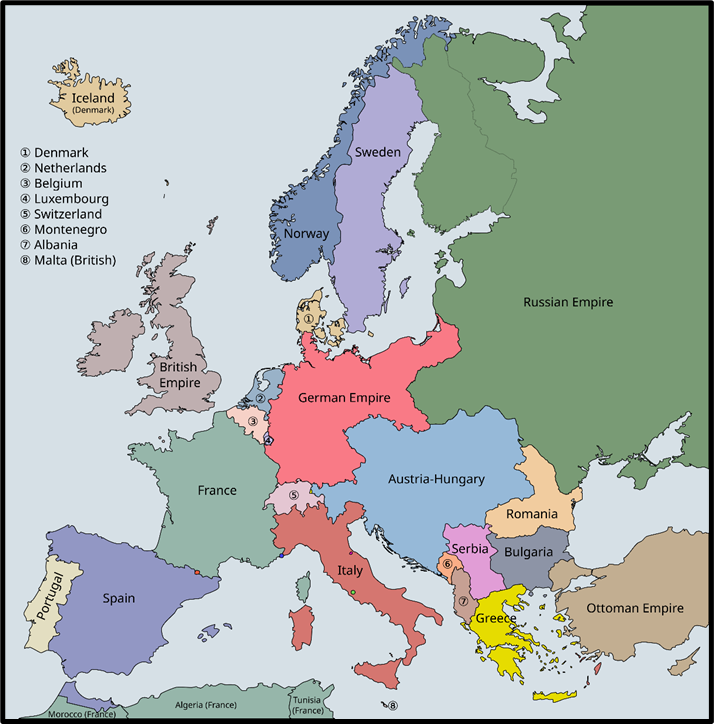
In 1914, Europe dominated global decision-making. Major political, economic, and strategic decisions were concentrated in European capitals.
Germany had emerged as the leading continental power, especially in industrial output—surpassing Britain in steel and pig iron production. Meanwhile, Britain remained strong, particularly in coal and naval supremacy. France, Austria-Hungary, and Italy lagged behind, while Russia, though industrializing, was still catching up.
However, outside Europe, significant shifts were underway:
- The United States had become an industrial giant.
- Japan, after defeating Russia (1904–05), had asserted itself as a rising Asian power
This phase reflects the emergence of a multipolar world, where power was no longer exclusively European—hinting at future global shifts.
Diversity in Political Systems
Democratic vs Autocratic Systems
The political systems of major powers varied significantly:
- Democratic States: Britain, France, and the USA had representative governments with elected parliaments.
- Semi-democratic States: Germany and Japan had parliaments, but real power rested with monarchs or elites.
- Autocratic Empires: Russia and Austria–Hungary were ruled by emperors with near-absolute authority.
This diversity created ideological tensions. Democracies emphasized accountability and public opinion, whereas autocracies relied on centralized authority. This mismatch often complicated diplomacy.
Some historians argue that the presence of autocratic regimes increased the likelihood of war because decision-making was concentrated in a few hands, reducing institutional checks.
Imperialism: Expansion and Competition
The Scramble for Colonies
From 1880 onwards, European powers aggressively expanded overseas, especially in Africa—an event famously termed the “Scramble for Africa.”
The motivations were → Access to raw materials, New markets, Strategic dominance
Simultaneously, China became a site of foreign intervention, with multiple powers extracting economic concessions. This weakened the Qing (Manchu) dynasty, culminating in its overthrow in 1911.
Marxist Interpretation:
Imperialism is seen as the highest stage of capitalism (Lenin). The competition for colonies was essentially a struggle for economic dominance among capitalist powers, inevitably leading to conflict.
The Alliance System: Europe Divided into Armed Camps
Formation of Two Rival Blocs
By 1914, Europe had split into two major alliance systems:
- Triple Alliance: Germany, Austria–Hungary, Italy
- Triple Entente: Britain, France, Russia
Additionally, Britain had an alliance with Japan.
Analytical Insight:
These alliances were meant to maintain balance of power, but instead they created a “chain reaction mechanism”—a local conflict could escalate into a global war.
Causes of Friction: The Underlying Tensions
The peace in Europe was fragile, sustained more by fear than cooperation. Several deep-rooted tensions existed:
Militarism and Naval Rivalry
Britain and Germany were engaged in an intense naval arms race, symbolizing broader military competition.
Legacy of Past Conflicts
France harbored resentment over the loss of Alsace-Lorraine to Germany in 1871, keeping the desire for revenge alive.
German Weltpolitik and Encirclement Fear
Germany pursued an aggressive foreign policy called Weltpolitik, aiming for global influence. However, it felt “encircled” by the alliance of Britain, France, and Russia.
Balkan Tensions: The Most Explosive Factor
The Balkans were the “powder keg of Europe.”
- Serbia aimed to create a Greater Serbia by uniting Slavic peoples.
- Austria–Hungary feared this would disintegrate its multi-ethnic empire.
- Russia supported Serbia due to shared Slavic identity.
The situation escalated after a political shift in Serbia (1903), when a pro-Russian regime replaced a pro-Austrian one.
Critical Insight: This was not just a regional conflict—it involved:
- Nationalism (Serbia)
- Imperial survival (Austria–Hungary)
- Great power rivalry (Russia vs Austria)
The Structural Crisis of Europe
A System on the Brink
All these factors—imperialism, nationalism, alliances, militarism—created a highly unstable system. Europe had already come close to war multiple times before 1914.
The continent resembled a tightly wound spring, where even a minor trigger could unleash massive destruction.
Conclusion: Towards the Inevitable War
The outbreak of war in July 1914 was not an isolated incident but the culmination of long-term structural tensions.
Final Analytical Reflection:
From a broader perspective, the First World War represents the failure of 19th-century diplomacy in managing 20th-century realities. It marked the end of the old European order and the beginning of a more violent, uncertain global era.
One Comment