
Events Leading to the Outbreak of the First World War in 1914
To understand the outbreak of the First World War, one must move beyond the simplistic idea of a single “cause” and instead see a chain of interconnected crises, alliances, and strategic miscalculations unfolding over decades. The period from the late 19th century to 1914 witnessed the gradual transformation of Europe into two hostile military blocs, where even a small spark could trigger a continental explosion.
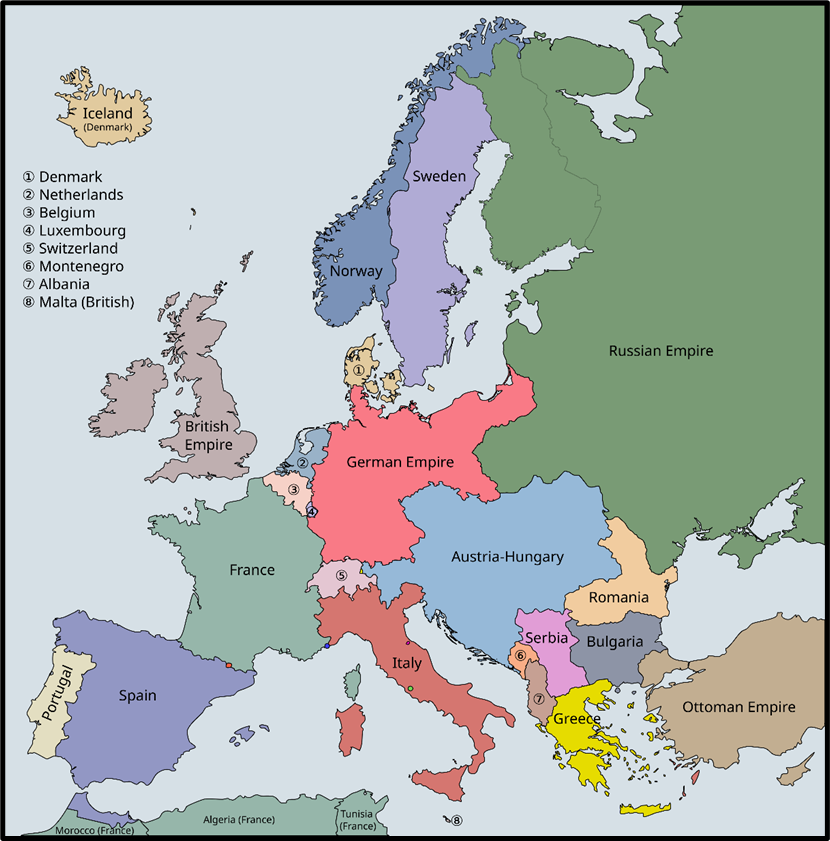
Formation of Rival Power Blocs
The late 19th century saw the crystallization of two opposing alliance systems:
- Triple Alliance (1882): Germany, Austria–Hungary, Italy
- Triple Entente (1907): Britain, France, Russia
Please imprint the following map in your mind—it will serve as a powerful tool for sharper analysis and long-term memorization.
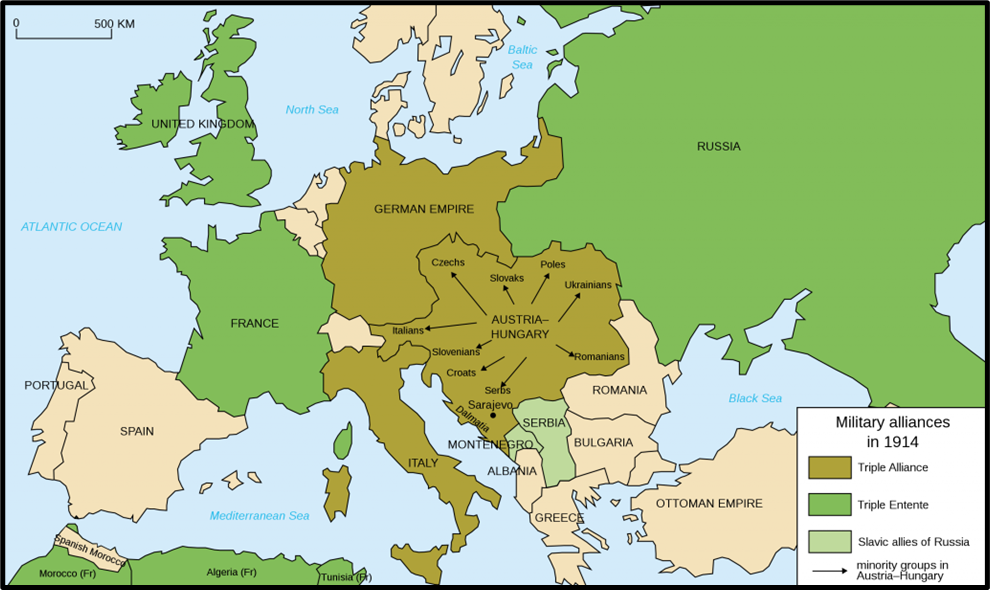
This division did not initially imply war, but it created a rigid diplomatic structure. Any local conflict now had the potential to escalate into a global one due to alliance obligations.
Simultaneously, militarism intensified—Germany’s naval expansion under Tirpitz and Britain’s launch of the Dreadnought battleship triggered a naval arms race, reflecting deeper insecurities and ambitions.
Critical Insight: Historians often describe this phase as the emergence of a “security dilemma”—where defensive measures by one state were perceived as threats by others, leading to escalating tensions.
The Moroccan Crisis (1905–06)
See, Germany had a policy of Weltpolitik under which it aimed for aggressive global expansion to gain colonies, build a strong navy, and establish itself as a dominant world power.
So, under this policy it, sought to expand its global influence and challenge French ambitions in Morocco. It also aimed to test the strength of the recently formed Anglo-French Entente (1904) and what was that?
- The Anglo-French Entente (1904) was a diplomatic agreement in which Britain and France settled colonial disputes (especially over Egypt and Morocco) and improved relations, ending long-standing rivalry without forming a formal military alliance.
Key Developments
Germany supported Moroccan independence and demanded an international conference at Algeciras (1906). Unexpectedly, Britain, Russia, Italy, and Spain backed France.
Consequences
Germany suffered a diplomatic defeat, realizing that Britain and France were more united than anticipated. This crisis strengthened the Entente and initiated Anglo-French military cooperation.
This marked a turning point where Germany began to feel diplomatically “encircled”, a perception that later shaped its aggressive strategies.
Anglo-Russian Agreement (1907)
Historically, Britain and Russia were rivals, especially in Central Asia (the “Great Game”). However, changing geopolitical realities—Russia’s defeat in the Russo-Japanese War (1904–05) and internal instability—altered priorities.
Key Developments
Britain and Russia settled disputes in Persia, Afghanistan, and Tibet, completing the Triple Entente.
Consequences
Though not a military alliance, Germany interpreted it as a deliberate attempt at encirclement.
Critical Insight:
This reflects how perception in international politics can be as important as reality. Even non-hostile agreements can be viewed as threats.
The Bosnia Crisis (1908): Rise of Balkan Nationalism
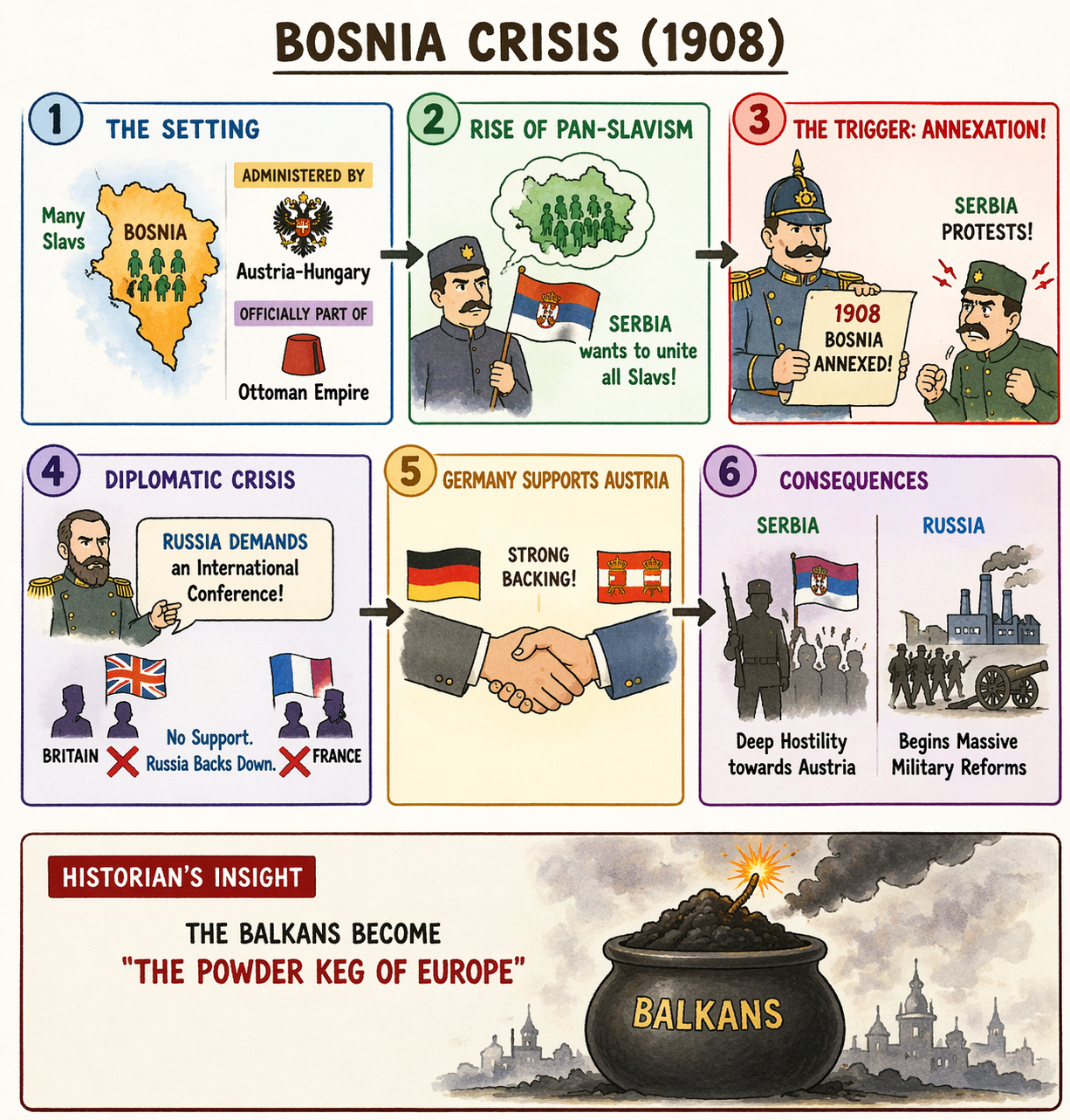
Bosnia, populated by many Slavs, was administered by Austria–Hungary but officially belonged to the Ottoman Empire. Serbia aspired to unite Slavic populations under its leadership (Pan-Slavism).
Key Developments
Austria annexed Bosnia in 1908, provoking Serbia. Russia, Serbia’s ally, demanded a conference but backed down due to lack of support from Britain and France. Germany strongly supported Austria.
Consequences
Serbia became deeply hostile to Austria, while Russia began massive military reforms to avoid future humiliation.
Historiographical Insight:
Many historians view this crisis as the moment when the Balkans became the “powder keg of Europe”—ready to explode.
The Agadir Crisis (1911): Escalation of Imperial Rivalries
France moved closer to controlling Morocco, prompting Germany to intervene again.
Key Developments
Germany sent the gunboat Panther to Agadir, attempting to force concessions. Britain strongly backed France, warning Germany against aggression.
Consequences
Germany accepted limited compensation in the Congo, but public opinion turned sharply anti-British. The naval arms race intensified, with Britain maintaining superiority in Dreadnoughts.
This crisis deepened mutual suspicion and nationalism, especially in Germany, where resentment against Britain intensified.
The Balkan Wars (1912–13): Regional Conflict with Global Implications
First Balkan War (1912)
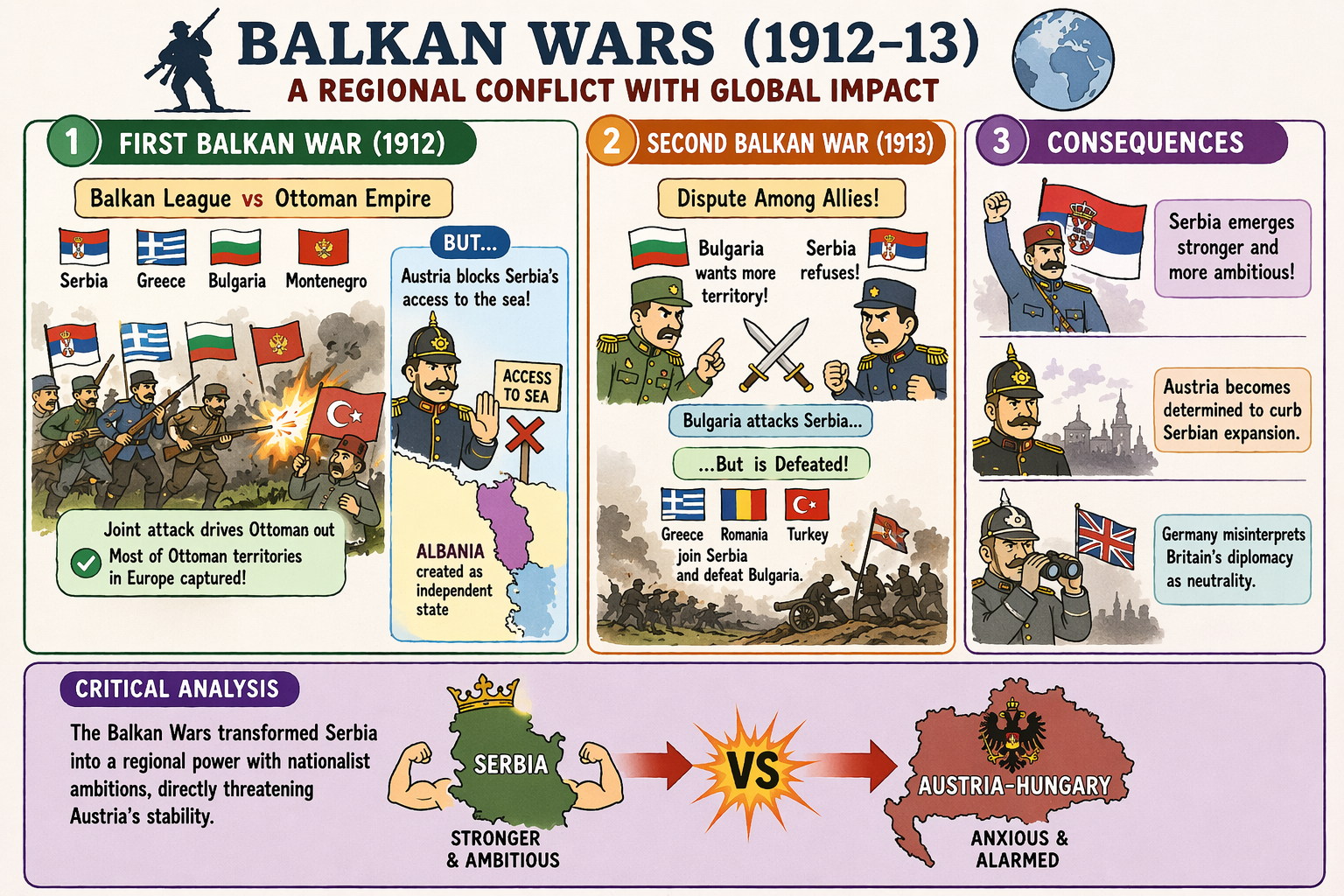
The Balkan League (Serbia, Greece, Bulgaria, Montenegro) attacked the weakening Ottoman Empire and captured most of its European territories.
However, Austria blocked Serbia’s access to the sea by creating an independent Albania, increasing tensions.
Second Balkan War (1913)
Dissatisfied with territorial distribution, Bulgaria attacked Serbia but was defeated by a coalition including Greece, Romania, and Turkey.
Consequences of Balkan Wars
- Serbia emerged stronger and more ambitious
- Austria became determined to curb Serbian expansion
- Germany misinterpreted Britain’s diplomacy as neutrality
Critical Analysis:
The Balkan Wars transformed Serbia into a regional power with nationalist ambitions, directly threatening Austria’s stability.
The Sarajevo Assassination (28 June 1914): The Immediate Cause
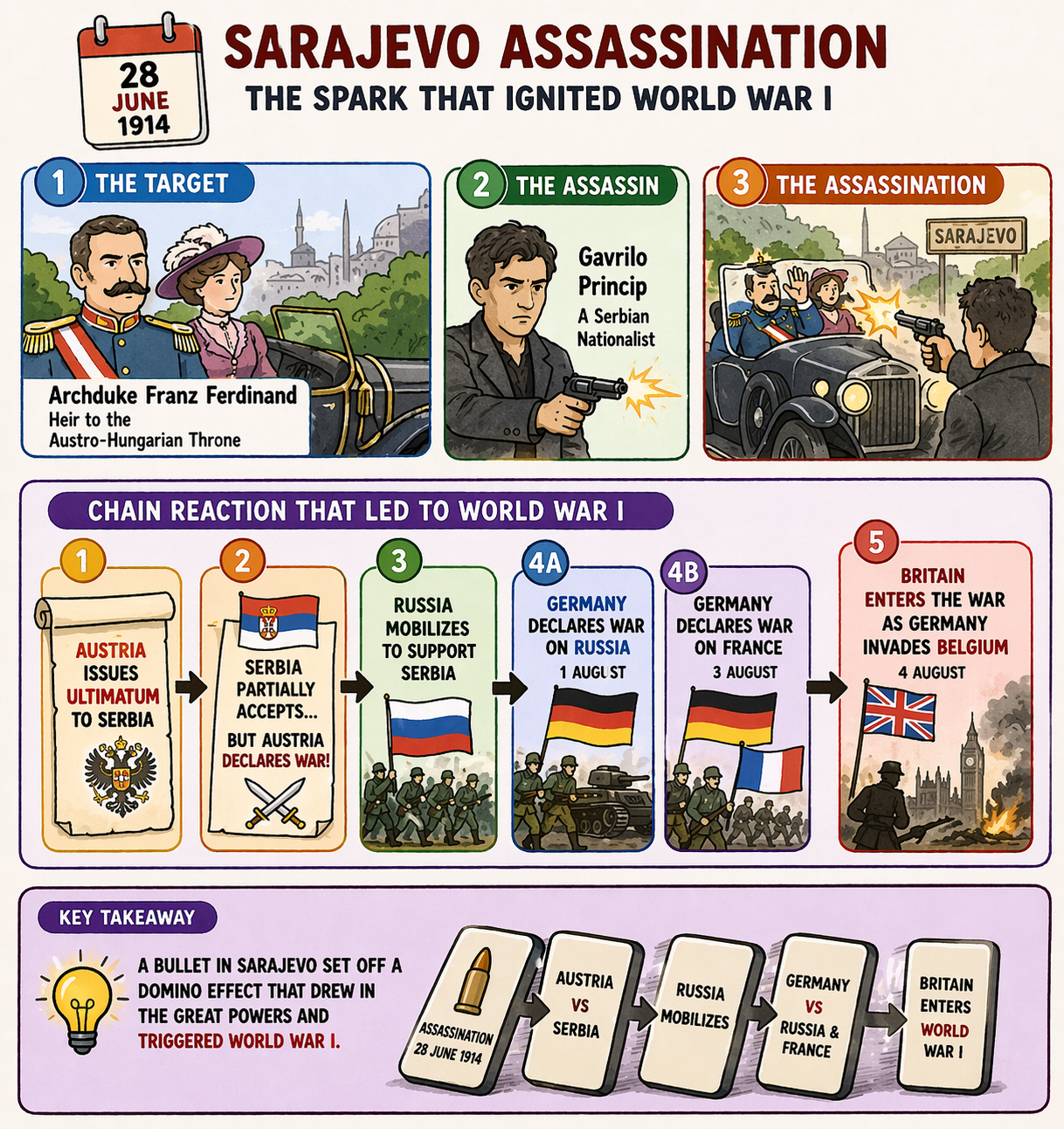
Archduke Franz Ferdinand, heir to the Austro-Hungarian throne, was assassinated in Sarajevo by Gavrilo Princip, a Serbian nationalist.
Chain Reaction
- Austria issued an ultimatum to Serbia
- Serbia partially accepted, but Austria declared war (28 July)
- Russia mobilized to support Serbia
- Germany declared war on Russia (1 August) and France (3 August)
- Britain entered after Germany invaded Belgium (4 August)
From Crisis to Catastrophe: Why War Became Inevitable
1. Alliance System and Chain Reaction
The rigid alliance system transformed a localized Balkan conflict into a world war.
2. Militarism and Mobilization Plans
Countries had detailed war plans (e.g., Germany’s Schlieffen Plan), making mobilization equivalent to declaring war.
3. Nationalism
Particularly in the Balkans, nationalism created explosive tensions—Serbian ambitions vs Austro-Hungarian authority.
4. Imperial Rivalries
Conflicts in Morocco and Africa reflected deeper competition for global dominance.
5. Miscalculation and Overconfidence
Leaders believed war would be short and decisive—an assumption that proved disastrously wrong.
Concluding Perspective: A War Waiting to Happen
The First World War was not caused by a single event but by a convergence of long-term structural tensions and short-term triggers. The Sarajevo assassination acted merely as the spark in an already volatile environment.
Modern historians often debate whether the war was inevitable or accidental. While structural factors made conflict highly likely, the decisions of political leaders in July 1914—often driven by fear, honor, and miscalculation—turned possibility into reality.