
International Relations from1919-1933 Explained
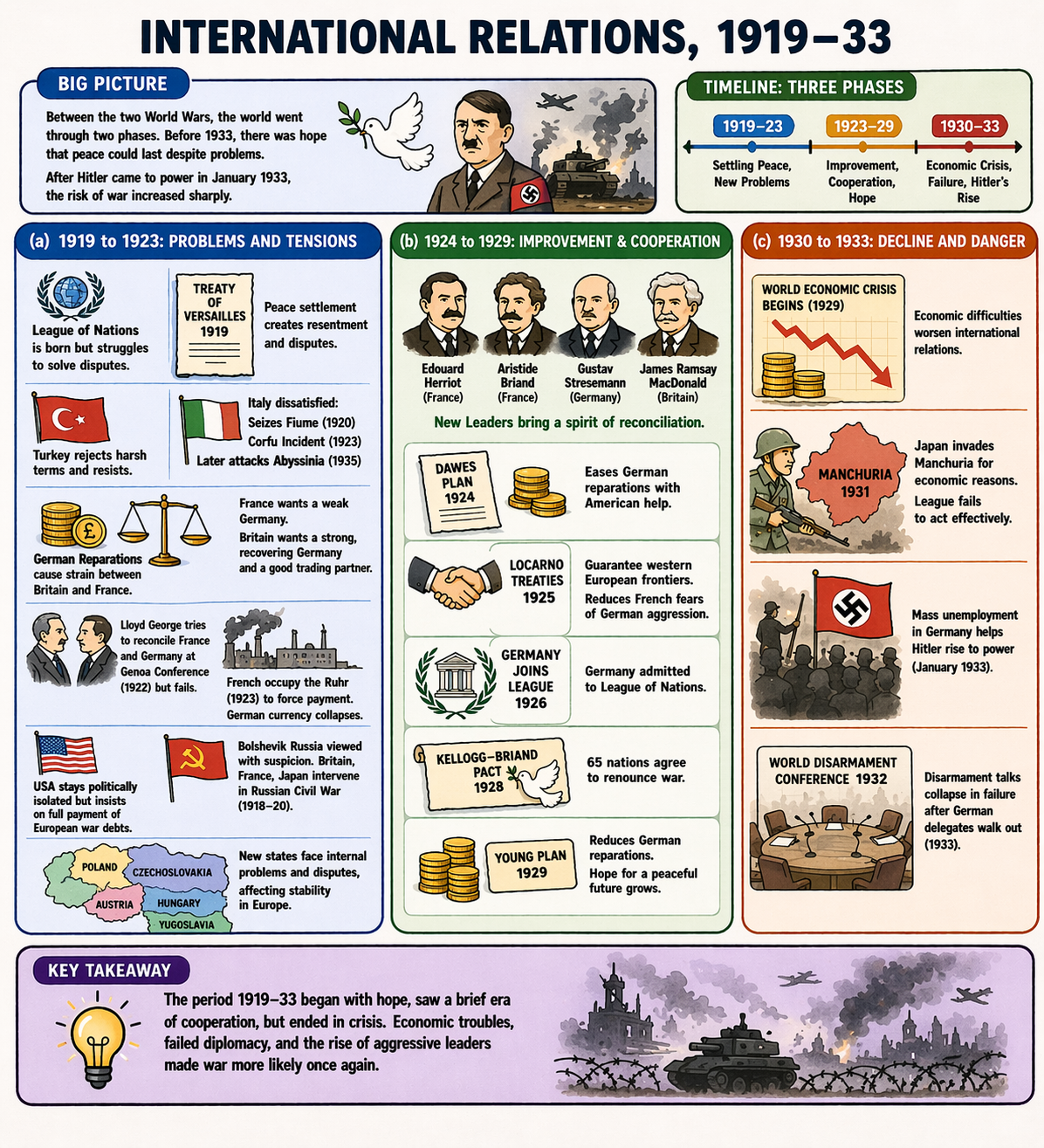
Attempts to Improve International Relations
The Broader Context: Hope Amid Fragility
The period after the First World War was marked by a deep desire to avoid another catastrophic conflict, yet this aspiration coexisted with unresolved tensions—harsh peace settlements, economic instability, and mutual distrust.
Thus, the years between 1919 and 1933 can be understood as a phase of experimental diplomacy, where multiple initiatives were undertaken to stabilize international relations. However, these efforts often suffered from structural weaknesses, lack of enforcement, and overdependence on economic prosperity.
The League of Nations: Idealism Without Power
The League of Nations represented the most ambitious attempt to institutionalize peace.
Role and Achievements
It successfully resolved several minor disputes and created a platform for international dialogue. This gave an impression that collective security could work.
Structural Weaknesses
However, its authority remained limited because:
- Major powers often bypassed it through independent agreements.
- Member states were unwilling to commit military force against aggressors.
Critical Insight
The League’s failure was not just institutional—it reflected the lack of political will among sovereign states. Peace required sacrifice, but nations prioritized national interest over collective security.
The Washington Conferences (1921–22): Managing Power in the Far East
Rising tensions between the USA and Japan over influence in East Asia, particularly China, threatened stability.
Key Agreements
- Naval limitation: Japan’s navy fixed at 3/5th of US and British strength.
- Japan withdrew from Shantung (China) but retained Pacific islands.
- Agreement to respect China’s neutrality and sovereignty.
Immediate Impact
These agreements temporarily improved relations and prevented a naval arms race.
Deeper Reality
Despite appearing balanced:
- Japan retained regional dominance in the Pacific.
- Western powers’ commitments were strategically weak.
Long-Term Consequence
This imbalance became evident in the 1930s when Japan expanded aggressively in China, and the USA remained largely inactive.
The Genoa Conference (1922): A Failed Attempt at European Reconciliation
Vision of David Lloyd George
The conference aimed to resolve:
- Franco-German hostility
- War debts
- Relations with Soviet Russia
Why It Failed
- France insisted on full reparations.
- USA refused to participate.
- Germany and Soviet Russia signed the Treaty of Rapallo, bypassing the conference.
Consequence
The failure directly contributed to:
- French occupation of the Ruhr (1923)
- Escalation of economic and political tensions
Analytical Note: This episode highlights how national rigidity undermined multilateral diplomacy.
The Dawes Plan (1924): Economic Stabilization as Political Strategy
Key Actors → Gustav Stresemann, Ramsay MacDonald, Édouard Herriot
Core Features
- Flexible reparations based on Germany’s capacity
- US loans (800 million gold marks) to revive German economy
- French withdrawal from Ruhr
Impact
- German economic recovery
- Reduction in tensions
- Beginning of the “Locarno phase” of reconciliation
Critical Insight
The plan worked because it linked economic recovery with political stability. However, it also made Europe dependent on American capital, which later proved disastrous.
The Locarno Treaties (1925): The Illusion of Lasting Peace
Core Agreements
- Germany, France, and Belgium guaranteed western borders
- Britain and Italy acted as guarantors
- Arbitration treaties with Poland and Czechoslovakia (but no guarantees)
Key Personalities → Gustav Stresemann, Aristide Briand, Austen Chamberlain
Immediate Impact
- “Locarno honeymoon”: optimism and reconciliation
- Germany admitted to the League (1926)
- Withdrawal of French troops from Rhineland
Critical Weakness
The treaties ignored Eastern Europe:
- No guarantees for Poland and Czechoslovakia
- Implicit signal that Western powers may not intervene in the East
Historiographical Perspective
Later historians argue that Locarno created a false sense of security, masking unresolved tensions.
The Kellogg–Briand Pact (1928): Moral Idealism Without Enforcement
Concept → Proposed by Aristide Briand and expanded by Frank B. Kellogg.
Key Idea → 65 nations agreed to renounce war as a tool of national policy.
Fundamental Flaw
- No enforcement mechanism
- No sanctions against violators
Outcome → It became symbolic rather than practical—Japan signed it but invaded China in 1931.
Analytical Insight → This reflects a recurring pattern: idealistic commitments without institutional backing.
The Young Plan (1929): A Missed Opportunity
Features
- Reduced reparations from £6600 million to £2000 million
- Long-term payment schedule (59 years)
Significance
- Acknowledged earlier harshness of Versailles
- Reflected improved diplomatic atmosphere
Opposition
- Strongly criticized by the Nazi Party
Turning Point
Before implementation:
- Death of Gustav Stresemann
- The Wall Street Crash (1929) triggered the Great Depression
Consequence → Economic collapse revived extremism and nationalism, undoing diplomatic progress.
The World Disarmament Conference (1932–33)
Objective → To reduce global armaments under League supervision.
Problems
- Britain wanted arms for empire defense
- France feared German resurgence
- Germany demanded equality
Outcome
- Adolf Hitler withdrew Germany (1933)
- Germany also exited the League
Significance → This marked the end of cooperative diplomacy and the beginning of open confrontation.
Overall Evaluation: Limited Success, Structural Failure
Why These Efforts Initially Worked
- Economic prosperity (1924–1929)
- Leadership of moderate statesmen
- Temporary willingness to compromise
Why They Ultimately Failed
- Dependence on Economic Stability → The Great Depression destroyed cooperation.
- Lack of Enforcement Mechanisms → Agreements were often voluntary and unenforceable.
- Selective Security → Western Europe was prioritized; Eastern Europe neglected.
- Rise of Authoritarian Regimes → New leaders rejected diplomacy in favour of aggression.
France and the ‘German Problem’
The end of the First World War did not bring peace of mind to France—it brought anxiety. Having suffered two devastating invasions by Germany within half a century (1870–71 and 1914–18), France’s central foreign policy objective in the interwar period was simple yet urgent: prevent Germany from ever becoming a threat again.
However, the path to achieving this goal was anything but straightforward. Between 1919 and 1933, France experimented with three distinct strategies—coercion, collective security, and reconciliation. Each appeared promising at first, yet ultimately, all failed.
Let us understand this evolution:
The Context: Why Was France Obsessed with Germany?
France’s fear was not irrational—it was rooted in lived experience. The devastation of northern France, the human losses, and the humiliation of earlier defeat in the Franco-Prussian War created a deep-seated insecurity.
Thus, French policy was driven less by idealism and more by strategic realism. Germany was larger, economically stronger, and potentially capable of rapid recovery. If left unchecked, it could once again dominate Europe.
Strategy One: Keeping Germany Weak
1. The Harsh Peace Settlement (1919)
At the Paris Peace Conference, France—under Georges Clemenceau—pushed for stringent terms to permanently weaken Germany.
Key provisions included:
- Limiting the German army to 100,000 troops
- Severe restrictions on armaments
- Demilitarization of the Rhineland
- French control over the Saar for 15 years
Although these measures seemed to guarantee security, they rested heavily on Anglo-American support. When the United States withdrew into isolationism and United Kingdom followed suit, France was left exposed.
Critical Insight: The Treaty of Versailles created a security paradox—it weakened Germany temporarily but also generated resentment, making long-term stability fragile.
Reparations: Economic Weakening of Germany
France insisted on massive reparations (£6600 million in 1921), believing that:
- A financially crippled Germany could not rearm
- French reconstruction could be funded
However, this policy had unintended consequences:
- Germany’s economic collapse destabilized Europe
- It fostered bitterness and nationalist anger within Germany
The Ruhr Occupation (1923): Coercion Peaks
When Germany defaulted on payments, Raymond Poincaré adopted a hardline approach by occupying the Ruhr—Germany’s industrial heartland.
Germany responded with → Passive resistance, Strikes and sabotage
The outcome was disastrous:
- Hyperinflation destroyed the German economy
- French gains were minimal
- Britain opposed the action, widening diplomatic rifts
Critical Analysis:
This episode exposed a key division:
- France preferred coercion and containment
- Britain preferred economic recovery and reconciliation
This divergence weakened the Allied front and indirectly helped Germany regain sympathy.
Strategy Two: Alliances and Collective Security
1. The ‘Little Entente’
France attempted to encircle Germany through alliances with → Poland (1921), Czechoslovakia (1924), Romania (1926), Yugoslavia (1927)
While impressive on paper, these alliances suffered from a structural flaw → the allies themselves were weak and divided.
Moreover, France lost a potentially strong ally—Russia—after the Bolshevik Revolution.
2. Faith in the League of Nations
France supported a strong League of Nations, ideally backed by military enforcement.
However:
- The League lacked real power
- Britain opposed stronger enforcement mechanisms like the Geneva Protocol
Result: France realized that collective security without enforcement was essentially symbolic, not practical.
Strategy Three: Reconciliation and Cooperation
1. Shift After 1924: From Force to Diplomacy
After the Ruhr failure, France—under leaders like Herriot and especially Aristide Briand—adopted a conciliatory approach. At the same time, Germany—under Gustav Stresemann—also pursued cooperation.
This convergence led to significant diplomatic achievements:
- Locarno Treaties (1925)
- Kellogg–Briand Pact (1928)
- Dawes and Young Plans (reparations restructuring)
2. Was Reconciliation Genuine? A Historiographical Debate
Historian A. J. P. Taylor offers a nuanced view:
- Briand and Stresemann were sincere
- But their domestic populations were not ready for compromise
Moreover, Stresemann had hidden objectives:
- Revision of the Polish border
- Union with Austria
- Revision of Versailles terms
Interpretation: Reconciliation was more tactical than transformative—a pause, not a permanent solution.
The Breakdown: Return to Tension (1929–1933)
Several developments shattered the fragile peace:
- Death of Stresemann (1929): Removed a key architect of cooperation.
- The Great Depression: Economic crisis radicalized German politics and strengthened extremist forces.
- Rise of Nazism: The growing influence of Adolf Hitler alarmed France.
- Collapse of Cooperation
→ France opposed the Austro-German customs union (1931)
→ Disputes at the World Disarmament Conference (1932–33)
→ Germany withdrew from the League and the Conference
Result: All diplomatic progress of the 1920s was undone. The German problem remained unresolved.
Conclusion: Why Did France Fail?
France’s failure was not due to lack of effort, but due to structural and strategic limitations:
- Over-reliance on External Guarantees → Without US and British support, French security strategy weakened.
- Contradictory Approaches → Coercion created resentment, Reconciliation lacked trust
- Weak International Institutions → The League of Nations lacked enforcement capability.
- Underestimation of German Nationalism → French policymakers failed to fully grasp how deeply Versailles had wounded German pride.
Final Analytical Insight
France’s interwar policy reflects a broader dilemma in international relations: Can security be achieved through punishment, cooperation, or deterrence?
France tried all three—but without consistent support, institutional backing, or mutual trust, none proved sustainable.
By 1933, with Hitler in power, the “German problem” had not been solved—it had merely entered a far more dangerous phase.
USSR’s Relations with Britain, Germany, and France
Context: From Revolutionary Isolation to Pragmatic Engagement
The emergence of the Bolshevik regime after the Russian Revolution (1917) fundamentally disrupted the existing international order. The new Soviet leadership, under Lenin, was ideologically committed to world revolution, which immediately placed it in conflict with capitalist powers.
Between 1917 and 1920, relations deteriorated sharply. Western powers—including Britain, France, the USA, and Japan—not only refused to recognize the Bolshevik regime but also intervened militarily in the Russian Civil War in support of anti-communist forces (the Whites). Simultaneously, Soviet attempts to spread revolution through the Comintern (1919) intensified Western fears.
However, by the early 1920s, a shift occurred. The failure of revolutions in Europe, combined with Soviet economic exhaustion, compelled Lenin to adopt a more pragmatic approach—peaceful coexistence and trade with capitalist states. This marked the beginning of a complex and often unstable diplomatic phase.
USSR and Britain: Ideology versus Pragmatism
Early Rapprochement (1921–1922)
The first significant breakthrough came with the Anglo-Russian Trade Agreement (1921). This reflected a mutual need: Britain sought economic opportunities, while the USSR needed trade and recognition.
Yet, underlying tensions remained. At the Genoa Conference (1922), Britain’s demand that the Soviets repay Tsarist debts triggered Soviet resentment, pushing them toward closer ties with Germany (Treaty of Rapallo).
Fluctuating Relations: The Role of British Domestic Politics
A key feature of Anglo-Soviet relations was their instability, largely determined by the party in power in Britain:
- Labour Governments (1924, 1929–31): More sympathetic to the USSR, leading to diplomatic recognition (1924) and renewed trade agreements.
- Conservative Governments (1924–29, 1931 onwards): Deeply suspicious of communism, viewing it as a threat to empire and domestic stability.
This ideological divide manifested in several crises:
- The Arcos Raid (1927) exposed alleged Soviet espionage, leading to a break in diplomatic relations.
- British concerns about Soviet support for anti-colonial movements, particularly in India, intensified hostility.
Final Phase: Strategic Reconsideration (Early 1930s)
By the early 1930s, tensions persisted, but a subtle shift emerged. With the rise of Nazi Germany, Stalin began to see Britain less as an ideological enemy and more as a potential strategic partner.
Thus, despite conflicts like the Metropolitan-Vickers trial (1933), both sides showed signs of cautious re-engagement.
USSR and Germany: From Isolation to Strategic Partnership
Shared Marginalization and Mutual Benefit
Unlike Britain, Soviet relations with Germany were relatively stable and cooperative. This was rooted in a shared international position:
- Both were “outcast” states after World War I.
- Both sought to revise the post-war settlement.
The Treaty of Rapallo (1922): A Turning Point
The Treaty of Rapallo marked a major diplomatic breakthrough:
- Mutual recognition and cancellation of financial claims.
- Strategic cooperation against common adversaries (notably Poland).
- Secret military collaboration:
- Germany trained troops and developed weapons in Soviet territory, bypassing Treaty of Versailles restrictions.
- The USSR gained access to German technical expertise.
This relationship was not ideological but purely pragmatic, reflecting realpolitik at its finest.
Continuation and Consolidation: Treaty of Berlin (1926)
The partnership was reinforced through the Treaty of Berlin, which ensured neutrality in case either state was attacked and prevented economic sanctions between them.
This demonstrated a rare example of stable interwar diplomacy, driven by mutual strategic interests.
Decline of Relations (1930–1933)
By the early 1930s, this cooperation began to weaken due to:
- Rising German nationalism.
- The growing strength of the Nazi Party, which was explicitly anti-communist.
- Germany’s attempts at expansion (e.g., proposed customs union with Austria).
The final break came when Hitler, after coming to power in 1933, shifted Germany’s policy, ending the special relationship and signing a pact with Poland.
USSR and France: From Hostility to Hesitant Engagement
Deep Ideological Hostility (1917–early 1920s)
France’s reaction to the Bolshevik Revolution was particularly hostile due to:
- The loss of Russia as a key ally against Germany.
- Fear of communist revolution spreading into Europe.
France actively:
- Intervened in the Russian Civil War.
- Supported Poland against Soviet expansion (1920).
- Ensured Soviet exclusion from the Versailles Conference.
The Franco-Polish alliance (1921) further underscored France’s anti-Soviet stance.
Limited Normalization (1924 onwards)
Diplomatic relations were restored in 1924 under a more moderate French government. However, relations remained lukewarm due to:
- Continued ideological mistrust.
- Soviet interference in French politics via the Communist Party (controlled by Moscow).
Shift in the Early 1930s: The German Factor
The rise of Nazi Germany gradually altered French perceptions. The USSR was no longer seen purely as a threat but as a potential counterweight to Germany.
This marked the beginning of a strategic reorientation, though full cooperation would only emerge later in the 1930s.
Comparative Analysis: Patterns and Contrasts
Ideology vs Realpolitik
A key theme across all three relationships is the tension between ideology and pragmatism:
- With Britain and France, ideology (anti-communism) often dominated, leading to unstable relations.
- With Germany, pragmatic considerations prevailed, enabling sustained cooperation despite ideological differences.
Impact of Domestic Politics
- British policy fluctuated with party changes.
- French policy was shaped by security concerns and fear of revolution.
- Soviet policy evolved from revolutionary zeal to pragmatic diplomacy under Lenin and later Stalin.
The Role of Germany as a Catalyst
Germany’s position was central:
- Initially, it served as a bridge for Soviet engagement with Europe (Rapallo).
- Later, under Hitler, it became the primary threat, forcing the USSR to reconsider its foreign policy and seek rapprochement with Western powers.
Consequences and Historical Significance
By 1933, Soviet foreign relations had undergone a transformation:
- From revolutionary isolation → to conditional integration into international diplomacy.
- From ideological confrontation → to strategic balancing.
However, the inability of major powers to form a stable and unified front—due to mistrust and conflicting interests—contributed to the fragility of interwar peace.
This ultimately set the stage for the diplomatic realignments of the late 1930s and the eventual outbreak of the Second World War.
Historiographical Insight
Historians often interpret Soviet foreign policy in two contrasting ways:
- Traditional View: Emphasizes ideological aggression and Soviet attempts to destabilize capitalist states.
- Revisionist View: Highlights Soviet insecurity and argues that its policies were largely defensive, aimed at survival in a hostile international environment.
In reality, Soviet diplomacy during this period reflects a dynamic interplay of ideology, security concerns, and pragmatic adaptation.
Final Insight
If we step back, a deeper pattern emerges: The USSR was not merely reacting to the international system—it was also reshaping it. But the lack of trust between ideological camps prevented the emergence of a stable order, making the interwar period inherently unstable.
The emergence of the ‘Successor States’
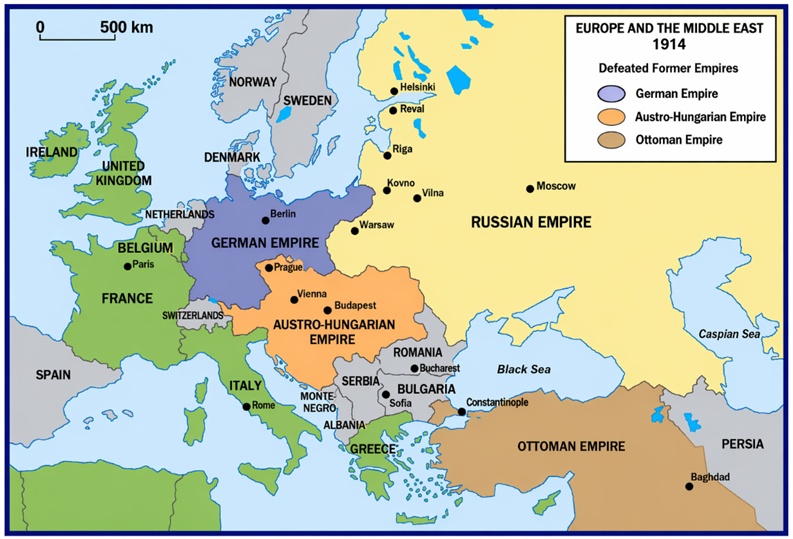
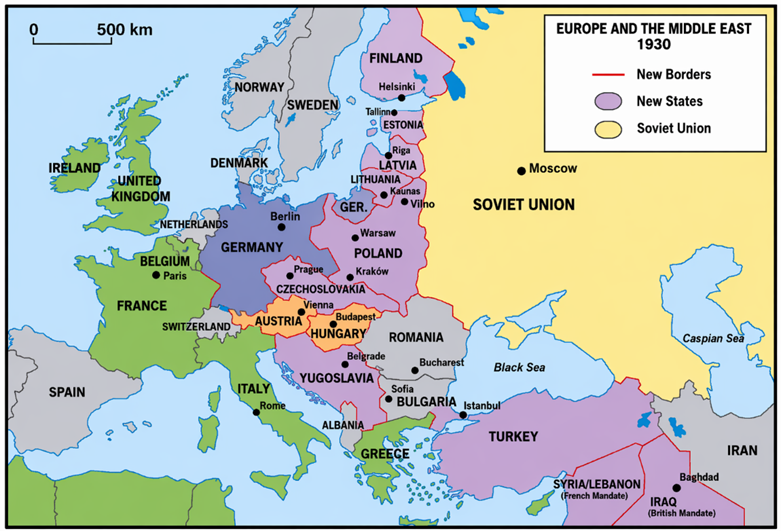
The end of the First World War did not merely redraw boundaries—it fundamentally restructured the political geography of Europe. Empires that had dominated for centuries—especially the Austro-Hungarian Empire—collapsed under the combined pressures of war, nationalism, and internal decay. In their place emerged a set of new nation-states, often referred to as the ‘successor states’ because they inherited the territories of these fallen empires.
These included Yugoslavia, Czechoslovakia, Austria, Hungary, and Poland—each representing an attempt to reorganize Europe along the principles of self-determination and democracy. At least in theory, these states were expected to act as a buffer zone against communist expansion from Russia and a stabilizing force in a volatile region.
However, this experiment was deeply flawed from the beginning. The ideals that inspired their creation soon collided with harsh geopolitical realities.

Structural Weaknesses
The Illusion of Self-Determination
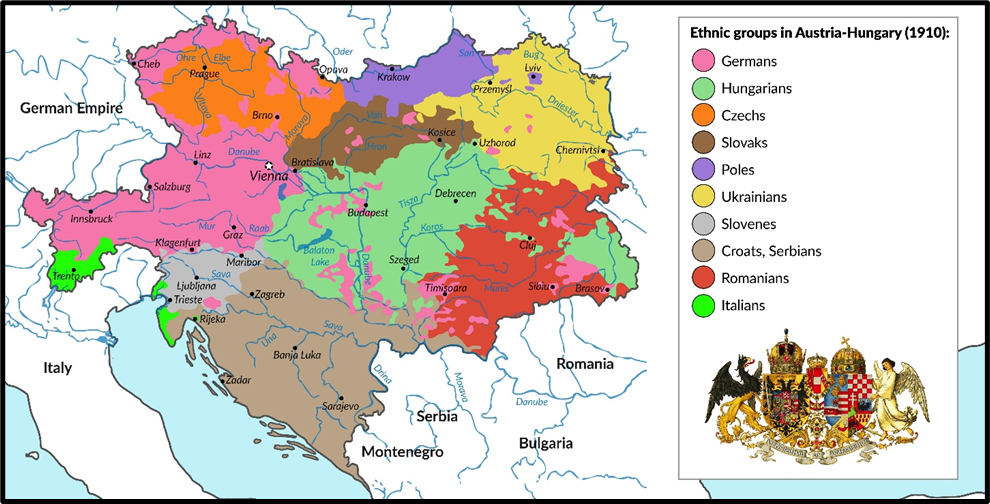
The principle of self-determination, strongly advocated by Woodrow Wilson, assumed that each nationality would form its own state. But eastern Europe was a mosaic of ethnic groups, intermingled across regions. It was practically impossible to draw borders that satisfied everyone.
As a result, new minorities replaced old ones. For example, Germans in Czechoslovakia, Croats in Yugoslavia, and Ukrainians in Poland all found themselves under governments they perceived as alien. This created a persistent sense of grievance and political instability.
Democratic Beginnings, Authoritarian Outcomes
Although most of these states began with democratic constitutions, democracy struggled to survive. Only Czechoslovakia managed to sustain a functioning liberal democracy for a significant period. Elsewhere, weak institutions, political fragmentation, and elite dominance led to authoritarian regimes.
This reveals a critical insight: democracy cannot thrive merely through constitutional design; it requires social cohesion and political culture, both of which were lacking.
Economic Fragility and the Great Depression
The early optimism of the 1920s was shattered by the Great Depression. These economies, heavily dependent on agriculture or limited industrial bases, were particularly vulnerable. Falling prices, unemployment, and declining trade intensified internal discontent.
Territorial Rivalries and Revisionism
The successor states were not united; they were divided by mutual suspicion and competing claims. Countries like Austria and Hungary resented the post-war settlements and sought revision, while others like Poland and Czechoslovakia aimed to preserve them. This created a deeply fractured regional order.
Case Studies: The Major Successor States
Yugoslavia: Unity in Name, Division in Reality
Formation and Ethnic Tensions
Yugoslavia emerged as a union of Serbia, Montenegro, Croatia, Slovenia, and other regions, initially called the Kingdom of the Serbs, Croats and Slovenes. However, this “unity” masked deep divisions. The Serbs, being the largest group, dominated politics, leading to resentment among Croats and others.
The Croats, feeling marginalized, increasingly demanded autonomy. By 1928, tensions escalated to the point where they withdrew from parliament and contemplated forming a separate state.
Drift Towards Dictatorship
In response to growing instability, Alexander I of Yugoslavia established a royal dictatorship in 1929, banning political parties. This marks a classic pattern: ethnic conflict → political paralysis → authoritarian intervention.
Economic Crisis and Political Violence
The Great Depression devastated Yugoslavia’s agrarian economy, intensifying social unrest. The assassination of King Alexander in 1934—linked to nationalist and separatist elements—highlighted the depth of internal divisions.
Foreign Policy and Strategic Vulnerability
Yugoslavia initially aligned with the Little Entente (with Czechoslovakia and Romania) to counter Hungary. However, rising threats from Fascist Italy under Benito Mussolini and economic dependence on Adolf Hitler’s Germany gradually pulled Yugoslavia into the Axis orbit.
Critical Insight: Yugoslavia’s trajectory illustrates how internal fragmentation can translate into external vulnerability.
Czechoslovakia: A Democratic Exception Under Threat
A Model Democracy
Among all successor states, Czechoslovakia stood out as a successful democracy. Under the leadership of Tomáš Masaryk, it maintained political stability and economic prosperity during the 1920s.
Its industrial strength—inheritance from the Habsburg Empire—made it one of the most economically advanced states in the region.
The Nationality Question
Despite its success, Czechoslovakia faced internal tensions, especially from the Sudeten Germans—ethnic Germans living along the border regions. They felt alienated in a Slavic-dominated state and became increasingly receptive to Nazi propaganda.
The Hitler Factor
The rise of Adolf Hitler transformed a manageable minority issue into a geopolitical crisis. The Sudeten German Party, led by Konrad Henlein, began demanding autonomy, backed by Nazi Germany.
Diplomatic Efforts and Strategic Failure
Foreign Minister Edvard Beneš attempted to secure alliances (France, USSR, Little Entente). However, these alliances proved ineffective when the crisis peaked in 1938.
Critical Insight: Czechoslovakia’s fall was not due to internal weakness alone, but also due to the failure of collective security.
Poland: Between Democracy and Authoritarianism
Rebirth of a Nation
Poland re-emerged after more than a century of partition under Russia, Prussia, and Austria. The Treaty of Versailles restored its independence and granted access to the sea.
However, like other successor states, Poland was ethnically diverse, with large Ukrainian, Jewish, German, and Belarusian minorities.
Democratic Instability
The democratic system introduced in 1921 quickly became dysfunctional due to excessive political fragmentation—14 parties competing for power. Frequent changes in government created instability.
The Rise of Authoritarian Rule
In 1926, Józef Piłsudski led a military coup, establishing an authoritarian regime. This reflects a broader regional trend where democracy gave way to strongman rule in response to instability.
Expansionism and Conflict
Poland pursued an assertive foreign policy. It took advantage of Soviet weakness during the Russian Civil War to expand eastward, leading to the Treaty of Riga.
However, these actions created long-term hostility with both the Soviet Union and Lithuania. Meanwhile, disputes with Germany and Czechoslovakia further isolated Poland diplomatically.
Opportunism and Miscalculation
In 1934, Poland signed a non-aggression pact with Nazi Germany, attempting to balance threats. However, in 1938, it opportunistically annexed territory from Czechoslovakia during the Munich crisis.
This short-term gain proved disastrous, as Hitler soon turned against Poland.
Austria: A State Without Foundations
A “Head Without a Body”: Structural Weakness at Birth
Austria, created by the Treaty of Saint-Germain, was perhaps the most artificial of all successor states. It was reduced from a vast imperial centre to a small, landlocked republic of about 6.5 million people. Vienna, once the grand capital of an empire, now dominated a much smaller and weaker state—famously described as “a head without a body.”
Economically, Austria was crippled. Most of its industrial resources had gone to other states like Czechoslovakia and Poland. Inflation, unemployment, and financial crises became persistent features, forcing dependence on loans arranged by the League of Nations.
The Anschluss Question: National Aspiration vs International Constraints
A majority of Austrians believed that their survival depended on union (Anschluss) with Germany. In fact, the Austrian assembly initially voted for it. However, the Treaty of Saint-Germain explicitly prohibited this union, reflecting the fear among Allied powers of a strengthened Germany.
This created a fundamental contradiction: Austria was politically independent but economically and culturally inclined towards Germany.
Political Polarization and the Collapse of Democracy
Austria’s internal politics became deeply polarized between:
- Left-wing Social Democrats (strong in Vienna)
- Right-wing Christian Socials (dominant elsewhere)
Both sides formed paramilitary groups—the Schutzbund and Heimwehr—turning politics into militarized confrontation. The economic crisis of the Great Depression intensified this conflict.
Dollfuss and the Authoritarian Turn
In 1932, Engelbert Dollfuss attempted to impose order by dissolving parliament and ruling by decree. While he banned both socialist militias and the Austrian Nazi Party, his actions backfired:
- Suppression of socialists alienated potential allies
- Nazi agitation, supported by Adolf Hitler, intensified
The 1934 Nazi coup attempt led to Dollfuss’s assassination, though the coup failed.
The Italian Factor and Final Collapse
Initially, Benito Mussolini supported Austrian independence and even deterred Hitler by mobilizing troops. However, after the formation of the Rome–Berlin Axis (1936), Mussolini abandoned Austria.
This shift removed Austria’s last protector. By March 1938, Germany annexed Austria in the Anschluss.
Critical Insight
Austria’s collapse illustrates a deeper truth: small states without economic viability and external guarantees cannot sustain sovereignty in a hostile geopolitical environment.
Hungary: Revisionism and Authoritarian Stability
From Revolution to Counter-Revolution
Post-war Hungary initially experimented with democracy under Mihály Károlyi, followed by a brief communist regime led by Béla Kun. However, this radical phase collapsed quickly due to:
- Lack of Soviet support
- Opposition from landowners
- Military intervention by Romania
The failure of communism led to a conservative backlash.
Horthy’s Regime: Authoritarian but Stable
Miklós Horthy established a right-wing authoritarian regime in 1920. Though Hungary remained formally a monarchy, Horthy ruled as regent.
Unlike Austria, Hungary achieved relative political stability, but at the cost of democracy. The regime relied on nationalism, repression, and control by elites.
The Trauma of the Treaty of Trianon
The Treaty of Trianon was a devastating blow:
- Hungary lost about two-thirds of its territory
- Nearly three-quarters of its population was affected
This created a powerful sense of injustice and humiliation.
Revisionism as Foreign Policy
Hungary’s entire foreign policy revolved around revising Trianon. It sought alliances with powers willing to challenge the post-war order:
- Italy (1927)
- Austria (1933)
- Germany (1934 onwards)
This gradually drew Hungary into the orbit of Nazi Germany.
Alignment with Axis Powers
By the late 1930s, Hungary openly aligned with Germany and Italy:
- Gained territory from Czechoslovakia (1938–39)
- Joined the Anti-Comintern Pact
- Withdrew from the League of Nations
Critical Insight
Hungary demonstrates how revisionist nationalism, when combined with authoritarianism, can become a driving force for destabilizing international order.
Integrated Analysis: The Failure of the Post-War Settlement
Now, when we synthesize all of them (Yugoslavia, Czechoslovakia, Poland, Austria, Hungary), a coherent pattern emerges.
1. Structural Contradictions of Nation-State Formation
The attempt to create nation-states in a multi-ethnic region produced new minorities and new conflicts, rather than resolving old ones.
2. Democracy Without Preconditions
Democracy was introduced without → Political stability, Economic security, Social cohesion. As a result, most states drifted toward authoritarianism.
3. Economic Vulnerability
The Great Depression acted as a stress test—and most states failed. Economic hardship strengthened extremist ideologies and weakened democratic systems.
4. Failure of Collective Security
Institutions like the League of Nations proved ineffective. Alliances (e.g., Little Entente) were insufficient when major powers like Britain and France refused decisive action.
5. Rise of Revisionism and Expansionism
States dissatisfied with the treaties (Germany, Hungary, Austria) sought revision, while others (Poland, Yugoslavia) were too divided to resist effectively.
Historiographical Perspective: Was Failure Inevitable?
Historians remain divided:
- Structuralist View: The settlement was inherently flawed due to ethnic complexity and unrealistic expectations.
- Intentionalist View: The system could have survived if Britain and France had enforced it more firmly.
A balanced interpretation suggests that both structural weaknesses and political failures contributed.
Final Synthesis
The ‘successor states’ were born from the ideals of peace and self-determination but were trapped in a web of contradictions → Politically fragile, Economically weak, Socially divided, Strategically vulnerable
These weaknesses made them easy targets for aggressive powers, especially Nazi Germany. Thus, instead of acting as a buffer for peace, they became pathways to conflict, directly contributing to the outbreak of the Second World War.
United States Foreign Policy (1919–1933)
This final segment adds a crucial dimension to our overall understanding of interwar international relations. While Europe struggled with the instability of the ‘successor states’, the role of the United States—potentially the most powerful stabilizing force—remained ambiguous, selective, and ultimately inadequate.
At the heart of this story lies a paradox: the USA shaped the post-war world but refused to take responsibility for sustaining it.
The Wilsonian Vision and Its Collapse
Idealism at Versailles
At the end of the First World War, the United States emerged as a decisive global power. President Woodrow Wilson played a central role at the Paris Peace Conference, advocating a new international order based on cooperation, collective security, and moral diplomacy.
His most ambitious project was the League of Nations—an institution designed to prevent future wars.
Domestic Rejection and the Turn to Isolation
Despite Wilson’s efforts, the US Senate rejected both the Treaty of Versailles and membership in the League.
This rejection reflected deeper currents in American society:
- War fatigue after heavy involvement in Europe
- Suspicion of European power politics
- Republican opposition to international commitments
From 1921 to 1933, Republican administrations adopted a policy of isolationism, avoiding formal political alliances and European entanglements.
Critical Insight
This moment is pivotal in world history: the absence of the USA fatally weakened the League of Nations, depriving it of both authority and enforcement capability.
Isolationism in Practice: Selective Engagement, Not Complete Withdrawal
Isolationism did not mean total disengagement. Rather, it meant avoiding political commitments while maintaining economic involvement.
Economic Expansion and Global Interests
During the prosperous 1920s, the USA expanded trade and investment across → Europe, Latin America, Canada. This inevitably drew it into international issues—for instance, disputes with Mexico over oil resources were resolved through negotiation.
Thus, American policy can be better understood as “political isolation, economic engagement.”
Strategic Concerns in Asia
The Washington Naval Conference, initiated under Warren G. Harding, reflected American concern over Japanese expansion in East Asia.
This shows that the USA was willing to act where its strategic and economic interests were directly involved, even while avoiding European conflicts.
War Debts, Reparations, and Economic Interdependence
The Debt Problem: A Source of Global Tension
During the war, the USA had lent vast sums (around $12 billion) to its allies. After the war, it insisted on full repayment, despite European expectations of debt cancellation.
This created a chain of dependency:
- Allies needed reparations from Germany
- Germany needed loans to pay reparations
- The USA provided those loans
The Dawes and Young Plans: A Circular System
Through the Dawes Plan and Young Plan, the USA helped stabilize German payments.
However, the system was fundamentally flawed:
- The USA lent money to Germany
- Germany paid reparations to Britain and France
- Britain and France repaid war debts to the USA
This circular flow created an artificial and fragile financial structure, heavily dependent on continued American lending.
Critical Insight
This system contributed significantly to the Great Depression. When American loans dried up, the entire structure collapsed—triggering global economic instability.
Diplomatic Initiatives: Idealism Without Enforcement
The Kellogg–Briand Pact (1928)
Kellogg-Briand Pact was an ambitious attempt by the USA (and France) to outlaw war as an instrument of policy.
While symbolically significant, it lacked enforcement mechanisms, making it ineffective.
Naval Agreements and Anglo-American Relations
Tensions with Britain over naval power were eased through agreements like the London Naval Conference, which reaffirmed limits set earlier.
This reflects a pattern: the USA preferred limited, issue-specific agreements over broader political commitments.
The Limits of Isolation: The Manchurian Crisis (1931)
Japan’s Aggression and American Inaction
When Japan invaded Manchuria in 1931 (Mukden Incident), the USA condemned the action but refused to impose sanctions or take military steps.
This had far-reaching consequences:
- Britain and France hesitated to act without US support
- The League of Nations was exposed as ineffective
- Aggressive powers learned that international opposition lacked teeth
Integrated Analysis: The USA and the Failure of Interwar Stability
1. A Power Without Commitment
The USA had the economic and political strength to stabilize the post-war system, but lacked the willingness to engage fully.
2. Economic Dominance Without Responsibility
By insisting on debt repayments and maintaining high tariffs, the USA worsened global economic tensions.
3. Weakening of Collective Security
Without American participation, institutions like the League of Nations became structurally weak.
4. Encouragement of Aggression
American inaction during crises (e.g., Manchuria) indirectly encouraged revisionist powers like Japan, Germany, and Italy.
Concluding Insight
The interwar period was not merely a “failure of peace treaties”—it was a failure of global cooperation.
The United States, despite its immense power, chose selective engagement over leadership. In doing so, it unintentionally contributed to the breakdown of the international order, paving the way for the Second World War.