
The League of Nations
Origins of the League of Nations
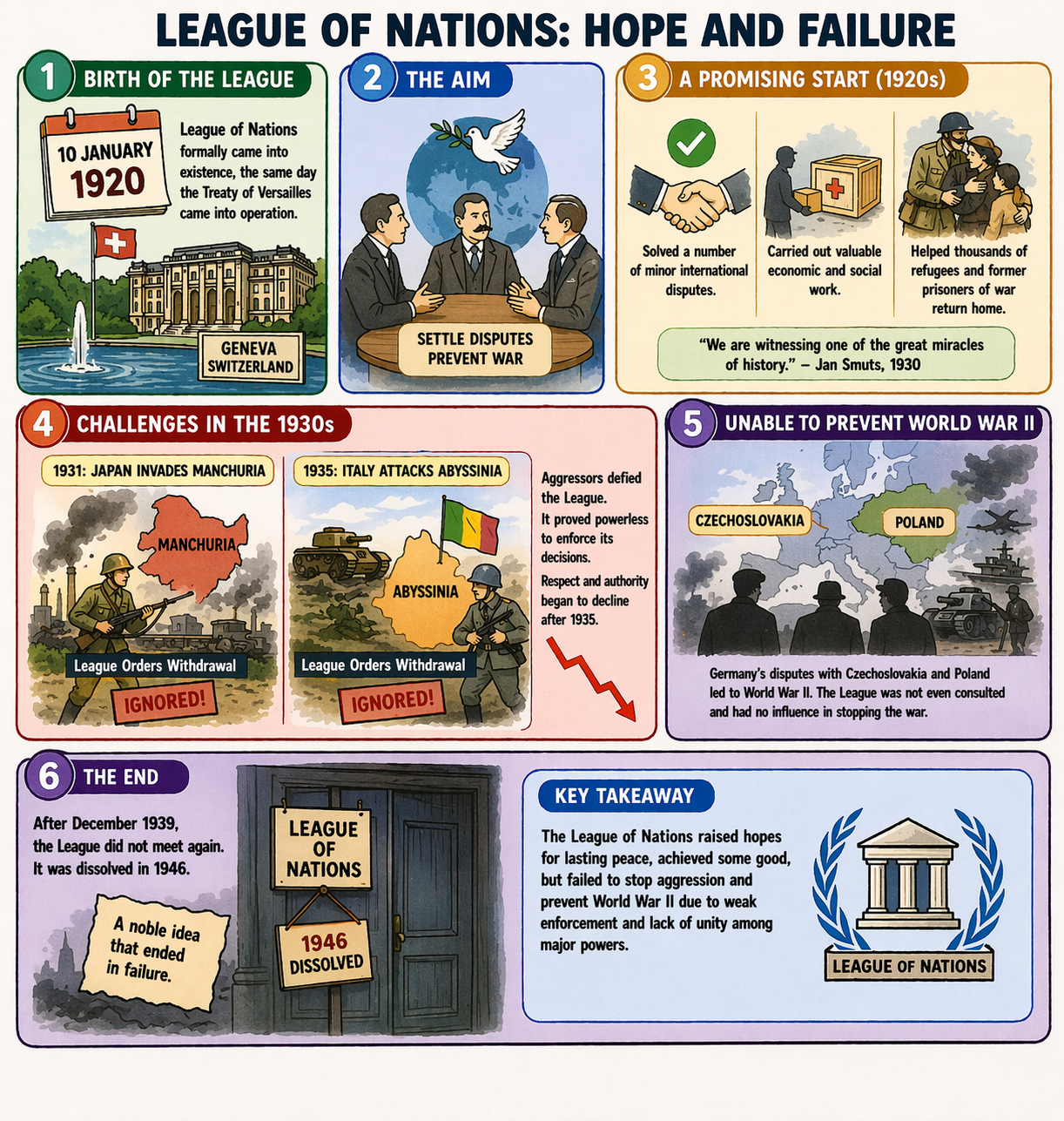
The League of Nations is often popularly associated with Woodrow Wilson, but this view is somewhat simplistic. In reality, the League emerged from a broader intellectual and political climate shaped by the devastation of the First World War. The unprecedented scale of destruction created a collective realization among global leaders that traditional balance-of-power politics had failed.
Multiple statesmen contributed to the idea. Figures like Lord Robert Cecil, Jan Smuts, and Leon Bourgeois independently proposed frameworks for an international organization aimed at preserving peace. Even David Lloyd George included such an institution among Britain’s war aims.
Wilson’s Decisive Contribution
Wilson’s most significant role was institutional rather than conceptual. He ensured that the League Covenant—essentially its constitutional framework—was embedded within the post-war peace treaties. This transformed the League from an abstract idea into a functioning international organization.
Core Objectives
The League was founded on two interrelated principles:
- Collective Security: An attack on one member would be treated as an attack on all, requiring a unified response.
- International Cooperation: Addressing economic, social, and humanitarian issues to reduce the underlying causes of conflict.
This dual vision reflects an important shift in international relations—from mere power politics to a rules-based global order.
Organizational Structure
The League’s structure reveals an ambitious attempt to balance inclusivity with efficiency.
General Assembly: Voice of the Many
All member states participated here, each with equal voting power. This democratic principle was revolutionary for its time, as even small states could influence global discussions. However, the requirement of unanimity often slowed decision-making.
Council: Power Concentrated
The Council functioned as the executive body, dealing with urgent political disputes. Dominated by major powers like Britain, France, Italy, and Japan, it reflected the reality of international politics—where power asymmetry persisted despite formal equality.
Notably, the absence of the United States—a key architect—was a major structural weakness, undermining the League’s authority from the outset.
Permanent Court of International Justice
Located at The Hague, this body institutionalized the idea that international disputes could be resolved through legal mechanisms rather than war. Its success in handling 66 cases indicates a gradual acceptance of international law as a legitimate framework.
Secretariat: Administrative Backbone
An international civil service ensured continuity and efficiency. Its professional functioning demonstrated that global governance could be practically managed.
Commissions and Committees: Expanding the Scope of Governance
The League went beyond political issues to address social and economic problems. Committees on labour, health, refugees, and disarmament highlight an early form of what we now call global governance.
Working Mechanism: Idealism Meets Reality
The League’s peacekeeping mechanism was based on a clear process:
- Disputes would be referred to the League.
- Aggression would be identified.
- Collective sanctions—economic or military—would be imposed.
At a conceptual level, this was revolutionary. However, it relied heavily on member states’ willingness to act, which proved to be its Achilles’ heel.
Successes of the League
1. Social and Humanitarian Achievements
It would be historically inaccurate to label the League as a complete failure.
- The International Labour Organization (ILO), under Albert Thomas, improved working conditions globally by promoting labour rights.
- The Refugee Organization, led by Fridtjof Nansen, successfully repatriated around half a million prisoners of war and later assisted refugees fleeing Nazi persecution.
- The Health Organization played a crucial role in controlling epidemics, such as typhus in Russia.
These achievements demonstrate that while the League struggled politically, it excelled in humanitarian and technical domains.
2. Administrative and Territorial Successes
The League effectively managed mandates (former German and Ottoman territories) and supervised regions like the Saar, ensuring a peaceful plebiscite in 1935.
3. Resolution of Minor Political Disputes
In the 1920s, the League successfully mediated several conflicts:
- Finland vs Sweden (Aaland Islands)
- Germany vs Poland (Upper Silesia)
- Greece vs Bulgaria (border conflict)
- Turkey vs Britain (Mosul dispute)
These successes show that the League could function effectively when great power interests were not directly threatened.
Limitations and Emerging Weaknesses
Despite its early successes, certain structural flaws became evident.
1. Dependence on Major Powers
The League could only function when powerful nations cooperated. When their interests were at stake, compliance weakened.
2. Unanimity Rule
While intended to ensure consensus, it often resulted in paralysis.
3. Parallel Power Structures
The existence of bodies like the Conference of Ambassadors undermined the League’s authority. For example:
- The Vilna dispute (Poland vs Lithuania)
- The Corfu Incident involving Benito Mussolini
In both cases, the League failed to assert itself, revealing its inability to challenge powerful states.
Why Did the League of Nations Fail to Preserve Peace?
To understand the failure of the League of Nations, one must move beyond a simplistic conclusion and instead examine the deeper structural, political, and economic realities of the interwar period. The League did not collapse suddenly; rather, it gradually lost credibility—especially when confronted with aggressive nationalism in the 1930s.
A useful way to approach this is to see the League as an idealistic experiment operating in a largely realist world—a mismatch that ultimately proved fatal.
A. The Foundational Weakness
1. Association with the Versailles System
The League was too closely tied to the Treaty of Versailles. This created an inherent legitimacy problem.
For the defeated powers, especially Germany, the League appeared not as a neutral peacekeeping body but as an instrument of victor’s justice. Even among victors, dissatisfaction existed—Italy felt cheated, while new states like Czechoslovakia contained uneasy ethnic compositions (e.g., Germans within its borders).
Analytical Insight:
This meant the League was not standing above international politics—it was embedded within a controversial and unstable peace settlement. Therefore, defending peace often meant defending an unjust status quo.
2. Absence of the United States
Ironically, the League’s strongest advocate, Woodrow Wilson, could not ensure his own country’s participation.
The refusal of the US Senate to join had multiple consequences:
- Loss of economic and military strength
- Weakening of moral authority
- Reduced deterrence against aggressors
Critical Perspective:
Without the USA, the League lacked the global balance of power necessary to enforce its decisions.
3. Delayed or Missing Membership of Key Powers
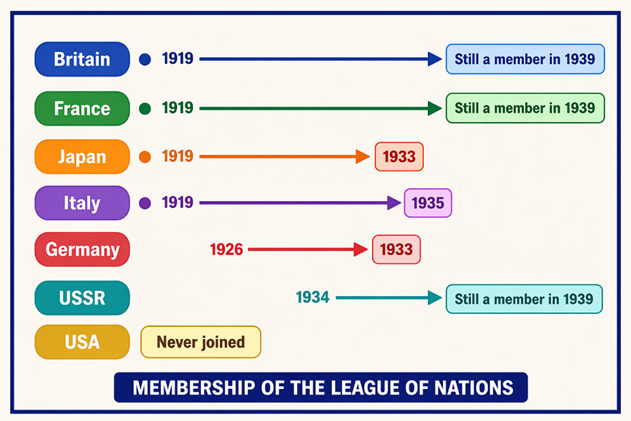
Initially, major powers like Germany and the USSR were excluded.
- Germany joined only in 1926 and later withdrew
- The USSR joined as late as 1934
This meant the League lacked universality during its crucial formative years.
Interlinkage:
A peace organization without key stakeholders resembles a court without defendants—it cannot function effectively.
B. Structural and Institutional Limitations
1. Weaknesses in the Covenant
The League’s foundational document—the Covenant—contained serious flaws:
- Unanimity Rule: Decisions required consensus, often leading to paralysis
- No Standing Army: Enforcement depended on member states
- Voluntary Sanctions: States could choose whether to act
Even attempts to strengthen the system, such as the Geneva Protocol (1924) proposed by Ramsay MacDonald, failed due to lack of consensus.
Deeper Analysis:
The League assumed that states would prioritize collective security over national interest. This assumption proved unrealistic.
2. The “Lack of Teeth” Problem
The League’s inability to enforce decisions made it fundamentally weak.
A telling contradiction emerges: States relied on the League for security, yet were unwilling to commit resources to uphold it.
This created a collective action problem, where each state hoped others would bear the burden.
3. The Conference of Ambassadors
The existence of the Conference of Ambassadors undermined the League’s authority.
- In the Vilna dispute (1920), the League’s decision was overridden
- During the Corfu Incident (1923) involving Benito Mussolini, the League was sidelined
Interpretation:
This revealed that real power still lay outside the League, reducing it to a secondary institution.
C. Political Will: The Real Deciding Factor
1. Dominance of Britain and France
With the absence or weakness of other powers, the League became largely a British-French enterprise.
However:
- Britain followed a policy of caution and appeasement
- France prioritized its own security concerns
For example, instead of using the League, Britain preferred bilateral agreements like the Locarno Treaties (1925).
Key Insight:
The League’s effectiveness depended on great power commitment—but that commitment was inconsistent and self-serving.
2. Pacifism and Domestic Constraints
After the trauma of World War I, public opinion in many countries—especially Britain—was strongly pacifist.
This led to:
- Reluctance to use military force
- Avoidance of strong sanctions
Analytical Link:
Democratic governments were constrained by public opinion, making decisive action difficult.
D. The Turning Point: The Great Depression (1929)
1. Economic Crisis and Rise of Extremism
The Great Depression marked a decisive turning point.
Its effects included:
- Massive unemployment and instability
- Rise of extremist regimes in Germany and Japan
- Shift towards aggressive expansionism
Connection:
Economic insecurity weakened international cooperation and strengthened nationalism—directly undermining the League’s principles.
E. The Ultimate Test: Aggression in the 1930s
This is where the League’s theoretical weaknesses translated into practical failure.
1. Japanese Invasion of Manchuria (1931)
Japan invaded Manchuria; the League condemned the action but failed to act decisively.
- The Lytton Commission delayed response
- No sanctions were imposed
- Japan simply withdrew from the League
Inference:
The League failed its first major test against a powerful state.
2. Failure of the Disarmament Conference (1932–33)
Germany demanded equal armaments; France resisted.
This allowed Adolf Hitler to:
- Withdraw from the conference
- Exit the League
Analytical Note:
Instead of preventing militarization, the League inadvertently accelerated it.
3. Italian Invasion of Abyssinia (1935)
This was the most decisive blow.
- Italy invaded Abyssinia (Ethiopia)
- The League imposed partial sanctions—but excluded crucial resources like oil
As a result:
- Italy successfully completed its conquest
- Sanctions were abandoned
Consequences:
- Mussolini moved closer to Hitler
- Smaller states lost faith in the League
- Hitler became emboldened (e.g., Rhineland remilitarization)
F. The Core Reason: Failure of Collective Security
At its heart, the League failed because → Its members were not willing to enforce collective security when it mattered most.
Britain and France, the key powers, avoided confrontation with aggressors like Japan, Italy, and Germany. Thus, the League’s strength—collective action—became its greatest weakness due to lack of commitment.
Historiographical Perspective: Was It Really a Failure?
Traditional interpretations label the League as a complete failure. However, historians like Ruth Henig offer a more nuanced view.
She argues:
- Expectations from the League were unrealistically high
- It had no army or enforcement mechanism
- Yet, it made significant contributions to international cooperation
Legacy
The League served as a prototype for the United Nations:
- Its Assembly → UN General Assembly
- Its Council → UN Security Council
- Its Court → International Court of Justice
- Its agencies → WHO, ILO, ECOSOC
Conclusion: A Failure That Shaped the Future
The League of Nations did fail in its primary objective—preventing war. However, its failure was not merely due to institutional flaws, but due to the absence of political will in a world still governed by national interests.
In a deeper sense, the League was a necessary experiment. It exposed the limitations of idealism and provided a blueprint for a more robust system—the United Nations.
Thus, rather than dismissing it, we should understand it as a transitional phase in the evolution of global governance, where humanity first attempted—and partially failed—to replace war with cooperation.
2 Comments