
India and Bhutan
Introduction: The Model Neighbour
If India’s neighbourhood policy has a success story, it is Bhutan. Amid a periphery marked by suspicion, disputes and Chinese inroads, the India–Bhutan relationship stands out as remarkably stable, warm and free of serious friction. The two are often described as ‘all-weather friends’.
This closeness rests on an unusual combination: deep civilizational and Buddhist bonds, geographical interdependence, a landmark friendship treaty, and a hydropower partnership that ties the two economies together. Yet even this model relationship now faces new tests—Chinese overtures, hydropower delays, and Bhutan’s own quiet search for strategic space.
| Why Bhutan Matters to India — In One Line Bhutan is India’s strategic buffer against China, the upper riparian source of clean hydropower, and the least troubled of all India’s neighbourhood relationships—which makes preserving it a first-order priority. |
Historical and Civilizational Foundations
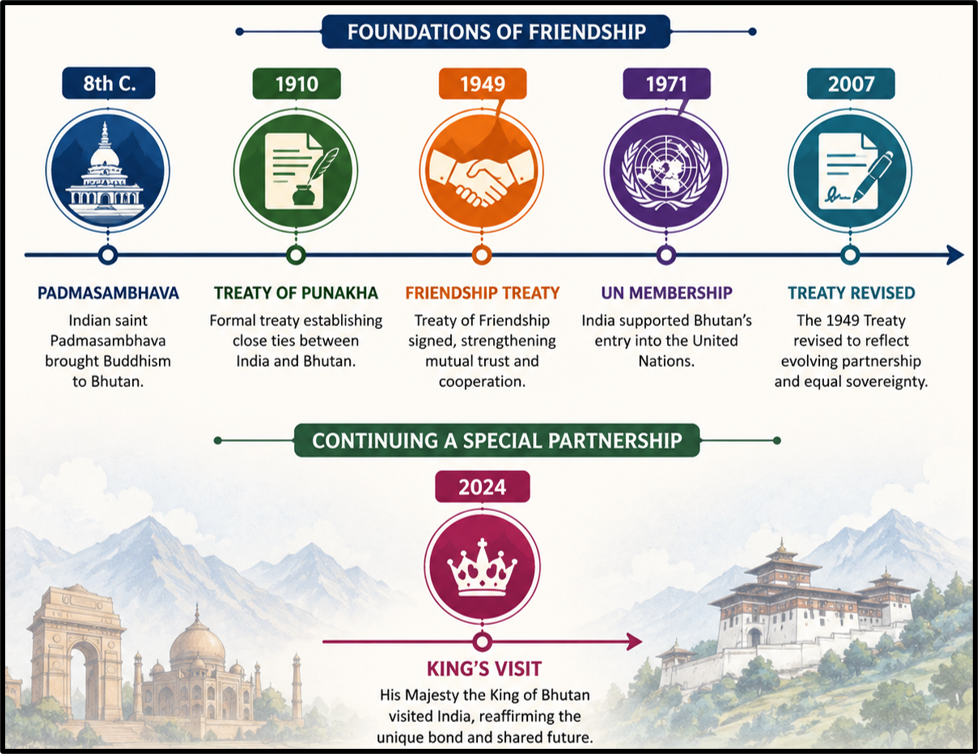
The relationship is anchored in a shared Buddhist civilizational heritage. The ties reach back to the 8th century AD, when the revered Buddhist master Padmasambhava (Guru Rinpoche) travelled from India and spread Tantric (Nyingmapa) Buddhism in the Himalayas, shaping the spiritual life of the land the Bhutanese call Drukyul—the ‘Land of the Thunder Dragon’. This spiritual kinship remains the emotional bedrock of the partnership today.
In the colonial era, the Anglo–Bhutan wars drew Bhutan into the British orbit, and the Treaty of Punakha (1910) left its legal status undefined without formally annexing it. The decisive turn came at Independence: Nehru personally journeyed to Bhutan to build ties, and when China took over Tibet in 1949–50, the resulting fears of annexation pushed Bhutan firmly toward India.
Bhutan was among the first countries to recognise India’s independence, and India in turn championed Bhutan’s entry into the United Nations in 1971.
The Bedrock: The Friendship Treaty of 1949 and its 2007 Revision
The India–Bhutan Treaty of Friendship, 1949 is the legal foundation of the entire relationship. It provided for peace, free trade and commerce, equal justice, an open border (citizens moving without visa), national treatment (Indians and Bhutanese enjoying equal employment rights in each other’s territory), and extradition.
Its most consequential clause was Article 2, under which Bhutan agreed to be ‘guided by the advice of India’ in its external affairs—while India recognised Bhutan’s sovereignty and did not interfere in its internal matters.
As Bhutan matured into a modern democracy, Article 2 came to feel like a relic of a ‘big brother’ relationship. In 2007, Bhutan sought its revision and India agreed immediately—a gesture that generated enormous goodwill and signalled that India was a genuine partner in Bhutan’s progress, not an overlord. The revised treaty is the template for how India ideally wishes to be seen by all its neighbours.
| Key Changes under the Revised 2007 Treaty It replaced the old ‘guidance’ clause with an element of equality, doing away with the big-brother framing.Independent foreign policy — Articles 2 and 4 let Bhutan conduct its foreign policy more independently, while keeping India’s security interests in mind.Procurement of weapons — Article 4 allows Bhutan to import military equipment from other countries without India’s prior consent.Mutual security duty — both countries commit not to allow their territory to be used for activities harmful to the other’s security. |
Areas of Cooperation and Significance
The partnership is genuinely multidimensional. The table below maps the principal dimensions.
| Dimension | Substance |
| Political | India supported Bhutan’s smooth transition to democracy in 2007. Bhutan has consistently backed India in international forums—including support for India’s nuclear tests—and both cooperate through SAARC, BIMSTEC and BBIN. |
| Economic | India is Bhutan’s largest trade partner (roughly 80% of Bhutan’s trade). Bilateral trade nearly tripled from about USD 484 million (2014–15) to USD 1,615 million (2022–23). India funds Bhutan’s Five-Year Plans (₹4,500 crore for the current plan) and provides duty-free transit. |
| Hydropower | The flagship pillar: joint projects such as Chukha, Kurichhu, Tala and the 720 MW Mangdechhu (2019) power both Bhutan’s exports and India’s northern/north-eastern grid. |
| Cultural & educational | Shared Buddhist and Hindu heritage; India remains a preferred destination for Bhutanese students, and cooperation spans science, technology, sport and healthcare. |
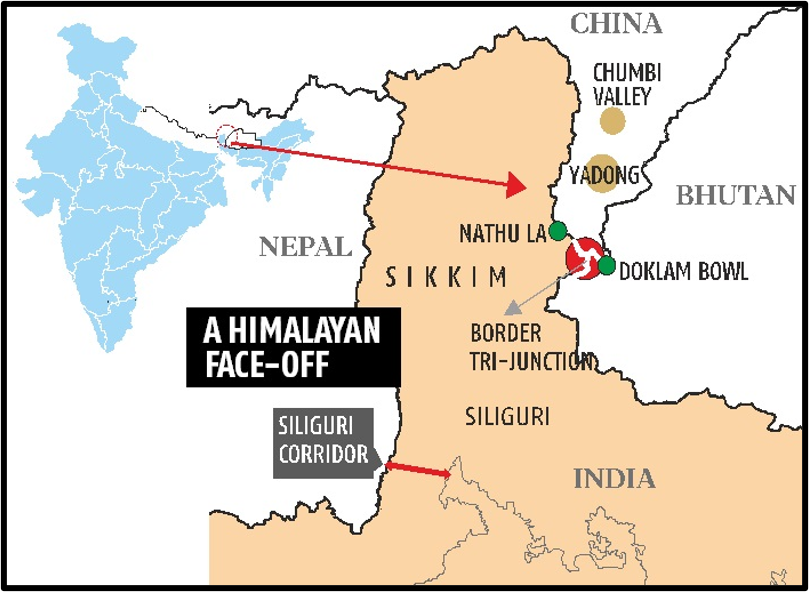
| Geostrategic | Bhutan is India’s buffer against China. The Doklam plateau, near the India–China–Bhutan trijunction, is strategically vital. River-data sharing supports flood forecasting and regional water security. |
| Internal security | Joint efforts have tackled insurgent groups such as ULFA and NDFB; the 2007 treaty deepened security cooperation. |
| Flood management | A Joint Group of Experts addresses flood challenges and promotes timely hydrological data sharing. |
Commercial and Development Diplomacy
India’s economic engagement began in 1961, when it funded Bhutan’s first and second Five-Year Plans—India remains the principal external partner even after Bhutan’s aid diversified upon joining the UN in 1971.
Trade flows overwhelmingly through the Kolkata port and the Phuntsholing–Paro road; Indian banks such as SBI and Bank of Baroda operate in Bhutan; and trade is governed by the Agreement on Trade and Commerce (2006), which provides duty-free trade and third-country transit.
India’s development partnership has evolved across three phases: physical infrastructure (1960–80), democratic capacity-building and decentralisation (1980–2000), and today a diversified portfolio spanning hydropower, IT, education and skilling.
Hydro-Diplomacy: The Engine of the Relationship
Nothing binds the two economies like hydropower. Bhutan is a Himalayan upper-riparian state with immense hydro potential, and it exports a large share of its generation to India—turning a natural endowment into foreign exchange for Bhutan and clean baseload power for India. The story is one of mutual dependence built up over decades.
Bhutan’s electrification itself began with Indian help in the 1960s (diesel sets, then imported power from the Jaldhaka plant in Bengal, and a 33 MW plant at Chukha in 1989). Serious hydropower cooperation then unfolded in two phases:
- Phase 1 (1987–2007) built site-specific plants at Chukha, Kurichhu and Tala, financed on a 60% grant / 40% loan model;
- Phase 2 (from 2007) scaled up toward the ambitious target of 10,000 MW of installed capacity. The 720 MW Mangdechhu project was jointly inaugurated in 2019.
| The Hydropower Model — Why It Works (and Why It Strains) It is a win–win: Bhutan earns revenue and India secures renewable power feeding its northern and north-eastern grids.But strains have emerged: the 2014 Assam floods raised downstream concerns; Bhutan resents the dominance of Indian firms and their use of cheaper Bangladeshi labour, which limits Bhutanese corporate and workforce growth.Generation is seasonal—Bhutan imports power from India in winter and exports in summer—prompting the idea of a power bank to smooth the imbalance. |
Security Cooperation and the China Factor
Since the 1962 Sino–Indian war, India has valued forward access to the upper Himalayas to watch China—and here Bhutan is strategically indispensable. Because Bhutan maintains no diplomatic relations with China (owing to an unresolved border dispute dating to 1947), India enjoys a wide sphere of influence.
India maintains the Indian Military Training Team (IMTRAT) in Bhutan’s Haa district, trains Bhutanese officers, and—through the Border Roads Organisation’s Project Dantak (since 1961)—has built roads, telecom, schools and colleges across the country.
The Chumbi Valley and Doklam
The Chumbi Valley is a trijunction of Bhutan, India and China lying dangerously close to the Siliguri Corridor (the ‘Chicken’s Neck’)—the narrow strip linking India’s North-East to the rest of the country, barely 500 km away. By pressing claims in western Bhutan (Doklam, Charithang, Sinchulimpa, Dramana), China seeks to widen this valley and gain manoeuvring space in any conflict. This is precisely why the 2017 Doklam standoff—a 73-day India–China military face-off after China tried to extend a road on land Bhutan claims—was so serious, and why India supported Bhutan’s claim.
| Case Study — Operation All Clear (2003–04) The Royal Bhutan Army launched a major operation to flush out ULFA and NDFB insurgents from southern Bhutan.The Indian Army positioned 12 battalions along the border to block any insurgents fleeing into India.Bhutan neutralised around 650 insurgents and destroyed some 30 camps—a landmark example of security cooperation and Bhutan’s reliability as a partner. |
China has meanwhile shifted to soft power: committing to build the tallest Buddha statue in Thimphu, investing in telecom, and courting Bhutan through cultural and religious diplomacy.
Crucially, in October 2021 Bhutan and China signed a ‘Three-Step Roadmap’ to expedite boundary negotiations (delimitation → joint survey → demarcation of the ~477 km border). India watches this closely, as any settlement touching the Doklam trijunction directly affects its security.
Recent Developments: The King’s Visit, December 2024
The official visit of King Jigme Khesar Namgyel Wangchuck to India in December 2024 reaffirmed the depth of the partnership and set its future direction. Key outcomes included:
- Gelephu Mindfulness City — India expressed strong interest in partnering on Bhutan’s visionary sustainable-urban Special Administrative Region project on the Assam border.
- Energy cooperation — agreement to fast-track Punatsangchhu-I and satisfaction that the 1,020 MW Punatsangchhu-II project was nearing commissioning.
- Connectivity — the opening of the Darranga Integrated Check Post in Assam to boost trade and tourism in eastern Bhutan.
- Space & STEM cooperation — progress in space collaboration and growing educational ties, especially in STEM.
Issues and Challenges
For all its warmth, the relationship is not frictionless. The challenges are best grouped as economic, security-strategic and political.
Economic strains
- Rising external debt — Bhutan’s debt is heavily hydropower-linked; its external-debt-to-GDP ratio has climbed toward nearly 100%, much of it owed to India.
- Hydropower delays — India has repeatedly failed to complete projects on schedule, slowing progress toward the 10,000 MW target.
- Electricity-tariff pressure — India’s own power surplus and cheap wind/solar make it harder for Bhutan to run a profitable hydro-export business.
Strategic and security concerns
- The Chinese overture — Chinese attempts to open diplomatic ties and extend the BRI to Bhutan worry India, especially after Bhutanese statements hinting at a more balanced approach.
- Insurgent residue — lingering concern over insurgent groups in Bhutan’s south-eastern jungles.
Political sensitivities
- Perceived interference — the reduction of cooking-gas subsidy just before Bhutan’s 2013 elections was widely read as Indian meddling.
- Sovereignty anxieties — even benign projects like Project Dantak have fed local fears of Indian over-involvement in domestic affairs.
- BBIN opt-out — Bhutan declined to join the BBIN Motor Vehicle Agreement on environmental and climate grounds, reflecting its own priorities.
| Is Bhutan Drifting Away from India? The accumulated issues have given Bhutan leverage to enhance engagement with China.China is seeking diplomatic ties, which Bhutan has not yet accepted, and both are pursuing the 3-Step Roadmap on the border.Bhutan increasingly plays a balancing act—even during the 2017 Doklam crisis it adopted a careful, non-confrontational stance.The measured verdict: Bhutan is not defecting, but it is delicately diversifying its options—so India cannot take the relationship for granted. |
Way Forward
The guiding principle is simple: India must remain Bhutan’s partner of choice, not its patron. That means respecting Bhutan’s autonomy while quietly out-competing China on delivery.
Political and diplomatic
- Respect Bhutan’s autonomy and non-interference, and deepen inter-parliamentary and institutional cooperation, leveraging Bhutan’s role in the Act East and Neighbourhood First policies.
Economic
- Diversify Bhutan’s exports to reduce external debt and the trade imbalance; promote cultural tourism, manufacturing and services; and expand currency-swap support under the SAARC framework.
- Sustain aid levels amid China’s growing regional presence.
Hydropower, defence and knowledge
- Fulfil the 10,000 MW commitment and import surplus energy, restoring credibility on delivery.
- Deepen defence cooperation through joint military and air exercises (especially post-Doklam) and coordinated action against insurgents.
- Expand knowledge and space ties via the National Knowledge Network, the India–Bhutan Foundation, and joint work on satellites and ground stations.
- Counter China by supporting Bhutan in managing its border disputes and strengthening joint preparedness at the trijunction.
Conclusion
India–Bhutan relations remain the gold standard of India’s neighbourhood diplomacy—a rare case where civilizational affinity, economic interdependence and strategic alignment reinforce one another. The 2007 treaty revision showed India at its diplomatic best, and hydropower has woven the two economies together.
Yet the model is being tested by hydropower delays, mounting debt, and a patient Chinese courtship. The task ahead is not to hold Bhutan back but to remain, through generosity, reliability and respect for its sovereignty, the partner Bhutan freely chooses. If India succeeds here, it validates the entire philosophy of Neighbourhood First.