
India and Nepal
Introduction: The Closest and Most Complicated Neighbour
No neighbour is closer to India—by blood, faith and geography—than Nepal. The two share an open border, a common Hindu-Buddhist civilizational heritage, and a bond so intimate it is captured in the phrase ‘Roti-Beti ka Rishta’ (a relationship of bread and marriage).
Families straddle the frontier; Nepali Gorkhas serve in the Indian Army; pilgrims cross freely between the two lands. Yet precisely because the relationship is so close, it is also uniquely sensitive: any perception of Indian ‘big-brotherly’ interference ignites nationalist backlash, and a rising China now offers Nepal an alternative it never had before. India-Nepal ties are therefore a study in the paradox of intimacy.
| The Central Tension in One Line Nepal is bound to India by kinship and economic dependence, yet driven by nationalism and Chinese opportunity to assert distance—so India must lead with soft power and respect, not leverage. |
Historical and Political Background
The relationship reaches back to the age of the Sakya clan and Gautama Buddha. Nepal’s feudal era began under the Licchavis; the Newari and later Malla periods (peaking in the 12th century) marked a cultural zenith and a gradual shift from Buddhism to Hinduism.
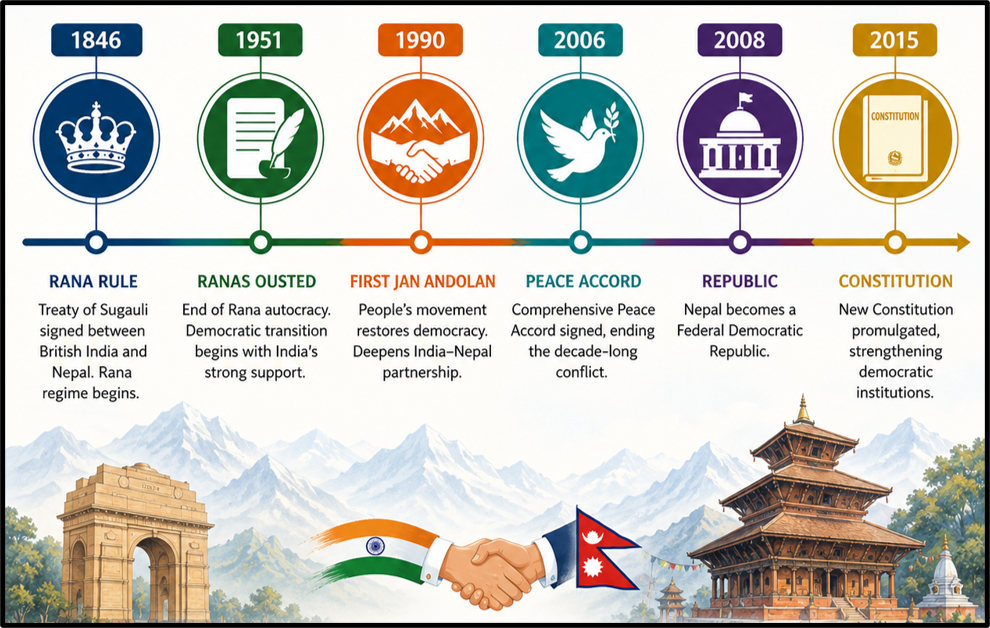
From 1846, the Rana dynasty of hereditary prime ministers ruled until 1951. Crucially, Nepali elites who joined India’s freedom struggle absorbed the idea of non-violent mass movement, and the Nepali Congress led the ouster of the Ranas.
Nepal’s long struggle with democracy
Post-1951 Nepali politics oscillated between monarchy and democracy. King Mahendra dismissed the elected Congress in 1959 and imposed a party-less Panchayat system. Popular pressure produced the First Jan Andolan (1990) restoring multiparty democracy, and—after a Maoist insurgency and King Gyanendra’s power grab—the Second Jan Andolan (2006), a Peace Accord, and an Interim Constitution (2007).
After years of deadlock over the form of government and federalism, and amid Madhesi assertion, Nepal finally adopted its seventh constitution in September 2015.
The Bedrock: Treaty of Peace and Friendship, 1950
Signed on 31 July 1950, the Treaty of Peace and Friendship is the foundation of the special relationship. It guarantees mutual peace, sovereignty and non-interference; it grants national treatment (citizens of each country enjoying equal rights to property, residence, trade and movement in the other), an open border requiring no visa, and—under Article X—a provision allowing either party to seek the treaty’s revision. Notably, Nepal is to consult India on arms imports from third countries.
| Case Study — Why Nepal Resents a Treaty that Favours It Paradoxically, the treaty is more generous to Nepal, yet Nepal objects to it. It was signed with an unpopular Rana ruler on the eve of his fall, which Nepal sees as tainting its legitimacy. It was signed by the Indian ambassador, not Nehru himself, which Nepal read as a signal of unequal status. Since the UML’s anti-India campaign of 1994, demanding revision of the 1950 treaty has become a reliable route to political mileage. Under Article X, India has always accepted Nepal’s requests to revise—but lack of consensus within Nepal stalls any real progress. |
Areas of Cooperation and Significance
| Dimension | Substance |
| Economic | India is Nepal’s largest trade partner—about 64% of Nepal’s total trade (roughly USD 8.66 billion, FY 2022-23). Indian firms account for ~40% of Nepal’s approved FDI, with around 150 ventures. Trade flows through 22 transit routes (Raxaul, Tanakpur, Biratnagar) and Nepal uses the Kolkata port for third-country trade. |
| Social & cultural | ‘Roti-Beti ka Rishta’ captures deep familial ties. Shared Hindu-Buddhist heritage underpins cooperation, including sister-city pacts (Janakpur–Ayodhya, Kathmandu–Varanasi, Lumbini–Bodhgaya) and Indian-funded heritage restoration at Pashupatinath and Patan Durbar. |
| Connectivity & transit | Nepal, being landlocked, depends on India for sea access. Projects span rail links, inland waterways and Integrated Check Posts at Birgunj and Biratnagar. |
| Water & hydropower | Nepal’s rivers are vital to the Ganga basin; a 2008 bilateral mechanism manages water cooperation and hydropower. |
| Defence | The annual joint exercise Surya Kiran and the deep Gorkha connection anchor military ties; India trains and equips the Nepali Army. |
| Disaster management | Cooperation under BIMSTEC and major Indian assistance after Nepal’s 2015 earthquake. |
Hydropower Diplomacy: The Great Missed Opportunity
Nepal’s Himalayan rivers hold an estimated 83,000 MW of hydropower potential (about 42,000 MW economically viable), yet installed capacity has historically been a tiny fraction, leaving the country plagued by long power cuts. The tragedy is one of under-development driven by suspicion: Nepal has long feared that if it builds big hydro projects with India, India will dominate the generated power—so it hesitates, even as India points to Bhutan’s success. Three treaties frame the water relationship.
| Treaty | Substance & Contention |
| Kosi (1954) | Aimed at taming the Kosi—the ‘Sorrow of Bihar’—via an Indian-built barrage in Nepal, whose management India holds on a 199-year lease. Nepal objects that the lease far outlasts a barrage’s ~50-year life and that India mismanages water release, causing floods. |
| Gandak (1959) | A 13-article treaty for joint use of the Gandak’s waters for irrigation and power. |
| Mahakali (1996) | Envisages joint dams at Sarada, Tanakpur and the flagship Pancheshwar. Progress stalled for years over cost-sharing and pending social/environmental assessments. |
The Border: Open Frontier and Territorial Disputes
India and Nepal share a roughly 1,800 km open border, a British-era practice codified by the Treaty of Sagauli (1816) after the Anglo-Nepal war, which fixed the Kali (Mahakali) river as the western boundary. The open border is a blessing—fostering kinship and economic opportunity—but also a vulnerability.
The Kalapani–Lipulekh–Limpiyadhura dispute
The core dispute flows from an ambiguity in the Sagauli Treaty: it named the Kali river as the boundary but never fixed its point of origin. India holds that the river rises near Kalapani/Lipulekh, placing the ~300–370 sq km tract inside India (occupied since the 1962 war and strategically vital, near the Kailash-Mansarovar route). Nepal argues the river rises further west at Limpiyadhura, claiming the whole area. The dispute escalated sharply when India opened a road via Lipulekh in May 2020 and Nepal responded by publishing a new official map (2020) incorporating all three areas—later even printing the map on a new 100-rupee currency note (2024), which India dismissed as an ‘artificial enlargement’. A second, older dispute at Susta arises from the shifting course of the Gandak river.
| Case Study — Security Threats along the Open Border Pakistan’s ISI has exploited the open border to infiltrate agents and pump fake currency into India.The frontier enables drug trafficking, gold and human smuggling, and illegal arms trade, with criminals using each other’s territory as refuge.The remedy is better management, not closure: a Cross-Border Crime Control Action Plan and a modernised, empowered Sashastra Seema Bal (SSB). |
The 2015 Constitution, the Madhesi Question and the Blockade
Nepal’s seventh constitution (20 September 2015) was historic—its first drafted by an elected Constituent Assembly rather than a monarch. But it left the Madhesis and Tharus of the southern Terai—who form a majority of that region’s population—feeling under-represented, with far fewer seats per head than the hill (Pahadi) regions and rolled-back provisions on proportional inclusion and citizenship. India, which shares deep ‘roti-beti’ ties with the Madhesi belt, ‘noted’ rather than ‘welcomed’ the constitution and urged an inclusive revision.
The Madhesi agitation culminated in a months-long blockade of the Birgunj–Raxaul border (2015-16), choking supplies of fuel, medicine and LPG into Nepal. Nepalis widely blamed India (which denies any role), and the resulting hardship—fuel shortages, deforestation for firewood, smog over Kathmandu—generated intense anti-India sentiment and, crucially, eroded India’s soft power. The episode is the textbook lesson that, as Joseph Nye argued, in the 21st century it is soft power that wins—and coercion that backfires.
The China Factor: A New Great Game in the Himalayas
China’s original interest in Nepal was to ensure Tibetans could not use Nepali soil for dissent. But its footprint has grown dramatically—from economic presence to soft power (Mandarin schools in the Terai), infrastructure, education and health. China engages Nepali politicians directly, building trust and steadily eroding India’s traditional primacy. The Himalayas, once a barrier, are no longer one.
| Markers of Deepening China–Nepal Ties Ties were elevated to a ‘Strategic Partnership’ during Xi Jinping’s 2019 visit; Nepal joined the Belt and Road Initiative in 2017, and signed a BRI cooperation framework in December 2024. Transit and trade agreement giving Nepal access to Chinese ports, plus a rail-link agreement and the Trans-Himalayan Connectivity Network. First-ever PLA–Nepali Army joint exercises (2017, 2018) and regular Chinese financial assistance to Nepal’s army since 2019. Strategic infrastructure such as the Pokhara International Airport near the Indian border, raising Indian security concerns. The Himalayan ‘Quadrilateral’ (China-Pakistan-Afghanistan-Nepal) is read in Delhi as an attempt to contain India. |
Issues and Challenges — A Consolidated View
- The ‘big brother’ perception — India’s real or perceived micro-management (as Prachanda called it) reliably provokes nationalist backlash.
- Territorial nationalism — the Kalapani-Lipulekh-Limpiyadhura map and currency-note controversies have hardened positions on both sides.
- Trust deficit and the 2015 blockade — the single greatest wound, still cited in Nepali politics.
- Delay in project completion — India’s chronic failure to deliver aided projects on time feeds the trust deficit and pushes Nepal toward China.
- Treaty revision demand — recurring calls to rewrite the 1950 treaty and regulate the open border.
- The China challenge — BRI, debt-trap risk, and China’s threat to India’s role as Nepal’s top trade and energy partner.
- Border security — terrorist infiltration and cross-border crime through the open frontier, especially amid India-China tensions in Ladakh and Sikkim.
Way Forward
- Shed the big-brother image — practise sensitivity in a polity where power shifts every few months, and avoid micro-management.
- Deliver projects on time — nothing rebuilds trust faster than credible, completed infrastructure.
- Lead with soft power — leverage kinship, religion and people-to-people ties; recognise Nepal’s diversity and engage all sections, including the Madhesis.
- Resolve the boundary diplomatically — pursue the Kalapani and Susta questions through the established Boundary Working Group and foreign-secretary mechanism, ratifying the pending strip maps.
- Unlock hydropower — advance Pancheshwar and power-trade arrangements so Nepal sees tangible economic gain, as Bhutan has.
- Deepen connectivity — transit agreements, inland-waterway access and cross-border transmission lines (e.g., Dhalkebar-Muzaffarpur) bind the economies together.
- Manage, don’t close, the border — modernise the SSB and joint crime-control mechanisms while preserving the open frontier that defines the relationship.
Conclusion
India-Nepal relations are the most emotionally charged in India’s neighbourhood—rooted in kinship yet strained by nationalism, dependence yet resentment. The 2015 blockade and the map disputes have shown how quickly goodwill can be squandered, while China’s patient advance has permanently altered Nepal’s strategic options. The path forward is not through leverage but through generosity, reliability and respect for Nepali sovereignty.
If India can deliver on hydropower and connectivity, honour Nepal’s diversity, and win the contest of soft power, the ‘roti-beti’ bond will remain India’s deepest asset in South Asia. Coercion, the record shows, only drives Nepal north.