
UPSC CURRENT AFFAIRS — 5 NOVEMBER 2026
1. Death Penalty: Supreme Court’s Turn Towards Due Process
(POLITY AND GOVERNANCE) (TH) The World Day Against the Death Penalty (10 October) has revived debate on how India applies the ‘rarest of rare’ test. Recent Supreme Court rulings have moved the focus from the brutality of the crime to a fair, individualised sentencing hearing for the accused.
The Legal Framework
In India, life imprisonment is the rule and death the exception. Judges must record “special reasons” for a death sentence — earlier under Section 354(3) CrPC, now under Section 393(3) of the Bharatiya Nagarik Suraksha Sanhita (BNSS), 2023.
- Confirmation: a Sessions Court death sentence must be confirmed by the High Court; an appeal lies to the Supreme Court.
- Clemency: mercy petitions go to the President under Article 72 or the Governor under Article 161.
- Last remedy: a curative petition, recognised in Rupa Ashok Hurra v. Ashok Hurra (2002), survives even after a review is dismissed.
- Exempt groups: persons who were juveniles at the time of the offence, pregnant women and persons with serious mental illness cannot be executed.
How the Jurisprudence Evolved
Bachan Singh (1980) ➜ Machhi Singh (1983) ➜ Bariyar (2009) ➜ Manoj (2022) ➜
Vasanta Sampat Dupare (2025) ➜ Waris (2026)
| Case | What it held |
|---|---|
| Bachan Singh v. State of Punjab (1980) | Upheld the death penalty but limited it to the ‘rarest of rare’ cases, where life imprisonment is “unquestionably foreclosed”; courts must weigh aggravating and mitigating circumstances. |
| Machhi Singh v. State of Punjab (1983) | Shifted attention to the circumstances of the crime, leading to a crime-centric approach. |
| Santosh Kumar Bariyar v. State of Maharashtra (2009) | Declared Ravji (1995) per incuriam for ignoring the criminal’s circumstances; the State must show that reformation is impossible. |
| Manoj v. State of Madhya Pradesh (2022) | Made psychological, psychiatric, prison-conduct and socio-economic reports mandatory before a death sentence. |
| Vasanta Sampat Dupare v. Union of India (2025) | Linked a proper sentencing hearing to Articles 14 and 21; a sentence passed without it can be reopened. |
| Waris v. State of Madhya Pradesh (2026) | Upheld the conviction for a child’s rape and murder but commuted death to imprisonment for the rest of natural life without remission, as the State had not ruled out reformation. |
Persistent Gaps
- Trial-court practice: many sentences are still passed on the gravity of the crime alone, with little inquiry into mitigation.
- Rushed hearings: sentencing is often heard on the day of conviction, leaving no time to gather mitigating evidence.
- Weak investigations: a high share of death sentences end in acquittal on appeal, a warning against an irreversible punishment.
- Inequality: most death-row prisoners come from poor backgrounds and lack strong legal aid at trial.
Global and Treaty Position
India is a party to the ICCPR, whose Article 6 restricts capital punishment to the “most serious crimes”. It has not signed the Second Optional Protocol (1989), the only global treaty aimed at abolition.
Way Forward
- Law Commission’s 262nd Report (2015): abolish the death penalty for all crimes except terrorism-related offences and waging war.
- Mitigation specialists: a State-funded cadre of social workers and psychologists to make the Manoj guidelines work in practice.
- Clemency timelines: give statutory backing to Shatrughan Chauhan v. Union of India (2014) to prevent “death-row syndrome”.
- Calibrated alternatives: wider use of life imprisonment without remission instead of death.
📖 Read More: Pardoning Power of the President • Supreme Court • Judicial Review
2. PAC Conference: Making Every Public Rupee Count
(POLITY AND GOVERNANCE) (DD) (TH) The Lok Sabha Speaker inaugurated the two-day All India Conference of Chairpersons and Members of Public Accounts Committees (PACs) of Parliament and State/UT Legislatures at Thiruvananthapuram, Keralam, on 3–4 November 2026. The theme was “Audit, Accountability and Good Governance – The Evolving Role of the PAC”.
Note: the State’s official name has been Keralam since 25 August 2026, under the Kerala (Alteration of Name) Act, 2026. This was the first time the State hosted the national PAC conference.
Key Messages
- Outcomes, not just accounts: PACs should test whether spending has produced real development on the ground, going beyond the findings of the CAG.
- Fiscal discipline: every rupee drawn from the exchequer must be accounted for and used for the purpose for which it was sanctioned.
- Digital tracking: a common audit-monitoring platform for State legislatures, on the model of Parliament’s Audit Para Monitoring System (APMS).
- Resolutions: standard timelines for Action Taken Notes, closer cooperation among PACs and capacity-building of members.
Public Accounts Committee at a Glance
| Feature | Details |
|---|---|
| Origin | Set up in 1921 after the Montagu-Chelmsford Reforms (Government of India Act, 1919). |
| Basis | Not constitutional or statutory; constituted every year under Rule 308 of the Lok Sabha Rules of Procedure. |
| Members | 22 — 15 from Lok Sabha and 7 from Rajya Sabha, elected by proportional representation through single transferable vote; one-year term. |
| Chairperson | Appointed by the Speaker; by convention since 1967, from the Opposition. |
| Bar | A Minister cannot be a member; a member who becomes a Minister ceases to be one. |
| Core work | Examines Appropriation and Finance Accounts and CAG audit reports; excess spending is regularised under Article 115. |
Limitations
- It examines spending only after it has taken place (post-mortem scrutiny).
- Its recommendations are advisory and do not bind the government.
- It does not question policy; it checks only how faithfully and economically money was spent.
PAC is one of the three financial committees of Parliament, along with the Estimates Committee and the Committee on Public Undertakings.
📖 Read More: Financial Committees • Parliamentary Committees • CAG
3. Fast Track Special Courts Extended Till 2031
(POLITY AND GOVERNANCE) (PIB) The Union Cabinet has approved the continuation of the Centrally Sponsored Scheme for Fast Track Special Courts (FTSCs), including exclusive POCSO Courts, for five years — FY 2026-27 to FY 2030-31 — to ensure speedy trial of rape and child sexual abuse cases.
Background
- Legal trigger: the Criminal Law (Amendment) Act, 2018 prescribed stringent, time-bound trials for rape.
- Judicial trigger: a Supreme Court order of July 2019 sought exclusive courts in districts with more than 100 pending POCSO cases.
- Launch: 2 October 2019 by the Department of Justice, Ministry of Law and Justice; the central share is met from the Nirbhaya Fund.
- New phase: total outlay of ₹3,788.04 crore — Centre ₹2,353.15 crore and States/UTs ₹1,434.89 crore — for up to 850 courts.
- Track record: 779 functional FTSCs, including 399 exclusive POCSO Courts, have disposed of 4,02,457 cases since launch.
- Last extension: the previous phase ran from April 2023 to March 2026 with an outlay of ₹1,952.23 crore.
How an FTSC Works
Case filed (BNS rape / POCSO) ➜ Exclusive FTSC judge ➜ Special Public Prosecutor ➜
Child-friendly deposition ➜ Time-bound verdict
- Each court has a dedicated judicial officer, a Special Public Prosecutor and support staff.
- Courts handle only rape and POCSO cases, so trials run day to day without being displaced by other matters.
- Vulnerable Witness Deposition Centres let child victims testify without facing the accused.
Significance
FTSCs give effect to the right to a speedy trial under Article 21 and to equal access to justice under Article 39A. Faster disposal also spares survivors repeated court visits and the secondary trauma of long-drawn trials.
📖 Read More: Judicial Review • Supreme Court
4. US Midterms: A Democratic Congress and India
(INTERNATIONAL RELATIONS) (IE) (TH) In the US midterm elections held on 3 November 2026, the Democratic Party won control of both the House of Representatives and the Senate. A Republican President now faces an opposition-run Congress — a divided government — with consequences for trade, sanctions and immigration policy that matter to India.
What Are Midterm Elections?
Midterms fall halfway through a President’s four-year term, on the Tuesday after the first Monday of November. All 435 House seats (two-year terms) and about one-third of the 100 Senate seats (six-year staggered terms) are contested. Democrats have secured at least 54 Senate seats, including two independents who caucus with them.
Why Congress Can Restrain the President
- Power of the purse: revenue bills begin in the House; Congress can cap or condition spending, including on military operations.
- Oversight: committees can summon officials and subpoena records.
- Senate consent: confirmation of judges, ambassadors and Cabinet nominees, and approval of treaties.
- Veto override: a two-thirds vote in both chambers.
US Congress vs Indian Parliament
| Dimension | United States | India |
|---|---|---|
| System | Presidential; strict separation of powers | Parliamentary; executive drawn from and responsible to the Lok Sabha |
| Executive tenure | President serves a fixed four-year term whatever the Congress result | Government survives only while it commands a Lok Sabha majority |
| Mid-term polls | Fixed, every two years | Only if the Lok Sabha is dissolved early |
| Upper House | Two Senators per State, directly elected | Rajya Sabha seats by population; elected by MLAs; one-third retire every two years (Article 83(1)) |
| Party discipline | No anti-defection law | Tenth Schedule — the anti-defection law |
| Election body | Run by individual States | Constitutional Election Commission of India (Article 324) |
Implications for India
- Trade: pushback against inflation-raising tariffs may help conclude the long-pending India–US trade deal, though the President keeps delegated powers under Section 232 (Trade Expansion Act, 1962) and Section 301 (Trade Act, 1974).
- Energy and sanctions: India must lobby both parties to protect waivers on Russian oil, as Congress hawks favour secondary sanctions.
- West Asia: tighter war-powers scrutiny could ease tensions in the Strait of Hormuz, vital for India’s crude, LNG and fertiliser imports.
- People-to-people ties: Democrats generally favour predictable skilled migration, relevant to H-1B workers and the Indian diaspora.
- Strategic continuity: bipartisan support for the Quad, defence ties and the TRUST initiative on critical technologies is likely to continue.
Lessons for India
- An independent Parliamentary Budget Office, like the US Congressional Budget Office, for non-partisan fiscal analysis.
- Mandatory scrutiny of major Bills by Departmentally Related Standing Committees, with public hearings.
- Limiting party whips to confidence motions and Money Bills, as suggested by the Law Commission’s 170th Report.
📖 Read More: India–United States Relations • Parliamentary System in India • Anti-Defection Law
5. VISTAR: Rebuilding India’s Statistical System
(ECONOMICS) (PMI) The Union Cabinet has approved VISTAR (Viksit Bharat Initiative for Statistical Transformation, Analytics & Research), a Central Sector Scheme of the Ministry of Statistics and Programme Implementation (MoSPI) with an outlay of ₹4,371.10 crore for FY 2026-27 to FY 2030-31.
VISTAR brings all of MoSPI’s statistical and data-management work under one umbrella. Its aim is timely, granular and reliable data for policy, using digital tools and new data sources.
Three Components
| Component | What it does |
|---|---|
| 1. Statistical operations and ecosystem | Expands major surveys from 43 to 59 in the 16th Finance Commission cycle; new Headline Index of Services Production and Index of Unincorporated Sector Enterprises; uses mobile, scanner and e-commerce data; AI/ML-based processing; internships and research grants. |
| 2. Support for Statistical Strengthening (SSS 2.0) | Deliverable-linked funds to States/UTs for district-level and million-plus-city estimates from PLFS, HCES and ASUSE, and for State/District GDP and State IIP. |
| 3. 8th Economic Census | Counts all non-farm establishments and workers down to Gram Panchayat and Ward level; forms the base of a National Statistical Business Register. |
Why It Matters
Better data ➜ Better GDP estimates ➜ Targeted district policy ➜ Better spending
- Informal economy: better measurement of unorganised enterprises improves national income estimates.
- Decentralisation: district-level numbers allow States to plan for local needs.
- Less burden on respondents: alternative data sources supplement long household surveys.
📖 Read More: National Income Accounting • Methods for Measurement of National Income
6. High-Level Committee to Reshape Indian Banking
(ECONOMICS) (PIB) The Ministry of Finance has constituted a High Level Committee on Banking for Viksit Bharat, announced in the Union Budget 2026-27. It will recommend structural, regulatory and legislative reforms to make Indian banking globally competitive, inclusive and resilient by 2047, and report within six months.
Composition
| Role | Member |
|---|---|
| Chairman | Suresh N. Patel, former Central Vigilance Commissioner |
| Members | Shirish Chandra Murmu (Deputy Governor, RBI); Padmaja Chunduru (former MD & CEO, Indian Bank); N. S. Vishwanathan (former Deputy Governor, RBI) |
| Member Secretary | Joint Secretary (Banking), Department of Financial Services |
Terms of Reference
- Regulation: review frameworks for commercial banks, Regional Rural Banks and cooperative banks to improve ease of doing banking.
- Capital: assess long-term capital needs of banks, Development Financial Institutions and NBFCs, and the cost of capital.
- Inclusion: revisit Priority Sector Lending and the Lead Bank Scheme for data-driven credit delivery.
- Technology: a roadmap for AI and digital innovation, with safeguards against cyber risks.
- Global standards: review prudential norms and build a future-ready workforce.
The committee follows a long line of banking reviews, such as the Narasimham Committees of the 1990s. Its timing reflects the need to finance a much larger economy while keeping balance sheets healthy and financial inclusion deep.
📖 Read More: Banking Sector Reforms in India • Classification of Banks • Financial Inclusion in India
7. ₹2,814-Crore Push for Critical Mineral Refining
(ECONOMICS) (NDTV) The Union Cabinet has approved the Capex Support Scheme to Promote Critical Mineral Processing, with an outlay of ₹2,814 crore for FY 2026-27 to FY 2030-31. Run by the Ministry of Mines, it subsidises plants that refine lithium and nickel in India.
Key Features
| Feature | Details |
|---|---|
| Subsidy | 30% of eligible capital investment in refining and processing plants |
| Lithium | Two plants of at least 30 kilotonnes each; support capped at ₹500 crore per beneficiary |
| Nickel | Two plants of at least 50 kilotonnes each; support capped at ₹900 crore per beneficiary; cobalt recovered as a by-product |
| Selection | Two-stage bidding — technical, then financial, on a least-cost basis |
| Payment | Three tranches tied to verified construction and commissioning milestones |
Why Processing Matters
India has been auctioning critical mineral blocks, but mining alone is not enough. Refining capacity is concentrated in China, so ores mined anywhere still pass through its plants. Domestic refining closes this midstream gap.
Exploration & auction ➜ Mining ➜ Refining (this scheme) ➜ Battery-grade chemicals ➜ Cells, EVs & storage
- Supply security: cushions India against export curbs and price swings.
- Value chain: feeds advanced chemistry cell batteries, EVs, grid storage, defence and specialty steel.
- Complements recycling: builds on the ₹1,500-crore critical mineral recycling scheme under the National Critical Mineral Mission.
📖 Read More: Critical Minerals • Critical Minerals in the Indian Context • Lithium
8. Biosphere Reserves: Where Conservation Meets Livelihoods
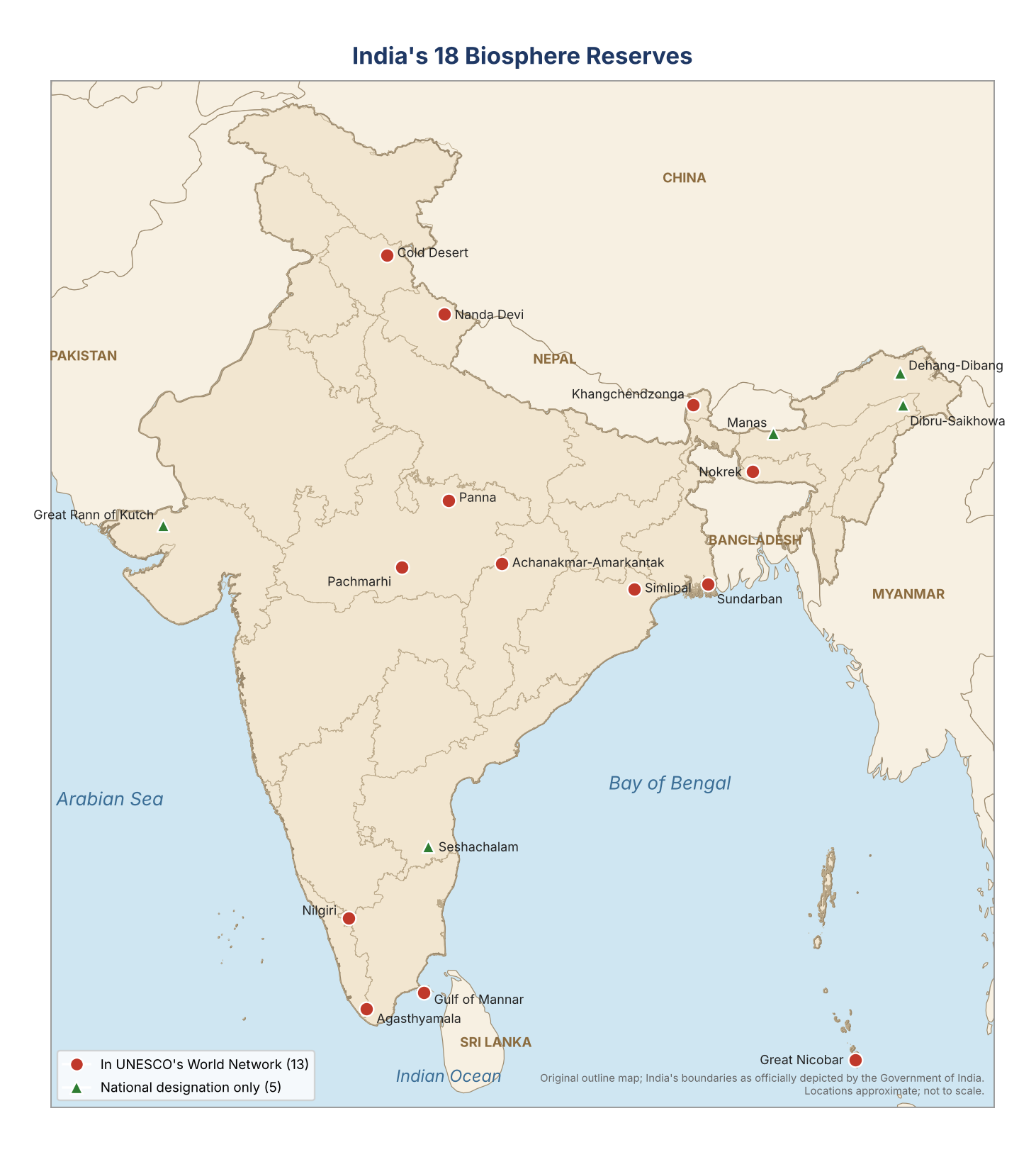
(ENVIRONMENT) (PIB) The International Day for Biosphere Reserves, observed every year on 3 November, highlights landscapes that conserve biodiversity while supporting the people who live in them. India has 18 notified Biosphere Reserves, of which 13 are in UNESCO’s World Network.
What Is a Biosphere Reserve?
A Biosphere Reserve is a large area, designated by the national government, that combines conservation with research and sustainable use. International recognition comes through UNESCO’s Man and the Biosphere (MAB) Programme (1971). Designation does not by itself give legal protection under the Wildlife (Protection) Act, 1972.
| Zone | Purpose | Activities allowed |
|---|---|---|
| Core | Strict protection of ecosystems | Monitoring and approved research; often a National Park or sanctuary |
| Buffer | Surrounds the core | Education, research, regulated eco-tourism |
| Transition | Outer area | Farming, forestry, settlements and sustainable livelihoods |
Global and Indian Network
- World Network: after 14 new sites in June 2026, it has 797 reserves in 145 countries, covering more than 5% of the Earth’s surface.
- First in India: Nilgiri Biosphere Reserve (1986), spread over Tamil Nadu, Kerala and Karnataka.
- Latest UNESCO entry: Cold Desert (Himachal Pradesh), India’s 13th, in September 2025 — home to snow leopard, Himalayan ibex and blue sheep.
- Not yet on the UNESCO list: Manas, Dibru-Saikhowa, Dehang-Dibang, Great Rann of Kutch and Seshachalam.
Government Support
- The Biodiversity Conservation Scheme of MoEFCC funds States for management plans of Biosphere Reserves; costs are shared 60:40 with States, and 90:10 with North-Eastern and Himalayan States.
- Five-year Integrated Management Plans have been piloted for Nanda Devi, Pachmarhi, Dehang-Dibang and Agasthyamala.
- Community enterprise: in Nilgiri, tribal artisans turn the invasive Lantana camara into elephant sculptures and furniture.
📖 Read More: Biosphere Reserves in India • Biodiversity of India • Invasive Species
9. Malabar Tree Toad Named Karnataka’s State Amphibian
(ENVIRONMENT) (NIE) Karnataka’s Department of Forest, Ecology and Environment has notified the Malabar Tree Toad (Pedostibes tuberculosus; Kannada: Malenadina Mara Gantikappe) as the State Amphibian, drawing attention to a rare, tree-dwelling toad of the Western Ghats.
Species Profile
| Feature | Details |
|---|---|
| Family | Bufonidae (true toads); the only species of the genus Pedostibes |
| Distribution | Endemic to the Western Ghats, a global biodiversity hotspot |
| Habitat | Wet evergreen and semi-evergreen forests; lives in tree canopies, hollows and leaf bases |
| Unusual trait | India’s only arboreal toad, with sticky toe pads for climbing |
| Breeding | Comes down to stream-side pools during pre-monsoon and early monsoon rains |
| History | Described in 1876; not seen for about a century and rediscovered in 1980 in Silent Valley, Kerala |
Why It Matters
- Indicator species: it needs clean streams and intact canopy, so its presence signals healthy forests.
- Climate risk: a citizen-science study projects its range in protected areas could shrink by up to 68.7% under high emissions.
- Flagship value: State symbols draw public attention and funds to little-known species; Karnataka has also chosen the Indian honeybee (Apis cerana) as its State insect.
📖 Read More: Biodiversity Hotspots • Biodiversity of India
10. Binance Hack: Lessons From a Record Crypto Heist
(INTERNAL SECURITY) (TH) Binance, the world’s largest cryptocurrency exchange, lost about US$6.3 billion in a cyberattack on 29 October 2026 — about four times the US$1.5 billion Bybit hack of 2025 and the largest crypto theft on record.
How It Happened
Targeted phishing of an engineer ➜ Malware-laced code ➜ Laptop compromised ➜
Access to hot wallets ➜ Funds drained
- Spear-phishing: a personalised message tricks a chosen person into opening a malicious file or link.
- Hot wallets: internet-connected wallets used for quick transactions are easier to attack than offline “cold” wallets.
- Attribution: blockchain analysts linked the attack to the North Korea-linked group TraderTraitor; about US$3 billion was frozen on-chain.
- Recovery: Binance said it would cover losses from its Secure Asset Fund for Users (SAFU) and company funds.
Why It Matters for Security
- Crypto theft can finance state weapons programmes and evade sanctions.
- Stolen assets can be laundered through mixers and cross-chain bridges — a money-laundering risk.
- The human weak link (social engineering) defeats even strong technical defences.
Regulatory Takeaways for India
- Clarity on crypto: a comprehensive law is still awaited; exchanges are covered by PMLA reporting rules.
- Stablecoins: if permitted, issuers should hold audited, fully backed reserves and follow anti-money-laundering rules.
- Cyber hygiene: mandatory audits, cold-storage norms and incident reporting for exchanges, in line with India’s cyber security framework.
📖 Read More: India’s Cyber Security Challenges • Blockchain Technology and Governance • Money Laundering
11. Network Anubhav: TRAI Maps Real-World Connectivity
(SCIENCE AND TECHNOLOGY) (DD) The Telecom Regulatory Authority of India (TRAI) has launched Network Anubhav, a geospatial web platform that shows real-world mobile and broadband performance and offers online Do Not Disturb (DND) services.
Data Sources
MySpeed app tests ➜ MyCall feedback ➜ TRAI drive tests ➜ Network Anubhav maps
Key Features
- Interactive maps: filter results by operator, location, technology (4G/5G) and download/upload speed.
- Realistic speeds: shows the median, and the speed reached in 80% of mobile and 90% of fixed-broadband tests, instead of peak advertised speeds.
- DND online: register preferences, complain about spam calls and messages, and track complaints.
- Operator dashboard: a secure view of user-test data on call quality, coverage and speed to fix weak spots.
- MySpeed SDK: approved third-party apps can add speed-testing and contribute data.
Significance
The platform empowers consumers to compare operators and helps TRAI track Quality of Service and 5G roll-out with evidence. TRAI notes that crowd-sourced results are indicative, not a formal assessment under a standard method.
📖 Read More: Mobile Cellular Networks: 1G to 5G • Digital India Programme
12. e-Sanjeevani Crosses 50 Crore Teleconsultations
(SOCIAL JUSTICE) (TOI) e-Sanjeevani, India’s free national telemedicine service, has facilitated over 50 crore consultations since its launch in 2019, bringing doctors within reach of remote and underserved areas from the Andamans to Zanskar.
About the Platform
- Owner and developer: Ministry of Health and Family Welfare; built by C-DAC, Mohali (under MeitY).
- Milestone: the 50-crore mark was crossed on 15 September 2026, with users in all 36 States and UTs.
- New features: an AI-based Clinical Decision Support System and integration with the Emergency Response Support System (ERSS-112).
Two Service Models
| Model | How it works |
|---|---|
| Provider-to-provider (hub and spoke) | A health worker at an Ayushman Arogya Mandir connects the patient to a doctor or specialist at a hub hospital |
| Patient-to-provider (eSanjeevaniOPD) | The patient consults a doctor directly from home on a phone or computer |
Significance
Women account for over 57% of all consultations, showing how telemedicine lowers barriers of distance, cost and mobility. The service supports the Ayushman Bharat Digital Mission and Digital India, and now extends to specialist OPDs at premier institutions such as AIIMS.
📖 Read More: Ayushman Bharat Digital Mission • National Health Mission
13. Agnipath Revamped: A Pathway for Every Willing Agniveer
(INTERNAL SECURITY) (HT) (AIR) As the first batch of Agniveers nears the end of its four-year term, the Union Cabinet has approved a two-year extension for the 75% who are not retained at the four-year mark. Those willing to serve on after the extension will be enrolled in the regular Armed Forces.
The Original Scheme (June 2022)
- Who: youth aged 17½ to 21 years (a one-time relaxation to 23 in 2022) recruited below officer rank in the Army, Navy and Air Force.
- Tenure: four years, including about six months of training.
- Pay and exit: monthly package rising from ₹30,000 to ₹40,000; a tax-free Seva Nidhi of about ₹11.71 lakh (with interest) on exit.
- Retention: up to 25% of each batch enrolled in the regular cadre on merit.
- Insurance: non-contributory life cover of ₹48 lakh.
What Changes
4 years as Agniveer ➜ 25% retained on merit ➜ 75% get 2-year extension ➜ Willing personnel enrolled
- Higher remuneration during the extension, according to officials.
- The scheme is to be reviewed periodically; reports indicate a financial review of the revamp.
Significance
The change answers the main criticism of the 2022 scheme — that most Agniveers would leave after four years with uncertain futures. It retains trained manpower and protects combat experience, but raises long-term salary and pension costs. Earlier, 10% of vacancies in CAPFs and Assam Rifles were reserved for former Agniveers.
📖 Read More: Agnipath Scheme • Armed Forces and Internal Security
14. Dakshata Padak 2026: Honouring Excellence in Policing
(INTERNAL SECURITY) (PIB) The Ministry of Home Affairs announced the Kendriya Grihmantri Dakshata Padak 2026 for 490 personnel from States, UTs, Central Armed Police Forces and Central Police Organisations, on 31 October — Rashtriya Ekta Diwas, the birth anniversary of Sardar Vallabhbhai Patel.
About the Medal
- Instituted: by an MHA notification of 1 February 2024, merging four earlier awards.
- Purpose: reward outstanding work, raise professional standards and boost morale.
- Eligibility: no minimum length of service; nominees must meet integrity and disciplinary standards.
Four Categories
| Category | Recognises |
|---|---|
| Special Operations | Counter-terrorism, border security, Left Wing Extremism, arms control, anti-narcotics and rescue operations |
| Investigation | Outstanding, evidence-based criminal investigation |
| Intelligence | Daring and exceptional intelligence work |
| Forensic Science | Meritorious work by serving government forensic scientists |
Of this year’s awardees, 358 were honoured for special operations, 123 for investigation and nine for forensic science. Such recognition supports the wider agenda of police reforms focused on professional, scientific policing.
📖 Read More: State Police and Police Reforms • Central Armed Police Forces
15. Assam Moves to Dismiss Employees Practising Polygamy
(SOCIETY) (ANI) The Assam Cabinet has approved amendments to the Assam Services (Discipline and Appeal) Rules, 1964, so that government employees found practising polygamy can be dismissed and barred from future State government jobs.
Context
- Polygamy means having more than one spouse at the same time; its common form is polygyny (one man, several wives).
- Hindu, Christian and Parsi marriage laws and the Special Marriage Act forbid bigamy; Muslim personal law permits up to four wives.
- Earlier step: the Assam Prohibition of Polygamy Bill, 2025, passed by the Assembly on 27 November 2025, makes polygamy a criminal offence (jail up to seven years; ten if an earlier marriage is concealed). Sixth Schedule areas are exempt, and it was sent for the President’s assent under Article 254(2).
- An expert committee headed by Justice (Retd.) Rumi Kumari Phukan (2023) had examined the State’s power to legislate on the subject.
Arguments For and Against
| For the move | Concerns raised |
|---|---|
| Protects women’s dignity and financial security (Right to Equality, Articles 14–15) | Questions of religious freedom (Article 25) and conflict with the Muslim Personal Law (Shariat) Application Act, 1937 |
| Public servants should follow uniform conduct standards | Service rules may punish the employee without helping the affected wife and children |
| Advances gender justice ahead of a possible Uniform Civil Code | Exempting some communities raises questions of uneven application |
Way Forward
Reform works best when it is backed by legal aid, maintenance and property rights for affected women, along with community dialogue. The deeper task is to empower women socially and economically, so that the role of women in society is shaped by choice, not dependence.
📖 Read More: Role of Women in Indian Society • Right to Equality • Right to Freedom of Religion
16. Ladakh: India’s First Fully Organic Union Territory
(GEOGRAPHY) (TOI) Lieutenant Governor Vinai Kumar Saxena has declared Ladakh India’s first 100% organic Union Territory, after farmland across Leh and Kargil moved away from chemical fertilisers and pesticides. Sikkim became the first fully organic State in 2016.
Location and Landscape
- A trans-Himalayan cold desert between the Karakoram to the north and the Great Himalaya to the south, drained by the Indus and its tributaries such as the Shyok and Zanskar.
- Became a separate Union Territory on 31 October 2019; districts include Leh and Kargil.
- Very low rainfall; farms depend on glacier-fed channels called kuhls.
How the Transition Happened
Manure-based tradition ➜ Mission Organic Development Initiative ➜
Fertiliser ban (July 2026) ➜ Certification ➜ 100% organic UT
- Certification: organic status needs a two-to-three-year conversion and certification under the NPOP or the Participatory Guarantee System of India (PGS-India).
- Inputs: compost, animal manure, bio-fertilisers and biological pest control replace chemicals.
Farm Produce and Opportunities
| Product | Note |
|---|---|
| Hull-less barley (grim) and buckwheat | Hardy crops of high-altitude organic farming |
| Raktsey Karpo apricot | GI-tagged; premium export potential |
| Ladakh sea buckthorn | GI-tagged; used in juices and nutraceuticals |
Significance and Challenges
- Ecology: keeps chemicals out of glacier-fed streams and fragile soils.
- Incomes: organic and GI branding can fetch premium prices for farmers and self-help groups.
- Challenges: short growing season, storage and processing gaps, and reliable supply of organic inputs.
📖 Read More: Organic Farming • Natural Farming • Union Territories