
UPSC CURRENT AFFAIRS — 4 NOVEMBER 2026
1. Counting Urban India: The Case for a National Policy
(SOCIETY) (TH) India’s first Census in 16 years will keep the 2011 yardsticks for what counts as “urban”. Experts warn that this will again under-record the towns growing on city fringes, and argue that only a unified National Urbanisation Policy (NUP) can bring these settlements into planning and finance.
How India Defines “Urban”
The Census uses a two-track definition. A settlement becomes urban either by legal notification or by meeting demographic tests, even if it is still governed as a village.
| Category | Basis | Governed by |
|---|---|---|
| Statutory Town | Notified under State municipal law — Municipal Corporation, Municipality, Nagar Panchayat, Cantonment Board — irrespective of size | Urban Local Body (ULB) |
| Census Town | Population ≥ 5,000; density ≥ 400 persons/sq km; ≥ 75% of male main workers in non-farm work | Still a Gram Panchayat |
Census 2011 counted about 377 million urban residents — 31.2% of the population. Satellite-based estimates cited by official economic advisers put functional urbanisation far higher, close to two-thirds of the population by 2015.
Why the Rural–Urban Binary Fails
- Capacity gap: Gram Panchayats lack engineers, planners and legal powers to run drainage, fire safety or sewerage for dense, non-farm settlements. Logistics belts such as Bhiwandi near Mumbai show the problem — urban economies under village administration.
- Outdated planning law: Many States still plan with frameworks that pre-date the 74th Constitutional Amendment, leaving peri-urban land without statutory zoning.
- Fiscal exclusion: Census towns miss urban grants, municipal bonds and capital schemes, surviving on small rural untied grants.
- Mismatch with environmental problems: Air pollution and flooding follow airsheds and river basins, not municipal lines; a city-only clean-air plan cannot tackle smoke generated outside its limits.
- Weak municipal finances: Municipal corporations’ revenue receipts are only about 0.6% of GDP; the oft-quoted comparison with Brazil (7.4%) and South Africa (6%) refers to total municipal revenue, not property tax alone.
Seven Shifts a National Policy Should Deliver
Classify settlements periodically ➜ Plan at regional scale ➜ Fix municipal finance ➜
Create a National Urbanisation Council ➜ Plan around functional regions ➜ Tie funds to devolution ➜ Build city knowledge networks
- Dynamic classification using satellite and geospatial economic data, instead of waiting a decade for the Census.
- Regional master planning below the million-plus threshold, guiding land conversion and transit-oriented growth on the fringe.
- Finance reform — digitised property tax and predictable, formula-based transfers in place of scheme-tied grants.
- A National Urbanisation Council, modelled on the GST Council, to coordinate Centre–State–local action.
- Functional geographies — airsheds, river basins and commuter corridors — as planning units.
- Incentives for devolution of the 18 functions listed in the Twelfth Schedule.
- Shared-service platforms and project-preparation support for tier-2 and tier-3 towns.
Way Ahead
- Use the Urbanisation Premium: the 16th Finance Commission earmarked ₹10,000 crore to reward States that merge peri-urban villages into adjoining larger ULBs.
- Activate constitutional bodies: make District Planning Committees (Article 243ZD) and Metropolitan Planning Committees (Article 243ZE) working regional planners.
- City Economic Regions: the Union Budget 2026–27 offers ₹5,000 crore per region over five years to fund shared transit and utilities across urban clusters.
- Pair notification with the 3Fs — funds, functions and functionaries — so a newly notified town actually gains staff and revenue.
📖 Read More: Urbanization: Problems and Remedies • Urbanisation • Local Governance in India • Suburbs & Suburban Growth
2. Qeshm Island: Flashpoint in the Strait of Hormuz
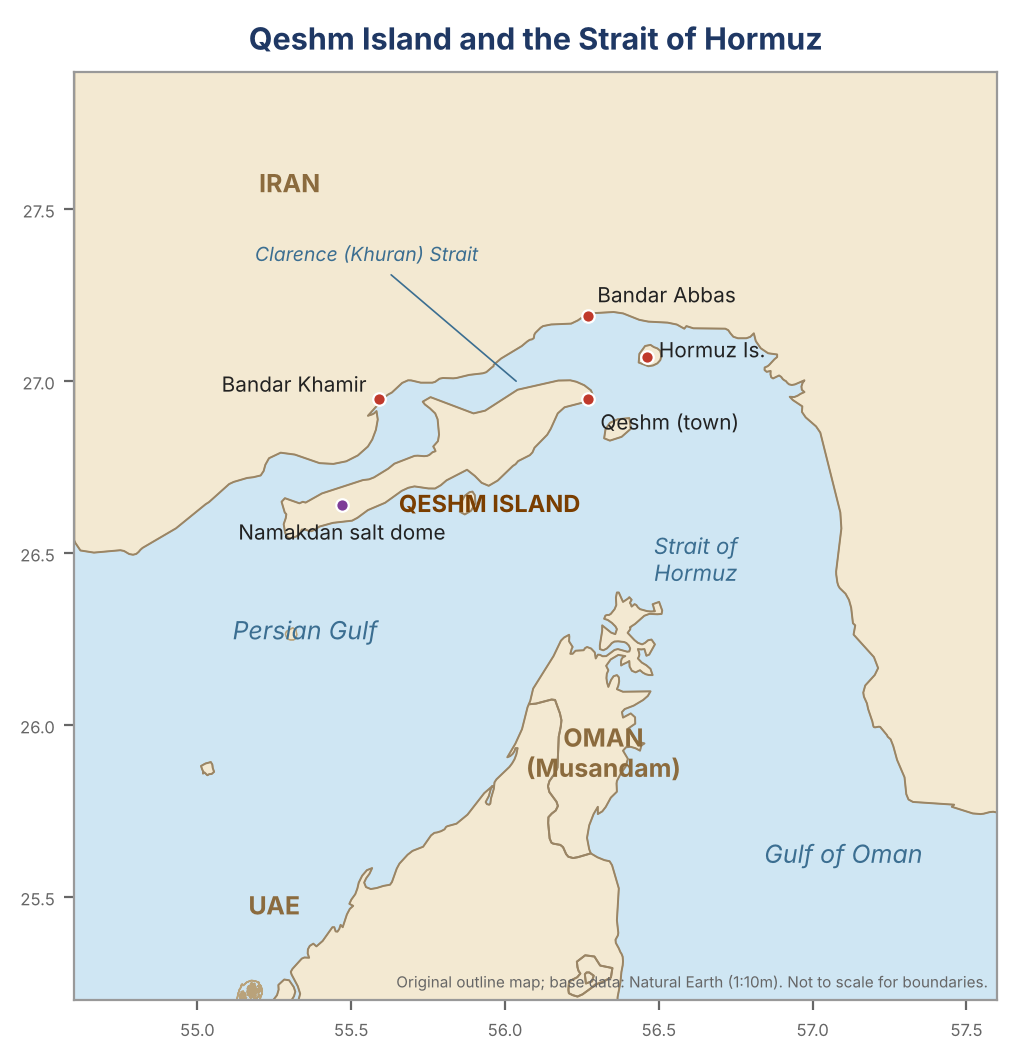
(GEOGRAPHY) (NDTV) The United States has again struck military targets on Iran’s Qeshm Island, describing them as defensive strikes against missile and drone positions that threaten shipping in the Strait of Hormuz. The island has been hit repeatedly since June 2026 despite a fragile US–Iran ceasefire.
Location and Physical Features
- Largest island of the Persian Gulf, in Iran’s Hormozgan province, lying off Bandar Abbas and Bandar Khamir.
- Separated from the mainland by the narrow Clarence (Khuran) Strait; it faces Oman’s Musandam peninsula across the Strait of Hormuz.
- About 1,491 sq km in area and roughly 135 km long — nearly twice the size of Bahrain.
- Highest point: the Namakdan salt dome (about 397 m) in the south-west.
Why It Matters
| Dimension | Significance |
|---|---|
| Geology | Namakdan Salt Cave (~6.6 km), one of the world’s longest salt caves, is the key site of the Qeshm Island UNESCO Global Geopark |
| Ecology | Hara mangrove forests on the north-west coast shelter migratory birds and marine life |
| Economy | Designated a free trade and industrial zone |
| Strategy | Reported IRGC tunnels for anti-ship missiles, drones and fast boats; overlooks the main oil-shipping lanes |
Implications of the Strikes
- Escalation near the Strait of Hormuz raises freight insurance costs and crude price volatility — a direct concern for India’s energy imports.
- Hitting coastal missile sites erodes Iran’s anti-access/area-denial (A2/AD) capacity, but tit-for-tat retaliation keeps the Gulf on edge.
📖 Read More: India – Iran Relations • Oil and Energy Diplomacy • India and West Asia Policy
3. Data Law vs Press Freedom Reaches the Supreme Court
(POLITY AND GOVERNANCE) (TH) The Supreme Court has sought the Centre’s reply to a petition by the Digital News Publishers Association (DNPA), representing 21 news organisations. It argues that the Digital Personal Data Protection (DPDP) Act, 2023 and the DPDP Rules, 2025 cripple investigative journalism.
The Provisions Under Challenge
| Provision | What it does | Concern raised |
|---|---|---|
| Sections 7 and 17 | List “legitimate uses” and exemptions | No carve-out for journalism; reporters become data fiduciaries needing consent from those they investigate |
| Section 36 | Centre may call for information from fiduciaries | Risk to confidential sources and whistle-blowers |
| Section 37 | Centre may block content on a Data Protection Board reference | Fear of executive pre-censorship |
| Section 44(3) | Amends Section 8(1)(j) of the RTI Act, 2005 | Removes the “larger public interest” override; all personal information becomes exempt |
A data fiduciary is any person who decides the purpose and means of processing personal data. Treating newsrooms this way imports consent, erasure and notice duties into reporting.
The Constitutional Balance
Privacy (Art. 21) ➜ Harmonious balance ➜ Press freedom (Art. 19(1)(a))
- Privacy was declared a fundamental right in K.S. Puttaswamy (2017).
- Press freedom flows from Article 19(1)(a), subject to reasonable restrictions under Article 19(2).
- The Centre counters that defining a “journalist” in the age of independent creators is legally difficult. Related challenges, including one by RTI activist Venkatesh Nayak, are pending.
📖 Read More: Data Localisation and Privacy Issues • Right to Information (RTI) • Media and Broadcasting Governance
4. Women’s Rights and the Transgender Law: A New PIL
(SOCIAL JUSTICE) (TH) A Bench led by the Chief Justice issued notice on a PIL by Women’s Declaration International India. It argues that legal recognition of gender identity under the Transgender Persons (Protection of Rights) Act, 2019, as amended in 2026, should not automatically extend sex-specific protections meant for women.
The 2019 Act at a Glance
- Enacted after NALSA v. Union of India (2014), which recognised transgender persons as the “third gender”.
- Bars discrimination in education, health care and employment; set up the National Council for Transgender Persons.
- Section 6: identity certificate from the District Magistrate; Section 7: revised certificate (male/female) after gender-affirming surgery.
What the 2026 Amendment Changed
| Feature | 2019 Act | After 2026 Amendment |
|---|---|---|
| Self-identification | Section 4(2) recognised self-perceived gender identity | Section 4(2) omitted |
| Definition | Broad, inclusive of non-binary identities | Narrowed largely to socio-cultural identities and specified intersex variations |
| Certification | District Magistrate on application | DM acts on recommendation of a Medical Board headed by a Chief Medical Officer |
The amendment itself is under challenge: the Court issued notice on 4 May 2026 and later stayed parallel High Court proceedings.
Concerns Raised by the Petitioners
- Article 15(3): special provisions for “women” should mean biological females.
- Local-body reservation: seats reserved under Articles 243D and 243T could be diluted.
- Safe spaces: women’s prisons, shelters and toilets.
- Criminal procedure: BNSS, 2023 safeguards such as search only by women officers.
- Sport: fairness in the female category.
Balancing Both Sets of Rights
- Clarify “sex” for affirmative action and “gender identity” for anti-discrimination.
- Offer horizontal reservation for transgender persons, as Karnataka does with 1% in public jobs, rather than sharing women’s quotas.
- Build parallel infrastructure — transgender wards, gender-neutral facilities — and open categories in sport.
- Record both sex at birth and legal gender in official data to keep sex-disaggregated statistics reliable.
📖 Read More: LGBTQIA+ Communities and Minorities • NALSA Case (2014) • Women-led Development
5. Why India Votes Against Regional Arms Control
(INTERNATIONAL RELATIONS) (NIE) India and Israel voted against a Pakistan- and Belarus-sponsored draft on “Conventional arms control at the regional and subregional levels” in the UN General Assembly’s First Committee (Disarmament and International Security).
What the Resolution Proposes
- Pursue conventional arms control mainly through regional and subregional arrangements, at the “lowest level” of military equilibrium.
- Place a special responsibility on militarily significant States in a region.
- Ask the UN Disarmament Commission (UNDC) to frame principles for regional agreements, and refer specifically to proposals for South Asia.
India’s Explanation of Vote
Threats are global ➜ Arms control must be universal ➜ No South Asia clause
- India’s security environment spans Pakistan, China and the Indian Ocean; a South-Asia-only balance would constrain it unfairly.
- The UNDC has already adopted guidance by consensus — 1993 guidelines on regional disarmament, 1999 guidelines on conventional arms control and 2017 recommendations on practical confidence-building measures — so a fresh mandate is redundant.
India has opposed this text every year; in 2024 it was the only country to vote “no” while Israel abstained, so Israel’s “no” this year is a notable shift.
📖 Read More: The United Nations • India’s National Security Policy • Evolution of Indian Foreign Policy
6. Tiger Triumph 2026: India–US Disaster Drill
(INTERNATIONAL RELATIONS) (NIE) The 5th edition of Tiger Triumph, the India–US bilateral tri-service Humanitarian Assistance and Disaster Relief (HADR) exercise, opened on 2 November 2026 at the Maritime Warfare Centre, Visakhapatnam.
| Aspect | Details |
|---|---|
| First held | 2019, on the Visakhapatnam–Kakinada coast |
| Format (2026) | Tabletop Exercise (TTX) — joint planning and crisis management rather than large field drills |
| Indian participants | Navy, Army, Air Force and Special Forces of all three Services |
| First-ever | A team of the National Disaster Response Force (NDRF) joins for the first time |
| Domains | Maritime, land, air, space, cyber and combat medicine — under Combined Joint All-Domain Operations |
Significance
- Builds interoperability for coordinated disaster response in the cyclone-prone Bay of Bengal and wider Indo-Pacific.
- Bringing in the NDRF strengthens civil–military coordination, a key lesson of large disasters.
- Turns foundational pacts such as LEMOA into practical joint planning, deepening the India–US Major Defence Partnership.
📖 Read More: India – United States Relations • International Cooperation on Disaster Management
7. Fish and Buffalo Meat Now Lead Farm Exports
(ECONOMICS) (IE) Commerce data for April–September 2026 (H1 FY27) show marine products (about $4.5 billion) and buffalo meat (about $3.4 billion) as India’s two largest agricultural exports, ahead of traditional leaders such as basmati rice.
| Indicator (H1 FY27) | Value | Growth (y-o-y) |
|---|---|---|
| Total agri-exports | $27.1 billion | 4.7% |
| Marine products | $4.5 billion | 13.2% |
| Buffalo meat | $3.4 billion | 53.8% |
Buffalo meat crossed $5 billion for the first time in FY26, and average realisation has risen sharply — from roughly $2,700 per tonne in FY23 to over $4,300 in H1 FY27.
What Is Driving the Shift
- Market diversification: buffalo meat goes to Vietnam, Egypt, Malaysia, Indonesia and Saudi Arabia; seafood is expanding to the EU, China and Japan to offset US tariff risk.
- Quality upgrade: exports only from APEDA-registered integrated abattoirs that meet sanitary and phytosanitary (SPS) norms; lean, halal-certified carabeef now fetches premium prices.
- Aquaculture boom: vannamei shrimp farming in Andhra Pradesh, Odisha and Gujarat, backed by disease-free hatcheries.
- Policy stability: unlike rice, wheat or sugar, these products rarely face sudden export bans or minimum export prices.
- Climate resilience: livestock and aquaculture are less exposed than rain-fed crops to an erratic monsoon.
Challenges
| Challenge | Example |
|---|---|
| Non-tariff barriers | Rejections of shrimp in the US and EU over antibiotic residues |
| Animal disease | Foot-and-Mouth Disease (FMD) keeps Indian meat out of premium Western markets |
| Environmental footprint | Salinisation of groundwater and mangrove loss around intensive shrimp ponds |
| Freight shocks | West Asia tensions raising reefer-container costs to the Gulf |
Way Ahead
- Use the National Animal Disease Control Programme to win FMD-free zone recognition from the World Organisation for Animal Health (WOAH).
- Move up the value chain — ready-to-eat seafood, seaweed and cage culture under PMMSY.
- Accredited pre-shipment testing labs and digital traceability to cut residue rejections.
📖 Read More: Agriculture and Allied Sectors • Livestock Resources and White Revolution • Aquaculture • Fishing Industry
8. Saving Sikkim’s Siri Cattle
(ECONOMICS) (DD) The Union Minister of Fisheries, Animal Husbandry and Dairying announced a Centre of Excellence for the indigenous Siri cattle breed in Sikkim and launched the North District Cooperative Milk Producers’ Union at Mangan under White Revolution 2.0.
About the Siri Breed
- Indigenous dual-purpose (milk and draught) cattle of the eastern Himalaya — Sikkim and the Darjeeling hills; known in Bhutan as Nublang.
- Hardy in mountain terrain; recognisable by a prominent hump covered with long hair.
- Numbers have fallen, partly due to cross-breeding — hence the need for genetic conservation.
Key Initiatives
| Initiative | Purpose |
|---|---|
| Siri Cattle Conservation Programme | Preserve the breed’s genetic resources and promote scientific breeding |
| Siri Bull Mother Farm, Chuchachen (Pakyong) | Produce quality germplasm for breed improvement |
| IVF work plan | Faster multiplication of superior animals |
| “Sikkim Milk” brand | NDDB to plan plant modernisation and cooperative expansion |
| Pig-breeding protocols | Standards for semen production and AI with liquid semen in the North-East |
📖 Read More: Rashtriya Gokul Mission • Livestock Resources and White Revolution
9. SUVIKALP: New Lives for Closed Coal Mines
(ECONOMICS) (PIB) The Coal Controller Organisation (CCO) under the Ministry of Coal has developed SUVIKALP – Mine Repurposing Tool, a digital decision-support platform to turn closed and abandoned coal and lignite mines into productive assets.
How the Tool Works
Factor selection ➜ Option generation ➜ Community priorities ➜
Suitability assessment ➜ Final ranking
- Unified site profile: combines geo-mining, environmental, infrastructure, resource, financial and socio-economic data.
- TOPSIS method: a multi-criteria decision-making technique that ranks options by their closeness to an ideal solution, reducing subjective bias.
- RECLAIM (Community Engagement and Development Framework): weaves local jobs, livelihoods and infrastructure needs into the assessment.
- PRISM (Post-Mining Repurposing Implementation Strategic Model): concept notes, case studies, sample tenders and agency details to move from plan to project.
- Aligned with the Mining Plan Guidelines for Coal and Lignite Mines, 2025.
Significance
- Possible end-uses include eco-parks, floating solar, afforestation, agriculture, tourism and industrial hubs.
- Supports a just transition for coal regions — restoring land while protecting livelihoods.
📖 Read More: Coal Sector in India • Recent Developments in Coal Sector • Schemes under Ministry of Coal
10. CBD COP-17 Ends with the Yerevan Pathway
(ENVIRONMENT) (DD) The 17th Conference of the Parties to the Convention on Biological Diversity, held in Yerevan, Armenia (19–30 October 2026), closed with the Yerevan Pathway. India pressed for predictable finance and technology transfer to implement the Kunming–Montreal Global Biodiversity Framework (KMGBF).
Key Outcomes
| Outcome | What it means |
|---|---|
| Yerevan Pathway | Follows the first global review of the KMGBF; urges countries to align budgets with nature goals, reform harmful subsidies and tighten monitoring before 2030 |
| Sevan Guidelines | Operating rules for a new permanent subsidiary body on Article 8(j) — Indigenous Peoples and Local Communities |
| Finance pledges | Nearly $2 billion announced, including the Species Recovery Alliance (over $500 million) |
| Harmful subsidies | Language softened from “urge” to “encourage”, “in accordance with national circumstances”; India was among those opposing stronger text |
| Cali Fund (DSI) | Pilot certificates for voluntary corporate contributors; the fund had raised only about $10,000 against a $1 billion-a-year ambition |
| Next COP | COP-18 to be hosted by Ecuador in 2028 |
India’s Statement
- KMGBF implementation must respect national priorities and be backed by finance, capacity building and technology transfer.
- Supported benefit-sharing from Digital Sequence Information through the Cali Fund; urged a precautionary, science-based approach to synthetic biology.
- Updated NBSAP sets 23 national targets with 142 indicators.
| India’s conservation network | Number |
|---|---|
| Protected Areas | 1,134 |
| Ramsar Sites | 103 |
| Biodiversity Heritage Sites | 57 |
| Biosphere Reserves (13 in UNESCO MAB) | 18 |
- Showcased MISHTI (mangroves), Amrit Dharohar (wetlands), the International Big Cat Alliance, Mission LiFE and “Ek Ped Maa Ke Naam”.
- Village-level Biodiversity Management Committees under the Biological Diversity Act, 2002 anchor access and benefit-sharing.
KMGBF in Brief
COP-15 (2022) ➜ 23 targets by 2030 ➜ 4 goals by 2050 ➜
Vision: living in harmony with nature
The KMGBF replaced the Aichi Targets. It is not legally binding; countries align their National Biodiversity Strategies and Action Plans with it, and the Global Biodiversity Framework Fund under the GEF finances implementation.
📖 Read More: International Initiatives for Biodiversity Conservation • National Initiatives for Biodiversity Conservation
11. Crocodile Deaths Alarm Bhitarkanika
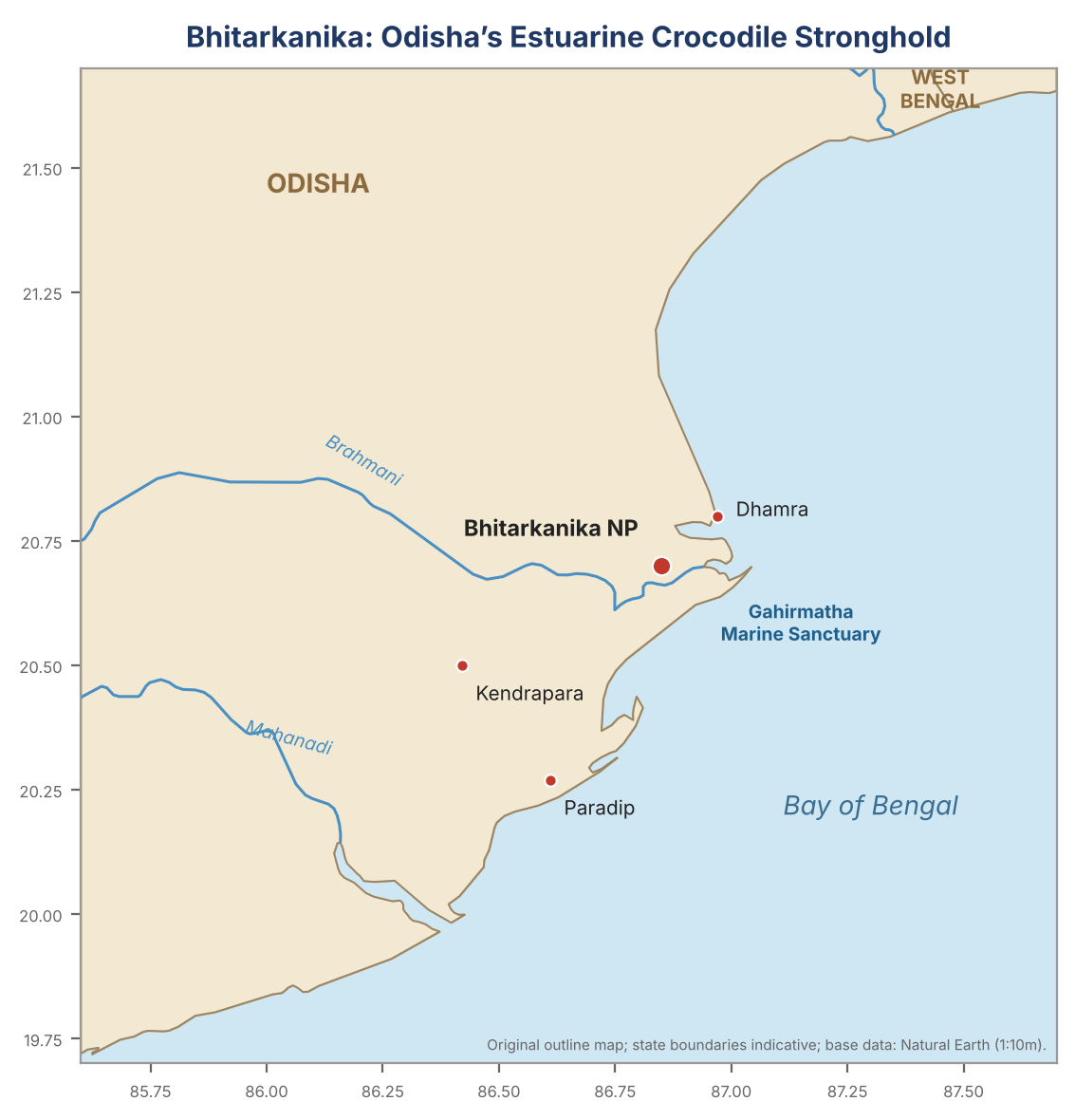
(ENVIRONMENT) (DTE) Five saltwater crocodiles died within 27 days in and around Bhitarkanika National Park, Kendrapara (Odisha). Conservationists suspect drowning in illegal fishing nets; unnatural deaths now total 22 in six years and 44 in 14 years.
The Saltwater (Estuarine) Crocodile
- The largest living reptile; adult males can exceed 6 m and 1,000 kg.
- Lives in mangroves, estuaries, deltas and lagoons from eastern India to Southeast Asia and northern Australia; can cross open sea.
- Salt glands on the tongue excrete excess salt; one of the strongest bite forces measured in any animal.
- Females guard mound-nests of rotting vegetation and carry hatchlings to water in their jaws.
- Status: IUCN Least Concern; Schedule I of the Wildlife (Protection) Act.
Bhitarkanika at a Glance
| Feature | Details |
|---|---|
| Area | 145 sq km National Park within the 672 sq km Bhitarkanika Wildlife Sanctuary |
| Rivers | Delta of the Brahmani, Baitarani, Dhamra and Pathsala on the Bay of Bengal |
| Recognition | Ramsar Site (2002); India’s second-largest mangrove ecosystem after the Sundarbans |
| Crocodiles | From about 95 in 1975 to 1,858 in the January 2026 census — India’s largest wild population |
| Neighbour | Adjoins Gahirmatha Marine Sanctuary, a mass-nesting beach of Olive Ridley turtles |
The conservation programme began in 1975 with support from the Union Environment Ministry and UNDP — one of India’s early species-recovery successes now threatened by unregulated fishing.
📖 Read More: National Parks in India • Conservation of Major Indian Wildlife Species • Wetland Ecosystem
12. Swift Observatory’s Final Plunge
(SCIENCE AND TECHNOLOGY) (NASA) NASA’s Neil Gehrels Swift Observatory, roughly 1.5 tonnes, is making an uncontrolled re-entry after more than two decades of service. NASA expected re-entry on 4 November 2026; any surviving fragments can fall only between about 20.6° N and 20.6° S, with a very low risk to people.
Mission Profile
| Aspect | Details |
|---|---|
| Launch | 20 November 2004 on a Delta II rocket |
| Purpose | Detect gamma-ray bursts (GRBs) and swing its telescopes to catch their afterglows within seconds |
| Renamed | January 2018, after principal investigator Neil Gehrels (died 2017) |
| Design life | Two years — it operated for over 20 |
| Operator | NASA Goddard, with Penn State, UK and Italian partners |
Three Telescopes, One Target
BAT spots burst (15–150 keV) ➜ Autonomous slew ➜
XRT (0.2–10 keV) + UVOT record afterglow
- Burst Alert Telescope (BAT): coded-mask imager watching a wide patch of sky.
- X-Ray Telescope (XRT): pinpoints and analyses the afterglow.
- Ultraviolet/Optical Telescope (UVOT): a 30-cm telescope tracking early optical and UV light.
Legacy
- Detected well over a thousand GRBs, including GRB 090423 from about 630 million years after the Big Bang.
- Helped track the counterpart of the neutron-star merger GW170817, a landmark of multi-messenger astronomy.
- Its end also highlights re-entry and debris risks from ageing satellites.
📖 Read More: Current Astronomical Advances • Orbits in Space Technology
13. A Journal That Guards Traditional Knowledge
(SCIENCE AND TECHNOLOGY) (PIB) CSIR–NIScPR concluded the International Conference on Communication and Dissemination of Traditional Knowledge (CDTK-2026), marking 25 years of the Indian Journal of Traditional Knowledge (IJTK) and releasing its anniversary issue.
About IJTK
- A peer-reviewed, diamond open-access journal — free to read and free to publish.
- Published by CSIR–NIScPR (formed in 2021 by merging NISCAIR and NISTADS).
- Covers ethnobotany, ethnomedicine, AYUSH systems, reverse pharmacology and rural technologies.
- Indexed in major international databases, and recognised as prior-art literature for patent examination under the WIPO Patent Cooperation Treaty.
Why It Matters
Document knowledge ➜ Publish as prior art ➜ Block biopiracy patents
- Complements the Traditional Knowledge Digital Library (TKDL) in defending India’s heritage against misappropriation.
- Supports benefit-sharing and prior informed consent under the Biological Diversity Act, 2002.
📖 Read More: Intellectual Property Rights • Institutional Framework of S&T in India
14. CRPF Marks a Year Without Combat Deaths
(INTERNAL SECURITY) (TOI) The Central Reserve Police Force (CRPF) has completed 12 consecutive months without an operational fatality — the first such stretch in 47 years. Its last operational death was on 30 October 2025.
About the CRPF
- India’s largest Central Armed Police Force, under the Ministry of Home Affairs.
- Raised in 1939 as the Crown Representative’s Police; renamed CRPF by the CRPF Act, 1949.
- Roles: counter-insurgency, anti-Naxal operations, riot control, election duty and VIP security.
What Made the Difference
Better equipment & training ➜ Intelligence-led planning ➜
Rapid casualty evacuation ➜ Zero operational deaths
The Unfinished Agenda
Operational safety has not ended personnel losses. The NHRC took suo motu cognizance of reported suicides among CRPF personnel in 2026, pointing to the need for mental-health support, predictable leave and welfare measures.
| GS Paper | Link |
|---|---|
| GS II | Welfare of security personnel; role of the NHRC |
| GS III | Security forces and their mandate; Left-Wing Extremism |
| GS IV | Duty of care and institutional accountability |
📖 Read More: Central Armed Police Forces • Countering Left Wing Extremism