
India and West Asia Policy
West Asia — the region stretching from the eastern shores of the Mediterranean Sea across the Arabian Peninsula to the Persian Gulf — is one of the most consequential theatres for India’s foreign policy. It is simultaneously India’s energy storehouse, its largest labour destination, a major trading partner, and a volatile strategic frontier.
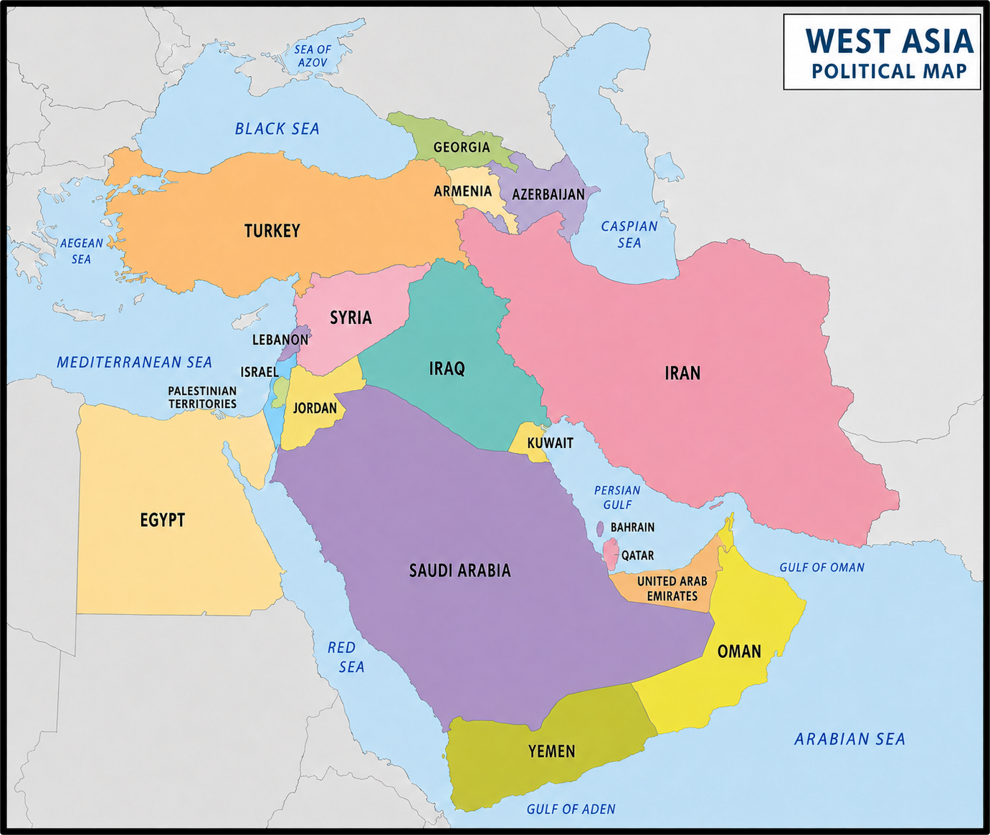
Because so many of India’s core national interests converge here, the region is best understood not as a distant zone but as India’s “extended neighbourhood.” This section traces how the relationship evolved, isolates the key drivers that shape policy today, and maps the cooperation, challenges and choices ahead.
| Why the term “Key Drivers”? India’s West Asia policy is propelled by a distinct set of enduring interests — remembered as the 5 E’s: Energy security, Economy & trade, Expatriates (diaspora & remittances), External balancing (strategic-security), and the Extended neighbourhood logic. Every discussions that follows can be linked back to these drivers. |
Historical Evolution of the Relationship
The India–West Asia bond is civilisational, not merely diplomatic. Trade in turquoise, copper and spices linked the Indus Valley Civilisation to the region, and Indian merchants traded along the Arabian coast — including with Mecca — even before the advent of Islam.
From the 6th century BCE, Indians also traded with Jewish communities settled on India’s west coast. This deep-rooted familiarity is the bedrock on which modern policy rests.
A. The Colonial Overlay
British rule added a geo-strategic dimension. For the empire, West Asia was a land bridge connecting India to Afghanistan, Europe and the Mediterranean, and a shield for maritime trade.
The region was administered partly through the Persian Gulf Residency, and the Indian Rupee circulated as legal tender in Qatar, Kuwait, Oman and Bahrain until 1959 — a striking marker of how integrated the two regions once were. Regional politics in this era was pulled by three currents: Arab nationalism, Western imperialism and the Zionist movement.
B. Nationalism, Palestine and the Birth of Israel
India’s freedom movement instinctively sympathised with the Arab cause. Viewing Zionism through an anti-colonial lens, Indian nationalists supported the Palestinian Arabs; the Congress even observed a Palestine Day on 27 September 1936.
At the United Nations, India opposed the partition of Palestine and backed a unified federal Arab Palestine. When partition nonetheless occurred, the state of Israel was born in May 1948.
C. Post-Independence: The “Two-Point” Policy
After 1947 India followed a twin approach: political solidarity with the Arabs and support for secular, socialist Arab leaders such as Nasser of Egypt and the Ba’ath leadership of Iraq.
Non-alignment became the moral foundation of Indo-Arab friendship, and India used NAM platforms to press for a peaceful settlement of the Palestine question — even supporting the 1975 UN resolution equating Zionism with racism. Two quiet motives ran underneath: securing Gulf oil and countering Pakistan’s influence in the Islamic world.
D. The Post-Cold War Recalibration
The 1990s forced a pragmatic reset. With the Soviet collapse and India’s 1991 economic liberalisation, economics displaced ideology as the compass of policy. In 1992, under P. V. Narasimha Rao, India established full diplomatic relations with Israel.
The 1993 Oslo Accords — under which the PLO and Israel signed a peace deal — gave India the diplomatic space to deepen ties with Israel without abandoning the Palestinian cause. Meanwhile, an earlier flow of unskilled and semi-skilled Gulf migrants (accelerated by the 1973 oil boom) matured into a large diaspora sending home vital remittances.
E. Look West Policy → “Look West, Act East”
In 2005, Prime Minister Manmohan Singh articulated the Look West Policy (LWP), formally describing West Asia as part of India’s extended neighbourhood and prioritising economic integration.
The policy later acquired fresh momentum through intensive high-level engagement, adding defence, counter-terrorism and strategic content to what had been a largely commercial relationship.
Tellingly, as Gulf states diversify away from oil and turn eastward with their own “Look East” outlook, India has emerged as a preferred partner — the operative mantra becoming “Look West and Act East.”
Timeline at a Glance
| Ancient | Indus Valley trade in spices, copper, turquoise; merchants trading with Mecca & Jewish communities. |
| Colonial | Persian Gulf Residency; Rupee as Gulf currency till 1959; region as imperial land-bridge. |
| 1936–48 | Palestine Day (1936); India opposes UN partition; Israel created (1948). |
| Cold War | Two-point policy: Arab solidarity + NAM; oil access; countering Pakistan. |
| 1992–93 | Full ties with Israel (1992); Oslo Accords enable de-hyphenation (1993). |
| 2005 | Manmohan Singh unveils Look West Policy; West Asia = “extended neighbourhood.” |
| Present | “Look West, Act East”: defence, strategic & counter-terror dimensions added. |
The Key Drivers of India’s West Asia Policy
Five interlocking interests explain almost every Indian move in the region. They are best studied together, since each reinforces the others.
| Driver | What it means for India |
| Energy security | The Persian Gulf supplies the bulk of India’s crude and gas. Around 60% of India’s crude imports and the majority of its LPG/LNG originate here, making stable Gulf ties a non-negotiable of economic survival. |
| Economy & trade | West Asia is among India’s largest trading blocs and a growing investment source, from sovereign wealth funds to refinery and infrastructure partnerships. |
| Expatriates & remittances | Roughly 9 million Indians work in the Gulf — India’s largest overseas community — anchoring the world’s highest remittance inflows and giving India deep human stakes in regional stability. |
| External balancing (strategic) | Defence cooperation, maritime security, counter-terrorism and the goal of diluting Pakistan’s traditional influence in the Islamic world. |
| Extended neighbourhood | Proximity across the Arabian Sea makes West Asia a strategic periphery — a gateway to Central Asia, Africa and Europe, and the Indian Navy’s primary area of maritime interest. |
Significance of West Asia for India
The region’s importance is genuinely multi-dimensional — political, economic, strategic, energy-related, cultural and diasporic. These strands are tightly interlinked: energy dependence drives trade, trade sustains the diaspora, and the diaspora deepens the political stake.
- Energy dimension: The Gulf meets a dominant share of India’s hydrocarbon needs — around 60% of crude imports, along with the majority of LPG and LNG. Iraq and Saudi Arabia are among the top suppliers, and any disruption directly threatens growth and prices.
- Economic dimension: West Asia is a crucial trade and investment partner in construction, infrastructure, technology and energy. Gulf sovereign funds increasingly invest in Indian ventures, signalling growing economic interdependence.
- Diaspora dimension: Millions of Indians live and work here — an estimated ~3.5 million in the UAE and ~2.5 million in Saudi Arabia. They generate massive remittances and act as living bridges of goodwill.
- Strategic dimension: The Gulf is the Indian Navy’s primary maritime interest area; partnerships aid counter-terrorism, counter-radicalisation and the security of vital sea lanes.
- Connectivity dimension: West Asia is India’s gateway to Central Asia, Afghanistan, Russia and Europe through corridors such as Chabahar, the INSTC and IMEC.
- Cultural dimension: Centuries of civilisational exchange, shared heritage and a network of cultural centres sustain strong people-to-people links.
Areas of Cooperation
Trade and Commerce
Commerce is the ballast of the relationship. The India–UAE CEPA (Comprehensive Economic Partnership Agreement) has been transformational: bilateral trade nearly doubled to about USD 83.7 billion in FY 2023–24 from roughly USD 43 billion three years earlier, with non-oil trade crossing USD 57 billion and both sides targeting USD 100 billion by 2027.
The UAE ranks among India’s top three trading partners, while Iraq and Saudi Arabia remain leading crude suppliers.
Energy Cooperation
- Long-term gas contracts: India’s 20-year LNG deal with QatarEnergy extends supplies to 2048, locking in affordable, predictable gas.
- Strategic petroleum reserves: Gulf majors store crude in India’s underground reserves (e.g., an Abu Dhabi National Oil Company (ADNOC) facility in Karnataka), cushioning India against shocks.
- Green & renewable energy: Gulf sovereign funds invest in Indian solar and green-hydrogen projects, reflecting the region’s own push beyond oil.
- Joint ventures: Collaboration on refining, petrochemicals and exploration, including large west-coast refinery projects planned with Gulf partners.
- Sea-lane security: The Indian Navy safeguards Gulf energy shipping through sustained maritime patrols such as Operation Sankalp.
Defence and Security
Once a taboo subject, defence is now the fastest-growing pillar. India conducts joint exercises, defence-industrial cooperation and intelligence-sharing with partners such as the UAE, Saudi Arabia and Israel.
Israel is a critical source of high-technology systems — air-defence, drones and airborne early-warning — while Gulf states increasingly view India as a reliable security interlocutor. As Gulf capitals lost confidence in the West as a dependable guarantor, many adopted a “Look at India” posture — a striking inversion of the old dynamic.
Connectivity Initiatives
| Corridor / Project | Strategic value |
| IMEC | The India–Middle East–Europe Economic Corridor, announced at the 2023 G20 Summit in New Delhi, links India via the UAE and Saudi Arabia to Europe through rail, ports, clean-hydrogen pipelines and data cables. Signatories include India, Saudi Arabia, the UAE, the EU, France, Germany, Italy and the US. |
| Chabahar Port | India-developed port in Iran opening a route to Afghanistan and Central Asia that bypasses Pakistan. |
| INSTC | The International North–South Transport Corridor — a multimodal link to Central Asia, Russia and Europe via Iran. |
| Duqm Port (Oman) | Access to a deep-water port outside the Strait of Hormuz choke point, boosting India’s maritime reach. |
| Ashgabat Agreement | Joined by India in 2018; enhances transit and trade between Central Asia and the Persian Gulf. |
Diaspora and Cultural Cooperation
The ~9-million-strong Indian community in the Gulf is both an economic asset and a policy priority. Protecting its welfare, ensuring remittance flows and building cultural centres and educational exchanges are core objectives.
In a notable diplomatic signal, India attended the Organisation of Islamic Cooperation (OIC) foreign ministers’ meet as a “guest of honour,” underlining its widening outreach in the Islamic world.
India’s Foreign-Policy Approach
Underlying the cooperation is a coherent doctrine built on balance and restraint. Five principles stand out.
- De-hyphenation: India maintains independent relationships with rival pairs — Israel and Palestine, Iran and Saudi Arabia — refusing to let one relationship be held hostage by another. This is India’s signature contribution to regional diplomacy.
- Strategic balancing: Policymakers have deliberately cultivated a fine equilibrium among Iran, Saudi Arabia and Israel while continuing to support the Palestinians — an approach that maximises India’s room to manoeuvre.
- Hands-off, stability-first: India favours democratic pluralism but avoids interference in internal affairs. Through the upheavals of the Arab Spring (2011), it kept a non-interventionist posture, prioritising stability and its own interests over ideological crusades.
- Economics over ideology: Since 1991, economic interest — not political rhetoric — has been the organising logic of engagement. The old anti-Israel rhetoric was shed; commerce became the lodestar.
- Food-for-energy compact: A neat complementarity underpins ties — India offers the Gulf food security and skilled manpower in return for energy security, with expanding cooperation in solar technology and Gulf security.
| The elegant symmetry India looks West for energy, capital and jobs; the Gulf looks East — to India and Asia — for markets, food and a dependable security partner. This mutual “look-at-each-other” logic, rather than any bloc alignment, is what makes the partnership durable. |
Issues and Challenges
The relationship is not without friction. The principal challenges cut across energy, security, geopolitics and the diaspora.
- Energy vulnerability: Heavy dependence on Gulf oil and gas leaves India exposed to price shocks and supply disruptions whenever the region destabilises.
- Chronic instability: Unrest in Syria, Iraq and Yemen, the aftershocks of the Arab Spring, and recurrent Israel–Iran escalation endanger Indian investments, trade routes and citizens.
- Syria after Assad: The fall of the Assad regime (December 2024) and the rise of Hayat Tahrir al-Sham (HTS) — a former al-Qaeda affiliate — create fresh dilemmas. India must protect its interests without legitimising radical actors, while watching for spillover radicalisation and an unfriendly Turkish posture on Kashmir.
- The sectarian tightrope: India must balance ties between Shia-majority Iran and Sunni-majority Saudi Arabia amid deep sectarian rivalry.
- Major-power rivalry: China’s expanding footprint — through investments, infrastructure and diplomacy — directly competes with Indian influence.
- Emerging regional security alignments: The Mecca Joint Defense Agreement (2026) between Saudi Arabia, Türkiye and Pakistan adds a new strategic variable for India by linking a key West Asian partner with Pakistan and Türkiye through a collective-security framework. It may complicate India’s regional balancing and increase Pakistan’s strategic leverage.
- Terrorism and radicalisation: Groups such as ISIS threaten Indian nationals abroad and feed domestic security concerns.
- Untapped economic potential: Despite growth, West Asia is still a modest share of India’s total trade, and a GCC–India Free Trade Agreement remains pending.
- Israel–Palestine balance: Sustaining warm ties with Israel while credibly championing the Palestinian cause demands constant, careful calibration.
- Diaspora fragility: A regional war could put millions of expatriates at risk, exposing India’s reliance on ad-hoc evacuations rather than a standing evacuation framework.
A Region on the Boil — Recent Escalation and Its Lessons for India
The structural vulnerabilities above stopped being theoretical during the 12-day Israel–Iran war of June 2025. Israel’s Operation Rising Lion struck Iranian nuclear and military sites; the United States followed with strikes on Fordo, Natanz and Isfahan before a ceasefire took hold.
The trigger was the collapse of the nuclear threshold — Iran’s growing stockpile of highly enriched uranium — and the episode showed how quickly regional deterrence can tip into open, multi-theatre conflict.
The volatility has continued to shadow the region since, keeping every one of India’s key drivers under stress.
Why such crises hit India hard
- Energy lifelines: India depends on the Persian Gulf for a very large share of its LPG, LNG and crude; any closure of the Strait of Hormuz — through which a fifth of global oil passes — spikes prices and freight and insurance costs.
- Remittance shock: Disruption threatens the US$100-billion-plus in annual remittances that support millions of Indian households.
- Connectivity freeze: Conflict can stall flagship corridors — the IMEC and the INSTC — cutting India’s alternative routes to Europe and Eurasia.
- Defence supply risk: Reliance on Israel for critical air-defence, drone and AWACS subsystems means a war there can choke India’s spares and maintenance pipeline.
- Diaspora evacuation: A full-scale war endangers the ~9 million Indians in the Gulf, underscoring the need for a standing evacuation policy beyond one-off missions.
Way Forward
- Deepen economic institutions: Fast-track the GCC–India FTA, expand CEPA-style pacts, and grow investment in infrastructure and technology.
- Build energy resilience: Expand strategic petroleum reserves, diversify suppliers, accelerate domestic exploration, and scale up renewable and green-hydrogen partnerships to cut import dependence.
- Institutionalise security cooperation: Forge structured intelligence-sharing and joint military arrangements with Israel, Saudi Arabia, the UAE and Bahrain to counter terrorism.
- Complete connectivity projects: Operationalise IMEC, Chabahar and INSTC, and leverage Duqm and Oman as maritime hubs outside vulnerable choke points.
- Expand minilaterals: Broaden frameworks like I2U2 (India–Israel–UAE–US) to more partners and to green-energy and food-security agendas.
- Protect the diaspora: Enact a statutory evacuation and welfare framework with dedicated logistics and funding for large-scale emergencies.
- Hold the balanced line: Preserve strategic autonomy and de-hyphenation — engaging Iran, Saudi Arabia, Israel and the Palestinians simultaneously — while offering humanitarian leadership as a responsible power.
Conclusion
India’s West Asia policy has travelled a long arc — from civilisational trade and anti-colonial solidarity, through Cold-War caution, to today’s economics-first, multi-aligned engagement. The key drivers — energy, economy, expatriates, external balancing and the extended-neighbourhood logic — remain remarkably constant even as the tactics evolve. The enduring wisdom of Indian statecraft here is that West Asia is “not a region to display power, but to augment it.” In an era of sharpening rivalries and recurrent crises, India’s ability to stay engaged with all sides while shielding its energy, economic and human stakes will define its success as an aspiring net security and stability provider in its western maritime neighbourhood.