India’s scientists did not just contribute to Indian progress — many of them changed the world. From a monk-like mathematician working in isolation in Madras, to a missile engineer who became the most beloved President of India, these are stories of brilliance, determination, and quiet patriotism. Learn these profiles not just for Prelims facts but for the inspiration they carry into your Mains answers.
👤Who was he? An Indian physicist, biologist, and pioneer of interdisciplinary science — decades ahead of his time. He could have been famous for radio waves OR for plant physiology. He was pioneering in both, simultaneously.
Radio Wave Research: In the 1890s, Bose demonstrated wireless communication using early microwave apparatus — significantly advancing radio science.
Critically, he was largely opposed to patenting his work, believing science should be freely shared.
This likely helped Marconi, not Bose, gain commercial priority and public credit; Marconi later shared the 1909 Nobel Prize in Physics with Karl Ferdinand Braun.
Plants Respond to Stimuli: Bose showed that plants respond to light, heat, and electrical signals — inventing the Crescograph to measure subtle plant growth responses. His work revealed plant electrical activity, challenging the plant-animal divide and establishing plant neurophysiology.
📌UPSC Note: Jagadish Chandra Bose is regarded by many historians as a true pioneer of wireless radio communication. His 1895 demonstration preceded Marconi’s first wireless patent. The IEEE also honours him as a Father of Radio Science.
👤Who was he? An eminent civil engineer and statesman who modernised India’s infrastructure when India had almost none. He lived to the remarkable age of 101, building dams and dreams his entire life. His birth anniversary — September 15 — is celebrated as Engineers’ Day in India.
Contribution
Details & Significance
Flood Protection & Sluice Gates
Designed automatic sluice gates — first implemented at Khadakwasla Dam, Pune. Later contributed to Hyderabad’s flood control after the devastating 1908 floods. These gates automatically close when water reaches a critical level — a genius engineering solution.
Krishnaraja Sagar Dam (KRS), Mysuru
Chief Engineer of the KRS Dam — one of India’s earliest multipurpose river projects. It irrigated vast tracts of agricultural land and powered Mysore’s industrial development.
Industrial & Economic Planning
As Diwan of Mysore (1912–1918), he promoted industrialisation, supported Mysore Iron and Steel Works (MISL), and advanced technical education. He was essentially India’s first technocrat-administrator.
👤Who was he? The man who knew infinity. A self-taught mathematical genius from Erode, Tamil Nadu, who produced extraordinary mathematics with almost no formal training — as if the theorems came to him in dreams. His collaboration with G.H. Hardy at Cambridge is one of the greatest intellectual partnerships in history.
Ramanujan had no formal training in pure mathematics beyond high school. Yet he independently developed results in number theory, infinite series, continued fractions, and mathematical analysis that professional mathematicians had never seen.
When he wrote to G.H. Hardy at Cambridge, Hardy initially thought it was a fraud — then realised he was reading the work of a genuine genius.
Number Theory: Ramanujan’s work on partition functions, prime numbers, and modular forms remains actively used in modern mathematics and physics.
Ramanujan’s Taxi Cab Number (1729): The famous story — Hardy visited Ramanujan in hospital and mentioned he arrived in taxi number 1729, calling it ‘uninteresting’. Ramanujan instantly replied: ‘No, it is very interesting — it is the smallest number expressible as the sum of two cubes in two different ways.’ (1729 = 1³ + 12³ = 9³ + 10³). Even on his deathbed, he was doing mathematics.
National Mathematics Day: India celebrates 22nd December (Ramanujan’s birthday) as National Mathematics Day.
👤Who was he? Sir Chandrasekhara Venkata Raman — the first Asian to win a Nobel Prize in the sciences (Physics, 1930). His discovery began with a simple observation on a sea voyage: why is the ocean blue? The answer led to one of the most important discoveries in modern physics.
The Raman Effect (1928)
When light passes through a transparent material, most of it passes straight through (like sunlight through glass). But Raman observed that a tiny fraction is scattered with a change in wavelength. This change is a fingerprint of the material’s molecular structure. It proved that light interacts with molecular vibrations — providing strong experimental support for quantum theory.
Raman Spectroscopy: Based on the Raman Effect — used to identify molecular structures without destroying the sample. Applications span chemistry, medicine, forensics, pharmaceuticals, materials science, art authentication, and even Mars exploration (NASA’s Perseverance rover carries a Raman spectrometer!).
National Science Day: India celebrates 28th February (the day the Raman Effect was discovered in 1928) as National Science Day.
👤Who was he? An Indian astrophysicist from a humble background who asked a profound question: why do stars show different spectral lines? His answer — the Saha Ionisation Equation — became one of the foundations of modern astrophysics.
Saha Ionisation Equation: Explained how elements in a star become ionised (lose electrons) at extremely high temperatures. This allowed scientists to deduce the temperature and composition of stars from their spectral lines — essentially reading a star’s identity card from its light.
Impact: His equation unlocked the spectral classification of stars — the Harvard spectral classification (O, B, A, F, G, K, M) that astronomers use today is underpinned by Saha’s theory.
👤Who was he? A theoretical physicist from Calcutta whose work on quantum statistics was so profound that Albert Einstein personally extended it — and a fundamental category of particles in the universe is named after him. Despite never winning a Nobel Prize himself, his name lives in every physics textbook.
Bose-Einstein Statistics (1924)
Bose developed a new statistical method to explain Planck’s quantum radiation law — by treating photons (light particles) as indistinguishable. He sent his paper directly to Albert Einstein (bypassing conventional journals because it kept being rejected).
Einstein read it, was immediately impressed, translated it into German, got it published, and extended the theory to atoms.
Bose-Einstein Condensate (BEC): The theory predicted a new fifth state of matter — experimentally verified only in 1995 (70 years later!), earning the Nobel Prize for the experimenters.
Bosons: Particles that follow Bose-Einstein statistics are called Bosons in his honour. Examples: photons, gluons, W & Z bosons, and the famous Higgs Boson (the ‘God Particle’ discovered at CERN in 2012).
Unique Property of Bosons: Multiple bosons can occupy the same quantum state simultaneously — unlike fermions (electrons, protons). This explains laser coherence, superfluidity, and superconductivity.
👤Who was he? Called the Father of Research Laboratories in India — Bhatnagar was the architect of India’s post-independence scientific infrastructure. If Nehru was the political father of modern India, Bhatnagar was its scientific father.
Father of Research Laboratories: Led the establishment and expansion of CSIR (Council of Scientific and Industrial Research) — India’s largest R&D network with 35+ national laboratories.
Institutional Builder: Played a key role in establishing several national laboratories — from NEERI (environment) to CDRI (drug research) to CSIO (scientific instruments).
Applied Chemistry: Advanced applied chemistry and linked scientific research directly to industrial development — the philosophy that science must serve the nation.
Shanti Swarup Bhatnagar Prize: India’s highest science award, given annually to scientists under 45 for outstanding contributions — named in his honour.
👤Who was he? The Father of India’s Nuclear Programme — a visionary physicist, institution-builder, and architect of India’s long-term energy strategy. Bhabha was also a gifted artist and musician — a reminder that the greatest scientists are often also great humanists.
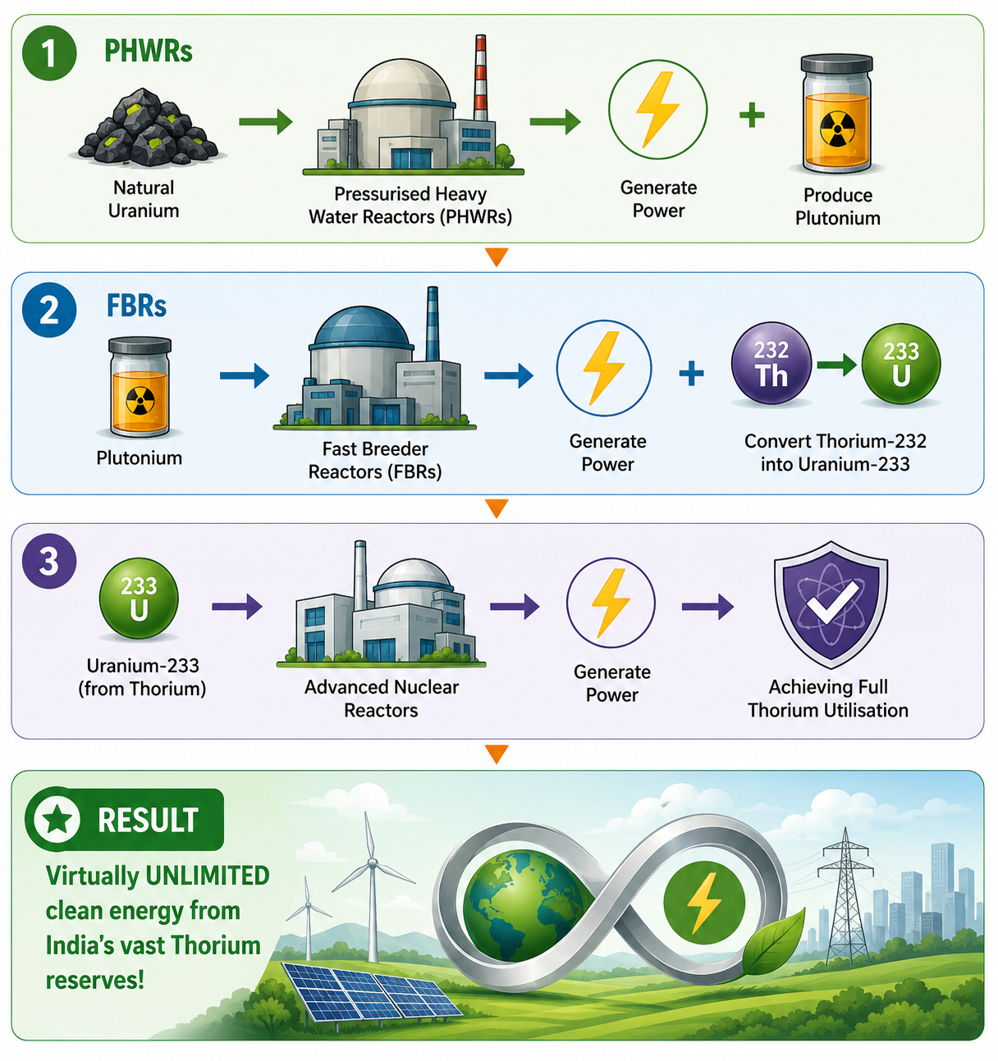
India’s Three-Stage Nuclear Power Programme
India has limited Uranium reserves but massive Thorium reserves (world’s largest). Bhabha’s genius was designing a three-stage nuclear strategy that would eventually harness Thorium — making India’s energy future fundamentally self-reliant:
Apsara Reactor (1956): India’s first nuclear reactor, established at BARC, Trombay — under Bhabha’s personal oversight.
TIFR (Tata Institute of Fundamental Research), 1945: Founded by Bhabha — India’s premier fundamental research institution.
BARC (Bhabha Atomic Research Centre): Originally called AEET (Atomic Energy Establishment, Trombay, 1954) — renamed BARC in his honour after his tragic death in a plane crash in 1966.
👤Who was he? The Father of the Indian Space Programme. Sarabhai argued — at a time when India could barely feed itself — that space technology was NOT a luxury for a developing nation. It was a NECESSITY. History proved him right: India’s satellites today guide fishermen, warn of cyclones, and connect remote villages.
INCOSPAR (1962): Established the Indian National Committee for Space Research — which later evolved into ISRO in 1969. He is, in every sense, ISRO’s founding father.
TERLS (Thumba Equatorial Rocket Launching Station): Established India’s first rocket launching site at Thumba, Kerala — chosen because it is near the magnetic equator, ideal for scientific experiments. The first rockets were literally transported on bicycles!
Vision for Space: Sarabhai envisioned satellites for education, communication, weather forecasting, and resource mapping — decades before these applications became standard globally.
👤Who was he? The Missile Man of India. The People’s President. The Dream Merchant of the nation. Born to a humble family in Rameswaram, Tamil Nadu, Kalam rose to become India’s most beloved scientist AND its most popular President. His life is a testament to what ambition, hard work, and patriotism can achieve.
Missile Development — IGMDP
Kalam was the key architect of the Integrated Guided Missile Development Programme (IGMDP), launched in 1983 — India’s ambitious project to develop an entire family of indigenous missiles:
Missile
Type
Significance
Agni Series
Ballistic Missile (surface-to-surface)
India’s nuclear-capable ICBM class missiles. Agni-V has ~5,000+ km range.
Prithvi
Surface-to-surface ballistic missile
Short-range tactical battlefield missile.
Akash
Surface-to-air missile
India’s indigenous air defence system.
Nag
Anti-tank guided missile
For armoured warfare — fire-and-forget capability.
Trishul
Surface-to-air missile
Low-level quick-reaction system (now retired).
💡 Mnemonic: Remember the five core IGMDP missiles easily using the acronym PATNA (Prithvi, Agni, Trishul, Nag, Akash).
SLV-3 & Rohini Satellite (1980): Kalam served as Project Director of SLV-3 (Satellite Launch Vehicle) — India’s first indigenous satellite launch vehicle. In 1980, SLV-3 successfully placed the Rohini satellite in orbit, making India the 7th nation to independently launch a satellite.
11th President of India (2002–2007): The “People’s President” — chose to spend his evenings with schoolchildren rather than at official banquets. His books Wings of Fire and India 2020 have inspired millions.
👤Who was he? An Indian-American biochemist who helped crack one of the greatest codes in biology — the genetic code. Nobel Prize in Physiology or Medicine (1968). His work is the direct intellectual ancestor of CRISPR gene editing and modern biotechnology.
Deciphering the Genetic Code: Showed that nucleotide triplets (codons) specify amino acids — essentially decoding how DNA directs protein synthesis. This is the Rosetta Stone of molecular biology.
First Artificial Synthetic Gene: His team synthesised the first functional artificial gene (yeast tRNA) — enabling genetic manipulation and laying the foundation for modern biotechnology and gene therapy.
Legacy: His work directly influenced CRISPR gene-editing technology — one of the most powerful biological tools of the 21st century.
👤Who was he? Father of the White Revolution in India. The man who transformed India from a milk-deficit nation into the world’s largest milk producer — not through technology alone, but through cooperative empowerment of India’s farmers. The Amul model he created is studied in business schools worldwide.
Operation Flood (1970s–1990s): Kurien led the world’s largest dairy development programme — organising milk cooperatives across India, modernising dairy processing, and achieving dairy self-sufficiency.
The Amul Model: Farmer-owned cooperatives + fair pricing + elimination of middlemen = the Amul (Anand Milk Union Limited) Model. This rural development blueprint is now being replicated globally.
Impact: India went from importing milk powder to becoming the world’s largest milk producer — a true White Revolution, comparable in scale to the Green Revolution.
Ramon Magsaysay Award (1963): For community leadership and transforming rural India through dairy cooperatives.
👤Who was he? A structural biologist who made discoveries that every biochemistry student encounters in their first year. His work on collagen and protein structure established India as a serious player in structural biology.
Triple-Helical Structure of Collagen: Discovered that collagen — the most abundant protein in the human body (provides structural strength to skin, bones, and connective tissues) — has a triple-helix structure. This was a parallel discovery to Watson-Crick’s DNA double helix.
Ramachandran Plot: A fundamental tool in protein structure analysis — a graph that shows which conformations of a protein’s backbone are sterically allowed. Used by every structural biologist globally. Named after him.
👤Who was he? Father of India’s Green Revolution. The man who saved India from famine in the 1960s. Working with Nobel laureate Norman Borlaug, he adapted high-yield wheat varieties to India’s conditions and transformed the nation’s food security. He passed away in 2023 and was awarded the Bharat Ratna posthumously in 2024.
HYV Seeds & Green Revolution:Introduced High Yielding Variety (HYV) seeds, improved irrigation practices, and modern fertilisers. Working with Norman Borlaug, he adapted high-yield wheat to India’s agro-climatic conditions.
Food Deficit to Surplus: India in the 1960s was importing wheat from the USA under PL-480 (derogatorily called the ‘ship-to-mouth’ existence). By the 1970s, India had food surplus. This transformation is Swaminathan’s legacy.
Evergreen Revolution: Later in life, he moved beyond yield maximisation to advocate an “Evergreen Revolution” — boosting productivity WITHOUT environmental degradation. Sustainable farming, genetic conservation, and climate-resilient agriculture.
Awards: Ramon Magsaysay Award (1971); World Food Prize (1987); Padma Vibhushan; Bharat Ratna (2024, posthumous).
👤Who is he? Kailasavadivoo Sivan — the ‘Rocket Man of India’. Chairman of ISRO (2018–2022). The son of a farmer from Tamil Nadu who went on to lead India’s most ambitious space missions.
PSLV & LVM3 Development: Significant contributions to the Polar Satellite Launch Vehicle (PSLV) and Geosynchronous Satellite Launch Vehicle Mk-III (LVM3) — India’s workhorse rocket.
Chandrayaan-2 Leadership: Led India’s second Moon mission — while the lander Vikram could not soft-land, the orbiter continues to function perfectly, sending valuable lunar data.
Gaganyaan Mission: Made significant progress on India’s first crewed spaceflight mission under his leadership.
👤Who is she? The ‘Rocket Woman of India’ — a senior ISRO scientist who led two of India’s most historic missions. Her story is one of scientific excellence and quiet determination in a field historically dominated by men.
Mars Orbiter Mission (Mangalyaan, 2013): Served as Deputy Operations Director — making India the first Asian nation to reach Mars orbit, on its first attempt.
Chandrayaan-2 (2019): Served as Mission Director — led India’s second Moon mission. Though the lander could not soft-land, the mission demonstrated India’s advanced deep-space navigation capability.
👤Who is she? The ‘Missile Woman of India’ — Project Director for Agni-IV and Agni-V missiles. One of the first women in the world to head a missile project. Her story breaks every stereotype about who belongs in defence technology.
Agni-IV & Agni-V: Served as Project Director for these two long-range ballistic missiles — Agni-V is India’s ICBM-class missile with a range of 5,000+ km.
Trailblazer: One of the first women scientists to head a missile project in India — a role model for women in STEM and defence technology.
👤Who is he? An Indian-born structural biologist who won the Nobel Prize in Chemistry (2009) for mapping the ribosome — the tiny molecular machine inside every cell that builds proteins.
Structure of the Ribosome:Used X-ray crystallography to determine the ribosome’s three-dimensional structure at atomic resolution. The ribosome is the cell’s protein factory — understanding its structure is fundamental to understanding life itself.
Impact on Antibiotic Development: By revealing how antibiotics bind to bacterial ribosomes (but not human ribosomes), his work explained why certain antibiotics are selective — and opened pathways to designing better antibiotics against drug-resistant bacteria.
Nobel Prize in Chemistry (2009): Shared with Thomas Steitz and Ada Yonath.
The Internet is the single most impactful invention of the 20th century — more impactful than the automobile or the television, because it contains and accelerates all other technologies. The Internet is a global network of interconnected computers and communication systems that allows users to share information, access services, and communicate across long distances. It…
Space Debris: The Scattered Danger in Orbit Let’s begin with a small everyday picture. Imagine you are driving on a highway at 100 km/h, and suddenly a tiny pebble flies up and hits your windscreen. Even at that modest speed, a small stone can crack the glass. Now take that same scene and move it…
Militarisation of Space There is an important conceptual distinction you must remember: Militarisation vs. Weaponisation. Militarisation is using space to SUPPORT military operations — like using GPS for troop coordination. Weaponisation is placing or using WEAPONS in space itself. The Outer Space Treaty (1967) does not ban militarisation. It only bans WMDs in orbit. This…
Space Traffic Management (STM) Think of outer space as a busy international airspace — except there is no Air Traffic Control, no unified radar network, no binding rules for who gives way to whom, and no international police. Over 9,000 active satellites and millions of debris fragments share the same sky. Without STM, catastrophic collisions…
Major Lunar Missions — The Story of the Moon The Moon has always been humanity’s first space destination — simply because it is the nearest. But getting there was never a straight line; it was a clear evolution: first we went just to take photographs, then we attempted soft landings, then we sent humans, and…
India is not a latecomer to science. Before Europe had universities, India had Nalanda and Takshashila. Before the West developed algebra, India gave the world Zero. Before modern surgery, India had Sushruta performing rhinoplasty. The story of Science and Technology in India is, in many ways, the story of a civilisation’s journey — from ancient…