
Biosphere Reserves in India
Where a national park draws a hard line around a slice of wilderness, a biosphere reserve does something more ambitious: it treats an entire living landscape — forests, rivers, farms and the people who depend on them — as a single unit to be conserved and developed together.
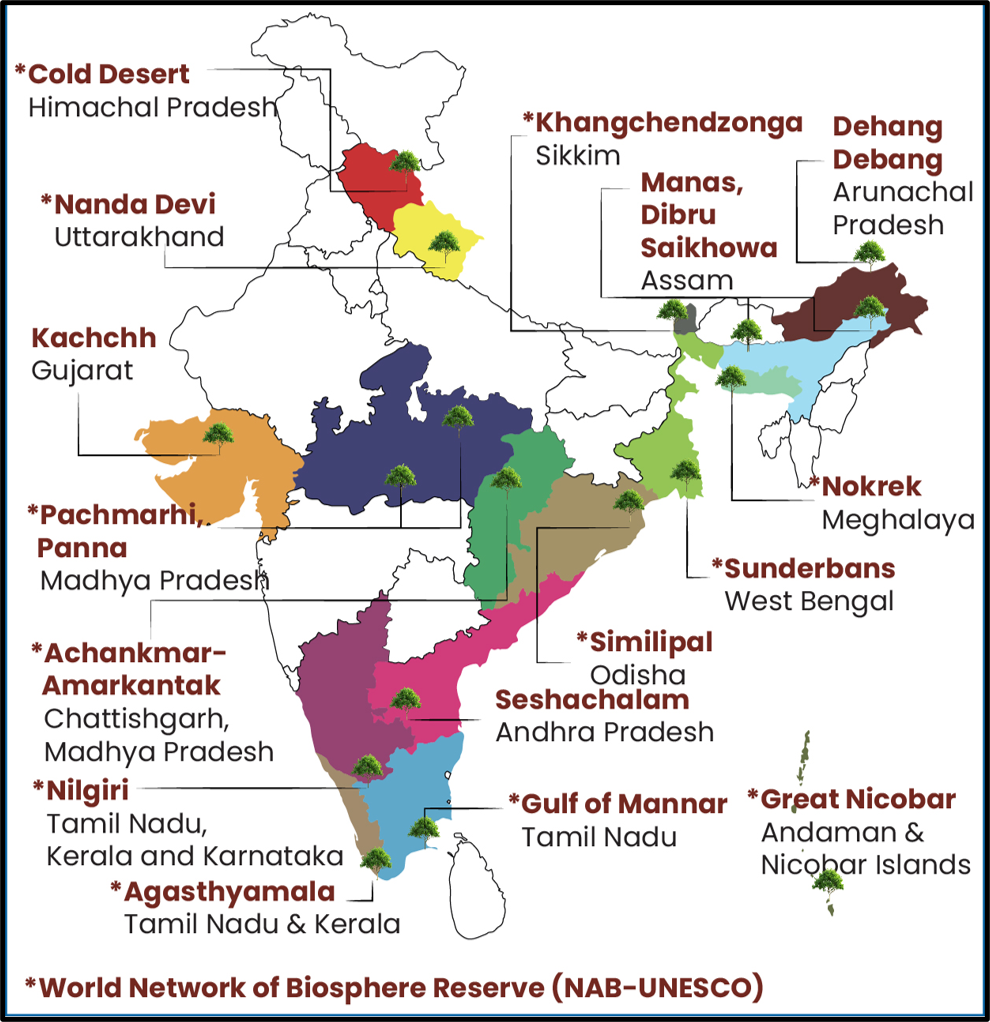
India has 18 biosphere reserves spanning about 91,425 km², from the mangroves of the Sundarban to the trans-Himalayan cold desert of Himachal. Thirteen of them are recognised internationally under UNESCO’s World Network of Biosphere Reserves.
This note explains the concept and its three-zone design, sets biosphere reserves against national parks and sanctuaries, and then walks through all eighteen — with a quick-revision fact box at the end.
What Is a Biosphere Reserve?
A biosphere reserve is a large area of terrestrial or coastal ecosystem — or a combination of both — recognised for conserving biodiversity while demonstrating sustainable use of natural resources. The idea comes from UNESCO’s Man and the Biosphere (MAB) Programme, launched in 1971, which conceived these reserves as ‘learning laboratories for sustainable development’ where conservation and human livelihoods are pursued hand in hand rather than in opposition.
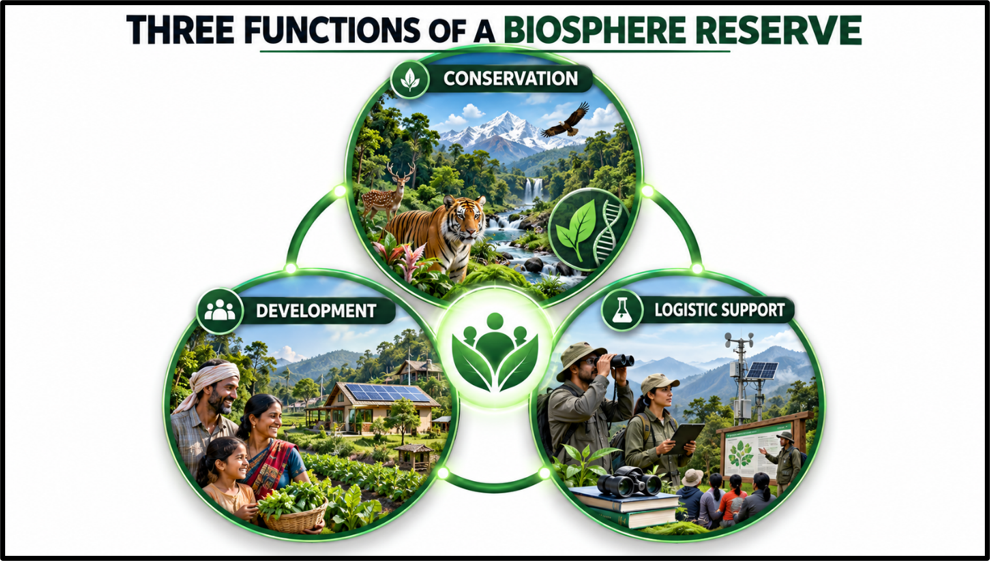
Every biosphere reserve is designed to deliver three complementary functions:
- Conservation: safeguard ecosystems, species, genetic diversity and landscapes.
- Development: foster economically and socio-culturally sustainable development for local communities.
- Logistic support: promote research, monitoring, environmental education and the exchange of information.
The Three Zones — Core, Buffer and Transition
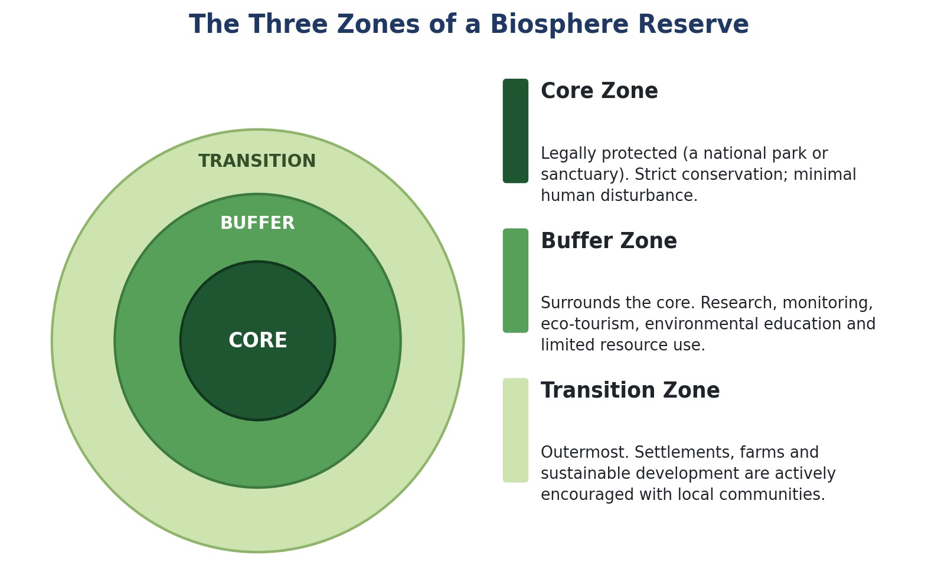
What makes a biosphere reserve distinctive is its concentric zonation. Instead of a single protected block, it is organised into three functional zones that move from strict protection at the centre to active human use at the edge — allowing conservation and development to coexist within one boundary.
How Biosphere Reserves Differ from National Parks & Sanctuaries
A crucial exam point: a biosphere reserve has no independent legal status under the Wild Life (Protection) Act, 1972. It is an administrative and international designation; the only part with statutory teeth is its core zone, which is itself a notified national park or wildlife sanctuary.
Biosphere reserves are therefore best understood as a management framework wrapped around existing protected areas, operating at a far larger, people-inclusive scale.
| Feature | Biosphere Reserve | National Park / Sanctuary |
| Legal basis | UNESCO MAB Programme + a MoEFCC scheme (administrative). | Wild Life (Protection) Act, 1972 (statutory). |
| Legal protection | No independent status; only the core (a park/sanctuary) is protected. | Legally notified and directly protected. |
| Scale | Very large — landscape level, often thousands of km². | Smaller — site level. |
| Human presence | People live and work in the buffer and transition zones. | Little or no habitation (especially a national park). |
| Primary aim | Conservation + sustainable development + research. | Protection of species / the ecosystem. |
| Zonation | Core – buffer – transition. | A single management unit. |
| Global tag | May be listed in UNESCO’s World Network (WNBR). | Not applicable (some are World Heritage / Ramsar sites). |
Biosphere Reserves in India — The National Picture
India set up its biosphere reserve programme in 1986 as a centrally sponsored scheme of the MoEFCC, beginning with the Nilgiris. The network has since grown to eighteen reserves, of which 13 are inscribed in UNESCO’s World Network of Biosphere Reserves (WNBR).
Several of them contain famous national parks in their core and overlap with India’s UNESCO World Heritage Sites and Ramsar wetlands.
| Indicator | Status / Figure |
| Total biosphere reserves | 18, covering about 91,425 km². |
| In UNESCO WNBR | 13 of the 18. |
| First biosphere reserve | Nilgiri (1986) — also the model for the programme. |
| First marine biosphere reserve | Gulf of Mannar, Tamil Nadu (1989). |
| Largest | Great Rann of Kutch, Gujarat (~12,454 km²). |
| Smallest | Nokrek, Meghalaya (~820 km²). |
| Newest notified | Panna, Madhya Pradesh (2011). |
| Latest UNESCO addition | Cold Desert, Himachal Pradesh (2025). |
| Framework | MoEFCC centrally sponsored scheme (since 1986); based on UNESCO’s MAB Programme (1971). |
The 18 Biosphere Reserves — At a Glance
Listed below in order of notification, from the Nilgiris (1986) to Panna (2011).
| Biosphere Reserve | State(s) | Year | UNESCO WNBR | Key Ecosystem & Core Protected Area(s) |
| Nilgiri | TN, Kerala, Karnataka | 1986 | 2000 | Western Ghats; cores incl. Bandipur, Nagarhole, Mudumalai & Silent Valley; lion-tailed macaque. |
| Nanda Devi | Uttarakhand | 1988 | 2004 | Western Himalaya; Nanda Devi & Valley of Flowers NPs (WHS); snow leopard. |
| Nokrek | Meghalaya | 1988 | 2009 | Garo Hills; smallest BR; red panda and wild citrus (Citrus indica). |
| Great Nicobar | A & N Islands | 1989 | 2013 | Tropical rainforest & coast; leatherback turtle, Nicobar megapode, crocodile. |
| Gulf of Mannar | Tamil Nadu | 1989 | 2001 | India’s first marine BR; coral reefs, dugong and sea grass. |
| Manas | Assam | 1989 | — | Terai grassland; tiger, rhino, golden langur, pygmy hog (a WHS & tiger reserve, but NOT in the WNBR). |
| Sunderban | West Bengal | 1989 | 2001 | World’s largest mangrove; Royal Bengal tiger, estuarine crocodile. |
| Simlipal | Odisha | 1994 | 2009 | Sal forest; tiger (incl. melanistic), elephant. |
| Dibru-Saikhowa | Assam | 1997 | — | Riverine wetland; feral horses and migratory waterbirds. |
| Dihang-Dibang | Arunachal Pradesh | 1998 | — | Eastern Himalaya; Mishmi takin, red panda; extreme biodiversity. |
| Pachmarhi | Madhya Pradesh | 1999 | 2009 | Satpura hills; Satpura NP with Bori & Pachmarhi sanctuaries. |
| Khangchendzonga | Sikkim | 2000 | 2018 | Himalaya; Khangchendzonga NP (mixed WHS); snow leopard, red panda. |
| Agasthyamalai | Kerala, TN | 2001 | 2016 | Southern Western Ghats; very high endemism; Neyyar, Peppara, Shendurney. |
| Achanakmar-Amarkantak | Chhattisgarh, MP | 2005 | 2012 | Maikal hills; source of the Narmada & Son; tiger, leopard. |
| Great Rann of Kutch | Gujarat | 2008 | — | Salt desert; largest BR; Indian wild ass and flamingos. |
| Cold Desert | Himachal Pradesh | 2009 | 2025 | Trans-Himalaya; latest UNESCO addition; snow leopard, ibex; Pin Valley NP. |
| Seshachalam Hills | Andhra Pradesh | 2010 | — | Eastern Ghats; red sanders and the slender loris. |
| Panna | Madhya Pradesh | 2011 | 2020 | Vindhyan; Panna NP & tiger reserve; newest BR; diamond-mining belt. |
Reserves Worth Knowing in Detail
A handful of reserves appear again and again in questions and current affairs. These are the ones to know beyond the table.
- Nilgiri — India’s first biosphere reserve and its flagship; a Western Ghats mosaic knitting together Bandipur, Nagarhole, Mudumalai, Mukurthi and Silent Valley, and a stronghold of the lion-tailed macaque and Nilgiri tahr.
- Sunderban — the world’s largest mangrove and the only mangrove tiger habitat; a natural laboratory for climate resilience and human–wildlife conflict.
- Gulf of Mannar — India’s first marine biosphere reserve, famous for coral reefs, sea grass beds and the dugong (‘sea cow’).
- Nanda Devi & Khangchendzonga — the two Himalayan reserves whose cores are also UNESCO World Heritage Sites, protecting snow leopard, red panda and fragile alpine meadows.
- Cold Desert — the most recent Indian addition to the UNESCO network (2025); a trans-Himalayan landscape of snow leopard and Himalayan ibex around Pin Valley.
- Great Rann of Kutch — India’s largest biosphere reserve; a seasonal salt marsh that is the only home of the Indian wild ass and a spectacular flamingo breeding ground — though not (yet) in the UNESCO network.
- Panna — India’s newest biosphere reserve (2011) and a celebrated tiger-recovery success story after local extinction.
Significance, Challenges & the Way Forward
Biosphere reserves matter because they conserve at the scale ecosystems actually work — whole watersheds and migration routes — while keeping people inside the conservation project rather than outside it. But the model faces real strains.
- Weak legal teeth: with no independent statutory status, protection depends on the core park and on state administrative will.
- Development pressure: mining, infrastructure and tourism in buffer and transition zones test the balance the model is meant to strike.
- Livelihood tensions: aligning conservation with the rights and incomes of resident communities remains difficult, echoing debates in the species of conservation concern and human–wildlife space.
The way forward lies in stronger funding and monitoring, genuine community co-management, and using the WNBR tag to attract research and eco-tourism that reward conservation.
Conclusion
India’s eighteen biosphere reserves are its boldest attempt to conserve nature and sustain people within the same boundary — landscapes where a strictly guarded core sits inside a working countryside. For the aspirant they reward exactly the kind of integrated thinking the exam prizes: know the concept and the zonation, remember the superlatives and the UNESCO list, and keep the handful of trap names straight, and biosphere reserves become one of the most dependable scoring areas in the environment syllabus.