
Production and Distribution of Iron Ore in India
🇮🇳 Distribution of Iron Ore: India
India, though not a top exporter like Australia or Brazil, is self-sufficient in iron ore, with abundant reserves of hematite and magnetite, distributed mainly in the peninsular shield region. Yet, the paradox is: “We have reserves, but we still underutilize them.”
Let’s understand why.
🪨 Geological Foundations: Peninsular Shield = Iron Belt
- India’s iron ore is geologically tied to ancient Dharwarian formations, rich in banded iron formations (BIFs).
- Hematite dominates (~24 billion tonnes), while magnetite (~11.2 billion tonnes) is abundant but largely untapped.
➡️ Stable cratonic geology gives us the reserves—but economic exploitation depends on accessibility, grade, and ecological clearances.
🔴 Hematite: The Workhorse of Indian Steel
- Most abundant and economically viable; constitutes the bulk of domestic production.
- High-grade ores are concentrated in Odisha, Jharkhand, Chhattisgarh, Karnataka, and Goa.
🔹 Top Hematite States (% Share of Reserves):
| State | % Share |
|---|---|
| Odisha | 39 |
| Jharkhand | 20 |
| Chhattisgarh | 19 |
| Karnataka | 12 |
| Goa | 5 |
🔹 Major Belts:
- Keonjhar-Barbil (Odisha)
- Singhbhum Belt (Jharkhand)
- Bailadila Hills (Chhattisgarh)
- Bellary-Hospet (Karnataka)
➡️ These are also proximity zones to major steel plants, enabling economic mining.
🧲 Magnetite
- Magnetite is high in iron content, but largely locked in ecologically sensitive zones like the Western Ghats.
- Despite ~11.2 billion tonnes in reserves, extraction is minimal due to environmental regulations.
🔹 Top Magnetite States (% Share):
| State | % Share |
|---|---|
| Karnataka | 70 |
| Andhra Pradesh | 13 |
| Rajasthan | 7 |
| Tamil Nadu | 5 |
| Goa | 2 |
🔹 Major Magnetite Zones:
- Kudremukh, Bababudan (Karnataka)
- Joda-Barbil (Odisha)
- Salem & North Arcot (Tamil Nadu)
➡️ India’s magnetite needs sustainable mining tech to make it viable.
🟡 Limonite & Siderite: Minor but Geologically Important
While not commercially significant, these ores mark the association between coalfields and iron—a geological clue for resource mapping.
🔸 Limonite Distribution:
- Raniganj (WB), Garhwal (UK), Sandur (Karnataka), Kalahandi (Odisha)
🔸 Siderite Distribution:
- Jharia, Bokaro (Jharkhand), Rajhara (Chhattisgarh), Raniganj (WB)
➡️ These are low-grade ores, relevant mainly for academic and geological interest, not commercial mining.
🛠️ 5. Resource Utilization: Explored vs. Untapped
| Category | Hematite | Magnetite |
|---|---|---|
| Total Resource | 24.05 billion t | 11.2 billion t |
| Recoverable Reserve | 6.2 billion t | ~0.2 billion t |
| Unexploitable Resource | 17.8 billion t | 11.0 billion t |
➡️ Most of India’s reserves are untapped due to:
- Low grade
- Lack of technology
- Environmental restrictions
- Transport infrastructure gaps
🏭 Strategic Insight: Steel Plants & Proximity
India’s integrated steel plants (Bhilai, Rourkela, Bokaro, Vijayanagar, etc.) are clustered near iron ore belts, ensuring input cost efficiency.
➡️ This is similar to Germany’s Ruhr Valley or China’s Anshan, where mineral and industrial co-location drives steel output.
✅ Conclusion: India’s Iron Story—Potential > Exploitation
India has enough iron ore to meet its needs, but exploitation is hampered by:
- Ecological challenges (Western Ghats, tribal zones)
- Outdated mining practices
- Focus on export of high-grade ores and import of steel—value addition is missing
➡️ Policy reform + sustainable tech could unlock India’s full iron potential, converting reserves into economic and strategic strength.
Iron Ore Production in India: An Overview
India ranks 4th globally in iron ore production, a significant feat considering the scale of the steel industry and the growing domestic demand. However, despite large-scale domestic production, India is also a net importer of high-grade iron ore, highlighting the complex dynamics between domestic reserves, quality of ore, and steel demand.
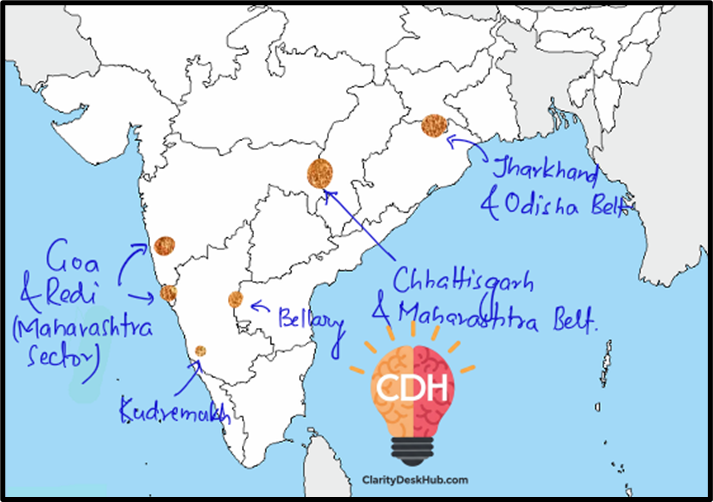
📊 Iron Ore Production Stats (2020-21)
- Total Production: ~205 million tonnes (MT) of iron ore.
- Exports: India exported 26.4 million tonnes (MT).
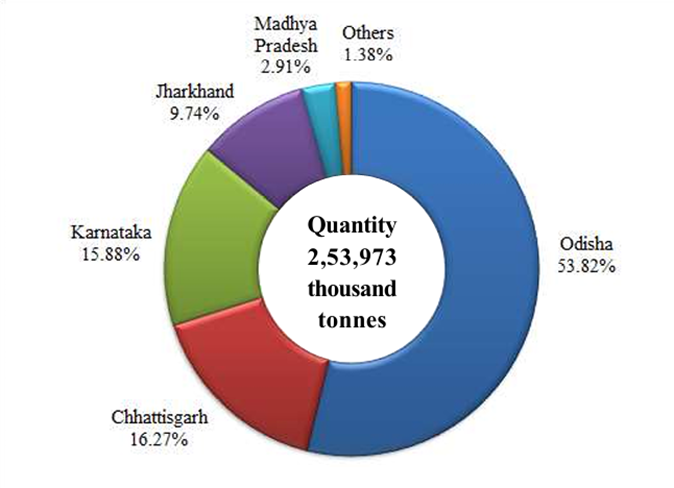
🏞️ State-wise Iron Ore Production (2020-21)
🪙 Key States and Their Contributions
Odisha
- Rich Hematite Deposits: The Barbil-Koira Valley is the epicenter of iron ore extraction.
- Other Areas: Sundargarh, Mayurbhanj, Cuttack, Sambalpur, Keonjhar, Koraput.
- Odisha’s ores are known for being high-grade hematite, contributing to its dominance in Indian production.
Chhattisgarh
- Bailadila Mines: Known for Asia’s largest mechanized mine.
- Exports: Bailadila ore, being high-grade, is exported via Visakhapatnam Port to Japan and other international markets.
- Smelting: Iron ore is shipped to the Visakhapatnam Iron and Steel Factory for processing.
Jharkhand
- Singhbhum District: Home to India’s earliest mines, producing some of the highest quality iron ore.
- Noamandi Mines: Considered the richest ore deposits in India.
Karnataka
- High-Grade Ore: Karnataka is home to Kemmangundi (magnetite), Sandur and Hospet (hematite) in the Bellary district.
- Magnetite Reserves: Karnataka holds 70% of India’s magnetite ore reserves.
Other States:
- Andhra Pradesh: Located in the Rayalaseema region.
- Maharashtra: Mining areas include Chandrapur, Ratnagiri, Sindhudurg.
- Tamil Nadu: Salem, Tiruchirappalli, Coimbatore, and Madurai.
🌍 Economic Implications of Production
- Global Rank: India is the 4th largest iron ore producer, but it struggles with exporting high-grade ore due to local demand and competition from countries like Brazil and Australia.
- Quality vs. Quantity: Despite vast iron ore reserves, India faces challenges in quality. Domestic steel producers often rely on imported high-grade ores to meet the needs of the steel industry, especially in regions like Chhattisgarh and Odisha.
✅ Conclusion: The Path Forward for India
India’s iron ore production is extensive but inefficient in fully exploiting the available resources, especially low-grade ores. While Odisha and Chhattisgarh lead the way in high-grade ore production, regions like Karnataka face challenges due to competitive pricing and quality concerns.
For India to maintain its position as a global leader in steel production, it needs to:
- Focus on improving beneficiation technologies to use low-grade ores effectively.
- Reduce import dependency through better utilization of domestic resources.
- Encourage sustainable mining practices to balance economic growth with environmental preservation.