
Ecological Organisation
Let’s begin with the word itself.
The term Ecology comes from two Greek words:
- ‘Oikos’ → means home
- ‘Logos’ → means study
So literally, Ecology means “the study of home.”
But whose home? — The home of life itself — the Earth and its natural surroundings.
🌱 Scientific Meaning
Ecology is that branch of biology that studies how organisms interact:
- With each other → that is, the flow of energy and cycling of minerals among living things.
- With their environment → that is, how physical conditions like light, water, and temperature influence life.
In short:
Ecology = Study of relationships between organisms and their environment.
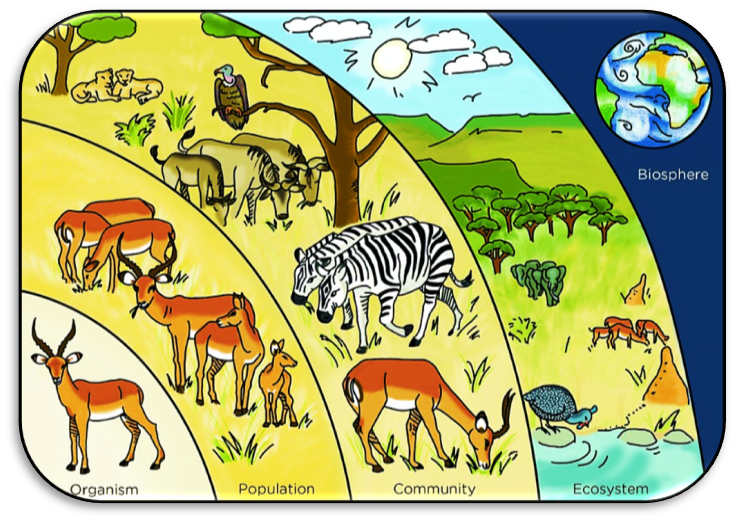
🧬 Levels of Organization in Ecology
Ecology studies life at different scales — from a single organism to the entire planet.
Let’s go step-by-step 👇
Individual and Species
- An individual is a single, independent living being — a plant, animal, or microbe.
- A species is a group of similar individuals capable of interbreeding (reproducing among themselves).
👉 Example: Homo sapiens (humans).
All humans share similar features and can reproduce, hence belong to one species.
📘 Note:
Species are the basic unit of classification (taxonomy), always written in binomial nomenclature — Genus + species.
Population
- A population is a group of individuals of the same species living in a specific area at a given time.
For example:
- All tigers in Ranthambore National Park form a tiger population.
- All mango trees in a grove form a mango population.
The population size changes depending on:
- Births and immigration → population increases.
- Deaths and emigration → population decreases.
🐾 Identifying Populations Using Pugmarks
In ecology, especially for large animals like tigers, leopards, and lions, scientists estimate population by studying pugmarks — the footprints left in soil or sand.
From pugmarks, ecologists can identify:
- Which species is present.
- Individual animals (each has a unique pugmark).
- The sex ratio and age group (males have broader pugmarks than females).
This helps in wildlife monitoring and conservation planning.
Community
When different populations (of different species) live and interact in the same area — it’s called a community.
Example:
In a forest → trees + grasses + deer + birds + microbes — all interacting together = forest community.
🪵 Communities are of Two Types:
| Type | Description | Example |
|---|---|---|
| Major Community | Large, self-sustaining, depends mainly on the Sun’s energy | Tropical Evergreen Forest |
| Minor Community | Small, depends on nearby communities | Lichen on cow dung, moss patch |
⚖️ Stable Community
A stable community maintains its productivity year after year — despite disturbances like drought, storm, or fire.
It is:
- Resistant → can withstand disturbances.
- Resilient → can recover quickly after disturbance.
Example: old-growth forests — very stable over centuries.
Ecosystem
We’ve already studied this before — an ecosystem is where biotic and abiotic components interact in a functional unit.
It includes multiple habitats overlapping, with energy exchange and nutrient cycling taking place.
E.g., a forest ecosystem includes soil, trees, animals, microbes, rainfall, sunlight, etc., all interacting.
Ecological Niche
This is a beautiful and important UPSC concept.
You can think of it like this 👇
- Habitat = address (where an organism lives)
- Niche = profession or lifestyle (what it does there)
👉 So, niche refers to the functional role and position of a species in its habitat.
Each species has a unique niche, which includes:
- Habitat niche → where it lives (forest floor, canopy, soil, etc.)
- Food niche → what it eats or decomposes, and whom it competes with.
- Reproductive niche → when and how it reproduces.
- Physical & chemical niche → preferred temperature, humidity, slope, etc.
If we want to conserve a species, we must understand its niche requirements.
Without it, conservation efforts fail because the species cannot perform its ecological “job.”
🏠 Difference Between Habitat and Niche
| Basis | Habitat | Niche |
|---|---|---|
| Meaning | Physical place where organism lives | Functional role (“profession”) in that place |
| Nature | Many species can share the same habitat | Each species has a unique niche |
| Example | A tree is a habitat for birds, insects, fungi | Bird’s niche = seed disperser; Insect’s niche = pollinator |
| Key Point | All species can live together only if their niches differ | No two species can have identical niches (Competitive Exclusion Principle) |
📍Example:
Many insects feed on the same plant, but they eat different parts — one eats leaves, another eats roots, another sucks sap.
That’s how they avoid competition by occupying different niches.
Biome
A biome is a large, naturally occurring community of flora and fauna that occupy a major climatic zone.

Think of biomes as global ecological regions, defined mainly by climate.
Examples:
- Tropical Rainforest Biome
- Desert Biome
- Tundra Biome
- Taiga (Boreal Forest) Biome
Biomes differ from habitats because:
- A biome can contain many habitats.
- Organisms in a biome share similar adaptations to similar climates (even if they live on different continents).
👉 For instance, taiga forests exist in Canada, Russia, and Scandinavia — all in northern latitudes with cold climates.
Ecotone
An Ecotone is a transition zone — a boundary where two different ecosystems meet and merge.
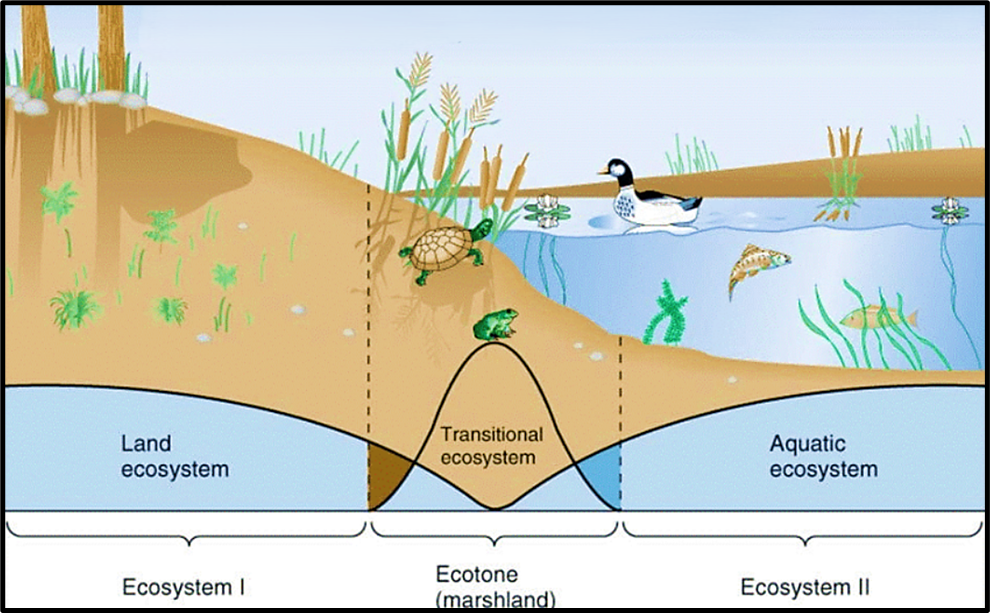
👉 Example:
- Mangrove forests → between land (terrestrial) and sea (marine).
- Grasslands → between forests and deserts.
- Estuaries → where freshwater meets seawater.
- Marshlands → between wet and dry zones.
Ecotones are zones of tension, because they have intermediate conditions — neither fully one ecosystem nor the other.
🌿 Characteristics of an Ecotone
- Can be narrow (like forest–grassland boundary) or wide (forest–desert boundary).
- Species from both neighboring ecosystems coexist here.
- Some species are unique to ecotones — not found in either adjoining ecosystem.
- They often show greater productivity and biodiversity than surrounding ecosystems — because they host species from both sides.
👉 Example: Mangroves, estuaries, and wetlands are among Earth’s most productive zones.
Ecocline
Now, don’t confuse Ecocline with Ecotone.
Let’s differentiate clearly 👇
| Concept | Meaning | Nature |
|---|---|---|
| Ecotone | Sharp transition between two ecosystems | Distinct boundary (like mangrove between land & sea) |
| Ecocline | Gradual, continuous change between ecosystems | No sharp boundary; change occurs across a gradient |
So, Ecocline represents a smooth blending of ecosystems due to gradual variation in abiotic factors — like:
- Altitude (temperature decreases with height → change in vegetation)
- Salinity (freshwater to marine)
- Temperature gradient in oceans (thermocline)
- Humidity, pH, etc.
In simple words:
Ecotone = “meeting point”
Ecocline = “transition slope”
Edge Effect and Edge Species
Because ecotones have mixed ecological features, they often show something special — the Edge Effect.
👉 Edge Effect:
Biodiversity and species density are usually higher in the ecotone than in either adjacent ecosystem.
👉 Edge Species:
Species that prefer these boundary zones are called edge species.
Example:
In the forest–desert ecotone, bird population is much higher than in deep forest or desert interior.
So, birds here are edge species.
Biosphere

Finally, we reach the largest ecological level — the Biosphere, our planetary home of life.
The Biosphere includes:
- Lithosphere (land)
- Hydrosphere (water)
- Atmosphere (air)
It comprises all living organisms and even the dead organic matter produced by them.
But note:
- Life is not uniform everywhere.
- Extreme zones — North & South Poles, highest mountains, deepest oceans — lack active life because of hostile conditions (temperature, pressure, lack of nutrients, etc.).
- Occasionally, spores of fungi or bacteria exist even above 8,000 m height — but they’re dormant, not active.
So, the biosphere is essentially the global sum of all ecosystems — the thin layer of life surrounding our planet.
🌎 Summary Table
| Level | Definition | Example |
|---|---|---|
| Individual | Single organism | A Tiger |
| Species | Group of similar, interbreeding individuals | Panthera tigris |
| Population | Members of a species in one area | Tigers in Sundarbans |
| Community | All populations living together | Forest community |
| Ecosystem | Interaction of community with environment | Pond, Forest |
| Biome | Large climatic region with typical flora & fauna | Desert, Tundra |
| Biosphere | Global sum of all life zones | Earth |
This topic is part of the complete Environment Notes for UPSC. Explore the full subject coverage here.