
Biodiversity Conservation
Introduction
Let us begin with a very basic idea: why do we even conserve biodiversity?
Think of biodiversity as the software that runs the hardware of the planet 😊.
If species disappear, ecosystems collapse like a computer that loses essential files.
So, biodiversity conservation is not emotional charity — it is ecological necessity.
Why is Biodiversity Conservation Important?
When we conserve biodiversity, several things happen automatically:
- Ecological diversity is preserved — forests, wetlands, grasslands, deserts all continue to function.
- Genetic diversity is maintained — allowing species to adapt, evolve, and survive diseases, climate changes, etc.
- Food chains remain intact — no species is isolated; everything is connected.
- Ecosystem services (like pollination, soil formation, climate regulation) continue.
- Sustainable utilisation of resources becomes possible without destroying the resource base.
So, conservation is not a luxury; it is survival logic.
Two Approaches of Conservation
To conserve biodiversity, we have two broad approaches:
1. In-situ Conservation (On-site)
Protecting plants and animals in their natural habitat.
Logic: If you save the ecosystem, you save everything inside it.
Example: Save the entire forest → tiger automatically survives.
2. Ex-situ Conservation (Off-site)
When a species is so threatened that it needs emergency protection outside its natural habitat.
Example: Zoos, botanical gardens, seed banks.
In-situ Conservation in India
India follows multiple legal categories to conserve ecosystems in their natural form:
- Biosphere Reserves
- National Parks
- Wildlife Sanctuaries
- Reserved Forests
- Protected Forests
- Nature Reserves
Each of these offers a different degree of protection. Let us understand them one-by-one.
Reserved Forests vs. Protected Forests
Both are declared under the Indian Forest Act, 1927.
Reserved Forests
- Enjoy highest protection among forests (not counting sanctuaries/parks).
- Default rule: Everything is prohibited unless specifically permitted.
- Activities like hunting, grazing, firewood collection are banned, unless the government explicitly allows.
Protected Forests
- Default rule: Activities are allowed unless specifically prohibited.
- Local communities may have certain rights such as grazing or forest produce collection.
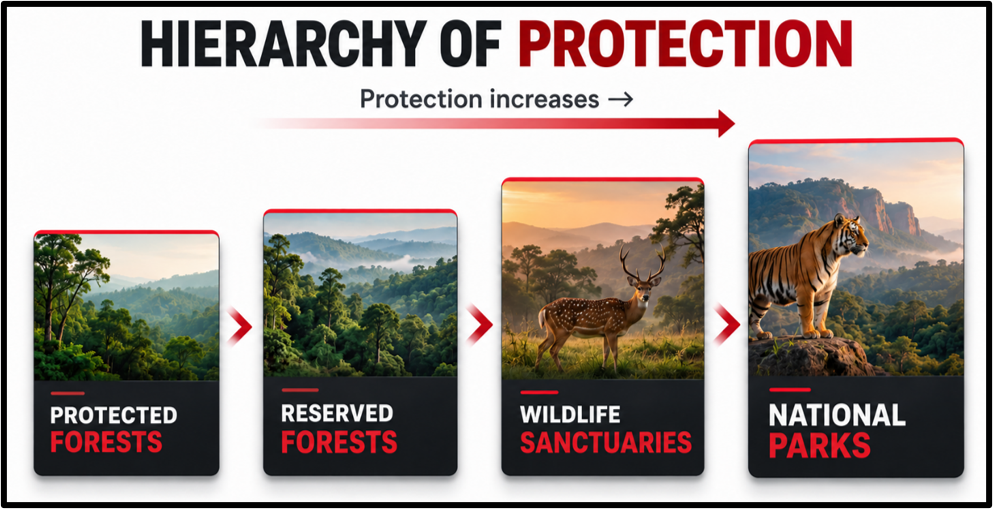
Hierarchy of Protection (in increasing order):
National Parks > Wildlife Sanctuaries > Reserved Forests > Protected Forests
Wildlife Sanctuaries (Wildlife Refuges)
Purpose: Protect endangered species in their natural habitat.
Key points:
- Declared by state government notification, under the Wild Life (Protection) Act, 1972.
- People may have some regulated rights — grazing, firewood collection, etc., mainly for tribals.
- Managed by the Chief Wildlife Warden.
- Settlements inside are discouraged and often relocated.
- A sanctuary can later be upgraded to a National Park.
Tiger Reserves
- Protection level: Same as Wildlife Sanctuaries.
- Special monitoring by the National Tiger Conservation Authority (NTCA).
- Operate under the famous core–buffer strategy.
- Created under Project Tiger.
National Parks
You can think of a national park as a stricter version of a sanctuary.
Main differences from a Sanctuary:
1. Rights of local people
- No rights allowed inside a National Park.
- In sanctuaries, certain traditional rights may continue.
2. Grazing
- Absolutely prohibited in National Parks.
- In sanctuaries, the Chief Wildlife Warden may regulate it.
3. Boundary definition
- Clearly demarcated in National Parks.
- Sanctuary boundaries are not always precisely fixed.
4. Change of boundary
- State government must take recommendation of National Board of Wildlife to alter boundaries.
5. Supreme Court (2022)
- No mining allowed in national parks and wildlife sanctuaries.
Biosphere Reserves
Think of a Biosphere Reserve as a large living laboratory. They aim to balance conservation + development + community participation.
Key points:
- Cover large landscapes: terrestrial, marine or coastal.
- Recognised under UNESCO’s Man and the Biosphere (MAB) Programme.
- Contain one or more National Parks or Wildlife Sanctuaries.
- Though internationally recognised, administration remains with the Indian government.
- Legal status of land does not change after UNESCO designation.
Who identifies them in India?
- Indian National MAB Committee (IN-MAB) — under MoEF.
- State government prepares the Management Action Plan.
UNESCO’s Criteria
- Must have a protected core area.
- Must support viable populations across trophic levels.
- Must involve local communities in management.
Seville Strategy (1995)
This was a major reform in biosphere reserve philosophy. It added → Social, Cultural, Spiritual, Economic needs of communities
Meaning: Conservation should not exclude people but should work with them.
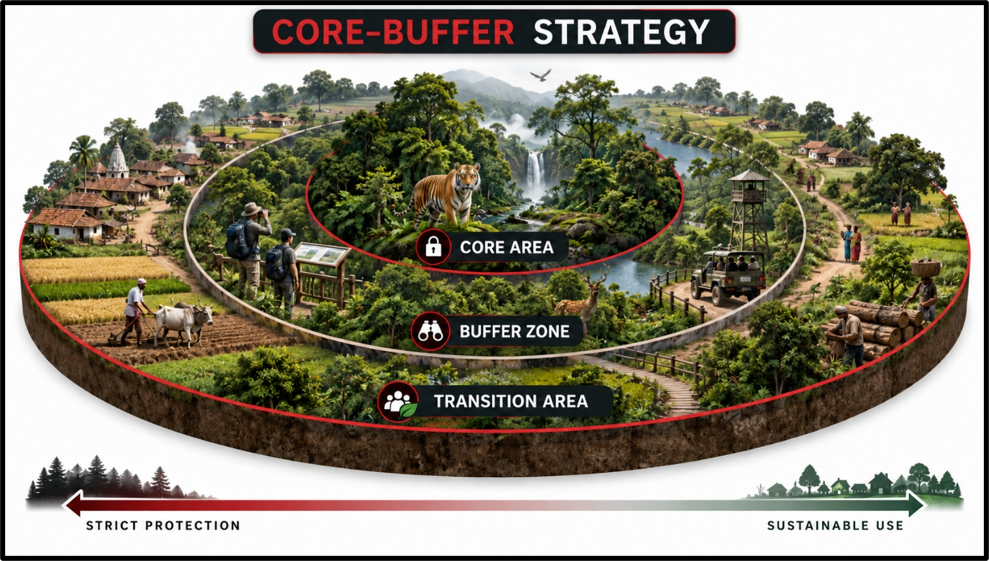
Core–Buffer Strategy
This is the backbone of biosphere reserves and tiger reserves.
Core Area
- Strictly protected.
- No human activity allowed.
- Usually overlaps with a national park or sanctuary.
Buffer Zone
- Controlled human activity allowed (research, training, limited recreation).
Transition Area
- Sustainable livelihood activities allowed — tourism, agriculture, forestry, etc.
This makes conservation scientifically strong + socially acceptable.
Eco-Sensitive Zones (ESZs)
ESZs act as protective shields around National Parks and Sanctuaries.
Purpose:
- Reduce human–animal conflict.
- Minimise ecological damage.
- Act as a transition zone around protected area.
Declaration
- Notified by MoEF.
- Based on Environmental (Protection) Act, 1986.
Typical extent
- Earlier guideline: up to 10 km around protected areas.
- Supreme Court (2022): Minimum 1 km mandatory ESZ around every PA.
Important Note
- The term “Eco-Sensitive Zone” is not mentioned in the EP Act.
- The government uses its power to regulate industries and processes to declare ESZs.
Activities in ESZs
- Prohibited: Commercial mining, Sawmills, Polluting industries, Major hydropower, Tourism activities like hot-air balloons, Discharge of effluents
- Regulated: Felling trees, Changing cropping systems, Using water resources commercially, Hotels/ resorts
- Allowed: Agriculture, Horticulture, Rainwater harvesting, Organic farming, Renewable energy
- Example: Bhagirathi ESZ (4179.59 sq km from Gaumukh to Uttarkashi).
Conservation Reserves
- Declared on government-owned land, often located between protected areas.
- Purpose: create wildlife corridors.
- Declared in consultation with local communities.
Community Reserves
- Declared on private or community lands.
- When individuals/communities voluntarily conserve wildlife.
- Do not affect rights of residents.
Protected Areas under the Wildlife Protection Act
National Parks | Wildlife Sanctuaries | Conservation Reserves | Community Reserves
Sacred Groves
These are the oldest form of conservation in India — protected not by law but by culture.
- Forest patches protected due to religious beliefs.
- No one cuts trees or hunts animals inside.
- Found in:
– Khasi & Jaintia Hills (Meghalaya)
– Aravallis (Rajasthan)
– Western Ghats (Karnataka & Maharashtra)
– Chanda & Bastar (Chhattisgarh)
Sacred groves show that traditional societies practiced conservation long before modern laws existed.
Other Effective Area-based Conservation Measures (OECMs)
OECMs are geographically defined areas outside formally recognised Protected Areas that nevertheless achieve effective and long-term in-situ conservation of biodiversity. Unlike National Parks or Sanctuaries, conservation need not be the area’s primary original purpose—the emphasis is on the actual conservation outcome.
Potential OECMs can include community-conserved areas, sacred groves, biodiversity parks, agricultural landscapes, restored industrial/mining sites and certain privately managed lands.
Example: Aravalli Biodiversity Park, Gurugram, a restored former mining landscape, has been recognised as India’s first established OECM.
Significance:
- OECMs complement the conventional Protected Area network by improving ecological connectivity, community participation and conservation on private/community lands.
- They are also important for achieving Target 3 of the Kunming–Montreal Global Biodiversity Framework, which calls for conserving at least 30% of terrestrial, inland-water, coastal and marine areas by 2030 through Protected Areas and OECMs.
Summary
| Category | Law | Who Declares? | Rights of People | Allowed Activities | Key Feature | Protection Level |
|---|---|---|---|---|---|---|
| National Park | WLPA 1972 | State Govt. (with NBWL for boundary change) | No rights allowed | Grazing & mining prohibited | Strictest protected area | Very High |
| Wildlife Sanctuary | WLPA 1972 | State Govt. | Some traditional rights may continue | Regulated by Chief Wildlife Warden | Species protection | High |
| Tiger Reserve | WLPA (Project Tiger) | NTCA + State Govt. | Same as NP/WLS (core strict; buffer regulated) | Research, eco-development in buffer | Core–buffer model | Very High (Core) |
| Biosphere Reserve | UNESCO MAB (concept) | IN-MAB + State Govt. | Depends on zone | Core strict; buffer regulated; transition allowed | Conservation + development | Moderate–High |
| Reserved Forest | Indian Forest Act 1927 | State Govt. | Very limited; mostly prohibited | Only if Govt. permits | Highest forest category | Medium–High |
| Protected Forest | Indian Forest Act 1927 | State Govt. | Broad rights of locals | Most activities allowed unless banned | Flexible protection | Medium |
| Eco-Sensitive Zone | EP Act 1986 | MoEFCC | Rights continue | Some activities banned; others regulated | 1 km mandatory buffer (SC 2022) | Regulatory Zone |
| Conservation Reserve | WLPA 1972 | State Govt. | Rights protected | Limited use | Wildlife corridor (Govt land) | Low–Medium |
| Community Reserve | WLPA 1972 | Community + State Govt. | All rights continue | Voluntary conservation | Private/community land | Low–Medium |
| Sacred Groves | Customary | Communities | Full traditional rights | Extraction traditionally avoided | Culture-based protection | High (Social), Low (Legal) |
Hierarchy of Protection (Highest → Lower)
National Parks ≈ Core of Tiger Reserves > Wildlife Sanctuaries > Reserved Forests > Protected Forests > CR/CmR > ESZ (regulatory) > Sacred Groves (customary)
Ex-situ Conservation
After understanding in-situ conservation, the next approach is ex-situ conservation.
Here the logic changes slightly:
When a species becomes too vulnerable, and its natural habitat cannot ensure survival, we must create an artificial but safe environment for protection.
Think of it as shifting a critically ill patient from a normal ward (natural habitat) to the ICU (ex-situ facility) 😊.
What is Ex-situ Conservation?
It means taking threatened plants or animals out of their natural habitats
and protecting them in controlled, specialised settings.
Common institutions used for ex-situ conservation include:
- Zoological Parks (Zoos)
- Botanical Gardens
- Wildlife Safari Parks
- Seed Banks / Gene Banks
Here, conditions like temperature, humidity, diet, and disease protection can be carefully regulated.
Botanical Gardens and Living Plant Repositories
Botanical gardens and living plant repositories conserve plant diversity outside natural habitats while also supporting research, environmental education and public awareness.
Example – Prakriti Gyan Dham: Developed by CSIR–National Botanical Research Institute (NBRI) at Banthra, Lucknow, it combines botanical conservation with experiential environmental education. Important components include:
- Vibhav Enclave – rare, threatened and endangered Indian plants.
- Bhairav Enclave – State Plants of Indian States and UTs.
- Indian Heritage Garden – historically and culturally significant trees.
- Bamboosteum – collection of 43 indigenous and exotic bamboo species.
It illustrates how modern botanical institutions can function simultaneously as living repositories, conservation centres and environmental-education spaces.
Why Ex-situ Conservation Became Necessary
Some species have reached such critical levels that their natural ecosystems can no longer guarantee survival.
In such cases, ex-situ institutions serve as:
- Rescue centres
- Breeding centres
- Educational centres
- Genetic diversity repositories
This ensures species survive even if they disappear from the wild.
Transformation of Zoos — From Entertainment to Conservation
Earlier, zoos were established primarily for public entertainment.
Visitors came to “see” animals.
But over the years, zoos have evolved into:
- Centres of captive breeding
- Wildlife research hubs
- Awareness and education centres
They now hold many species that are extinct in the wild but survive within zoo populations.
For example, several species of deer, big cats, birds, and reptiles exist only because of zoo-based conservation programs.
Advanced Ex-situ Techniques
Ex-situ conservation is no longer limited to keeping animals in cages or plants in gardens.
Modern biotechnology has expanded its scope dramatically.
1. Cryopreservation
A method where gametes (sperms and eggs) of threatened species are preserved at extremely low temperatures—often in liquid nitrogen.
Benefits:
- Stays viable and fertile for long periods
- Acts as a backup genetic library for future breeding programs
2. In vitro Fertilisation (IVF)
Eggs can be fertilised in laboratory conditions.
This helps in:
- Increasing population numbers
- Supporting species with low breeding success
3. Tissue Culture
Plants can be produced in large numbers from small tissue samples.
Useful for:
- Rare plants
- Commercially important species
- Restoring degraded habitats
Seed Banks
Seed banks are among the most cost-effective and long-term methods of conserving plant diversity.
Purpose:
- Preserve seeds of different genetic strains
- Especially for crops and plants of commercial and ecological value
- Maintain diversity for future breeding, research, and disaster recovery
India’s Most Important Facility: National Gene Bank (ICAR–NBPGR, Delhi)
- Managed by the National Bureau of Plant Genetic Resources (NBPGR)
- Conserves unique accessions (distinct samples of plant genetic material)
- Stores them as base collections
- Seeds are preserved for decades under controlled conditions
- Acts as India’s long-term biological insurance
This ensures that even if certain crop varieties disappear from fields, their genetic material remains safe for future generations.
For chapter-wise Environment preparation for UPSC Prelims and Mains, refer to the complete Environment UPSC notes page.