
Prevention & Control of Air Pollution
Control of Industrial Pollution — The First Line of Defence
Industrial units are major contributors to particulate and gaseous pollution. To control this effectively, the strategy has three pillars:
A. Cleaner fuels
Replaces dirty fuels (coal, furnace oil) with cleaner alternatives like:
➡️Liquefied Natural Gas (LNG)
➡️Low-sulphur fuels
➡️Cleaner industrial processes
Cleaner fuels = lower emissions of SO₂, NOx, particulate matter.
B. Cleaner technologies
Industries must adopt environment-friendly processes, better furnace designs, and efficient combustion techniques.
C. Pollution-control devices
These include:
- Filters (baghouse filters)
- Electrostatic Precipitators (ESPs)
- Inertial collectors (cyclones)
- Scrubbers (wet collectors)
- Catalytic converters
Each device targets a particular kind of pollutant—mostly SPM or gaseous pollutants.
Filters — Simple but Effective
Filters trap particulate matter before exhaust gases are released.
Baghouse Filter
- Most common industrial filtration system.
- Uses fabric bags made of cotton, synthetic fibres, or glass cloth depending on temperature.
- Works like a giant vacuum cleaner bag — air passes through; dust stays behind.
Best for: Large particulate matter.
Electrostatic Precipitators (ESPs)
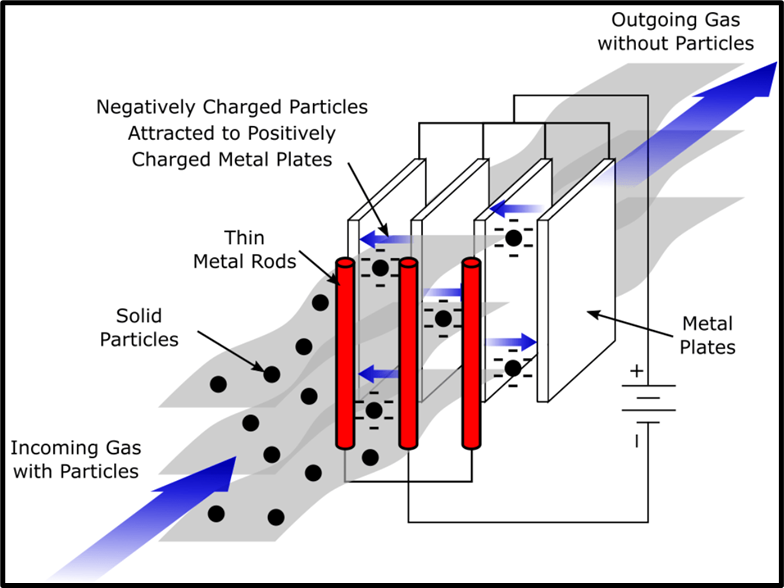
ESPs are one of the most efficient devices capable of removing >99% particulate matter.
Where used?
- Thermal power plants
- Cement factories
- Steel plants
- Industrial boilers and furnaces
Working Principle — Three Simple Steps
- Charging:
Electrode wires maintained at very high voltage (several thousand volts) create a corona discharge, releasing electrons. - Attachment:
Dust particles attach to electrons → become negatively charged. - Collection:
Charged dust sticks to grounded (positive) plates.
Periodic shaking dislodges particles → they fall into hoppers.
Key condition: Air velocity between plates must be low for effective settling.
Inertial Collectors (Cyclone Separators)
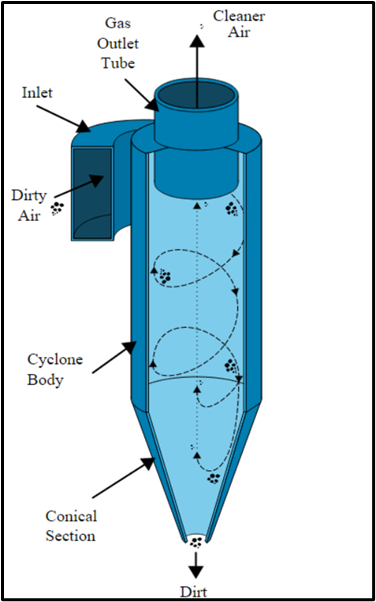
These devices use the inertia (mass) of particulate matter to separate heavy particles from the gas stream.
How it works?
- Gas enters a cylindrical chamber in a spiral motion.
- Centrifugal force pushes heavier particles outward → collected.
Where used?
- Gas cleaning systems
- Industries with coarse dust
Note: More effective for heavy particles; less effective for fine PM2.5.
Scrubbers — “Washing” the Pollutants
Scrubbers are wet collectors.
How they work
- Polluted gas passes through a scrubbing liquid (usually water).
- PM and gases like SO₂ dissolve or adhere to the liquid.
- The process mimics mucus in our respiratory tract trapping dust.
Special capability
- Scrubbers can remove both particulates and gases (especially SO₂).
Used in:
- Power plants
- Refineries
- Chemical industries
Catalytic Converters — Pollution Control Inside Vehicles
Catalytic converters use precious metal catalysts:
→ Platinum
→ Palladium
→ Rhodium
They convert harmful exhaust gases into safer forms.
Chemical Conversion Inside Catalytic Converters
- Unburnt hydrocarbons → CO₂ + H₂O
- Carbon monoxide (CO) → CO₂
- Nitric oxide (NO) → N₂ + O₂
Important rule
Vehicles with catalytic converters must use unleaded petrol, because lead poisons the catalyst.
Pollution Index (PI)
— Ranking Industries by Pollution Levels
To regulate pollution effectively, the Ministry of Environment, Forest and Climate Change (MoEFCC) categorised industries based on their Pollution Index (PI) — developed by CPCB + SPCBs.
What is PI?
A number (0–100) based on:
- Air emissions
- Water pollution
- Hazardous waste generation
- Resource consumption
Higher PI = more polluting.
Categories of Industries (Based on PI Score)
1. Red Category (Critically Polluted) — PI 60+
- Cement
- Petrochemicals
- Pharmaceuticals
- Paper & pulp
- Nuclear power plants
- Fertilisers
- Firecracker industries
2. Orange Category (Severely Polluted) — PI 41–59
- Coal washeries
- Glass manufacturing
- Paint industries
- Stone crushers
- Aluminium/copper extraction from scrap
3. Green Category — PI 21–40
- Steel furniture
- Soap manufacturing
- Tea processing
- Small-scale metal handicrafts
4. White Category — PI ≤ 20 (Practically Non-Polluting)
- Air coolers
- Chalk factories
- Biscuit trays
- Small electrical items
Special Relaxations
- White category industries do not require Environmental Clearance or Consent to Operate.
- Red category industries are not permitted in ecologically fragile areas.
Why is the Pollution Index Important for Governance?
It helps:
- Authorities like NGT enforce closures during severe pollution episodes.
- Industries self-assess and adopt cleaner technologies.
- Planners restrict polluting industries in ecologically sensitive zones.
Coal Gasification
— Cleaner use of coal
What it is:
Coal gasification converts solid carbonaceous feedstock (coal, biomass, waste) into a combustible gas mixture — syngas (mainly CO + H₂) — in a high-temperature, controlled reactor (gasifier) using oxygen and steam, not conventional combustion.
Why it helps air quality:
- Syngas can be cleaned of contaminants (sulphur, particulates) before use, giving much lower emissions than direct coal burning (less CO₂ per useful energy unit, lower SO₂, lower particulates).
- Syngas can be converted to SNG (synthetic methane), liquid fuels (e.g., synthetic diesel), hydrogen or used for electricity — flexible end-uses.
- Gasification of municipal and industrial waste also reduces landfill methane and GHGs.
Policy target (India):
Ambitious push (e.g., 100 Mt coal gasification by 2030) — seen as transitional tech to cleaner coal use and hydrogen production.
UPSC takeaway: Coal gasification = thermochemical route to cleaner fuels; reduces direct pollutant loads and enables value recovery from waste.
Measures to Control Vehicular Pollution in India
When we talk about air pollution in Indian cities, one of the biggest contributors is vehicular emissions. To control this, India has adopted a mix of regulations, technology upgrades, fuel reforms, and behavioural changes. Let us understand each measure step by step.
Improving Vehicle Technology
Catalytic Converter Standards
Vehicles today are fitted with catalytic converters, which act like filters and reduce harmful emissions such as CO, NOx, and hydrocarbons.
The government has set durability standards, meaning these devices must work efficiently for a long period.
Pollution Under Control (PUC) System
Cities like Delhi require vehicles to renew their PUC certificate regularly.
Think of PUC like a health check-up for vehicles:
- If emissions exceed legal limits → vehicle fails
- If within limits → certificate is issued
This ensures vehicles do not pollute beyond permissible norms.
Cleaner Fuel: Shift from BS-IV to BS-VI
Fuel quality is central to emissions control.
What changed?
- Sulphur content reduced from 50 ppm (BS-IV) to 10 ppm (BS-VI).
Lower sulphur = significantly cleaner fuel.
This low sulphur allows engines to use advanced technologies like better catalytic converters, reducing PM, NOx and other pollutants drastically.
Ban on Leaded Petrol
Earlier, tetraethyl lead was added to petrol to increase octane rating.
But lead emissions are extremely harmful → hence lead in petrol is now completely banned.
Use of Alternative Fuels: CNG in Delhi
Delhi made CNG mandatory for public transport vehicles.
Why is CNG preferred?
- Burns more completely → almost no unburnt hydrocarbons
- Cheaper than petrol/diesel
- Cannot be easily adulterated
- Cannot be siphoned off
The major challenge is laying distribution pipelines and ensuring uninterrupted supply.
By 2002, all Delhi buses shifted to CNG.
Vehicle Scrappage Policy 2021
Old vehicles pollute more.
The policy says:
- Govt vehicles → scrapped after 15 years
- Private cars → deregistered after 20 years
- Commercial vehicles → after 15 years
This encourages cleaner vehicles and reduces pollution load.
Bharat Stage (BS) Norms — India’s Emission Standards
- Bharat Stage (BS) emission norms regulate pollutants emitted by motor vehicles in India.
- Implemented by the Ministry of Road Transport and Highways (MoRTH) under the Central Motor Vehicles Rules (CMVR), 1989.
- Standards are based on European (Euro) emission norms.
- Aim to reduce: Particulate Matter (PM); Nitrogen Oxides (NOx); Carbon Monoxide (CO) and Hydrocarbons (HC)
Evolution of Bharat Stage (BS) Emission Standards:
- BS-I (2000): India’s first emission standard for motor vehicles, introduced to regulate harmful pollutants and promote the use of cleaner fuels and improved engine technologies.
- BS-II (2005): Tightened emission limits over BS-I and reduced sulphur content in fuels, leading to lower vehicular emissions and better urban air quality.
- BS-III (2010): Prescribed stricter limits on pollutants such as CO, HC, NOx and PM, while encouraging adoption of advanced emission-control technologies.
- BS-IV (2017 – Nationwide): Implemented across the country with stricter emission norms and low-sulphur (50 ppm) fuel, resulting in significant reductions in air pollutants.
- BS-VI (1 April 2020): Implemented nationwide by skipping BS-V, introducing 10 ppm sulphur fuel, On-Board Diagnostics (OBD), and Real Driving Emission (RDE) norms to achieve a substantial reduction in vehicular emissions and align India with global best practices.
India’s INDCs under UNFCCC
India committed to:
- Reduce emissions intensity of GDP by 33–35% by 2030
- Increase non-fossil fuel electricity share to 40% by 2030
- Create carbon sinks absorbing 2.5–3 billion tonnes CO₂ by 2030
BS-VI adoption directly helps meet these goals.
Advantages of BS-VI Vehicles and Fuel
- PM from diesel cars ↓ 80%
- NOx ↓ 70% for diesel, 25% for petrol
- Low sulphur enables better catalytic converters
- OBD (Onboard Diagnostics) mandatory → real-time efficiency monitoring
- RDE (Real Driving Emission) introduced → emissions measured in real-world conditions
- PM measured by number standard (not mass) for greater accuracy
Impact on Industry
- Heavy investments required in new technologies
- Upgradation of vehicles and infrastructure
- BS-VI vehicles became more expensive
However, long-term environmental benefits justify this cost.
Corporate Average Fuel Efficiency (CAFE) Norms
Corporate Average Fuel Efficiency (CAFE) norms prescribe the average fuel consumption and CO₂-emission limits that automobile manufacturers must achieve across their entire fleet of passenger vehicles sold in India.
- Compliance is based on the corporate/fleet average, not on each individual vehicle.
- They encourage manufacturers to produce more fuel-efficient and low-emission vehicles.
CAFE-III: Key Facts
| Aspect | Details |
| Governing Body | Bureau of Energy Efficiency (BEE), Ministry of Power |
| Legal Basis | Energy Conservation Act, 2001 |
| Status | Draft norms |
| Proposed Period | 1 April 2027 – 31 March 2032 |
| Vehicles Covered | M1 passenger vehicles |
| Fuel Types | Petrol, diesel, LPG, CNG, hybrids, EVs, etc. |
M1 Category: Passenger vehicles with seating capacity of up to 9 persons including the driver and prescribed mass limits.
Objectives
- Improve Fuel Efficiency: Reduce fuel consumption of passenger vehicles.
- Reduce GHG Emissions: Lower CO₂ emissions from road transport.
- Reduce Oil Import Dependence: Lower consumption of petrol and diesel.
- Promote Clean Mobility: Encourage EVs, hybrids, CNG and alternative-fuel vehicles.
- Support India’s Net Zero target by 2070.
Key Features of Draft CAFE-III
1. Progressively Stricter Efficiency Targets
Manufacturers must progressively reduce the average fuel consumption and CO₂ emissions of their fleets.
- 2027–28: about 3.996 litres/100 km or 94.76 g CO₂/km
- 2031–32: about 3.327 litres/100 km or 78.90 g CO₂/km
Thus, standards become progressively stricter during the CAFE-III period.
2. Carbon Neutrality Factors (CNFs)
For the first time, the draft proposes Carbon Neutrality Factors for vehicles using fuels such as → Ethanol, Compressed Biogas (CBG), Other recognised biofuels
This allows their lower lifecycle carbon emissions to be reflected in compliance calculations.
3. Block-Based Compliance
Instead of assessing compliance strictly every year, CAFE-III proposes two compliance blocks:
First Block: 3 years
Second Block: 2 years
This provides manufacturers greater flexibility in meeting fleet-average targets.
4. Credits for Fuel-Saving Technologies
Manufacturers adopting approved energy-saving technologies can receive additional compliance benefits.
- Total benefit: up to 9 g CO₂/km
- Maximum benefit from an individual approved technology: 1 g CO₂/km
5. Super Credits for Cleaner Vehicles
Additional weightage is proposed for cleaner vehicle technologies such as:
- BEVs – Battery Electric Vehicles
- REEVs – Range-Extended Electric Vehicles
- PHEVs – Plug-in Hybrid Electric Vehicles
- SHEVs – Strong Hybrid Electric Vehicles
- FFVs – Flex-Fuel Vehicles
This makes cleaner vehicles more favourable while calculating a manufacturer’s fleet average.
Evolution of CAFE Norms
| Parameter | CAFE-I | CAFE-II | CAFE-III (Draft) |
| Period | 2017–2022 | 2022–2027 | 2027–2032 |
| Broad Focus | Introduction of fuel-efficiency norms | Tighter fuel economy and emission standards | Deeper decarbonisation and clean mobility |
| Target Fuel Consumption | ~5.09 L/100 km | ~4.34 L/100 km | 3.327 L/100 km by 2031–32 |
| Approach | Basic fleet-efficiency standards | Stricter CO₂ limits | Progressive targets + technology incentives |
| Clean Technology Support | Limited | Greater encouragement | Super credits, biofuel recognition, technology credits |
BS Norms vs CAFÉ Norms
| Bharat Stage norms | CAFE norms |
| Apply pollutant-emission limits to an individual vehicle | Apply fuel-consumption/CO₂ targets to a manufacturer’s entire fleet |
| Primarily regulate NOx, CO, hydrocarbons and particulate matter | Primarily regulate fuel efficiency and CO₂ |
| Every vehicle model must comply with the applicable standard | Efficient models can offset less-efficient models in the manufacturer’s fleet average |
Electric Mobility in India
In 2017, India announced a vision of going 100% electric by 2030.
While the target isn’t binding, the government is currently focusing on 2-wheelers and 3-wheelers for faster adoption.
NITI Aayog Proposal
- Ban IC-engine 2-wheelers by 2025
- Ban IC-engine 3-wheelers by 2023
Though ambitious, the move signals a strong push toward EVs.
FAME India Scheme — Phase II
Implemented by Department of Heavy Industry.
Objectives:
- Promote EVs and hybrid vehicles
- Encourage localisation of EV components
- Build a market for:
- 10 lakh e-2Ws
- 5 lakh e-3Ws
Funding: ₹10,000 crore
Charging infrastructure is also being expanded under this scheme.
EV Charging Guidelines
Targets include:
Phase 1 (1–3 years)
- Mega cities (population 4+ million)
- Highways connected to these cities
Phase 2 (3–5 years)
- State capitals and UT headquarters
Key Provisions
- One charging station every 3×3 km grid
- Charging station every 25 km on highways
- Fast charger every 100 km
- Public Charging Stations to be de-licensed → Anyone can open
- BEE is the central nodal agency
Tax Incentives for EV Adoption
- ₹1.5 lakh income tax exemption on EV loan interest
- GST on EVs reduced from 12% to 5%
- GST on chargers reduced from 18% to 5%
These incentives aim to make EVs financially attractive.
Concerns and Challenges
1. Environmental Concerns
Even with EVs, emissions will fall only modestly because 55% of India’s electricity comes from coal.
But EVs will reduce urban air pollution, especially PM2.5.
2. Industry Challenges
Automobile sales already struggling due to:
- GST structure
- High insurance costs
- Expensive raw materials
- Fuel price volatility
Additionally, companies have already invested heavily in BS-VI infrastructure.
3. Resource Constraints
China dominates lithium and cobalt supply chains; India depends on imports.
Green Tax on Old Vehicles
Aimed at discouraging old, polluting vehicles.
Tax Structure
- Transport vehicles > 8 years → 10–25% of road tax
- Personal vehicles > 15 years → taxed
- Public transport → lower tax
- Highly polluted cities → 50% green tax
- Vehicles on clean fuels (CNG, LPG, ethanol, strong hybrid) → exempted
Revenue collected will be used for pollution control and advanced monitoring.
Polluter Pays Principle
Simple idea:
Whoever creates pollution must pay the cost of managing it.
This principle is part of the 1992 Rio Declaration.
If pollution costs aren’t imposed, they become externalities borne by society—classic market failure.
Sustainable Aviation Fuel (SAF)
India aims for 1% blending of SAF in jet fuel for international flights by 2027.
SAF (Bio-Jet Fuel) is produced from:
- Agricultural waste
- Municipal solid waste
- Agroforestry residues
- Or even carbon captured from the air
It reduces carbon footprint without requiring major changes in aircraft engines.
National Clean Air Programme (NCAP)
What is NCAP?
A first-of-its-kind national level, time-bound programme (launched 2019) to reduce ambient particulate pollution (PM2.5 & PM10) across Indian cities. It focuses on expanding monitoring, capacity building, city action plans and public awareness.
Targets:
- Original target: 40% reduction in PM2.5 / PM10 (relative to 2017) by 2024.
- Updated timeline: target carried forward to 40% by 2026.
- CPCB’s acceptable annual levels: PM2.5 = 40 µg/m³, PM10 = 60 µg/m³ (NAAQS).
Coverage & implementation:
- Targets 132 non-attainment cities (cities failing NAAQS for consecutive years).
- PRANA portal used to monitor NCAP implementation.
Major criticisms:
- Legal enforceability: NCAP is largely a cooperative framework; critics (including NGT) argue it lacks statutory teeth — not notified under a specific Act — so implementation depends on state will and funding.
- Time horizon vs. Right to Life: NGT criticised long timelines (10 years in original plan) as incompatible with the Right to Clean Air (Article 21). Clean air is immediate civic right; delays were unacceptable.
- Ambiguity in pollutant scope & funding: NCAP initially focused on PMs; critics point to insufficient clarity on other pollutants, weak financing and limited mandatory provisions.
NCAP is India’s first national, mid-term programme to reduce PM by 40% in selected cities, but suffers from implementation, funding and legal-mandate challenges.
National Air Quality Monitoring Programme (NAMP)
Purpose:
A nationwide network maintained by CPCB to measure ambient air pollutants, determine trends, assess compliance with NAAQS and identify non-attainment cities.
Scale:
- ~804 operating stations across 344 cities/towns (28 states + 6 UTs).
- Core pollutants monitored under NAMP: SO₂, NO₂, RSPM/PM10 and PM2.5.
- Meteorological parameters (wind speed/direction, RH, temperature) are integrated to interpret dispersion and sources.
NAMP provides the data backbone for air-quality management and identification of pollution hotspots.
National Ambient Air Quality Standards (NAAQS)
Authority
- Set and revised by Central Pollution Control Board (CPCB)
- Under Air (Prevention and Control of Pollution) Act, 1981
Latest Revision
- Revised in 2009 (currently in use)
- Applicable across the entire country
Number of Pollutants
- 12 pollutants included in NAAQS (important for Prelims)
The 12 NAAQS Pollutants
- SO₂
- NO₂
- PM₁₀
- PM2.5
- O₃
- Lead (Pb)
- CO
- Ammonia (NH₃)
- Benzene
- Benzo(a)pyrene
- Arsenic
- Nickel
Important Points
- Standards specify annual and 24-hour permissible limits.
- Ecologically sensitive areas have stricter limits than residential/industrial areas.
- NAAQS helps determine:
- Air quality categorisation
- Air quality index policies (AQI)
- Pollution control planning
For more details readthis.
WHO 2021 Air Quality Guidelines — a tougher benchmark
Authority & Purpose
- Issued by WHO to guide countries on safe air quality levels.
- Updated in 2021 after 2005 guidelines.
- Based on new evidence showing health impacts occur at lower concentrations than previously thought.
How many pollutants covered?
- WHO AQGs 2021 provide guidelines for 6 major pollutants.
The 6 WHO guideline pollutants:
- PM2.5
- PM₁₀
- O₃ (Ozone)
- NO₂
- SO₂
- CO
WHO 2021 Guidelines are MUCH stricter than:
- Earlier WHO 2005 guidelines
- India’s NAAQS (2009)
Example of trend:
- PM2.5 annual limit reduced from 10 → 5 µg/m³
- PM₁₀ annual reduced from 20 → 15 µg/m³
- NO₂ annual reduced from 40 → 10 µg/m³
This shows:
➡ WHO now believes even very low pollutant levels harm health.
Why is this important for India?
- If WHO standards are applied strictly, most of India would fall under “polluted” category, particularly for PM2.5 and PM₁₀.
- WHO guidelines are NOT binding, so countries are not legally required to adopt them.
- India still follows NAAQS 2009, which is far more lenient.
SAFAR System
When we talk about air pollution in big cities, one major challenge is real-time information. People usually know the air is “bad,” but how bad? And why? To solve this, the Government of India introduced a scientifically robust tool known as SAFAR.
What is SAFAR?
SAFAR stands for System of Air Quality and Weather Forecasting and Research.
It is a national-level initiative launched by the Ministry of Earth Sciences (MoES) — not by MoEFCC, which students often confuse in exams.
Why Was SAFAR Created?
Delhi has the country’s first Air Quality Early Warning System, and SAFAR is a central component of that system.
Its purpose is very straightforward:
To provide city residents with:
- Real-time air quality information, and
- Short-term forecasts (up to 72 hours)
This helps people make informed decisions — whether a morning walk is safe or whether asthma patients should avoid outdoor exposure.
What Does SAFAR Monitor?
SAFAR doesn’t only measure air pollution. It also tracks weather parameters because weather strongly influences pollution dispersion.
Weather parameters monitored:
- Temperature
- Rainfall
- Humidity
- Wind speed and wind direction
- UV radiation
- Solar radiation
These factors determine whether pollutants will disperse or stay trapped near the ground.
How Does the System Work?
SAFAR’s backbone consists of multiple air quality monitoring stations across each city.
Each station is equipped with continuous, real-time sensors for several pollutants.
The system is:
- Developed indigenously by the Indian Institute of Tropical Meteorology (IITM), Pune
- Operated by the India Meteorological Department (IMD)
This gives the system scientific accuracy backed by India’s leading meteorological institutions.
A large LED display board is installed in public spaces, showing:
- Real-time AQI
- Color-coded alerts
- 72-hour advance forecast
The aim is simple: increase public awareness and empower citizens.
Pollutants Measured Under SAFAR
SAFAR tracks a wide range of pollutants — from particulate matter to volatile organic compounds.
Particulate Matter
- PM2.5 (fine particles that enter lungs deeply)
- PM10
Gaseous Pollutants
- Ozone (O₃)
- Carbon Monoxide (CO)
- Nitrogen Oxides (NOx)
- Sulphur Dioxide (SO₂)
Volatile Organic Compounds (VOCs)
- Benzene – present in crude oil; reacts in air to form ground-level ozone (smog).
- Toluene – used in paint thinners; also an octane booster in gasoline.
- Xylene – used as a solvent in printing, rubber, and leather industries.
Heavy Metal
- Mercury
These pollutants collectively harm health, crops, visibility, and materials, making their monitoring crucial.
National Air Quality Index (AQI)
While SAFAR gives city-specific real-time data, the government introduced a more general framework called AQI for the entire country.
Who Launched AQI and When?
- Launched in April 2015
- Under Swachh Bharat Mission
- Introduced by the Ministry of Environment, Forest and Climate Change (MoEFCC)
(A common exam trick: SAFAR = MoES, AQI = MoEFCC.)
Purpose of AQI
AQI is like a report card of the air for ordinary citizens.
It converts scientific measurements into simple categories that anyone can understand.
AQI Categories (6 Levels)
- Good
- Satisfactory
- Moderately Polluted
- Poor
- Very Poor
- Severe
Each category corresponds to health impacts, making the system very citizen-friendly.
Pollutants Considered Under AQI (8 Pollutants)
AQI is calculated using eight key pollutants:
- PM10
- PM2.5
- NO₂
- SO₂
- CO
- O₃
- NH₃
- Pb
This standardisation allows comparisons across cities and time periods.
| SAFAR AQI Scale | World AQI Scale | ||
| Good | 0–50 | Good | 0–50 |
| Satisfactory | 51–100 | Satisfactory | 50–100 |
| Moderate | 100–200 | Unhealthy** (Sensitive Groups) | 100–150 |
| Poor | 201–300 | Unhealthy | 150–200 |
| Very Poor | 301–400 | Very Unhealthy | 200–300 |
| Severe | 401–500 | Severe | Over 300 |
Prevention & Control of Air Pollution in NCR
The National Capital Region (NCR) faces one of the world’s most complex air-pollution challenges. To deal with this, India created a set of special institutional mechanisms, emergency response plans, and technology-based interventions. Let us understand them one by one.
Commission for Air Quality Management (CAQM)
- Statutory body (2021) created under the CAQM Act; replaced EPCA i.e. Environment Pollution (Prevention & Control) Authority
- Jurisdiction: Delhi–NCR + adjoining areas of Haryana, Punjab, UP, Rajasthan.
- Mandate: Coordinate, regulate and enforce air-quality measures across states.
- Powers: Issue binding directions, shut industries, restrict construction/vehicles, and impose penalties up to ₹1 crore + jail.
- Responsible for implementing GRAP, monitoring emissions, and promoting clean fuel/technology adoption.
GRAP — Graded Response Action Plan
GRAP is not a year-round pollution-management strategy.
Instead, it is an emergency-trigger system.
Think of it like a “medical protocol” — when pollution crosses a threshold, certain actions are automatically imposed.
Key features:
i) GRAP is incremental
When air quality moves from “Poor” to “Very Poor”, the measures from both categories must be followed simultaneously.
ii) Regional coordination
It forces 13 agencies across Delhi, UP, Haryana and Rajasthan to work together — something that did not exist before GRAP.
iii) It creates clarity on accountability
Each action is assigned to specific agencies with deadlines.
GRAP Action Categories
A) Severe+ / Emergency
PM2.5 > 300 μg/m³ or PM10 > 500 μg/m³ for 48 hours
Measures:
- Stop entry of trucks (except essential goods).
- Halt all construction work.
- Implement odd–even scheme for private vehicles.
B) Severe
PM2.5 > 250 μg/m³ or PM10 > 430 μg/m³
Measures:
- Close stone crushers, hot-mix plants, brick kilns.
- Maximise power generation from natural gas to reduce dependence on coal.
- Mechanised road cleaning + water sprinkling.
C) Very Poor
PM2.5 > 120 μg/m³ or PM10 > 350 μg/m³
Measures:
- Ban diesel generator sets.
- Discourage the use of open fires by residents.
D) Poor
PM2.5 > 60 μg/m³ or PM10 > 100 μg/m³
Measures:
- Heavy penalty for garbage burning.
- Strict action against polluting industries and brick kilns.
- Mechanised sweeping, water sprinkling.
- Ban on firecrackers.
Other NCR-wide actions
- NGT ordered a ban on old vehicles inside Delhi.
- Open burning significantly reduced.
- Eastern and Western Peripheral Expressways completed to divert transit traffic.
Has GRAP Helped?
Yes, but only partially.
Successes:
- Clear accountability among agencies.
- Enabled coordinated action across four states.
- Led to three major policy achievements:
- Closure of Badarpur Thermal Power Plant
- Early introduction of BS-VI fuel in Delhi
- Ban on pet coke (a highly polluting industrial fuel) in NCR
Limitations:
- GRAP deals only with emergencies, not structural long-term causes (industry, transport, land use, etc.).
- Requires complementary long-term reforms through CAQM.
Controlling Stubble Burning
Crop-residue burning in Punjab, Haryana and Western UP spikes PM2.5 every winter.
Several technological and policy solutions have been introduced:
A) PUSA Decomposer
- Developed by IARI (PUSA).
- One capsule creates 25 litres of fungal solution.
- Applied on stubble → decomposes within 20 days.
- Converts straw into compost and avoids burning.
B) Super SMS & Happy Seeder
- Super SMS: chops paddy stubble and spreads it evenly.
- Happy Seeder: sows wheat directly without removing stubble, enabling in-situ management.
C) Baler Machine
- Compresses straw into bales for ex-situ uses (bioenergy plants, industries).
D) Crop Residue Management (CRM) Scheme
- Central Sector Scheme under Ministry of Agriculture.
- Provides 50% subsidy to farmers for residue-management machines.
Objectives:
- Protect nutrients & soil microflora that burning destroys.
- Promote both in-situ and ex-situ stubble management (bio-CNG, biomass co-firing, mulch, etc.).
Smog Towers
- Ordered by the Supreme Court for Delhi.
- Large structures fitted with carbon nanofibre filters.
- Designed to purify air locally by drawing polluted air inside and releasing cleaner air.
However, global evidence shows limited impact beyond a small local radius.
Emission Trading Scheme (ETS) — Gujarat’s innovation
A breakthrough because it is the world’s first ETS for particulate matter (PM).
How ETS works:
- Gujarat Pollution Control Board (GPCB) sets a cap on PM emissions for industries.
- Industries can buy and sell emission permits, measured in kilograms.
- Encourages industries to invest in cleaner technologies to reduce permit costs.
Why Surat?
Because most industries there already had Continuous Emission Monitoring Systems (CEMS) installed, enabling accurate measurement of PM.
Other measures for Prevention and Control
Pradhan Mantri Ujjwala Yojana (PMUY)
- Replacing biomass fuels with LPG significantly cuts indoor PM2.5 levels.
- LPG adoption rose from 56% (2015) to 95%+ of Indian households — a major environmental and public-health achievement.
Green Crackers
- 2019 SC order: only green crackers allowed.
- NEERI (CSIR) developed alternatives by replacing barium nitrate with potassium nitrate + zeolite.
- Reduce PM emissions by ~30%, but still polluting (Note: green crackers are not pollution-free).
Government Measures to Cut SO₂ Emissions
Flue-Gas Desulfurisation (FGD) Units
- 2015: MoEF introduced SO₂ emission limits for coal power plants.
- Enforcement remains inconsistent, raising concerns about public health impacts
Working:
- Wet FGD:
- Flue gas contacts lime slurry → SO₂ dissolves, forms calcium sulphite, later converted to gypsum (used in cement).
- Dry FGD:
- Lime injected directly in flue gas to remove SO₂ and HCl (suitable for low-sulphur fuels).
This article forms part of the broader Environment syllabus for UPSC preparation.