
Effects of Water Pollution
Water pollution does not remain confined to rivers or lakes. Its impact spreads to human health, ecosystems, food chains, and ultimately the economy and society.
Let’s break down each effect.
Effects on Human Health
Water polluted with sewage, chemicals, and heavy metals becomes a source of major diseases.
A. Diseases from Sewage Pollution
Sewage contains harmful pathogenic microorganisms, especially from domestic and hospital sources.
If such sewage enters drinking water:
- Typhoid
- Cholera
- Gastroenteritis
- Viral & parasitic infections
These outbreaks are common where wastewater treatment is poor.
B. Heavy Metals in Wastewater
Industries release metals like lead, zinc, arsenic, copper, mercury, cadmium.
These do not degrade; instead, they accumulate in human tissues, causing long-term toxicity.
Arsenic
- Accumulates in blood, nails, hair
- Leads to:
- Skin lesions
- Thickened, dry skin
- Rough patches
- Ultimately skin cancer
Mercury
- Bacteria convert mercury → methylmercury (highly toxic)
- Causes:
- Numbness of limbs
- Deafness
- Blurred vision
- Mental disorders
Famous case: Minamata disease (neurological syndrome).
Lead
- Causes lead poisoning:
- Anaemia
- Muscle weakness
- A blue line around the gum
- Damage to nervous & renal systems
Cadmium
- Causes Itai-Itai disease (“ouch-ouch disease”)
- Extremely painful bones and joints
- Lung cancer
- Liver cancer
Cadmium bioaccumulates in rice paddies, food chains, and water bodies.
Effects on the Environment
Water pollution disrupts ecological balance in multiple ways.
A. Oxygen Depletion
Organic matter in sewage requires decomposition.
Microorganisms consume oxygen while breaking it down.
➡ High organic load → high oxygen use → low DO → aquatic life suffocates
Fish, molluscs, and sensitive species die first.
B. Algal Bloom & Rapid Lake Ageing
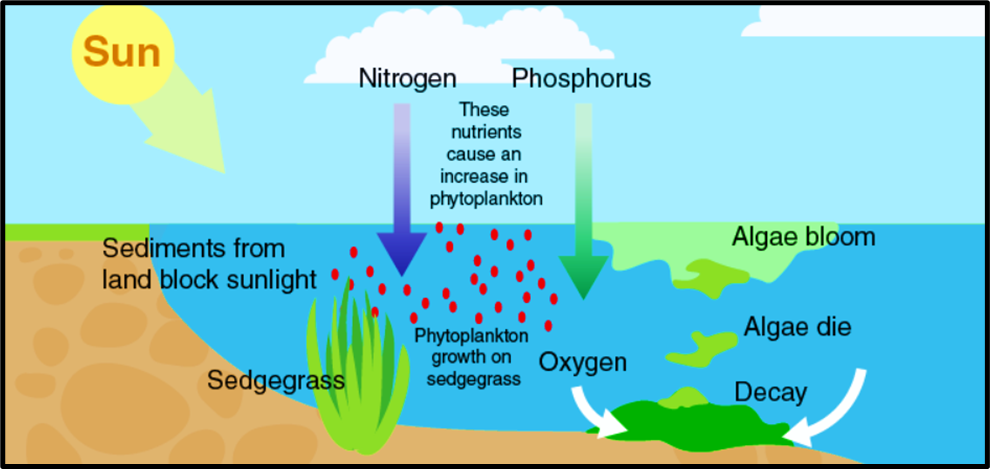
Excess nutrients (especially nitrates and phosphates) trigger explosive growth of planktonic algae.
This phenomenon is called algal bloom.
Effects:
- Blocks sunlight
- Reduces dissolved oxygen
- Accelerates the ageing of lakes (eutrophication)
C. Biological Magnification (Biomagnification)
Certain pollutants increase in concentration as they move up the food chain.
Most famous examples:
Mercury
Highly toxic methylmercury increases up the food chain.
DDT
Causes eggshell thinning in birds → eggs break prematurely → population decline.
This was the root cause behind the fall of eagles, falcons, and other raptors globally.
Effects on the Aquatic Ecosystem
Pollution affects not only fish but the entire aquatic web of life.
A. Thermal Pollution + Chemical Pollutants
Hot and polluted water from industries:
- Lowers DO
- Kills sensitive species like plankton, molluscs, fish
- Biocides, PCBs, and heavy metals eliminate entire species groups
Only highly tolerant organisms survive.
Indicator Species of Polluted Water
- Tubifex worm
- Certain insect larvae
They tolerate very low DO, so their presence signals high pollution.
Ocean Warming Increases Methylmercury in Fish
This is a new scientific insight linked to pollution + climate change.
Key observations:
- Seawater methylmercury has declined since the 1990s
BUT - Methylmercury in fish has increased
Why?
Two Main Reasons
(1) Overfishing → Predatory fish shift diets
Predators now consume:
- Larger fish
- Fish with higher toxin concentrations
This increases methylmercury levels in predators such as tuna, swordfish, and sharks.
(2) Ocean warming → Higher fish metabolism
Warmer water = faster metabolism
→ More energy spent on survival
→ Less on growth
→ Toxin concentration increases because toxins accumulate faster than body mass
Thus, predatory fish contain more methylmercury, even if seawater levels decline.
Impact
Human exposure to methylmercury increases through seafood consumption—an emerging climate-linked health risk.
Eutrophication & Ageing of Lakes
Lakes naturally age as they collect sediments and organic matter over thousands of years.
Natural eutrophication
- Slow process
- Nutrients enter via runoff
- Gradual increase in plant and algae growth
Cultural eutrophication
- Caused by human activity
- Extremely rapid
- Triggered by sewage, detergents, fertilizers
Lake Categories
- Oligotrophic → nutrient-poor, clean, deep water
- Mesotrophic → moderate nutrients
- Eutrophic → nutrient-rich, shallow, oxygen-poor
Most Indian lakes = eutrophic or mesotrophic, due to heavy nutrient load.
Effects of Eutrophication
1. Collapsing Food Chains
Dense growth of plants and phytoplankton → die → decompose → oxygen depletion → death of fish and fauna.
2. Invasion by New Species
Abundant nutrients change species composition:
→ Opportunistic species flourish
→ Native species decline
3. Loss of Freshwater Lakes
Sediment + dead biomass accumulate → lake becomes shallow → eventually becomes a marsh → then transitions toward terrestrial habitat.
4. Loss of Coral Reefs
High turbidity reduces sunlight → corals lose symbiotic algae → bleaching and decline.
5. Other impacts
- Navigation becomes difficult (due to turbidity)
- Water becomes yellow, green, or red (due to blooms)
- Bad odour develops
- Increase in toxic, inedible algae
- Bloom of gelatinous zooplankton
Eutrophication is essentially the ecological death of a lake.
Eutrophication & Algal Blooms
Eutrophication is essentially over-fertilisation of water bodies.
How does it happen?
When excess nitrates and phosphates enter lakes or rivers—either naturally or due to human activity—phytoplankton get abundant nutrients.
This leads to:
➡ Population explosion of phytoplankton → Algal Bloom
Phytoplankton spread over the water surface → block sunlight → underwater plants die → oxygen replenishment stops.
This is the beginning of a downward ecological spiral.
Phytoplankton — The Tiny Climate Engineers
Phytoplankton are microscopic, plant-like organisms with chlorophyll.
Key characteristics:
- Autotrophs (photosynthesise using sunlight)
- Some also ingest other organisms (mixotrophs)
- Base of the aquatic food web
- Produce more than half of Earth’s oxygen
- Major absorbers of CO₂, influencing global climate
Examples: diatoms, dinoflagellates, green algae, cryptomonads, cyanobacteria.
Phytoplankton Chlorophyll Types
Chlorophyll absorbs light (mainly blue/red) and appears green.
Types:
- Chlorophyll a – in all plants, algae, cyanobacteria
- Chlorophyll b – in higher plants, green algae
- Chlorophyll c – in brown algae, diatoms, dinoflagellates
- Chlorophyll d – red algae
Colour of algal blooms
Red or brown blooms → “Red Tides” or “Brown Tides”.
Climate connection
Warm water favours algae.
Thus climate change = more algal blooms.
Mechanism of Oxygen Depletion in Algal Blooms
To understand why algal blooms are dangerous, observe the day–night behaviour of phytoplankton:
Daytime
- photosynthesis
- oxygen is added to water
Night
- intense respiration
- oxygen consumption > oxygen production
Now add:
- Decomposition of dead algae
- Decomposition of dead fish
All this consumes even more oxygen → hypoxic conditions (very low DO).
Anaerobic bacteria thrive
Example: Clostridium botulinum, which produces deadly toxins affecting:
→ fish
→ birds
→ mammals
This is how a nutrient-rich lake turns into a toxic water body.
Harmful Algal Blooms (HABs)
Not all blooms are harmful.
But some species produce neurotoxins and hepatotoxins.
Impacts of HABs:
- Poisoning of fish (e.g., shellfish poisoning)
- Human health risks
- Collapse of fishing industries
- Loss of tourism
- Degradation of coastal habitats
Eutrophication and Dead Zones
Deoxygenation of the World’s Oceans
According to IUCN, the global ocean has lost ~2% oxygen from 1960 to 2010.
Primary reasons:
- Eutrophication
- Nitrogen deposition (from fossil fuel burning)
- Ocean warming
How warming reduces ocean oxygen:
(1) Oxygen becomes less soluble in warm water
Warm liquids hold less gas.
(2) Stratification increases
- Fresh, light meltwater stays on top
- Deep water stays below
- Mixing reduces
This prevents upwelling of nutrients, reducing photosynthesis by phytoplankton and altering the food web.
Dead Zones (Hypoxic Zones)
Dead Zones = ocean areas with extremely low oxygen, where most marine life cannot survive.
Characteristics:
- Occur mainly at 200–800 m depth
- Form when algae bloom → die → decompose → oxygen drops
Natural causes
- Upwelling bringing nutrient-rich water
Human-enhanced causes
- Fertiliser runoff
- Sewage discharge
- Industrial effluents
Global Examples:
- Gulf of Mexico (largest seasonal dead zone)
- Gulf of Oman (rapidly expanding)
Remember the sequence:
- Eutrophication
- Algal Bloom
- Oxygen depletion → hypoxia → Dead Zone
Blue Tide (Bioluminescent Tides)
Occasionally, polluted or eutrophic coastlines glow blue at night.
Why?
Presence of bioluminescent dinoflagellates in water low in oxygen and high in nitrogen.
Impact:
- Smaller blooms = harmless
- Larger blooms = disrupt fishing
- Often indicates degraded coastal water quality
Bioluminescence
Bioluminescence = ability of organisms to produce & emit light.
Why do organisms glow?
Mainly anti-predator response:
→ Startle predators
→ Attract predators of predators
→ Group formation for safety
Where do we see it?
In Bacteria, Fungi, Algae, Jellyfish, Crustaceans, Sea stars, Deep-sea fishes & sharks
Luminescence is stronger in:
- Deep-living organisms
- Planktonic organisms
This natural light show is beautiful, but when tied to eutrophication (like in blue tides), it becomes a warning sign of ecological stress.
This article forms part of the broader Environment syllabus for UPSC preparation.