
Water Pollution Control Measures
Controlling water pollution involves a combination of biological, physical, chemical, and ecosystem-based strategies.
Let’s explore them.
1. Bioremediation
Bioremediation means using living organisms (bacteria, fungi, plants) to break down or remove contaminants from soil and water.
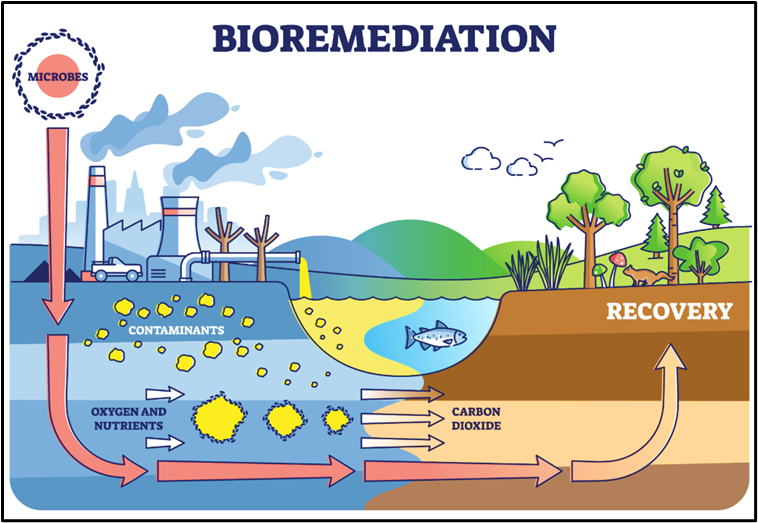
Microorganisms can even be genetically engineered to degrade pollutants more effectively.
Two major types exist:
A. In-situ Bioremediation
(“On-site”—treatment occurs where the contamination exists)
1. Bioventing
- Nutrients (like oxygen or nitrogen sources) are supplied through wells
- Stimulates indigenous bacteria present in the soil
- Helps them degrade pollutants faster
2. Biosparging
- Air is injected under pressure below the water table
- Increases dissolved oxygen in groundwater
- Enhances microbial breakdown of contaminants
3. Bioaugmentation
- New microorganisms are added to a contaminated site
- Useful when native microbes cannot degrade pollutants efficiently
Oilzapper & Oilivorous-S by TERI
These are bacterial consortia (mixtures) developed to degrade oil from:
➡️Oil spills
➡️Oil sludge
➡️Contaminated soil
They leave behind no toxic residue.
B. Ex-situ Bioremediation
(Removal of contaminated material → treatment elsewhere)
1. Landfarming
- Contaminated soil is excavated → Spread over a prepared surface → Periodically tilled → Aerobic bacteria degrade pollutants using oxygen
- Cheap and widely used
2. Bioreactors
- Contaminated soil/water is processed in engineered chambers
- Allows controlled conditions for faster degradation
3. Composting
- Organic waste decomposes naturally
- Microbes convert waste → stable compost
- Used for organic-rich contaminated soils
Bioremediation of Arsenic
Arsenic exists mainly in two toxic forms:
➡️Arsenate (As⁵⁺)
➡️Arsenite (As³⁺)
Agricultural use of arsenic-contaminated water increases arsenic in grains and fruits, entering the human food chain.
Bacteria used:
- Bacillus flexus → resistant to arsenate
- Acinetobacter junii → resistant to arsenite
Both possess special detoxification genes that convert toxic arsenic forms into less harmful ones.
Advantages of Bioremediation
- Destroys a wide range of contaminants
- Environment-friendly
- Often cheaper than chemical or physical cleanup
- Reduces pollutants permanently (not just transfers them elsewhere)
Limitations
- Works only for biodegradable compounds
- Some pollutants cannot be degraded biologically
- Slow process compared to chemical treatment
- Effectiveness depends on environmental conditions (temperature, pH, oxygen, etc.)
2. Riparian Buffers — Mitigating Eutrophication
A riparian buffer is a strip of vegetation planted along rivers, streams, farms, roadsides, etc.
Functions:
- Traps sediments
- Filters nutrients like nitrates & phosphates
- Prevents eutrophication
- Stabilises riverbanks
- Provides habitat for wildlife
Natural riparian buffers:
- Wetlands
- Estuaries
These are critical for nutrient filtration.
Phytoremediation
Phytoremediation = using plants to clean soil or water.
Key plants:
- Mangroves
- Wetland vegetation
- Estuarine plants
Types:
1. Phytoextraction / Phytoaccumulation
Plants absorb contaminants into:
→ Roots
→ Shoots
→ Leaves
Example:
Water hyacinth → absorbs heavy metals, toxic substances
(even though it is invasive, it can purify water when controlled)
2. Eucalyptus near sewage ponds
Eucalyptus trees:
→ Absorb large quantities of wastewater
→ Release pure water vapour through transpiration
Useful where sewage ponds overflow frequently.
3. Sewage Water Treatment (Domestic Water Treatment)
Sewage contains:
- Suspended solids
- Microbes (bacteria, algae, viruses, fungi)
- Minerals (iron, manganese)
So, water must be treated through a series of steps.
Coagulation / Flocculation
Tiny dirt particles cannot be removed by filtration alone.
How it works:
- Add alum, ferric sulfate, or sodium aluminate
- They neutralise charges on fine particles
- Particles clump together → form flocs
- Flocs are heavy → easy to remove
This is the first step in water purification.
Filtration
Treated water passes through layers of:
→ Sand
→ Gravel
→ Crushed anthracite
It removes:
→ Suspended impurities
→ Microorganisms
→ Residual flocs
Filtration greatly improves the effectiveness of disinfection.
Sedimentation
Water is held in sedimentation tanks.
➡️Heavy flocs settle down → form sludge
➡️Clear water moves on to next stage
This step reduces turbidity.
Disinfection
Purpose: Destroy pathogens before water is supplied to houses.
Chlorination
- Traditional & widely used
- Cheap, effective
- Leaves residual chlorine → protects water in pipelines
- But chlorine may react with organic matter → produce chloroform & carcinogenic by-products
- These risks are minimal after proper filtration & coagulation
Ozonation
- Stronger disinfectant
- No taste/odour problems
- No harmful by-products
- But ozone is unstable:
- must be generated on-site
- expensive
- leaves no residual protection in pipelines
Thus, most countries use chlorination for final disinfection.
Fluoridation & Defluorination
Fluoride is naturally present in water.
Optimum fluoride → prevents dental caries
Excess fluoride → causes fluorosis
BIS standards:
- Desirable limit: 1.0 mg/L
- Permissible limit: 1.5 mg/L
Defluorination at home:
Add:
- Alum solution
- Lime / sodium carbonate
- Bleaching powder
These cause fluoride to precipitate out.
pH Correction
Soft water can be corrosive.
To protect pipes:
- Lime is added to raise pH
- Stabilises water
- Prevents corrosion in pipelines and household plumbing
Removal of Iron
Especially needed in:
➡️Northeast India
➡️Some eastern & central regions
Iron problems:
- Bad taste
- Odour
- Staining of utensils
- Health issues at high levels
BIS limit: 0.3 mg/L
How iron is removed:
- Oxidise dissolved iron → ferric hydroxide
- Aeration + oxidising agents (e.g., lime)
- Ferric hydroxide precipitates → removed by filtration
Removal of Arsenic
BIS limit: 0.05 mg/L
Treatment chemicals:
- Bleaching powder
- Alum
These convert arsenic to forms that can be precipitated & filtered out.
4. Bio-Toilets — A Modern Sanitation Solution
Bio-toilets are designed to treat human waste on-site using biological processes.
They prevent open defecation, reduce sewage load, and help stop water pollution at the source.
To understand bio-toilets, first understand a few key terms.
Key Terms Associated with Bio-Toilets
Bio-digesters
- Steel structures where anaerobic digestion of human waste occurs.
Bio-tanks
- Concrete tanks for the same anaerobic digestion process.
Aerobic Bacteria
- Need free dissolved oxygen
- Break down organic matter
- Produce stable end products like CO₂ & water
- Cannot function in closed tanks without oxygen
Anaerobic Bacteria
- Thrive without oxygen
- Use bound oxygen from compounds like:
- Nitrates (NO₃⁻)
- Sulphates (SO₄²⁻)
- Reduce them to stable end products
- Produce foul-smelling gases:
- H₂S (hydrogen sulphide)
- CH₄ (methane)
Facultative Bacteria
- Can operate both aerobically and anaerobically
- Extremely useful in variable conditions
Anaerobic Microbial Inoculum
- A mixture of bacterial species
- Break down complex human waste → sugars → fatty acids → biogas
These inoculums are the “starter culture” for bio-digesters.
Anaerobic (Digester) Biodegradation System
Anaerobic digestion =
Microbes breaking down waste in the absence of oxygen
End products:
- Methane (CH₄) → biogas
- Carbon dioxide (CO₂)
- Biofertiliser (nutrient-rich slurry)
Environmental advantage:
Recycling 1 tonne of food waste via anaerobic digestion prevents 0.5–1 tonne of CO₂ emissions, compared to landfilling.
This is why anaerobic digestion is promoted under circular economy models.
Anaerobic vs. Aerobic Biodegradation
| Anaerobic Biodegradation | Aerobic Biodegradation |
| Occurs in complete absence of oxygen | Requires forced aeration (energy-intensive) |
| >99% pathogen inactivation | Incomplete aeration → foul smell |
| Can degrade detergents & phenyl | Cannot tolerate detergents |
| Produces very little sludge | Produces large volumes of sludge |
| One-time inoculation is enough | Repeated addition of bacteria/enzymes needed |
| Low maintenance, no recurring cost | High maintenance + recurring cost |
Inference:
Anaerobic systems (like bio-toilets) are more practical, eco-friendly, and affordable for large-scale sanitation.
EcoSan Toilets (Ecological Sanitation)
EcoSan = Urine-Diverting Dry Composting Toilets
Features:
- Do NOT use water
- Waste decomposes aerobically into safe compost
- Practical & cost-effective
- Prevents contamination of groundwater
- Recycles nutrients as natural fertiliser
EcoSan toilets are especially useful in:
- Water-scarce regions
- Hilly terrains
- Flood-prone areas
Bio-Toilets in Indian Trains
Designed by Indian Railways + DRDO.
How do they work?
- Human waste passes into a bio-digester chamber beneath the toilet
- Anaerobic bacteria break it down
- Final output:
- Neutral water (non-corrosive)
- Biogas traces
Why was this needed?
Old systems discharged human waste directly onto tracks →
→ Corroded rails + created sanitation issues at stations.
Bio-toilets eliminate this pollution entirely.
5. MAJOR RIVER CONSERVATION INITIATIVES
Water Pollution Control Measures in India
India’s primary legal instrument is:
THE WATER (PREVENTION & CONTROL OF POLLUTION) ACT, 1974
Purpose:
- Prevent and control water pollution
- Maintain or restore wholesomeness of water
It also established:
- Central Pollution Control Board (CPCB)
- State Pollution Control Boards (SPCBs)
They regulate:
- Industrial effluent discharge
- Water quality monitoring
- Pollution abatement programs
CPCB’s “Designated Best Use” Classification
CPCB categorizes water bodies based on their best intended use using parameters like:
➡️pH
➡️Dissolved Oxygen (DO)
➡️BOD
➡️Total coliform
➡️Free ammonia
➡️Electrical conductivity
Classes A–E:
- A: Drinking water without disinfection
- B: Outdoor bathing
- C: Drinking water (after treatment)
- D: Propagation of wildlife/fisheries
- E: Irrigation, industrial cooling
Why is this classification important?
- Helps planners identify water quality targets
- Prioritises polluted stretches for restoration
- Basis for major programmes like:
- Ganga Action Plan (GAP)
- National River Action Plan (NRAP)
This framework is still used for river rejuvenation missions across India.
India’s rivers, especially the Ganga, have been under pressure from domestic sewage, industrial waste, and agricultural runoff for decades.
Recognising this, the government initiated a series of river-cleaning programmes. Let’s study them:
Ganga Action Plan (GAP), 1985
GAP was India’s first major river-cleaning programme, launched by the Ministry of Environment & Forests (MoEF) in 1985 as a centrally sponsored scheme.
Original Objective
- Improve Ganga’s water quality to “acceptable standards.”
Revised Objective
Later recast to meet “Bathing Class” standards:
| Parameter | Bathing Class Standard |
| BOD | ≤ 3 mg/L |
| DO | ≥ 5 mg/L |
| Total Coliform | ≤ 10,000/100 ml |
| Faecal Coliform | ≤ 2,500/100 ml |
Progress
- GAP Phase-I (1985–2000): Partially successful
- Water quality improved in several stretches but BOD remained above limits in many locations.
GAP Phase-II
Expanded to include major tributaries:
→ Yamuna
→ Gomti
→ Damodar
GAP laid the foundation for future national river actions.
National River Conservation Plan (NRCP), 1995
GAP was broadened to cover all major rivers of India (except Ganga basin rivers) through the NRCP.
Implemented by
- Ministry of Jal Shakti
- Covers 160 towns, 34 rivers, across 20 states
Objectives
Bring river water to Bathing Quality Standards through:
Key Pollution Abatement Measures
- Capture & treatment of raw sewage before it enters rivers
(Responsibility: State Governments, ULBs) - Industrial pollution control
(Responsibility: SPCBs/PCCs) - Low-cost sanitation to stop open defecation on riverbanks
- Electric crematoria
– replaces wood-based cremation → reduces pollution - Riverfront development
– ghats improvement, bathing ghats renovation, etc.
NRCP acted as India’s umbrella scheme for river conservation until Namami Gange was launched.
National Ganga Council (NGC), 2016
The River Ganga (Rejuvenation, Protection & Management) Authorities Order, 2016 replaced the old National Ganga River Basin Authority (NGRBA).
NGC’s Role
- Apex council responsible for:
- Rejuvenation
- Pollution prevention
- Sustainable management of the entire Ganga River Basin
Implementation Wing
National Mission for Clean Ganga (NMCG)
(Registered as a society under the Societies Registration Act, 1860)
NMCG implements the Namami Gange Programme.
Members of the National Ganga Council
- Prime Minister → Chairperson
- Union Minister for Jal Shakti → Vice-Chairperson
- Union Ministers of:
- Environment
- Finance
- Power
- Housing
- Science & Technology
- States for Tourism and Shipping
- Chief Ministers of Ganga basin states
- Vice-Chairperson, NITI Aayog
This ensures top-level political coordination.
National Ganga River Basin Authority (NGRBA), 2009
- Established under Section 3 of the Environment Protection Act, 1986
- Declared Ganga as the “National River of India.”
- Replaced by National Ganga Council in 2016.
This shift signified a strengthened institutional mechanism.
Project Arth Ganga
A sustainable development model focusing on community-based economic activities along the Ganga.
Goal
- Contribute 3% of India’s GDP from the Ganga Basin economy.
Introduced
- At the 1st National Ganga Council meeting, 2019
Key components
- Re-engineering the Jal Marg Vikas Project (JMVP)
– Supported by the World Bank
– Develops Ganga as a navigation corridor
Small Jetty Terminals
To help:
➡️Farmers sell produce cheaply
➡️Boost rural logistics
➡️Create jobs along the river corridor
Arth Ganga aims at “Ganga-led economic development”.
Namami Gange Programme (2014)
A central sector flagship programme with ₹20,000 crore budget.
Twin objectives:
- Pollution abatement
- Conservation & rejuvenation of River Ganga
Eight Main Pillars
- Sewerage Treatment Infrastructure
- Riverfront Development
- River Surface Cleaning
- Biodiversity Conservation
- Afforestation
- Public Awareness
- Industrial Effluent Monitoring
- Ganga Gram
– Model villages that follow sanitation & river-friendly practices
Namami Gange integrates engineering, ecology, economics, and community participation.
Clean Ganga Fund (2014)
Established as a trust under the Indian Trusts Act, 1882.
Who can contribute?
- Resident Indians
- NRIs
- Persons of Indian Origin (PIOs)
- Public & private corporates
Why is it important?
- Contributions count as CSR (Corporate Social Responsibility)
- Provides financial support for projects under Namami Gange & NMCG
6. Swachh Bharat Mission (SBM), 2014
Launched on 2 October 2014, the Swachh Bharat Mission aimed to fundamentally transform India’s sanitation landscape.
Implementing Ministry
- Ministry of Drinking Water & Sanitation (later moved under Ministry of Jal Shakti, 2019)
Primary Objective
- Achieve universal sanitation coverage by making all Gram Panchayats Open Defecation Free (ODF).
Financial Incentives
Incentives for constructing household toilets were provided to:
- BPL households
- APL households belonging to:
- SC/ST
- Women-headed families
- Persons with disabilities
Cost-sharing pattern
- Centre:States = 75:25
- For NE + Himalayan + Special category States → Centre:States = 90:10
Performance of SBM
- Over 10 crore toilets constructed
- All rural areas declared ODF by Oct 2, 2019
- When SBM began (2014), rural sanitation coverage was only 38.7%.
This rapid transformation is considered one of India’s largest behavioural-change campaigns.
Swachh Iconic Places (SIP)
A special initiative under SBM to upgrade India’s iconic cultural, religious, and heritage sites to world-class cleanliness standards.
Aim
Enhance sanitation, hygiene, and waste management at high-footfall iconic locations.
Coordination
Central collaboration among:
- Ministry of Jal Shakti
- Ministry of Urban Development
- Ministry of Culture
- Ministry of Tourism
- Concerned State Governments
Key Interventions
- Improved sewage infrastructure
- Solid and liquid waste management (SLWM)
- Water vending machines
- Better sanitation facilities
- Lighting, road maintenance, landscaping
- Improved transport services
Swachh Bharat Mission – Phase II (2020–21 to 2024–25)
The second phase shifts from infrastructure creation to sustainability + waste management.
Focus: ODF Plus
Includes:
- Sustaining ODF behaviour
- Solid & Liquid Waste Management (SLWM)
- Village cleanliness systems
- Greywater management (non-toilet wastewater)
Integration with Other Schemes
- MGNREGA → funding for greywater channels, soak pits, etc.
- Jal Jeevan Mission → safe piped drinking water supply
Funding Pattern
- 90:10 → NE States, Himalayan States, J&K
- 60:40 → Other States
- 100:0 → Union Territories
SBM-II ensures long-term environmental and water quality benefits.
7. National Water Quality Monitoring Programme (NWMP)
This is India’s scientific backbone for tracking water pollution trends.
Implemented By
- Central Pollution Control Board (CPCB)
- In partnership with State Pollution Control Boards (SPCBs)
What does NWMP do?
- Monitors rivers, lakes, canals, groundwater
- Measures parameters like DO, BOD, pH, coliform bacteria, nutrients, heavy metals
- Identifies polluted river stretches
- Enables formulation of action plans
NGT Mandate
The National Green Tribunal has directed States/UTs to:
➡️Prepare River restoration action plans
➡️Get them approved by CPCB
➡️Implement them under strict timelines
This ensures accountability in reviving polluted stretches.
This article forms part of the broader Environment syllabus for UPSC preparation.