
Radioactive Pollution
What is Radioactivity?
Radioactivity is a natural property of certain unstable atoms.
When the nucleus of such an atom becomes unstable, it starts breaking down or disintegrating on its own.
During this breakdown, it emits:
- Alpha particles → positively charged (protons)
- Beta particles → negatively charged (electrons)
- Gamma rays → high-energy electromagnetic radiation
These emissions together are what we call nuclear radiation.
Two Types of Radiation
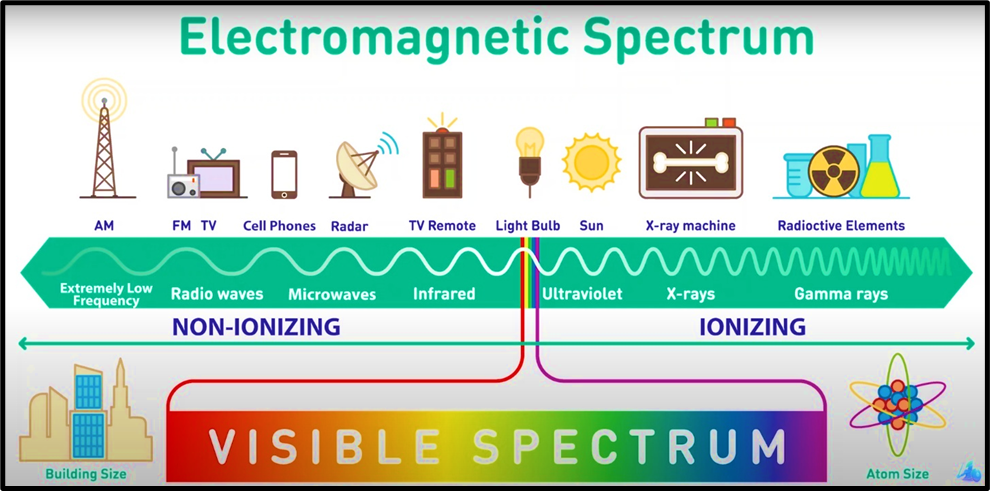
Radiations are grouped into:
- Non-ionizing radiation → cannot remove electrons from atoms
- Ionising radiation → has enough energy to ionise (i.e., remove electrons)
What is Radioactive Pollution?
Radioactive Pollution refers to the increase in the level of nuclear radiation (radioactive contamination) in the environment in such a way that it becomes dangerous to humans, animals, and plants.
What is Radioactive Contamination?
It means radioactive substances are present where they shouldn’t be:
→ On surfaces
→ In soil
→ In water
→ In air
→ Inside living bodies
Natural vs Artificial Sources of Radiation
A. Natural Sources
Earth and the universe naturally emit radiation.
- Cosmic rays → coming from outer space
- Terrestrial radiation → from radionuclides in Earth’s crust such as:
- Uranium-238
- Thorium-232
- Radium-224
- Potassium-40
- Carbon-14
These have been present since the formation of the Earth.
B. Artificial Sources
These are man-made and are the main cause of radioactive pollution:
1. Accidental leakages from nuclear power plants
This is the most dangerous form, as the leaked radiation spreads quickly through air, water, and soil.
2. Improper disposal of radioactive wastes
3. Nuclear weapon testing
The explosion releases nuclear fallout containing:→ Strontium-90→ Caesium-137→ Iodine-131
4. Mining of radioactive materials
Example: Monazite ore → source of thorium
5. Medical procedures
→ X-rays→ CT scans→ Cancer treatment (radiation therapy)
6. Research laboratories and reactors
Low-level radiation may leak over time.
Nuclear Power Plant Accidents
Inside a nuclear reactor, nuclear fission produces massive heat.
If the cooling system fails, the fuel rods overheat and melt down.
This can cause:
- Release of enormous radioactive material
- Long-term genetic and ecological damage
Despite multiple safety measures, three major disasters occurred:
1. Three Mile Island (USA, 1979)
- Reactor overheated
- Small leakage
- No immediate casualties
2. Chernobyl (USSR/Ukraine, 1986)
- Worst nuclear disaster in history
- Heavy and widespread radiation leakage
- Many workers died
- Radiation spread across Europe
- ▶️Watch this for more details.
3. Fukushima Daiichi (Japan, 2011)
- Triggered by a massive earthquake and tsunami
- Several reactors were damaged
- Significant radioactive release
- ▶️Watch this for more details
Safe Disposal of Nuclear Wastes
Radioactive wastes are of two main types:
A. Low-Level Radioactive Wastes (LLW)
Includes:
- Medical waste
- Research waste
- Protective clothing
- Materials from decommissioned reactors
These have low radioactivity but large volumes.
B. High-Level Radioactive Wastes (HLW)
These are the most dangerous.
Sources:
- Spent nuclear fuel rods
- Obsolete nuclear weapons
- Products of fission:
- Caesium-137
- Strontium-90
Current Disposal Methods
- Storage ponds at reactor sites
- Reprocessing plants (expensive but reduces volume)
- Deep underground burial (used by USA)
Common radioactive waste substances:
- Argon-41
- Radioiodine
- Cobalt-60
- Strontium-90
- Tritium
- Caesium-137
Non-Ionizing Radiation
These are low-energy electromagnetic waves:
- Radio waves
- Microwaves
- Infrared
- Visible light
- Part of the UV spectrum
They cannot ionise atoms but can heat them by causing vibration.
Effects:
- Snow blindness: due to reflection from snow/sand
- Sunburns: due to prolonged UV exposure
- Damage to skin and small blood vessels
Everyday Example:
In a microwave oven, the radiation makes water molecules vibrate faster — this generates heat and cooks the food.
Impact of Non-Ionizing Radiation from Cell Phone Towers
Cell towers use non-ionizing electromagnetic radiation (EMR)—mainly microwaves—for communication. Though non-ionizing, long-term exposure can still cause biological effects.
A. Health Impacts
1. Multiple antennas = higher radiation
A single tower may host antennas of multiple telecom operators.
More antennas → higher power output → more radiation intensity near the tower.
Radiation decreases gradually as we move away.
2. Thermal Effects
EMR is absorbed by the human body, producing heat.
This heating can cause:
→ Cellular stress
→ Psychological effects
→ Genetic defects
→ Reproductive and developmental issues
→ Central Nervous System disturbance
3. Non-Thermal Effects
These occur even when heating is too low to be detected.
How?
Radiofrequency fields can influence the movement of calcium and other ions across cell membranes, disturbing basic cellular processes.
Possible symptoms:
→ Fatigue
→ Nausea
→ Irritability
→ Headaches
→ Loss of appetite
→ Mood or psychological changes
4. Limitation of Safety Standards
Current safety guidelines mainly consider thermal effects.
But evidence of non-thermal effects is growing — yet not included in standard limits.
B. Impact on Birds
Birds are more vulnerable than humans.
Greater absorption
Birds have:
→ Larger surface area relative to body weight
→ Lower body water content
Hence, they heat up quickly when exposed to EMR.
Navigation problems
Birds use the Earth’s magnetic field to navigate.
Cell tower fields disrupt this ability.
Consequences:
→ Disorientation
→ Erratic flying
→ Collision with towers
→ Sudden deaths
This is one reason for declining bird populations around urban areas.
Ionising Radiation — More Dangerous
Ionising radiation includes:
→ Short-wavelength UV
→ X-rays
→ Gamma rays
→ Alpha particles
→ Beta particles
→ Neutrons (produced in nuclear fission)
These radiations remove electrons from atoms → a process called ionisation.
Key Differences
- Non-ionizing radiation → low penetration, affects only surface-level tissues.
- Ionising radiation → deeply penetrating; breaks macromolecules like DNA and proteins.
You can watch this ▶️ video for better insights.
Penetration Power of Radiation
| Radiation Type | Ability to Penetrate | Blocked By |
|---|---|---|
| Alpha particles | Very low | Paper, skin |
| Beta particles | Moderate | Glass, thin metals |
| Gamma rays | Very high | Thick concrete, lead barriers |
Gamma rays are the most penetrating and most dangerous.
Watch this ▶️video for better insights
Half-Life Period of Radioactivity
Every radioactive material decays at a fixed rate.
Half-life = Time taken for half of the atoms to decay.
➡️Can range from milliseconds to thousands of years.
➡️Radionuclides with long half-lives are the main cause of sustained environmental pollution.
Watch this ▶️video for better understanding.
Example:
Cesium-137 has a half-life of ~30 years → remains dangerous for centuries.
Radiation Dose (rem)
The traditional unit of biological radiation dose = rem (radiation equivalent in man).
- < 1 rem (background level): Body can repair damage quickly
- Up to 100 rem: Damage becomes harder to repair →
- Permanent cellular changes
- Cell death
- Radiation sickness
- Higher likelihood of cancer
Impact of Ionising Radiation
Ionising radiation is highly damaging because it breaks chemical bonds.
Short-Term Effects
- Skin burns
- Tissue death
- Impaired metabolism
- Organ malfunction
- Immediate mortality in severe exposure
Long-Term Effects
- Mutations
- Tumours and various cancers
- Reduced lifespan
- Developmental defects (if exposure occurs during pregnancy)
Chronic Low-Dose Exposure
Even low doses over time can cause:
➡️Childhood leukemia
➡️Miscarriages
➡️Low-birth-weight babies
➡️Infant mortality
➡️Weakened immune system (higher susceptibility to diseases like AIDS)
DNA Damage Mechanism
Ionising radiation produces charged particles that react with molecules in cells.
Example:
- Gamma ray passes through a cell
- Water molecules get ionised
- These ions react with DNA
- DNA bonds break → leading to:
- Genetic mutations
- Abnormal cell division
- Cancer
This is why radiation exposure is dangerous even without immediate symptoms.
Biological Damage: Somatic vs Genetic
Ionising radiation causes two broad categories of damage:
A. Somatic Damage (Radiation Sickness)
Affects body cells other than reproductive cells.
Examples:
→ Hair loss
→ Lung fibrosis
→ Cataracts
→ Immune system suppression (low WBC)
→ Cancers
→ Death in severe cases
Somatic damage affects only the exposed individual, not the next generation.
B. Genetic Damage
Affects reproductive cells (sperm or egg).
Consequences:
→ Permanent genetic mutations→ Birth defects→ Hereditary abnormalities
This damage is passed on to future generations.
This article forms part of the broader Environment syllabus for UPSC preparation.