
Climate Sensitivity
Climate sensitivity tells us how strongly Earth’s temperature responds to carbon dioxide.
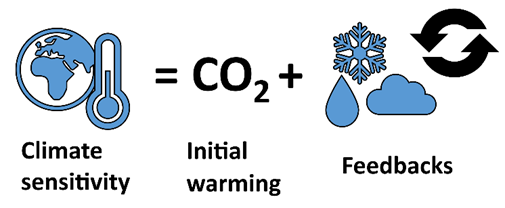
Formal Definition
Climate sensitivity is defined as the increase in global average temperature that occurs when the concentration of CO₂ in the atmosphere doubles compared to pre-industrial levels.
Why is this important?
- If we know climate sensitivity, we can estimate:
- How much CO₂ humanity can still emit
- And whether we can stay below the 2°C warming limit, as targeted under the Paris Agreement
In other words, climate sensitivity links science directly to climate policy.
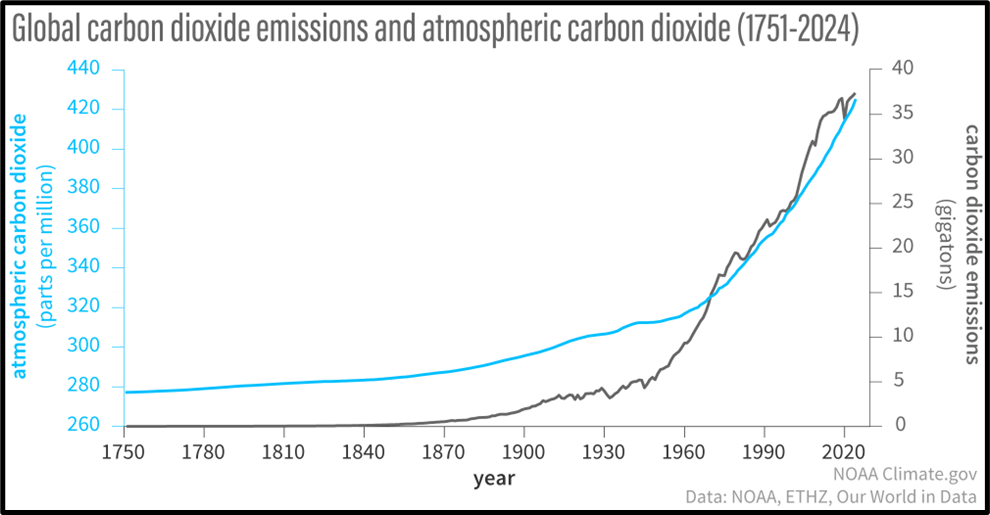
CO₂ Levels: From Pre-Industrial to Present
- Pre-industrial CO₂ concentration: ~ 260 ppm
- Doubling threshold: ~ 520 ppm
- Recent (2024) observed level: ~ 422 ppm
→ This is already over 60% higher than pre-industrial levels.
At current emission trajectories:
- The 520 ppm threshold could be crossed within 50–100 years, depending on future greenhouse gas emissions.
How Sensitive Is the Climate System?
Earlier scientific estimates placed climate sensitivity in the range of → 1.5°C to 4.5°C
However, newer climate models indicate that:
→ Climate sensitivity may lie between 3°C and 7°C
This shift is alarming and has profound implications for climate targets.
Why Is There So Much Uncertainty?
The uncertainty does not come from CO₂ physics itself.
It arises from climate feedback mechanisms.
What is Climate Feedback?
Climate feedback is a process that:
- Amplifies warming → positive feedback
- Or reduces warming → negative feedback
Feedbacks determine whether warming accelerates or slows down after the initial CO₂ increase.
Key Climate Feedbacks Driving Sensitivity
A. Permafrost Feedback: Earth as a GHG Source
- Permafrost contains massive stores of carbon and methane
- As temperatures rise:
- Permafrost melts
- CO₂ and methane are released
- This further increases global temperature
👉 This is a classic positive feedback loop, where warming causes more warming.
B. Water Vapour Feedback: The Strongest Feedback
- Warmer air can hold more water vapour
- Water vapour itself is a powerful greenhouse gas
As the planet warms:
- Evaporation increases
- Atmospheric water vapour increases
- Greenhouse effect strengthens
- Temperature rises further
👉 This makes water vapour the most significant positive feedback in the climate system.
C. Cloud Feedback: The Most Complex Feedback
Clouds behave like a double-edged sword.
Cooling Effect (Negative Feedback)
- Clouds reflect incoming solar radiation
- Reduces surface temperature
Warming Effect (Positive Feedback)
- Clouds trap outgoing terrestrial radiation
- Increases surface temperature
The net effect depends on cloud type.
Cloud Types and Their Climate Roles
Thick, Low-Level Clouds
- Reflect a large amount of sunlight
- Absorb little heat
- Act as strong coolers
- Represent negative feedback
Thin, High-Altitude Clouds (Cirrus Clouds)
- Reflect little sunlight
- Trap a large amount of heat
- Act as strong warmers
- Represent positive feedback
Why Clouds Increase Climate Sensitivity in New Models
Recent models show:
- A warmer and wetter atmosphere changes cloud composition
- Clouds with more liquid water droplets become:
- Optically thicker
- Better at blocking sunlight
- However, high-altitude cirrus clouds increase heat trapping
Additionally:
- Cloud cover may shift from the tropics towards the poles
- At higher latitudes:
- Sunlight is weaker
- Clouds block less solar radiation
- This reduces their cooling effect
👉 All these processes together push net cloud feedback towards warming.
Why Cloud Feedback Is Hard to Model
- Clouds vary by:
- Height
- Thickness
- Composition (ice vs water droplets)
- Small changes in cloud behaviour can produce large temperature differences
- This makes cloud feedback the single biggest source of uncertainty in climate sensitivity estimates.
Conclusion
- Climate sensitivity measures Earth’s temperature response to CO₂ doubling
- Rising estimates suggest greater warming than previously expected
- Feedback mechanisms, not CO₂ itself, drive uncertainty
- Water vapour and permafrost amplify warming
- Cloud feedback is complex and central to future projections
To explore all Environment topics in a structured manner, visit the complete Environment UPSC Notes page.