
Intergovernmental Panel on Climate Change (IPCC)
Background
The Intergovernmental Panel on Climate Change (IPCC) is the United Nations’ apex scientific body for assessing climate change.
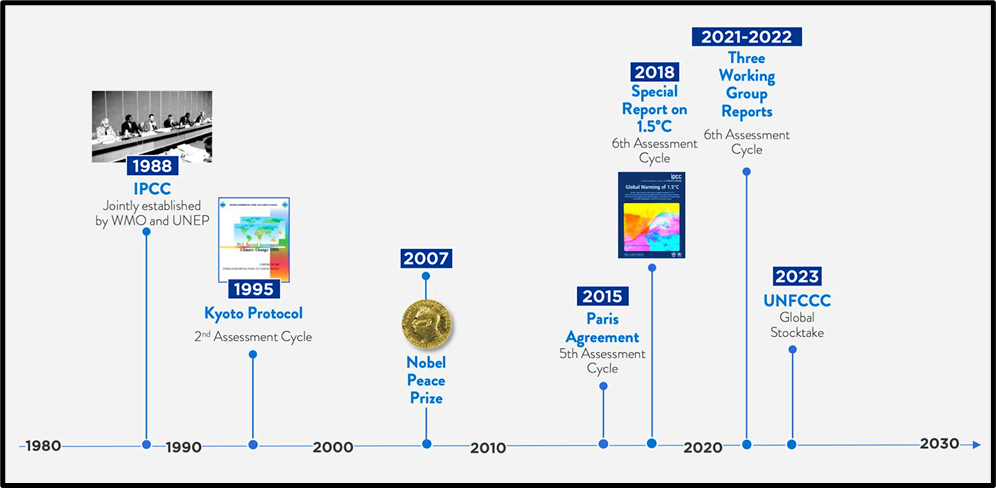
- It was established in 1988 by:
- United Nations Environment Programme (UNEP) and
- World Meteorological Organization (WMO)
📌 Important clarity for beginners:
👉 The IPCC does NOT do experiments or original research.
👉 Instead, it assesses, evaluates, and synthesizes existing global scientific research on climate change.
Think of IPCC as:
🧠 The world’s most authoritative “examiner” of climate science, not a laboratory.
Why was IPCC created?
The purpose of IPCC is to provide scientific evidence for:
- Understanding human-induced climate change
- Assessing risks and impacts
- Suggesting adaptation and mitigation options
These scientific assessments directly support global climate negotiations under the United Nations Framework Convention on Climate Change (UNFCCC).
📌 In simple words:
Policy is made by governments, but science is provided by IPCC.
How does IPCC work? (Very important for UPSC)
The work of IPCC is divided into three Working Groups (WGs) and one Task Force:
🔹 Working Group I (WG I)
- Studies the physical scientific basis
- Deals with:
- Temperature rise
- Greenhouse effect
- Climate models
- Ice melt, sea level rise
👉 This is pure climate science.
🔹 Working Group II (WG II)
- Assesses impacts, adaptation, and vulnerability
- Focus areas:
- Agriculture
- Water
- Health
- Ecosystems
- Human settlements
👉 This connects climate change with society and economy.
🔹 Working Group III (WG III)
- Focuses on mitigation
- Studies:
- Reduction of GHG emissions
- Renewable energy
- Carbon pricing
- Policy tools
👉 This is about solutions.
📌 UPSC Tip:
If a question asks about science → WG I
If it asks about impacts → WG II
If it asks about solutions → WG III
IPCC Assessment Reports (ARs): The backbone of climate policy
Since its formation, IPCC publishes Assessment Reports approximately every 6–7 years.
| Assessment Report | Year | Key Contribution |
|---|---|---|
| AR1 | 1990 | Basis of UNFCCC |
| AR2 | 1995 | Basis of Kyoto Protocol |
| AR3 | 2001 | Improved climate projections |
| AR4 | 2007 | Nobel Peace Prize |
| AR5 | 2014 | Basis of Paris Agreement |
| AR6 | 2021–23 | Global Stocktake |
Highlights of Individual Assessment Reports
🔸 AR1 (1990)
- Global temperature rise: 0.3–0.6°C in last 100 years
- Projected rise:
- 2°C by 2025
- 4°C by 2100
- Sea level rise: 65 cm by 2100
📌 Historical importance:
👉 Scientific foundation of the United Nations Framework Convention on Climate Change (1992)
🔸 AR2 (1995)
- Revised temperature rise to 3°C by 2100
- Sea level rise estimate: 50 cm
📌 Outcome:
👉 Led to the Kyoto Protocol
🔸 AR3 (2001)
- Temperature increase range: 1.4°C – 5.8°C by 2100
- Sea level rise: 80 cm by 2100
- Rainfall expected to increase globally
👉 Shows growing scientific confidence.
🔸 AR4 (2007)
- Worst-case temperature rise: 4.5°C
- Sea level rise: 60 cm
- IPCC awarded the Nobel Peace Prize 🏆
📌 Why Nobel?
For enhancing understanding of human-induced climate change and laying foundations for global action.
🔸 AR5 (2014)
- Temperature rise could reach 4.8°C by 2100
- CO₂, CH₄, N₂O concentrations highest in last 800,000 years
- Heat waves: “Virtually certain”
- Large fraction of species at risk of extinction
📌 Most important outcome:
👉 Scientific basis of the Paris Agreement
AR6 in Detail
WG I to AR6 (Physical Science Basis – Feb 2021)
This report answers a fundamental question:
“What is happening to Earth’s climate, and why?”
Crossing the 1.5°C Threshold
- The global average temperature is likely to cross 1.5°C above pre-industrial levels between 2021 and 2040.
- For the first time, the IPCC states clearly:
⚠️ 1.5°C warming is inevitable, even under the best-case emission scenario.
📌 Why is this historic?
Earlier reports spoke in probabilities. AR6 speaks in certainty — the science has matured.
What does 1.5°C warming actually mean?
At 1.5°C global warming, the world will experience:
- More frequent and intense heat waves
- Longer warm seasons
- Shorter and weaker cold seasons
👉 Climate change is no longer about the future — it is about changes in seasons we already observe.
Can warming still be stopped?
Yes — but only conditionally:
- GHG emissions must be halved by 2030
- Net-zero emissions must be achieved by 2050
📌 This aligns directly with the Paris Agreement temperature goals, but demands unprecedented global action.
India-specific scientific findings
WG I provides strong scientific backing to India’s climate diplomacy:
- Historical cumulative emissions, not present emissions alone, are the root cause of today’s crisis.
- Air pollution and aerosols have:
- Reduced monsoon rainfall intensity
- Altered rainfall patterns across India and South Asia
- Urbanisation + aerosols have increased intense rainfall events in Indian cities.
👉 Climate change in India is not just about temperature — it is about monsoon instability.
WG II to AR6 (Impacts, Adaptation & Vulnerability – Feb 2022)
This report answers:
“Who is affected, how badly, and can we adapt?”
Cities: The epicentre of risk
- More than half of the world’s population lives in cities
- Cities face the highest climate risks due to:
- Heat stress
- Flooding
- Water scarcity
- Poor adaptive capacity
📌 Urban climate risk is now a development issue, not just an environmental one.
Escalating impacts with every fraction of warming
- Climate impacts do not increase linearly — they escalate sharply with each additional degree.
- Losses increase disproportionately as warming rises.
Biodiversity under existential threat
At different warming levels:
- 1.5°C → 14% species at very high risk of extinction
- 3°C → 29% species
- 4°C → 39% species
📌 This shows that even small temperature differences matter enormously.
Irreversible and near-irreversible losses
Some climate impacts cannot be undone, such as:
- Species extinction
- Glacier retreat
- Thawing of permafrost (especially in the Arctic)
👉 These processes can self-accelerate, creating positive feedback loops.
Human health impacts
Climate change has already:
- Affected physical health (heat stress, malnutrition)
- Affected mental health (climate anxiety, disaster trauma)
Future risks include:
- Food insecurity
- Water scarcity
- Flood disasters
WG III to AR6 (Mitigation – Apr 2022)
This report focuses on:
“How do we reduce emissions, and is it happening fast enough?”
Current emission status
- Global GHG emissions reached 59 GtCO₂e in 2019
- Increase of 54% since 1990
- Growth rate has slowed slightly, but absolute emissions remain high
📌 Slowing growth is not enough — emissions must decline sharply.
Positive signals
- 18 countries have reduced emissions continuously for over 10 years
- Achieved through:
- Energy efficiency
- Renewable energy
- Reduced energy demand
Carbon Inequality & Least Developed Countries (LDCs)
This is one of the most powerful moral findings of AR6.
- LDCs emitted only 3% of global emissions in 2019
- Per capita emissions (1990–2019):
- LDCs: 1.7 tCO₂e
- Global average: 6.9 tCO₂e
- Historical contribution (1850–2019): <0.4%
📌 Yet, LDCs suffer the worst climate impacts — a classic case of climate injustice.
Why current pledges are insufficient
- Existing commitments make it very likely that 1.5°C will be breached
- To stay within 1.5°C:
- Global emissions must fall 43% by 2030
- Follow the C1 pathway with minimal overshoot
👉 Current Nationally Determined Contributions (NDCs) fall far short.
Recommended Solutions (WG III)
🔹 Core strategies
- Rapid transition to:
- Renewable energy
- Electric vehicles
- Financial support for developing countries
🔹 Carbon removal & geo-engineering
- CO₂ removal via:
- Natural sinks
- Artificial methods
- Even high-risk geo-engineering (e.g., aerosol injection) is discussed — showing urgency, not preference.
🔹 “Low-hanging fruit”: Methane
- Methane emissions from:
- Mines
- Wells
- Landfills
- Cutting methane gives quick climate benefits due to its short atmospheric life.
Low-Emission Technologies: Cost Revolution
Since 2010:
- Solar energy cost ↓ 85%
- Wind energy cost ↓ 55%
- Lithium-ion batteries cost ↓ 85%
Deployment growth:
- Solar → 10×
- EVs → 100×
📌 Climate action is no longer limited by technology — it is limited by policy and will.
Land Use, Food Systems & Climate Change
Emissions from land and food systems
If entire food systems are considered:
- Contribution may reach 37–50% of global emissions
Break-up:
- Agriculture → 15%
- Deforestation for food → 18%
- Transport, storage, waste → 17%
IPCC recommendations
- Shift diets towards:
- Coarse grains
- Pulses
- Fruits, vegetables, nuts
- Reduce meat consumption
- Reduce food loss and waste (~25% of food wasted globally)
Land as a carbon sink
- Soil, forests, plantations absorb CO₂ via photosynthesis
- Therefore:
- Deforestation
- Urbanisation
- Cropping pattern change
directly affect GHG emissions.
Synthesis Report of IPCC AR6
The Synthesis Report integrates findings of WG I, II, and III.
Key conclusions
- Earth has already warmed 1.1°C due to human activities
- There is a 50% probability of crossing 1.5°C by 2030
- This threatens the core objective of the Paris Agreement
Maladaptation (Very Important Concept)
Maladaptation occurs when:
Adaptation actions unintentionally increase vulnerability instead of reducing it.
Examples:
- Flood embankments increasing downstream flooding
- Cooling solutions increasing energy demand
📌 Poor adaptation can be worse than no adaptation.
Conclusion
IPCC AR6 establishes with high confidence that human-induced climate change is accelerating, impacts are escalating and becoming irreversible, current pledges are insufficient, and immediate, equitable, and transformative action is the only viable pathway forward.
Till now, we discussed Assessment Reports, which are broad and comprehensive.
In the next section we will understand IPCC Special Reports, which are theme-specific, sharper, and policy-critical.
Think of them as “emergency scientific briefings” released when the world needs focused answers on urgent climate issues.
To explore all Environment topics in a structured manner, visit the complete Environment UPSC Notes page.