
Climate Mitigation Measures
What Do We Mean by Climate Change Mitigation?
First, let us settle the core idea.
Climate change mitigation refers to all efforts aimed at:
- Avoiding or reducing Greenhouse Gas (GHG) emissions, and
- Removing already emitted GHGs from the atmosphere,
so that global temperatures do not rise to dangerous levels.
👉 In short:
Mitigation is about controlling the cause of climate change, not merely managing its effects.
1. Clean Coal Technology: Reducing Emissions from an Unavoidable Reality
Despite the growth of renewables, coal remains a dominant energy source, generating nearly half of the world’s electricity. Burning coal releases major GHGs:
- Carbon dioxide (CO₂)
- Methane (CH₄)
- Nitrous oxide (N₂O)
Since coal cannot be phased out overnight, Clean Coal Technology (CCT) aims to reduce emissions at different stages.
Key Clean Coal Techniques
- Coal Preparation / Coal Washing
- Coal is crushed and mixed with liquid.
- Heavier impurities settle down; cleaner coal floats.
- Result: Less ash, better combustion, lower emissions.
- Electrostatic Precipitators (ESP)
- Particulate matter is electrically charged.
- Charged particles stick to collection plates.
- Widely used to control air pollution, not CO₂ directly.
- Coal Gasification
- Coal is not burned directly.
- Instead, it reacts with steam and oxygen to form syngas (CO + H₂).
- Syngas is cleaned and then used to generate electricity.
- Advantage: Higher efficiency and lower emissions.
- Wet Scrubbers (Flue Gas Desulphurisation – FGD)
- Limestone and water are sprayed on flue gases.
- Removes Sulphur Dioxide (SO₂) — a GHG precursor and acid rain cause.
- Low-NOx Burners
- Control oxygen supply during combustion.
- Reduce formation of Nitrogen Oxides (NOx).
India’s Coal Reality: Why Technology Matters Even More
Indian coal has structural disadvantages:
- It is Gondwana coal, not Carboniferous coal.
- Low carbon content
- High ash content → disposal problems
- High moisture content → lower thermal efficiency, more emissions
The Way Forward for India
- Phase out sub-critical power plants
- Shift to super-critical and ultra-super-critical plants
- Efficiency gain: 15–20%, meaning less coal per unit of electricity
2. Carbon Capture and Storage (CCS)
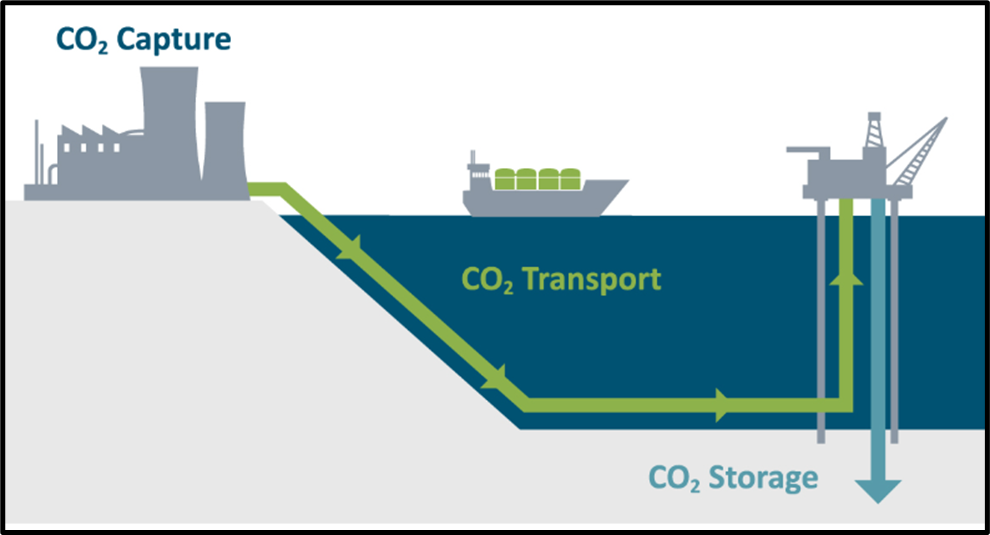
Carbon Capture and Storage (CCS) deals with stationary emission sources like thermal power plants.
How CCS Works
- Capture
- CO₂ is separated from flue gases.
- Condensed into a concentrated stream.
- Transport & Storage
- Stored securely so it cannot re-enter the atmosphere.
Storage Options
- Geological storage (preferred):
- Depleted oil & gas fields
- Deep saline aquifers
- Coal seams (CO₂ gets absorbed)
- Ocean storage (experimental):
- Liquid CO₂ injected at depths of 500–3000 m
- Problem: Ocean acidification, harm to marine life
Carbon Capture, Utilisation and Storage (CCUS): Turning Waste into Wealth
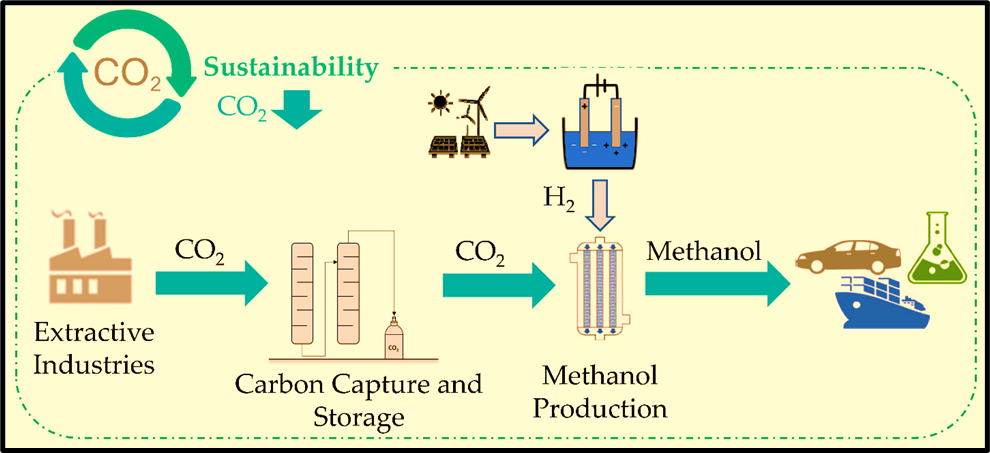
CCUS goes one step ahead of CCS.
Instead of only storing CO₂, it:
- Uses CO₂ to create valuable products, or
- Permanently stores it underground
According to NITI Aayog, CCUS is crucial for:
- Halving India’s CO₂ emissions by 2050
- Achieving net-zero emissions by 2070, pledged at COP26
Strategic Importance for India
- Supports sunrise sectors like:
- Coal gasification
- Hydrogen economy
- Enables transition:
- Blue hydrogen → fossil fuel-based + carbon capture
- Green hydrogen → renewable energy-based
CO₂ Valorisation (Circular Economy)
Captured CO₂ can be converted into:
- Green urea & ammonia
- Concrete and aggregates
- Methanol, ethanol
- Polymers and bioplastics
👉 This fits perfectly with the circular economy principle:
Make → Use → Reuse → Recycle → Reduce
3. Carbon Sinks and Carbon Sequestration
Carbon Sink
A carbon sink is any system that absorbs more carbon than it releases.
Carbon Sequestration
The process through which carbon sinks capture and store CO₂ for long periods.
Natural Carbon Sinks
- Forests
- Soils
- Oceans
⚠️ Ocean sequestration causes acidification, threatening corals and marine biodiversity.
Carbon Sink vs Carbon Source: A Dynamic Relationship
- Carbon sink → absorbs more than it emits
- Carbon source → emits more than it absorbs
Forests, soils, oceans, and atmosphere continuously exchange carbon via the carbon cycle.
Hence, the same system can act as a sink or source at different times.
Forests as Carbon Sinks
- Trees absorb CO₂ during photosynthesis.
- Carbon gets stored as biomass.
- If forests:
- Expand or densify → carbon sink
- Degrade or deforest → carbon source
⚠️ Decomposing biomass releases methane (CH₄), a powerful GHG.
Oceans and Blue Carbon
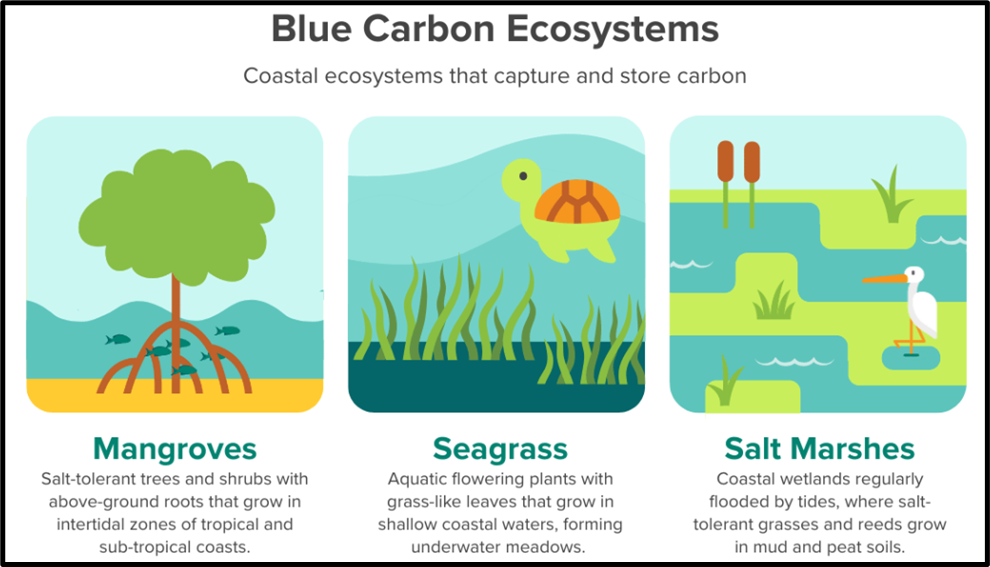
Blue carbon refers to carbon captured by:
- Mangroves
- Seagrasses
- Salt marshes
Though smaller in area than forests, these ecosystems:
- Sequester carbon much faster
- Can store it for millions of years
⚠️ When damaged, they release huge amounts of stored carbon, worsening climate change.
4. Geoengineering
What is Geoengineering?
The Oxford Geoengineering Programme defines geoengineering as:
“The deliberate large-scale intervention in the Earth’s natural systems to counteract climate change.”
📌 Key idea:
Geoengineering does not replace emission reduction. It is often discussed as a supplementary or last-resort option when mitigation alone seems insufficient.
Broad Categories of Geoengineering
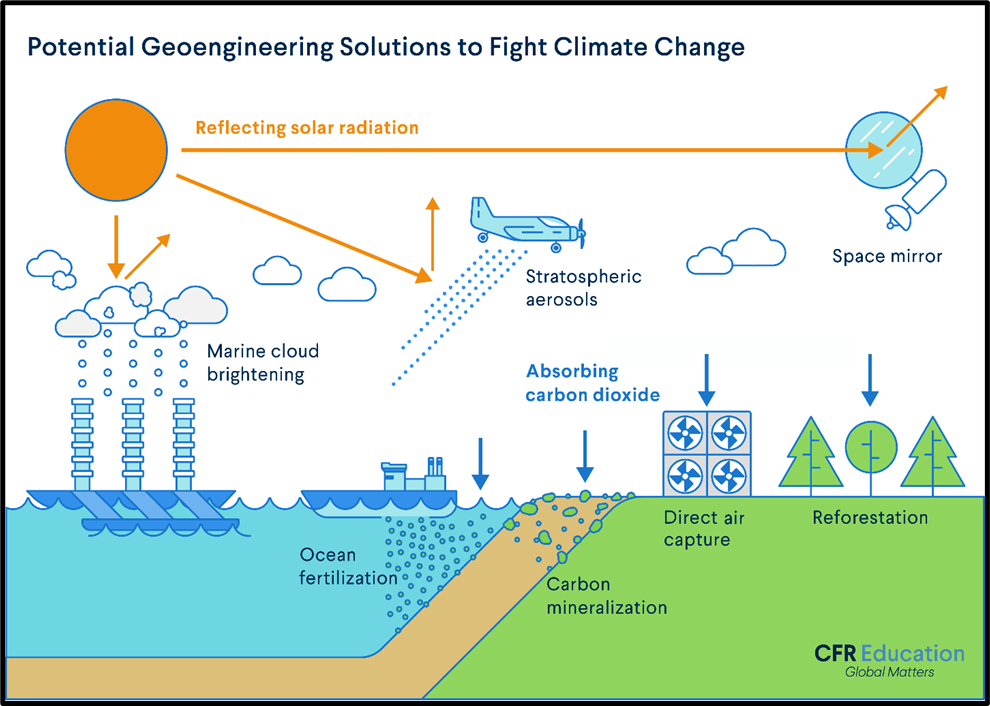
- Managing incoming solar radiation
- Removing greenhouse gases from the atmosphere
- Large-scale ecosystem interventions (forests, cryosphere, oceans)
Solar Radiation Management (SRM)
Solar Radiation Management (SRM) aims to reflect a small fraction of sunlight back into space, thereby cooling the planet without reducing GHG concentrations.
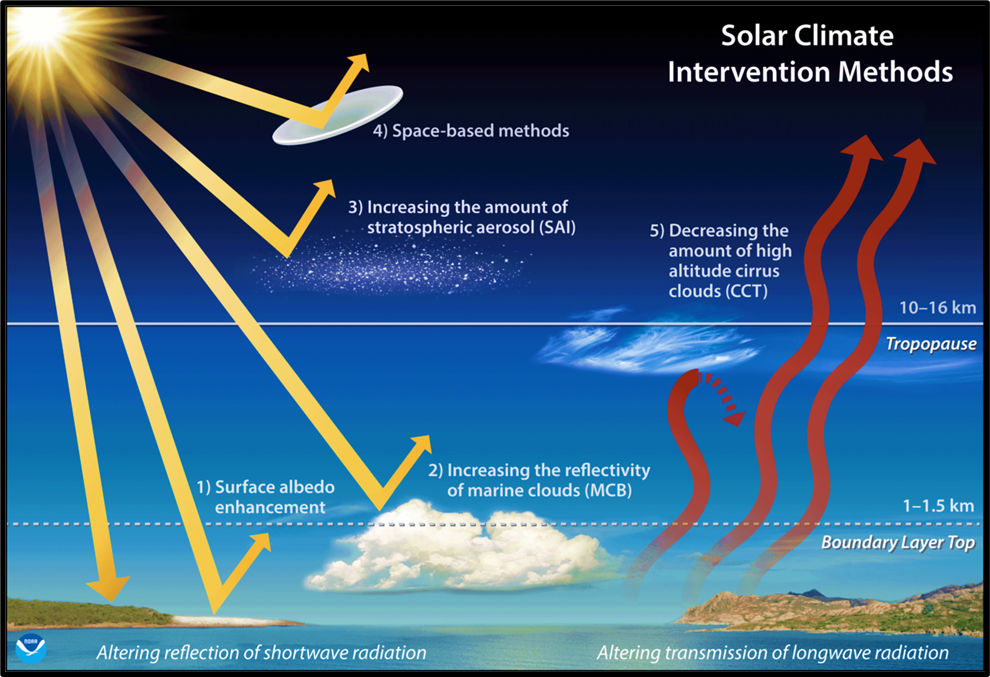
Major SRM Techniques
🔹 Albedo Enhancement
- Increasing the reflectivity (albedo) of:
- Clouds
- Land surfaces (e.g., lighter roofs, reflective crops)
- More reflection → less heat absorbed.
🔹 Space Reflectors
- Hypothetical mirrors or shields placed in space.
- Would block a tiny portion of solar radiation before it reaches Earth.
- ⚠️ Extremely expensive and technologically speculative.
🔹 Stratospheric Aerosols
- Injecting reflective particles (e.g., sulphates) into the stratosphere.
- Mimics cooling effects observed after large volcanic eruptions.
- ⚠️ Risks:
- Disruption of monsoons
- Ozone depletion
- Termination shock if abruptly stopped
📌 UPSC Insight:
SRM treats the symptom (temperature rise), not the cause (GHGs).
GHG Removal (GGR) or Carbon Geoengineering
Unlike SRM, GHG Removal (GGR) directly targets the root cause—excess greenhouse gases.
Key GGR Techniques
🔹 Afforestation
- Large-scale planting of trees to absorb CO₂.
- Simple but limited by land, water, and time.
🔹 Biochar
- Biomass is partially burned (charred) and buried in soil.
- Locks carbon in a stable form for centuries.
🔹 Bio-energy with Carbon Capture and Sequestration (BECCS)
- Biomass grown → burned for energy → CO₂ captured and stored.
- Net-negative emissions possible if sustainably managed.
🔹 Ambient (Direct) Air Capture
- Machines extract CO₂ directly from the air.
- Works only if carbon-negative (captures more CO₂ than it emits).
🔹 Ocean Fertilisation
- Adding nutrients (iron) to oceans to boost phytoplankton growth.
- Phytoplankton absorb CO₂ via photosynthesis.
- ⚠️ Ecological risks and uncertain long-term storage.
🔹 Enhanced Weathering
- Spreading reactive minerals that chemically bind CO₂.
- Carbon stored in soil or oceans as stable compounds.
Forests in Carbon Geoengineering
- Boreal forests:
- ~80% of carbon stored in soils as peat.
- Tropical forests:
- Absorb ~18% of fossil-fuel CO₂ emissions annually.
Because of this capacity, forests are often seen as temporary buffers against climate change.
📜 Policy Recognition
The Kyoto Protocol recognised:
→ Carbon absorption by trees and soils as equivalent to emission reductions.
⚠️ However, forests are vulnerable:
→ Fires, pests, deforestation can quickly turn sinks into sources.
Artificial Snow
The Problem
- The West Antarctic Ice Sheet (WAIS) is at risk of disintegration.
- Its collapse could cause ≥3 metres global sea-level rise over centuries.
The Proposal
- Blanket the ice sheet with artificial snow.
- Thousands of wind turbines pump seawater 1,500 m upward.
- Water freezes into snow, adding weight to stabilise ice.
📌 Critical View:
- Extremely energy-intensive
- Logistically complex
- Illustrates desperation, not sustainability
5. Transition Away from Coal
According to the Intergovernmental Panel on Climate Change (IPCC):
A 1.5°C-consistent pathway requires coal-based electricity to fall below 1% of global electricity by 2050.
Proposed Strategy
- Phase out oldest coal plants first
- Leads to differentiated transition:
- Faster in developed countries (older plants)
- Slower in developing countries (newer plants)
Current Global Coal Phase-out Efforts
- UK: Unabated coal exit by 2025
- France & Italy: Similar commitments
- Germany: Coal exit by 2038 (insufficient for <2°C)
Powering Past Coal Alliance
- Announced at UNFCCC COP23
- Commitments:
- OECD: coal phase-out by 2030
- Global: by 2050
⚠️ Major Gap:
- Largest coal users not aligned:
- USA, China, India, Japan
- Major exporters:
- Australia, Indonesia, Russia, South Africa
📈 Result:
- Coal declines in Europe are offset by rising use in Asia & Africa
- Global coal consumption projected to increase by 5% (2010–2040)
- India’s coal use may rise by 29% by 2040
Barriers to Phasing Out Coal Power
📌 Key Insight:
The barriers are economic and political, not technological.
Four Major Barriers
🔹 Livelihood Impacts
- India: ~1 million livelihoods depend on coal
- Coal royalties = ~50% of revenue for Jharkhand & Odisha
- China: ~5 million coal workers (limited reskilling options)
- Australia: ~50,000 workers; workforce ageing
🔹 Stranded Assets
- India:
- 151 GW coal capacity added since 2006
- ~75% subcritical
- Asset value ≈ $100 billion
- China: Overcapacity due to policy-driven expansion
- Export Dependence:
- Australia: 15% of exports (2017)
- Indonesia: 80% of coal exported
🔹 Electricity Prices
- In India:
- Existing coal power still cheaper than renewables
- Storage technologies add cost to renewables
- Cross-subsidy:
- Residential tariffs low
- Industrial tariffs high → weak transition incentive
🔹 Irresponsible Financing
- Coal-using countries increased from 66 (2000) to 78 (2018)
- G20 nations finance more overseas coal than renewables
- Africa:
- Planned coal capacity = 8× current capacity
- Developed countries shut coal at home, export it abroad
6. Climate Smart Cities
What Do We Mean by “Climate-Smart Cities”?
The term climate-smart refers to an integrated approach to managing urban landscapes and ecosystems so that cities can simultaneously address:
- Climate change
- Sustainable development
- Human well-being
Making cities resilient, sustainable, inclusive, and safe is a core objective of United Nations Sustainable Development Goal 11 (Sustainable Cities and Communities).
Why Cities Matter So Much
According to a United Nations Development Programme (UNDP) report:
- Cities are responsible for ~70% of global GHG emissions
- They are also most vulnerable to climate impacts:
- Heat waves & Urban Heat Islands (UHI)
- Water scarcity
- Flooding
- Epidemics and health stress
- Resource conflicts
📌 Key Insight:
Cities are both contributors to and victims of climate change — hence, they must be part of the solution.
The Core Urban Problem: Heat Retention
Modern cities trap heat because of:
- Dark asphalt roads
- Concrete-heavy buildings
- Dense construction
- Lack of vegetation
- Waste heat from vehicles, industries, and air conditioners
This creates the Urban Heat Island effect, where cities are significantly hotter than surrounding rural areas.
👉 Reducing heat retention = reducing electricity demand = lowering carbon footprint
Measures to Reduce the Heat-Retaining Nature of Cities
🔹 Surface & Material-Based Interventions
- Light-coloured asphalt and roofing instead of dark materials
- Cool pavements & cool rooftops that reflect sunlight
- Green roofs (vegetation-covered rooftops)
- Reduce indoor temperature
- Lower air-conditioning demand
🔹 Construction & Urban Form
- Transition away from heat-absorbent materials
- Promote alternative construction technologies
- Decentralisation of development and creation of green cities
- Example: Dholera Smart City
- Relocate polluting industries outside urban cores
🔹 Nature-Based Solutions
- Increase tree and vegetation cover
- Integrate urban green belts
- Treat heat waves as natural disasters (policy recognition)
Improving Urban Ventilation
Poor air circulation worsens heat stress and pollution.
Global Best Practices
- Stuttgart
- Located in a weak wind-flow region
- Developed ventilation corridors and protected open spaces
- Singapore
- Uses urban environmental modelling
- Designs building orientation to:
- Maximise wind flow
- Increase shading
- Improve outdoor thermal comfort
Passive Cooling: Using Nature’s Energy
Instead of consuming more electricity, cities can dissipate heat naturally.
Key Passive Cooling Techniques
- Double glazing
- Two glass panes with argon gas in between
- Reduces heat transfer
- Evaporative cooling (fountains, water bodies)
- Heat lost as latent heat of evaporation
- Indirect radiant cooling
- Heat flows from low-conductivity objects (humans, furniture)
- To high-conductivity materials (metals)
📌 UPSC Linkage:
Passive cooling = energy efficiency + climate adaptation + public health
Cooling Singapore: A Model Climate-Smart City
Cooling Singapore is a multi-institution initiative aimed at:
➡️Reducing Urban Heat Island (UHI) effect
➡️Improving Outdoor Thermal Comfort (OTC)
Key Components
- Green Roofs / Eco-roofs
- Vegetation on rooftops
- Vertical Greenery
- Living walls, vertical gardens on facades
- Vegetation Around Buildings
- Shade for pedestrians and structures
- Green Pavements
- Replace artificial surfaces with grass/soil
- Macroscale Urban Greening
- Large parks, urban forests, reservoirs
- Urban Farming
- Food production within cities
- District Cooling System
- Centralised cooling plants
- ~40% electricity savings
Climate-Smart Cities: Indian Initiatives
Ongoing Measures
- Cool roof & cool pavement programmes
- Integral to city Heat Action Plans
- National Mission on Sustainable Habitat
- Move away from heat-absorbent materials
- Building Material and Technology Promotion Council (BMTPC)
- Under Ministry of Housing and Urban Affairs
- Promotes alternative materials & technologies
Climate-Smart Cities Assessment Framework (CSCAF)
Why CSCAF?
- By 2030, ~40% of India’s population will live in cities.
- Urban growth must be climate-sensitive, not climate-blind.
Objectives of CSCAF
- Integrate climate concerns into urban planning
- Document and disseminate best practices
- Benchmark Indian cities against global standards
Institutional Support
- Implemented by Ministry of Housing and Urban Affairs
- Supported by:
- Climate Centre for Cities
- National Institute of Urban Affairs (NIUA)
Supporting National Missions
- Green India Mission (GIM)
- National Clean Air Programme (NCAP)
- AMRUT
- Swachh Bharat Mission
- Urban Transport initiatives
CSCAF 2.0: Climate-Smart Cities Assessment Framework
Launched by MoHUA, CSCAF 2.0 provides a clear roadmap for cities to combat climate change.
28 Indicators across 5 Categories
- Energy & Green Buildings
- Urban Planning, Green Cover & Biodiversity
- Mobility & Air Quality
- Water Management
- Waste Management
📌 UPSC Value Addition:
CSCAF reflects India’s shift from mission-mode urbanisation to climate-sensitive urban governance.
GRIHA: Measuring How Green a Building Truly Is
Green Rating for Integrated Habitat Assessment (GRIHA) is India’s national green building rating system.
Developed By
- The Energy and Resources Institute (TERI)
- Supported by Ministry of New and Renewable Energy (MNRE)
What GRIHA Assesses
- Energy efficiency
- Water use
- Waste management
- Environmental impact
- Overall sustainability of buildings
Benefits of Green Buildings
- Lower energy consumption (without comfort loss)
- Reduced air & water pollution
- Conservation of natural habitats & biodiversity
- Lower water usage
- Minimal waste through recycling & reuse
7. Transition to a Green Economy
What is a Green Economy?
A green economy is an economic system that:
➡️Improves human well-being and social equity
➡️While significantly reducing environmental risks and ecological scarcities
In simple terms:
A green economy grows without destroying the ecological foundations on which growth itself depends.
Three Core Priorities of Transitioning to a Green Economy
The transition is not merely technological; it is economic, social, and ethical.
(a) Decarbonising the Economy
- Reducing dependence on fossil fuels
- Shifting to low-carbon and zero-carbon pathways
- Directly linked to climate change mitigation
(b) Justice and Equity
- Environmental benefits and burdens must be fairly distributed
- Protecting:
- Vulnerable communities
- Informal workers
- Future generations
- This aligns with the idea of just transition
(c) Conserving the Biosphere
- Economic activity must respect planetary boundaries
- Conservation of:
- Forests
- Oceans
- Biodiversity
- Freshwater systems
📌 UPSC Insight:
A green economy integrates environment + economy + ethics, not just emissions reduction.
Practical Measures to Adapt to a Green Economy
Transitioning to a green economy begins with everyday decisions, not just global summits.
🔹 Energy & Resource Efficiency
- Energy audits to reduce building-level carbon footprints
- Wise water use
- Digitisation — using electronic files to reduce paper demand
🔹 Sustainable Production Systems
- Sustainable fishing practices
- Sustainably managed forests
- Supporting certified sustainable forest products
🔹 Sustainable Mobility & Lifestyle
- Car-pooling and public transport
- Walking or cycling for short distances
- Reduced dependence on private vehicles
🔹 Clean Energy Transition
- Expansion of renewable energy:
- Solar
- Wind
- Tidal
- Backbone of a green economy
🔹 Circular Economy Practices
- Recycling materials
- Composting food waste
- Minimising waste generation at source
📌 Key Idea:
A green economy is not anti-growth — it is smart growth.
Green Contracts: Greening the Market Itself
What are Green Contracts?
Green contracts are commercial agreements that:
- Mandate reduction of GHG emissions
- Across different stages of:
- Production
- Transportation
- Delivery of goods and services
Instead of relying only on government regulation, they embed environmental responsibility into market transactions.
Green Tenders
A green tender:
- Prescribes Green Qualifications at the bidding stage
- Selects bidders based not only on cost, but also:
- Environmental performance
- Sustainability credentials
Once selected:
- Environmental obligations are written into the contract
- They become legally binding and enforceable
📌 Significance:
This shifts environmental responsibility from voluntary CSR to contractual obligation.
Advantages of Green Contracts
✅ Environmental Benefits
- Direct reduction in carbon emissions
- Lower ecological footprint across supply chains
✅ Corporate Benefits
- Enhanced brand image and goodwill
- Competitive advantage in sustainability-conscious markets
✅ Economic Incentives
- Eligibility for tax rebates and incentives
- Long-term cost savings through efficiency
Concerns and Limitations
Despite their promise, green contracts face real challenges.
⚠️ Lack of Effective Audit Mechanisms
- Weak monitoring and verification
- Risk of greenwashing
- Environmental clauses may exist only on paper
⚠️ Higher Initial Costs
- Green contracts are often more expensive than:
- Traditional “brown contracts”
- Especially challenging for:
- Small firms
- Developing economies
📌 UPSC Perspective:
These are transition costs, not permanent barriers.
To explore all Environment topics in a structured manner, visit the complete Environment UPSC Notes page.