
Solar Energy
| Definition: Solar energy is energy derived from the Sun’s radiation, harnessed and converted into electricity or heat using technologies such as photovoltaic cells and solar thermal systems. |
The Two Roads: Solar PV vs Solar Thermal
Solar Photovoltaic (PV) — Sunlight straight to electricity
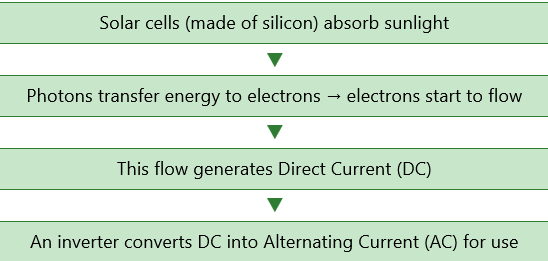
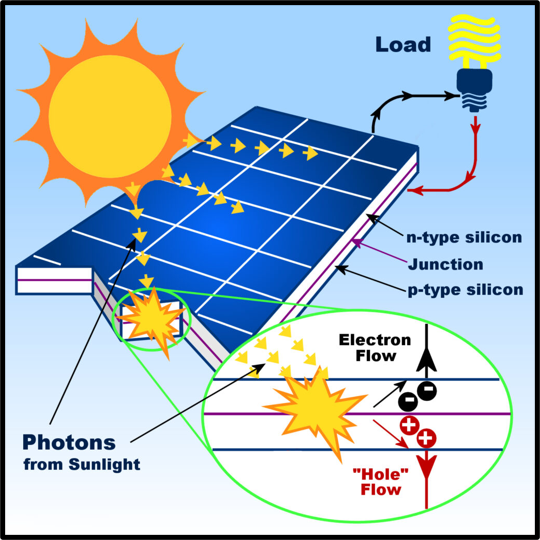
Solar Photovoltaic (PV) technology converts sunlight directly into electricity using semiconductor materials through the photovoltaic effect. Think of a material that gets excited by light and pushes out electrons — and a flow of electrons is exactly what we call electric current.
Working Principle of Solar PV
Key Components of a Solar PV system
- Solar panels (PV modules): capture the sunlight.
- Inverter: converts DC into AC (the form our homes use).
- Battery (optional): stores excess energy for night-time or cloudy periods.
- Charge controller: regulates voltage and protects the battery.
Types of Solar PV Cells
| Type of PV Cell | Efficiency | Key Characteristic |
| Monocrystalline | High | Long lifespan, but expensive |
| Polycrystalline | Moderate | Cheaper than monocrystalline |
| Thin-film | Lower | Flexible and lightweight |
Solar Thermal — Sunlight first becomes heat
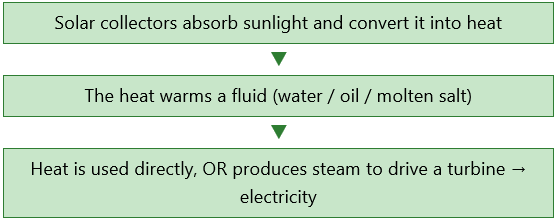
Solar thermal energy takes a different road: it uses sunlight to generate heat first, which is then used directly or converted into electricity. If PV is “light → electricity”, solar thermal is “light → heat → (sometimes) electricity”.
Working Principle of Solar Thermal
Types of Solar Thermal Systems
- Low-temperature systems: domestic use — solar water heaters and solar cookers.
- Medium-temperature systems: industrial heating, drying and cooking.
- High-temperature systems — Concentrated Solar Power (CSP): use mirrors/lenses to concentrate sunlight and produce high-temperature steam for electricity.
Key Components of Solar Thermal
- Solar collectors/reflectors: capture and concentrate sunlight.
- Heat transfer fluid: carries the heat (water, oil, molten salts).
- Storage system: stores thermal energy.
- Turbine & generator (in CSP): produce the electricity.
| Exam-critical distinction: PV generates DC directly from light; Solar Thermal generates heat, and if electricity is wanted it comes via a turbine (ultimately yielding AC). |
Advantages & Disadvantages of Solar Energy
A mature learner never falls in love with a technology blindly. Every source has two faces. Let us place them side by side.
| Advantages of Solar Energy | Disadvantages of Solar Energy |
| Renewable & inexhaustible — a permanent, abundant source | Intermittent — depends on sunlight (daytime, weather) |
| Environment-friendly — no direct greenhouse gas emissions | Energy storage required — batteries for night/cloudy use |
| Low operating cost after installation | High initial cost — panels, inverters, batteries |
| Energy independence — cuts fossil-fuel imports | Land requirement — large plants need extensive land |
| Decentralised — rooftops & remote areas, fewer losses | Efficiency affected by dust, shading, high temperatures |
| Scalable — from homes to solar farms | Manufacturing is energy-intensive with some concerns |
| Ideal for rural off-grid electrification & solar pumps | Disposal challenges — end-of-life panels create e-waste |
Major Solar Energy Initiatives in India
This is where Science & Technology quietly shakes hands with Polity and Governance. The examiner loves to test whether you can connect a technology to the scheme that promotes it.
| Initiative (Year) | What it does | Implemented by |
| National Solar Mission — NSM (2010) | Under the National Action Plan on Climate Change; promotes large-scale solar & cost reduction | MNRE |
| Solar Park Scheme (2014) | Develops ultra-mega solar parks with infrastructure support | MNRE |
| Rooftop Solar Programme (2015) | Encourages rooftop solar in residential & commercial sectors | MNRE |
| International Solar Alliance — ISA (2015) | Global initiative to promote solar among (largely tropical) countries | India (MNRE) & France |
| Atal Jyoti Yojana — AJAY (2016) | Solar street lighting in rural & semi-urban areas | MNRE |
| PM-KUSUM (2019) | Solar pumps, decentralised generation; lets farmers sell surplus power | MNRE |
| PLI Scheme for Solar PV (2021) | Boosts domestic PV-module manufacturing; cuts imports | MNRE |
| Green Energy Corridor (2021-22) | Transmission infrastructure to integrate renewables into the grid | Power Grid Corp. & State Transmission Utilities (Min. of Power) |
Emerging Trends in Solar Energy in India
- Floating solar plants: panels on reservoirs and dams — saves land, and the water’s cooling effect improves efficiency.
- Hybrid projects (solar + wind): the two complement each other for a steadier supply.
- Green hydrogen using solar power: solar electricity splits water via electrolysis to make green hydrogen, supporting the National Green Hydrogen Mission.
- Battery Energy Storage Systems (BESS): the answer to intermittency — storing power to keep the grid stable.
- Expansion of rooftop solar: rapid residential & commercial growth, boosting decentralised generation.
International Solar Alliance (ISA)
- ISA, or the International Agency for Solar Policy and Application (IASPA), is a treaty-based intergovernmental organisation. Its objective is to work for efficient consumption of solar energy to reduce dependence on fossil fuels.
- ISA was proposed by PM Modi at the India–Africa Summit ahead of the Paris Summit, and was launched by India and France at the 2015 UNFCCC (COP21, Paris) through the Paris Declaration. It is headquartered in Gurugram, India.
- ISA was established as an alliance of 123 countries, most of them being sunshine countries which lie either completely or partly between the Tropic of Cancer and the Tropic of Capricorn.
- Countries outside the Tropics can join the alliance, but with the exception of voting rights.
- As of Feb 2023, 92 countries have signed and ratified the ISA Framework Agreement.
- ISA will not duplicate or replicate the efforts others are engaged in, but will establish networks, develop synergies, and supplement their efforts in a sustainable manner.
To deploy cost-effective solutions — especially in the Least Developed Countries (LDCs) and the Small Island Developing States (SIDS) — ISA partners with multilateral development banks (MDBs), development financial institutions (DFIs), and other international institutions such as:
- International Renewable Energy Agency (IRENA)
- Renewable Energy and Energy Efficiency Partnership (REEEP)
- International Energy Agency (IEA)
- Renewable Energy Policy Network for the 21st Century (REN21)
- United Nations bodies, bilateral organisations, etc.
Objectives of the ISA
- To mobilise investments of more than USD 1000 billion (1 trillion USD) by 2030.
- To take coordinated action for promoting solar finance, solar technologies, R&D, capacity building, etc.
- Reduce the cost of finance to increase investments in solar energy in member countries.
- Scale-up applications of solar technologies in member countries.
- Facilitate collaborative R&D activities in solar energy technologies among member countries.
- Promote a common cyber platform for cooperation and exchange of ideas among member countries.
- ISA aims to create a World Solar Bank with an authorised capital of USD 15 billion to fund projects.
ISA Targets
| Target: The ISA has set a target of 1000 GW of solar energy by 2030. |
Delhi Solar Agenda
The Delhi Solar Agenda was adopted in the Founding Conference of the ISA. It states that the ISA member States, inter-alia, have agreed to pursue an increased share of solar energy in the final energy consumption in the respective national energy mix.
Solar Facility by the ISA
- ISA, in its 5th General Assembly meeting, approved the Solar Facility — a payment guarantee mechanism expected to stimulate investments into solar projects through two financial components: a Solar Payment Guarantee Fund and a Solar Insurance Fund.
- Its objective is to attract private capital to flow into underserved markets in Africa. The ISA would crowdsource investments from various donors across the globe, and proposed projects in Africa would be able to purchase payment guarantees or partial insurance premiums from these funds.
One Sun One World One Grid (OSOWOG)
- OSOWOG is India’s initiative to build a global ecosystem of interconnected renewable energy resources. Its blueprint will be developed under the World Bank’s technical assistance programme, implemented to accelerate the deployment of grid-connected rooftop solar installations.
- The concept intends to tap the global solar energy potential for the benefit of all nations and requires an international electricity grid to allow inter-country free flow of power.
- The grid has to be a smart grid to obtain the highest efficiencies given the constraints of transmission of solar power (i.e., transmission losses).
- OSOWOG is seen as India’s counter to China’s Belt and Road Initiative (BRI).
Regulatory changes required (two key areas)
- Grid security for the Indian grid.
- Development of an appropriate energy exchange.
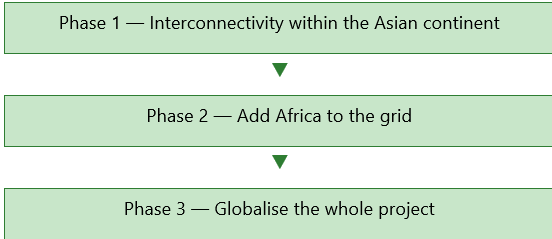
Three Phases of OSOWOG
Issues with Solar Power (in India)
- India is not a major manufacturer of solar panels — most are imported and assembled in India, making solar power relatively expensive.
- Though most of India gets abundant sunshine, high atmospheric pollution and aerosols reduce solar power generation efficiency by absorbing and scattering the sun’s rays and by soiling solar panels — increasing maintenance costs and water requirements for cleaning.
- Solar parks need 7,000–20,000 litres of water per MW per wash. Many Indian solar installations are in arid and semi-arid areas, bringing significant risk to the local ecosystem and communities.
- Large-scale solar parks are set up by clearing a large expanse of land of vegetation, which can lead to loss of wildlife habitats and soil erosion. Unlike wind facilities, there is less opportunity for solar projects to share land with agricultural/forestry uses.
Pollution
- Solar panel manufacturers use hazardous chemicals to clean the semiconductors — including hydrofluoric acid, sulfuric acid, and hydrogen fluoride.
- A solar PV panel is essentially glass, aluminium, metals, silicon and polymer fractions. Glass and aluminium (~80% of total weight) are non-hazardous, but a few materials are hazardous — polymers, antimony-containing glasses (used to improve stability of the glass upon exposure to UV radiation), lead, mercury, zinc and cadmium compounds (carcinogens).
- PV module recycling is still not commercially viable. The polymer component is difficult to recycle and can only be incinerated (air pollution).
- A lot of waste is generated during installation, and damaged panels are disposed of unscientifically. When buried, they can contaminate soil (leaching of heavy metals) and waterbodies; if burnt, they contaminate the air.
Not Tapping into the Commercial Potential of Recycling
- India has so far failed to put in place a mechanism to address end-of-life solar waste, including environmentally hazardous materials from solar PV panels.
- There are clear environmental and commercial benefits of recycling — high-value materials like silver and solar-grade silicon can be recovered viably. The problem is that India lacks the requisite recycling facilities to recover these materials.
Karnataka’s Pavagada Solar Park
- Pavagada Solar Park (Tumakuru district, Karnataka) is billed as the world’s largest solar park, spread over 13,000 acres of land.
- The arid region with fallow land was not irrigated, and a drought-like situation prevailed continuously. ISA said Pavagada can be an example for states like Rajasthan with abundant wasteland.
- A committee constituted in 2015 to deal with lease rent finalised a rate of Rs 21,000 / acre / annum with a 5% escalation every two years. The lease is for 28 years.
Issues
- The solar park helped only big farmers who have more than 25 acres of land.
- The temperature of nearby villages is higher due to the reflection and adsorption of light by the solar panels.
- Pavagada is close to the Jayamangali Blackbuck Reserve — a habitat for the Blackbuck as well as the Great Indian Bustard.
- Large mammals like bears and leopards, once seen frequently, are no longer around. There is a decline in populations of birds and pollinators like bees and butterflies.
For chapter-wise Environment preparation for UPSC Prelims and Mains, refer to the complete Environment UPSC notes page.