
Wind Energy
Wind energy harnesses the kinetic energy of moving air using wind turbines to generate electricity. It is a clean, renewable, and indigenous energy source, but its deployment is shaped strongly by geography, technology, and policy choices.
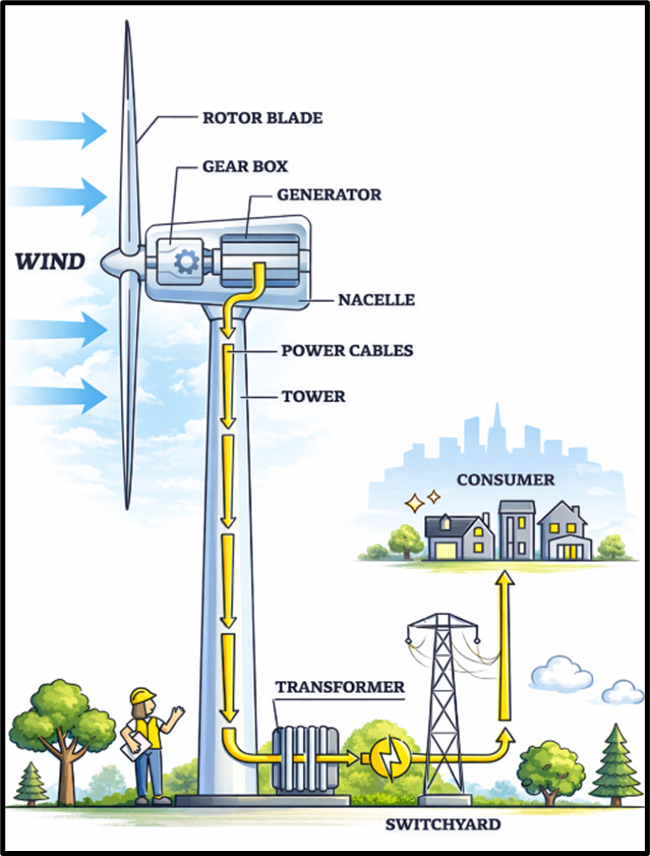
| Definition: Wind energy is the energy obtained from the kinetic energy of moving air (wind), converted into mechanical or electrical energy using wind turbines. |
Here is a lovely thought — wind is really “solar energy in disguise”. The Sun heats the Earth unevenly; warm air rises, cooler air rushes in to fill the gap, and that rushing air is what we call wind.
So when a turbine spins, it is, in a roundabout way, still harvesting the Sun. Its main uses: electricity generation (wind farms), water pumping, rural electrification.
Two Homes for the Turbine: Onshore vs Offshore
- Onshore Wind Energy: turbines on land (plains, hills, coasts) — the most widely used and cost-effective form.
- Offshore Wind Energy: turbines in the sea/ocean, where winds are stronger and steadier — higher efficiency, but much higher cost.
| Feature | Onshore Wind | Offshore Wind |
| Location | On land (plains, hills, coasts) | In sea/ocean waters |
| Wind speed | Lower and variable | Higher and more consistent |
| Efficiency | Moderate | Higher |
| Installation cost | Lower | Very high |
| Maintenance | Easier & cheaper | Difficult & expensive (marine conditions) |
| Land requirement | Requires land area | No land requirement |
| Power output | Lower per turbine | Higher per turbine |
| Environmental impact | Noise, visual impact, land use | Less visual impact, but affects marine ecosystem |
| Grid connectivity | Easier (near land grid) | Requires subsea cables |
| Status in India | Widely used (Tamil Nadu, Gujarat, Rajasthan) | Emerging (Gujarat & Tamil Nadu coasts) |
Advantages & Disadvantages of Wind Energy
| Advantages | Disadvantages |
| Renewable & inexhaustible — natural air movement | Intermittent — depends on wind availability |
| Environment-friendly — no GHG emissions in operation | Site-specific — needs high, consistent wind speeds |
| Low operating cost after installation | High initial cost of turbines & infrastructure |
| Energy security — cuts fossil-fuel imports | Noise & visual impact on the landscape |
| Scalable — small to large wind farms | Impact on wildlife — bird & bat collisions with blades |
| Land-use efficient — farming/grazing continues below turbines | Grid integration issues from variable output |
Major Wind Energy Initiatives in India
- National Wind-Solar Hybrid Policy (2018): promotes integration of wind and solar for better grid stability.
- National Offshore Wind Energy Policy (2015): develops offshore wind, especially along Gujarat & Tamil Nadu coasts.
- Green Energy Corridor (2013): transmission infrastructure to integrate renewables — including wind — into the grid.
India’s Installed Capacity
- Installed wind power capacity: ~54 GW (November 2025)
- 3rd highest in the world
- However, this is only ~54% of India’s target of 100 GW by 2030
State-wise Concentration
- Tamil Nadu – ~25%
- Gujarat – ~24%
- Followed by Rajasthan, Maharashtra, Karnataka
👉 Key UPSC insight:
Wind power in India is regionally concentrated, unlike solar, which has wider spatial spread.
Major Wind Farms of the World
| Wind Farm | Location | Capacity |
|---|---|---|
| Jiuquan Wind Base | China | ~20 GW |
| Alta Wind Energy Centre | USA | 1.54 GW |
| Muppandal Wind Farm | India (Tamil Nadu) | 1.5 GW |
| Jaisalmer Wind Park | Rajasthan | 1.06 GW |
Muppandal Wind Farm – Why Here?
Muppandal (Kanyakumari district) is one of the best examples of geography determining energy potential.
Geographical Advantages
- Vast barren land, unsuitable for agriculture
- Funnelling effect caused by gaps in the Western Ghats
- Receives strong westerly winds for nearly 9 months a year
Wind vs Solar Energy – A Balanced Comparison
Why Solar Appears to Be Winning
- Solar tariffs have fallen rapidly and are comparable or cheaper than wind
- Wind parks (like solar parks) are largely absent
- Best wind sites are already saturated
- Wind power is highly variable and seasonal
- Higher risk of curtailment compared to solar
Why Wind Still Matters
- Wind energy peaks during evening hours (7–10 pm) → peak demand period
- Wind generation is highest during monsoon months when solar output declines
- Wind sector supports local manufacturing, unlike solar which depends heavily on imports (especially from China)
👉 UPSC conclusion:
Solar is cheaper and scalable; wind is complementary and grid-stabilising.
Global Wind Report 2025
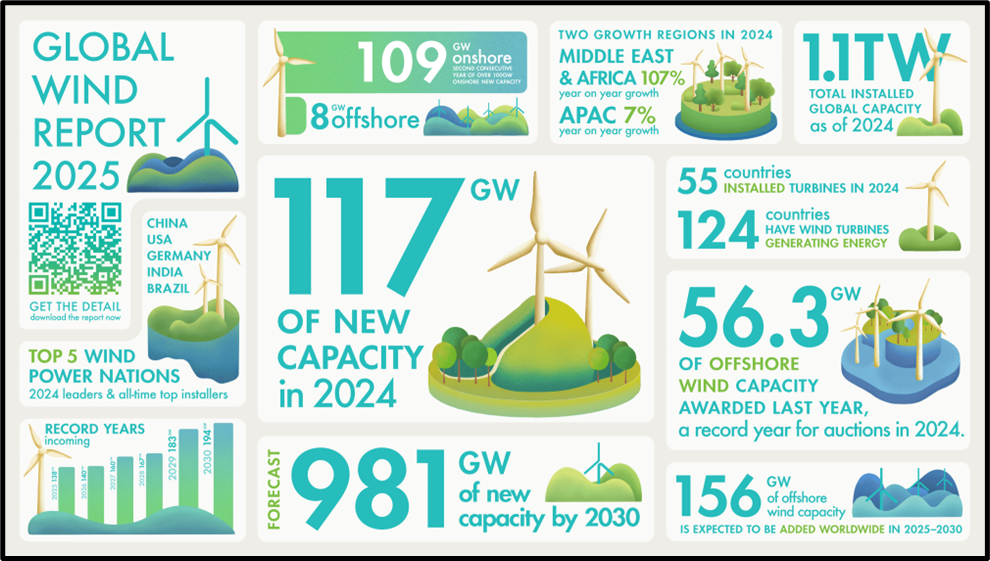
The Global Wind Energy Council (GWEC), in its Global Wind Report 2025, cautions that the projected global wind capacity expansion will achieve only about 77% of the required 2030 targets.
This shortfall poses a serious risk to:
- Net-zero emission pathways, and
- The goals of the Paris Agreement, particularly limiting global warming to below 2°C, with efforts towards 1.5°C.
Key Findings of the Global Wind Report 2025
1. Wind Power Installations
- In 2024, 117 GW of new wind capacity was added globally.
- This is a marginal increase from 116.6 GW in 2023.
- Total global installed wind capacity reached 1,136 GW.
2. Regional Performance
- China dominated the global wind market in 2024, accounting for about 70% of new capacity additions.
- Other major contributors included: United States, Brazil, India, Germany
- Emerging success stories:
- Uzbekistan, Egypt, and Saudi Arabia
- Onshore wind capacity in Africa and the Middle East doubled in 2024 compared to previous years.
3. Offshore Wind Trends
- Only 8 GW of offshore wind capacity was installed globally in 2024.
- This represents a 26% decline compared to 2023, highlighting stress in the offshore segment.
Major Challenges Highlighted in the Report
1. Policy and Regulatory Challenges
- Policy instability in key wind markets
- Delays in project approvals and permitting processes
2. Infrastructure Gaps
- Chronic underinvestment in transmission and grid upgrades, limiting evacuation of wind power
3. Financial and Market Pressures
- High inflation and elevated interest rates
- Trade protectionism
- Inefficient and poorly designed renewable energy auction mechanisms
4. Need for Rapid Scale-up
- At COP28 (Dubai), countries committed to tripling global renewable energy capacity by 2030.
- To meet this commitment, annual wind installations must rise to ~320 GW.
⚠️ Without such scale-up, the 1.5°C climate target may become unattainable, closing a critical window for climate action.
Challenges in Wind Energy Production in India
1. Land Acquisition Issues
- Each modern wind turbine (rotor diameter >150 m) requires 7–8 acres of land.
- Slow conversion of agricultural land to non-agricultural status leads to project delays, especially for large wind parks.
2. Non-modernised Grid Infrastructure
- High wind potential regions such as:
- Rajasthan
- Gujarat
- Coastal Tamil Nadu
lack adequate transmission infrastructure.
- Distance from demand centres increases power evacuation costs.
3. Policy Inconsistencies
- Withdrawal of incentives like:
- Accelerated Depreciation (AD)
- Generation-Based Incentives (GBI)
has created uncertainty for investors.
- Variations in state-level policies related to:
- Tariffs
- Power Purchase Agreements (PPAs)
- Approval mechanisms
hinder uniform growth.
4. High Upfront Costs
- Wind projects involve substantial initial investment in:
- Turbines
- Installation
- Grid connectivity
- Smaller developers face difficulties in accessing affordable finance.
5. Supply Chain Constraints
- Domestic manufacturing capacity:
- Towers: ~5,200 MW
- Gearboxes: ~8,000 MW
- Blade manufacturing remains insufficient, leading to imports.
- Continued reliance on imported components (especially from China) raises:
- Supply chain risks
- Cybersecurity concerns
6. E-waste and Environmental Concerns
- Disposal of outdated components (control systems, inverters, batteries) is challenging due to hazardous substances such as:
- Lead
- Cadmium
- Mercury
- Wind turbine blades made of composite materials are difficult to recycle, aggravating e-waste problems.
Measures to Strengthen Wind Energy Production in India
1. Strengthen the Policy Framework
- Simplify and fast-track land acquisition and clearances
- Introduce a uniform national wind policy
- Promote repowering of old wind farms with high-capacity turbines
2. Creation of a Land Bank
- Establish pre-secured, dispute-free land banks to:
- Reduce project delays
- Ensure clear ownership
- Lower costs
- Enhance investor confidence
3. Boost Offshore Wind Development
- Collaborate with global leaders such as:
- Denmark
- United Kingdom
- Accelerate offshore turbine deployment and related infrastructure.
- Explore hybrid projects combining wind and tidal energy to enhance reliability.
4. Promote Wind–Solar Hybrid Projects
- Hybrid systems allow:
- Better land utilisation
- Reduced variability
- More stable power generation
5. Financial and Market Innovations
- Mobilise finance through:
- Green bonds
- Carbon credit mechanisms
- Monetise emissions reductions from wind energy projects.
6. Strengthen Domestic Manufacturing
- Launch a PLI scheme for wind energy equipment, covering: Blades, Towers, Gearboxes
- Invest in skill development programmes, especially for:
- Offshore wind
- Operations & Maintenance (O&M)
7. Focus on Emerging Technologies
- Promote floating wind turbines to tap deep-sea wind potential.
- Integrate wind energy with green hydrogen production, using surplus power for electrolysis.
Conclusion
India’s wind energy sector has made notable progress, but persistent challenges—such as land acquisition hurdles, grid inadequacies, policy uncertainty, supply chain dependence, and e-waste management—continue to constrain its full potential.
To align with net-zero commitments and global climate goals, India must:
- Scale up offshore wind capacity,
- Strengthen domestic manufacturing,
- Promote hybrid and repowering projects, and
- Invest in innovation, including floating turbines and green hydrogen integration.
For chapter-wise Environment preparation for UPSC Prelims and Mains, refer to the complete Environment UPSC notes page.