
Right to Information (RTI)
Introduction
Imagine you are a labourer in a drought-relief work programme in rural Rajasthan. You have worked every single day for a month. But when you go to collect wages, you are told your name does not appear on the muster roll. Someone has pocketed your wages under a ghost entry.
You know it is corruption. But how do you prove it? You need to see the government record. But the officer says — “That is confidential. You have no right to it.”
This is exactly where the Right to Information Act (RTI Act, 2005) steps in. It demolishes that wall of secrecy. It says: the information belongs to the citizen — the government only holds it in trust.
RTI is not just a law; it is a power transfer — from the government to the governed.
So, when we talk about democratic governance, one idea stands at the very core: an informed citizen. The Right to Information (RTI) institutionalises this idea by giving citizens the legal power to ask questions and demand answers from the State.
RTI as a Fundamental Right
The Supreme Court of India has consistently held that the Right to Information is a fundamental right flowing from Article 19(1)(a) of the Constitution, which guarantees the right to freedom of speech and expression.
Why is information linked to free speech?
Because speech without information is hollow. To form opinions, criticise policies, or participate meaningfully in democracy, citizens must first know how decisions are taken and how public power is exercised. Thus, access to information becomes a constitutional necessity.
Purpose of the Right to Information (RTI)
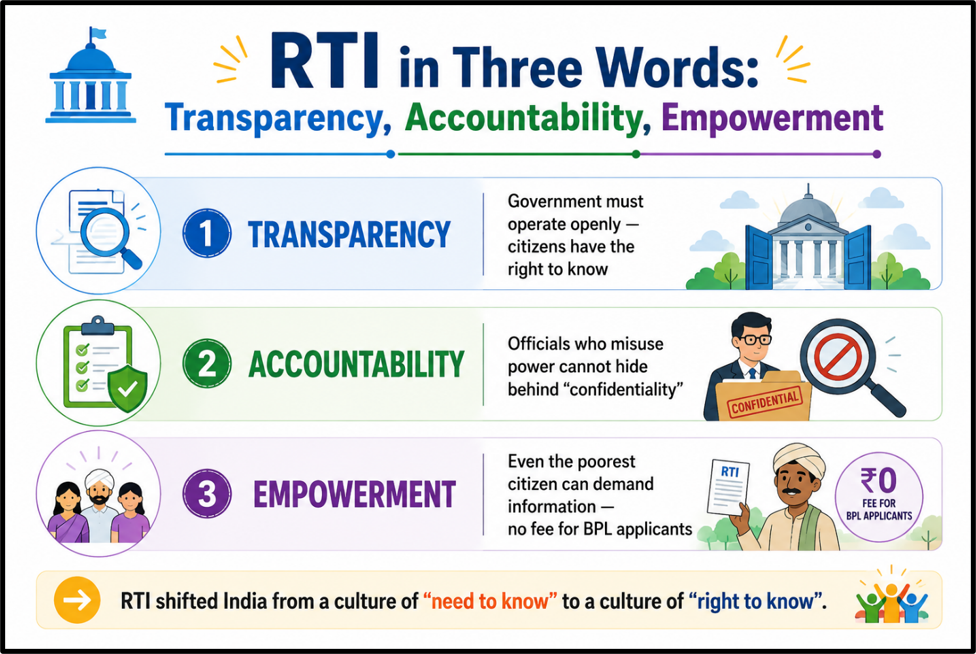
The RTI Act, 2005 is not merely a procedural law; it is a democratic empowerment tool. Its core purposes are:
- Promoting transparency in the functioning of public authorities by opening government records to public scrutiny.
- Empowering citizens by granting them a legally enforceable right to seek information from the State.
- Reducing corruption by exposing administrative decisions to public oversight, thereby increasing accountability.
- Strengthening democracy by ensuring that citizens remain informed about government policies, programmes, and decision-making processes.
In essence, RTI shifts governance from authority-centric to citizen-centric.
History and Development of the RTI Act
Before 2005, India operated under a deep culture of administrative secrecy inherited from British rule. The Official Secrets Act (1923) was the legal backbone of this culture. Government servants were trained to be discreet — sharing information “on a need-to-know basis” only. Files were routinely stamped “Confidential” or “Secret.”
Even the CAG — the constitutional auditor of India — was denied access to the “noting section” of government files, where the actual decision-making logic was recorded.
The Watergate scandal in USA (1974) and the Pentagon Papers case showed the world what happens when government secrecy goes unchecked: democracy itself is subverted. As Justice Mathew of the Supreme Court of India observed:
| “In a government of responsibility like ours, where all agents of the public must be responsible for their conduct, there can be but few secrets. The people of this country have a right to know every public act, everything that is done in a public way, by their public functionaries… to cover with veil of secrecy the common routine business, is not in the interest of public.” — Justice Mathew, Supreme Court of India |
Global Timeline of Freedom of Information Laws
| Country / Event | Year | Significance |
| Sweden | 1766 | World’s FIRST freedom of information law — driven by Parliament’s desire to access the King’s records |
| USA (First FOI Law) | 1966 | Shifted burden of justifying secrecy onto the government; introduced “severability” principle |
| Denmark & Norway | 1970s | Nordic tradition of open government extended further |
| Post-Watergate USA | 1976 | Scandal-driven strengthening of FOI law — a lesson in why transparency matters |
| UK | 2000 | Late but significant adoption — FOI Act covering all public authorities |
| Global Growth | 1990 → 2011 | National information laws grew from just 13 (1990) to 852+ (2011) |
| India — Tamil Nadu, Goa | 1997 | First Indian states to enact RTI laws |
| India — Rajasthan | 2000 | RTI movement sparked by muster roll protests by wage workers |
| India — RTI Act | 2005 | National law enacted; replaced the never-implemented Freedom of Information Act 2002 |
The Indian RTI story has a beautiful, grassroots origin. In central Rajasthan, poor wage workers on drought-relief works discovered that government muster rolls showed inflated attendance — ghost entries — to siphon off public funds. Their demand was simple: show us the official records.
Let us verify the muster rolls ourselves. This movement, supported by the National Campaign on People’s Right to Information (NCPRI), spread across the country and eventually forced the national government’s hand
India’s journey towards RTI was driven as much by judicial interpretation as by grassroots activism:
- Raj Narayan vs Uttar Pradesh Government (1975):
The Supreme Court recognised the Right to Information as implicit in Article 19, laying the constitutional foundation. - Mazdoor Kisan Shakti Sangathan (MKSS), 1994:
The first mass-based RTI movement, demanding transparency in rural development works. - National Campaign for People’s Right to Information (NCPRI), 1996:
Played a crucial role in drafting early RTI proposals. - Tamil Nadu (1997):
Became the first Indian state to enact an RTI law followed by Goa in the same year and Rajasthan in 2000. - Freedom of Information Act, 2002:
Passed by Parliament but remained largely ineffective. - Right to Information Act, 2005:
Came into force on 12 October 2005, marking a turning point in India’s democratic governance.
Salient Features of the RTI Act, 2005
1. Rights Provided Under the Act
- Every citizen can request information from public authorities.
- Section 4 mandates:
- Proper record maintenance.
- Proactive disclosure of key information to reduce the need for formal RTI applications.
2. Institutional Framework
- Central Information Commission (CIC) and State Information Commissions (SICs) oversee implementation.
- Public Information Officers (PIOs) are appointed at central and state levels to supply information and handle RTI requests.
3. Applicability
The Act applies to:
- All public authorities established by the Constitution, laws, or government notifications.
- NGOs and organisations receiving substantial government funding, directly or indirectly.
4. Timely Response
- Information must be provided within 30 days.
- In cases involving a third party, the limit extends to 45 days.
5. Provision for Appeal
- First appeal: Departmental Appellate Authority.
- Second appeal: Central or State Information Commission if the first appeal is unsatisfactory.
6. Disclosure Obligations
Public authorities must disclose information related to:
- Organisational structure
- Functions and duties
- Decision-making processes
- Public schemes and expenditures
7. Type of Information That Can Be Requested (Section 2(f))
RTI covers a wide range of information, including:
- Records, documents, memos, e-mails
- Opinions, circulars, press releases
- Contracts, log books, and electronic data
- Information relating to private bodies, if accessible by a public authority under any law
8. Exemptions Under Section 8
RTI is not a blanket right to ALL information. A democracy that tells its enemies how nuclear reactors are secured, or exposes active CBI investigations, would be self-defeating. The Act lists categories of information that are exempt.
Think of these as the “Harm Test” — information is exempt if disclosure would cause specific, identifiable harm.
| 🚫 Mnemonic: SPINE-FICTC — The 10 RTI Exemption Categories |
| • S — Sovereignty & Security (affects integrity of India, security, strategic/scientific/economic interests) • P — Privilege of Parliament or State Legislature • I — Investigation/prosecution of offenders (if disclosure impedes the process) • N — National/foreign secrets (information received in confidence from foreign governments) • E — Espionage / Court-prohibited (information forbidden by court or tribunal) • F — Fiduciary relationship (information held in trust — unless larger public interest warrants) • I — Intellectual Property / Trade Secrets (commercial confidence, competitive position of third party) • C — Cabinet papers (deliberations of Council of Ministers, Secretaries) • T — Third-party privacy (personal information with no public interest; privacy invasion) • C — Corruption exception: Intelligence/security agencies STILL answerable for corruption & human rights violations → OVERRIDE RULE: Even exempt info can be disclosed if PUBLIC INTEREST outweighs harm to protected interests |
| ⚖️ Important Special Rules on Exemptions |
| • Where practicable, PART of a record can be released (severability) — only the exempt portion is withheld • Intelligence/security agencies are exempt from RTI EXCEPT in corruption and human rights violation cases • Third-party information can be released AFTER giving notice to the concerned third party • MOST exempt information (with some exceptions) can be released after 20 years • Information that CANNOT be denied to Parliament/State Legislature cannot be denied to ANY person • RTI overrides the Official Secrets Act, 1923 — public interest disclosure trumps OSA restrictions |
9. Jurisdiction
- Lower courts cannot entertain RTI-related disputes.
- Writ jurisdiction under Articles 32 and 226 remains unaffected, preserving constitutional remedies.
10. Whistleblower Protection
- Safeguards the identity of whistleblowers.
- Penalises harm caused to individuals exposing corruption or wrongdoing.
- Encourages ethical governance and internal accountability.
The RTI activism and whistleblower protection issues are deeply intertwined. The murder of Satyendra Dubey — an NHAI engineer who wrote to the Prime Minister’s office exposing corruption in highway construction — became India’s defining moment for whistleblower protection.
| 🕊️ The Satyendra Dubey Case: A Catalyst for Change |
| • Who: Satyendra Dubey, National Highways Authority of India (NHAI) engineer • What: Wrote to the PM’s office detailing corruption in the National Highway Development Project • Outcome: Was killed — his identity was supposedly kept confidential but was leaked • Consequence: Public outcry forced the Supreme Court to press the government into action • April 2004: Public Interest Disclosures and Protection of Informers Resolution, 2004 issued — CVC designated as nodal agency for corruption complaints • 2010: Public Interest Disclosure (Protection of Informers) Bill 2010 introduced in Lok Sabha on August 26, 2010 • Bill provides: Mechanism to register complaints about corruption/ wilful misuse of power; safeguards against victimisation of complainant |
What is a “Public Authority” Under RTI?
RTI casts obligations on “public authorities” — and the definition is deliberately wide to prevent loopholes. Anybody established or constituted under:
| Category | How Established | Examples |
| (a) | By or under the Constitution | Election Commission, CAG, UPSC |
| (b) | By any law made by Parliament | Central Electricity Regulatory Commission, TRAI |
| (c) | By any law made by State Legislature | Gujarat Infrastructure Development Board |
| (d)(i) | By government notification/executive order; or body owned/controlled/substantially financed by govt | All Govt departments, Planning Commission (executive order) |
| (d)(ii) | Non-Government organization substantially financed by government funds | NGOs receiving major government grants |
Notice that this covers not just the government itself, but also PSUs, regulatory bodies, and even NGOs receiving substantial government funding. The key principle: if public money funds it, the public has a right to information about it.
The RTI Machinery: How Does It Actually Work?
The Institutional Architecture
RTI creates a tiered system of information providers and appellate authorities. Think of it as a ladder: at the bottom is the PIO handling your request; at the top is the CIC, an independent quasi-judicial body.
| 🏛️ The RTI Architecture — From Ground Level to Apex |
| ① Public Information Officer (PIO) — designated officer in each department/agency who receives and responds to RTI requests ② Assistant PIO (APIO) — at sub-district level; receives applications, forwards to concerned PIOs ③ Departmental Appellate Authority — First Appeal if PIO refuses or ignores the request ④ Central Information Commission (CIC) — independent apex body at Centre; Second Appeal; monitors RTI implementation; prepares annual report ⑤ State Information Commissions (SICs) — mirror of CIC at State level → PIOs and APIOs are EXISTING officers given additional RTI duties — they are NOT new appointees |
Time Limits — The Accountability Clock
One of RTI’s most powerful features is the strict time limit on response — the government cannot simply sit on a request. Different situations have different deadlines:
| Situation | Time Limit | Why This Limit? |
| Ordinary information requests | 30 days | Standard processing time for routine information |
| Matters involving life or liberty | 48 hours | Urgency — delay could endanger a person’s life |
| Request made to APIO (sub-district) | 35 days | Extra 5 days for forwarding to PIO |
| Third party information involved | 40 days | Time to give notice and hear the third party |
| Human rights violations from security/intelligence agencies | 45 days | Sensitive agencies need more review time |
| No action in 30 days | Deemed refusal | Prevents indefinite stonewalling through silence |
Teeth of the Act: Penalties and Universal Access
Penalties for non-compliance
An RTI Act without penalties would be toothless. The Information Commission can act against PIOs who violate the Act:
| Violation Type | Penalty | Additional Action |
| Unreasonable delay in providing information | ₹250 per day, up to ₹25,000 total | Applicable to PIO or officer assisting PIO |
| Illegitimate refusal to accept application | Up to ₹25,000 | Commission can recommend departmental action |
| Malafide denial of information | Up to ₹25,000 | Applies even to knowingly providing false info |
| Knowingly providing false information | Up to ₹25,000 | Commission can also recommend disciplinary action |
| Destruction of information | Up to ₹25,000 | Serious violation — equivalent to obstruction |
| Persistent/serious violations | Recommend departmental action | CIC can escalate to disciplinary authority |
| ⚠️ Important: No Criminal Liability Under RTI |
| • RTI Act does NOT impose criminal penalties on officers — only financial penalties and departmental action • RTI Act provides IMMUNITY from legal action for actions taken in good faith • This balance is deliberate: penalise non-compliance, but protect honest officers from harassment suits |
Universal Access — RTI for Every Citizen
RTI was designed to be citizen-friendly, especially for the poor. The access provisions reflect this democratic intent:
- Low fee structure — access to information is affordable for ordinary citizens
- NO FEE for people below the poverty line (BPL) — RTI is free for the poorest
- No need to specify reasons for seeking information — you do not have to justify yourself
- No need to furnish personal details beyond what is needed for correspondence
- APIOs at sub-district levels help people reduce oral requests to writing
- Provisions for assistance to disabled persons
- Information provided in local languages when necessary
- Applications can be submitted in writing OR electronically
Obligations of Public Authorities: The Proactive Disclosure Duty
RTI does not only create a reactive right — where citizens ask and government responds. It also imposes a PROACTIVE duty on public authorities to voluntarily put information in the public domain, even before anyone asks. This is crucial because most citizens do not know what to ask for — they need the government to first show its hand.
| 📋 What Public Authorities Must Do — The 9 Proactive Duties |
| ① Appoint PIOs/APIOs within 100 days of RTI Act enactment ② Maintain, catalogue, index, computerise and network all records ③ Publish within 120 days a comprehensive set of information — and update it every year ④ Publish all relevant facts while formulating important policies or decisions affecting the public ⑤ Provide reasons for administrative or quasi-judicial decisions to affected persons ⑥ Provide information suo motu by placing it on the internet ⑦ Provide information to the Information Commission as required ⑧ Raise awareness, educate, and train staff on RTI ⑨ Compile (within 18 months) and regularly update a local-language guide to information |
Landmark CIC Judgments: RTI in Action
The Central Information Commission is not just a complaints body — it has shaped the interpretation of RTI through landmark orders that expanded the right to information in creative and powerful ways.
| 1 | UPSC Marks Disclosure (2006) CIC directed UPSC to disclose individual marks of 2,400 candidates who appeared for Civil Services Preliminary Exams 2006, and to declare cut-off marks for each subject. This opened up UPSC’s historically opaque evaluation process. |
| 2 | Paramveer Singh vs Punjab University — Record Management Applicant sought information on merit list for a university post but received no proper response. CIC held that every public authority must take all measures for efficient record management systems so requests can be dealt with promptly and accurately. |
| 3 | Shyam Yadav vs DOPT — Property Statements Are Not Confidential (2009) Applicant sought details of property statements filed by bureaucrats. CIC held that property statements filed by civil servants are NOT confidential and can be disclosed, subject to obtaining the views of concerned officials as per RTI Act provisions. |
| 4 | Ram Bhaj vs Delhi Government — Grievance Timeframes (2010) Applicant sought information on whether DoPT guidelines on disposal of public grievances within specific timeframes had been notified by Delhi Govt. CIC directed Delhi Govt to inform common citizens about the timeframe required to redress their grievances. |
| 5 | Political Parties Under RTI — The Most Controversial Ruling CIC held that major political parties (Congress, BJP, CPI-M, CPI, NCP, BSP) are answerable under RTI Act. Applicants sought information on party finances, voluntary donations, and donor details. CIC directed parties to appoint PIOs and comply with proactive disclosure requirements. ▸ Basis: Parties received substantial govt assistance (land, buildings, radio time); they affect public lives; they are under Election Commission purview ▸ Parties rejected the ruling; Government proposed amending RTI to exempt parties — but later dropped the move ▸ Status: Legal controversy — parties have resisted compliance; matter remains unresolved |
Significance of the RTI Act, 2005
The RTI Act has transformed Indian governance in tangible ways:
- Empowers Citizens: Enables informed participation in public affairs.
- Promotes Transparency: Section 4 disclosures reduce secrecy.
- Example: Coalgate scam revelations led to reforms in resource allocation.
- Ensures Accountability: Citizens can monitor public expenditure.
- Example: RTI exposed non-utilisation of MPLADS funds.
- Combats Corruption: Reveals misuse of power and administrative fraud.
- Example: Fake job cards under MGNREGA in Rajasthan.
- Improves Policy Implementation: Citizens track scheme execution.
- Example: Corrections in MGNREGA data after RTI queries.
- Strengthens Democracy: Creates an informed, vigilant, and engaged citizenry.
Issues and Challenges in the Implementation of RTI
Despite being one of the most progressive transparency laws in the world, the RTI Act, 2005 faces serious challenges at the level of implementation. These challenges can be broadly classified into functional, structural, procedural, awareness-related, and legal conflicts.
Functional Challenges
1. Vacancies in Information Commissions
A major institutional bottleneck is the acute shortage of Information Commissioners in both Central and State Information Commissions.
- Several posts, including Chief Information Commissioners, remain vacant.
- As of October 2024, 7 out of 29 State Information Commissions were defunct or understaffed due to vacancies, as reported by Satark Nagrik Sangathan (SNS) in its 2023–24 report.
This directly weakens enforcement of the RTI Act.
2. Backlog of Appeals and Complaints
- Over 4.05 lakh appeals and complaints were pending across 29 commissions as of June 30, 2024.
- Maharashtra alone accounts for 1.08 lakh cases.
- Six State Information Commissions, including Maharashtra and Odisha, lack a Chief Information Commissioner, which is crucial for administrative leadership.
- At the central level, 8 CIC posts are vacant, despite a backlog of 23,000 cases.
In some states, disposal of cases takes more than a year, defeating the principle of time-bound access to information.
3. Inadequate Gender Representation
- Since 2005, only about 9% of Information Commissioners have been women.
- This reflects poor inclusiveness and lack of diversity in transparency institutions.
4. Dysfunctionality of Commissions
- Due to prolonged vacancies and administrative neglect:
- 4 out of 29 SICs are defunct
- At least 3 remain headless, according to SNS studies.
Structural Challenges
1. Misuse of Exemptions under Section 8
- Exemptions related to national security, personal privacy, and public order are often used mechanically to deny information.
- Example: PM CARES Fund has been excluded from RTI by not being classified as a public authority, raising transparency concerns.
2. Dilution through RTI (Amendment) Act, 2019
- The 2019 amendment empowers the Central Government to decide → Tenure, Salary, Service conditions of Information Commissioners
- This raises concerns regarding institutional independence, as commissions may become executive-dependent.
📌 Case Study: PM CARES Fund and RTI
- Legal status: PM CARES is a public charitable trust and has maintained that it is not a “public authority” under Section 2(h) of the RTI Act, 2005.
- RTI implication: Consequently, it does not fall within the RTI disclosure framework applicable to public authorities.
- Transparency debate: Its exclusion from RTI scrutiny has raised questions regarding transparency and accountability, particularly because of its public role and composition.
Procedural Challenges
1. Bureaucratic Resistance
- Many officials hesitate to disclose information due to → Fear of scrutiny, Exposure of inefficiency, Potential corruption revelations
2. Non-Compliance by Political Parties
- Despite being declared public authorities under RTI → Major political parties have not appointed Public Information Officers (PIOs).
- This weakens transparency in electoral democracy.
3. Dependence on Subordinate Rules
- RTI implementation depends heavily on State-specific rules.
- Example → States like Tamil Nadu do not accept Indian Postal Orders (IPOs), restricting access for applicants.
Awareness and Safety-Related Challenges
1. Safety Concerns for RTI Activists
- RTI users exposing corruption face → Threats, Harassment, Physical violence
- This creates a chilling effect on transparency activism.
2. Weak Whistleblower Protection
- The Whistleblowers Protection Act, 2014:
- Lacks strong enforcement mechanisms
- Does not provide adequate protection to RTI activists
- This undermines accountability-driven disclosures.
Other Legal Challenges
Digital Personal Data Protection Act, 2023
- The Act amends Section 8(1)(j) of the RTI Act.
- It restricts access to personal information by prioritising privacy, drawing from the K.S. Puttaswamy (2017) judgment.
- Concern → Excessive emphasis on privacy may dilute the public interest test, thereby reducing transparency.
RTI vs Legislations Restricting Disclosure of Information
While RTI promotes openness, several laws restrict information disclosure in the name of national interest.
Key Restrictive Laws
- Indian Evidence Act (Sections 123, 124, 162)
Allows withholding documents related to state affairs. - Atomic Energy Act, 1912
Prohibits disclosure of classified atomic information. - Central Civil Services (Conduct) Rules
Restrict officials from sharing official information without permission. - Official Secrets Act (OSA), 1923
Penalises unauthorised disclosure of confidential information.
These laws reflect the tension between transparency and confidentiality.
RTI Act and Official Secrets Act (OSA)
Background of OSA
- Enacted in 1923 during the colonial period.
- Focused on secrecy, espionage, and protection of state information.
RTI vs OSA
- Section 22 of the RTI Act provides overriding effect over OSA.
- If public interest outweighs harm, disclosure is permitted even if OSA applies.
Landmark Judicial Interventions
- The Supreme Court of India has strengthened RTI jurisprudence:
- Rafale Deal Case: Court upheld transparency within limits.
- 2019 Judgment: Office of the Chief Justice of India brought under RTI, enhancing judicial accountability.
Reasons for Stringent Secrecy Norms
- National Security: Prevents harm from sensitive leaks.
- Dynamic Security Challenges: Require stable and confidential decision-making.
- Limits on Free Speech: Absolute freedom does not exist in security matters.
Concerns Regarding OSA
- Subjective Interpretation: Sensitive data may be classified differently by successive governments.
- Declassification Issues: India lacks a robust culture of systematic declassification.
- Balancing Act: Officials struggle to balance transparency with security.
OSA and 2nd ARC Recommendations
- The Second Administrative Reforms Commission (2nd ARC) recommended:
- Repealing the OSA
- Replacing it with a law aligned with democratic transparency
- Reinforced by the judiciary’s pro-RTI stance in recent years.
2nd ARC Recommendations to Strengthen RTI
- Uniform RTI Fee Structure across states
- Multiple Payment Options, including postal orders
- Single Window System at district level with APIOs
- Inclusion of Major NGOs receiving ₹1 crore or more in government funding
- Filtering Frivolous Applications with appellate approval
Way Forward
To revitalise RTI as a governance tool, the following steps are essential:
- Implement SNS and CES recommendations on commission performance
- Fill vacancies in CICs and SICs promptly
- Enhance public awareness, especially in rural and marginalised areas
- Ensure protection of RTI activists
- Strengthen Whistleblowers Protection Act
- Improve record management through digitisation and PIO training
- Preserve autonomy of Information Commissions and conduct performance audits, as recommended by the Comptroller and Auditor General
Concluding Lines
The challenge before India is not whether transparency is needed—but how to balance transparency with legitimate secrecy. The future of RTI depends on institutional autonomy, citizen safety, judicial vigilance, and political will.
RTI vs Right to Privacy
The Right to Information (RTI) and the Right to Privacy are both recognised as fundamental rights in India. However, in certain situations, these rights come into conflict.
Key Differences
- RTI promotes transparency and enables access to government-held information. Certain personal data may be exempt from disclosure under Section 8 of the RTI Act.
- Right to Privacy protects personal and sensitive information such as medical, financial, and biometric data.
Points of Conflict
- Personal Information:
RTI requests seeking personal information may conflict with privacy rights. Disclosure is permitted only when public interest outweighs privacy concerns. - Public Interest vs Privacy:
Information related to public officials in discharge of public duties may be disclosed, while personal information unrelated to public functions remains protected.
Legal Balance
- The Supreme Court has held that:
- The Right to Privacy is not absolute and may be restricted in the interest of public good.
- RTI also contains exceptions to protect personal privacy.
Recent Developments
- The Digital Personal Data Protection (DPDP) Act, 2023 strengthens personal data protection and impacts how public authorities handle RTI requests involving personal information.
Judiciary under the Ambit of the Right to Information (RTI)
- CPIO, Supreme Court of India vs Subhash Chandra Agarwal (2009)
- The Central Information Commission held that the Office of the Chief Justice of India (CJI) is a public authority under the RTI Act.
- Secretary-General, Supreme Court vs Subhash Chandra Agarwal (2019)
- The Supreme Court upheld the Delhi High Court judgment, confirming that the Office of the CJI is subject to RTI.
- Anil Kumar vs High Court of Punjab and Haryana (2010)
- The High Court ruled that High Courts are public authorities under RTI, reinforcing judicial transparency and accountability.
Corruption Perceptions Index 2024
India ranked 96th in the Corruption Perceptions Index (CPI) for 2024, down from 93rd in 2023, with a score of 38, a decline from 39 in 2023.
- CPI: Published annually by the non-governmental organization Transparency International since 1995.
- It ranks 180 countries based on perceived levels of public sector corruption, using a scale from 0 (highly corrupt) to 100 (very clean).
- Denmark topped the CPI 2024 as the least corrupt nation, followed by Finland and Singapore. Among India’s neighbours, Pakistan (135), Sri Lanka (121), and Bangladesh (149) ranked poorly, while China stood at 76.
- While 32 countries have significantly reduced their corruption levels since 2012, 148 countries have either stagnated or worsened during the same period, highlighting the ongoing challenge.
- According to the Transparency International, Corruption hampers climate action by misusing funds meant for mitigation and adaptation, with fossil-fuel interests obstructing policies.
- It also links to declining democracy, instability, and human rights violations, necessitating urgent global action
RTI Amendment Act, 2019
Key Provisions
- Term and Appointment
- Central government empowered to determine tenure of Chief Information Commissioner (CIC) and Information Commissioners (ICs), removing the fixed five-year term.
- Salary Determination
- Earlier linked to CEC, ECs, and State Chief Secretaries.
- Amendment allows central government to prescribe salary, allowances, and service conditions.
- The RTI Act does not envisage the Information Commission as a constitutional body.
- Excessive centralisation has raised concerns over the autonomy of the CIC.
Impact on Autonomy and Independence
Negative Impacts
- Increased Executive Influence → Control over tenure affects impartiality of commissioners.
- Reduced Public Trust → Perceived lack of independence discourages citizens from filing RTIs.
- Erosion of Federalism → State Information Commissions lose autonomy due to central oversight.
Positive Impacts
- Administrative Flexibility → Enables government to adjust tenure and salary based on governance needs.
- Financial Prudence → Decoupling from Election Commission salaries allows fiscally sustainable administration.
- Stronger Executive Coordination → Central oversight may ensure uniformity and alignment with national governance objectives.
Major Scams Exposed through the RTI Act
- Adarsh Housing Society Scam
- RTI exposed misuse of authority by politicians, bureaucrats, and military officials.
- Flats were allotted at below-market rates.
- Led to the resignation of the then Chief Minister of Maharashtra.
- 2G Spectrum Scam
- RTI revealed irregularities in telecom license allocation under Telecom Minister A. Raja.
- Licenses were issued at undervalued prices.
- Estimated notional loss: ₹1.76 lakh crore to the exchequer.
- Vedanta University Land Acquisition Case
- RTI disclosures showed denial of fair hearing to affected landowners in Odisha.
- Violations of Land Acquisition (Companies) Rules, 1963 were exposed.
- Information aided legal challenges against the project.
Conclusion: RTI as Democracy in Action
The RTI Act is, at its core, a power-reversal statute. For decades, the government held information as its exclusive property, sharing it at its discretion. RTI reversed this equation: information belongs to the people — the government merely holds it in custody. The Act has made India a more accountable, more transparent, and in many ways a more democratic society.
But, a right that requires its activists to pay with their lives is a right under siege. The murders of RTI activists, the resistance of political parties, the delays in SICs — all remind us that transparency is not just a legal provision; it is a continuous democratic struggle. The law gives you the sword. Whether you have the will to wield it — and the protection when you do — is the unfinished business of Indian democracy.
“The RTI Act is the most powerful tool in the hands of a citizen after the right to vote. With it, the voter can hold the elected accountable not just once in five years, but every day of those five years.”
| 🏆 RTI’s Place in India’s Anti-Corruption Architecture |
| • CVC → Vigilance in Central Government departments • CAG → Audit of government expenditure • Lokpal → Independent investigation of corruption complaints • RTI → Citizen-initiated transparency and accountability in ALL public authorities • Whistleblower Protection → Safety net for those who expose corruption through RTI and other means → RTI is the CITIZEN’S TOOL — while other institutions are state-driven, RTI empowers ordinary people directly |
This topic is covered under the Polity and Governance UPSC notes series designed for UPSC Prelims, Mains, and Interview preparation.