
Vance’s Urban Realms Model
– The Modern Face of Urban Morphology
🔰 Background – Evolution Beyond Multiple Nuclei
Earlier, we understood that cities are no longer unicentric (as per Burgess), but multicentric, as Harris and Ullman’s Multiple Nuclei Theory suggested.
But with increasing suburbanization, especially in the post-World War II American context, even this explanation seemed inadequate.
That’s where James E. Vance, in 1964, brought in the Urban Realms Model — a more evolved and realistic depiction of the structure of modern metropolises.
📌 Main Idea – Cities as a Collection of Urban Realms
“A modern city is not one city — it is a group of several mini-cities, or realms, that function almost independently.”
These urban realms are:
- Large, self-sufficient zones
- Each with its own downtown, economic core, and functional identity
- Yet, all these realms are part of a larger metropolitan region
Imagine Delhi:
- There’s the main CBD (Connaught Place)
- But there are also mini-CBDs like Noida, Gurugram, Dwarka, Faridabad — each with its own business centres, malls, residences, and industries.
- This is not urban sprawl— it’s urban realms.
🧭 What Defines an Urban Realm?
Vance gave five key criteria that determine the structure and extent of each realm:
1. Terrain (Topography & Water Barriers)
- Natural features like rivers, hills, or lakes influence how cities expand.
- These features may separate one realm from another, encouraging independent development.
2. Overall Size of the Metropolis
- Larger the city, greater the chance that independent realms will emerge.
- A small town can have only one centre, but a mega-city like Mumbai or Los Angeles must develop multiple urban cores.
3. Economic Self-Sufficiency of Each Realm
- If a suburban area has enough employment opportunities, commercial centres, and housing, it becomes a self-sustaining realm.
- It no longer depends on the central city.
4. Internal Accessibility
- Within each realm, transport facilities must allow smooth movement — roads, metro, bus systems.
- This helps the realm function independently and efficiently.
5. Inter-Accessibility Among Realms
- What makes this model modern is the role of circumferential routes and airports.
- People and goods can travel from one realm to another without needing to pass through the original CBD.
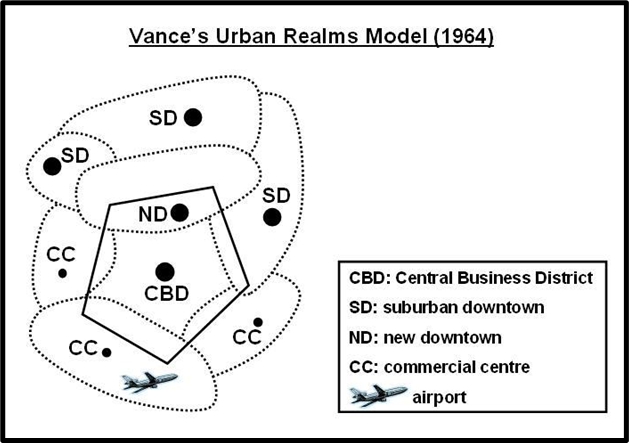
🛫 Role of Airports and New Downtowns
“Earlier, everything revolved around one CBD. Now, with airports and highways, urban areas can develop radially — not just centripetally.”
- New downtowns emerge after suburban downtowns.
- Suburban areas are no longer passive satellites but active economic cores with their own infrastructure.
- For example:
- Gurugram’s Cyber Hub
- Noida’s Film City
- Dwarka’s Convention Centre
Each of these is a new downtown — functioning with connectivity, infrastructure, and autonomy.
🧠 Urban Realms in the Indian Context
While the model was proposed for American cities, it is highly applicable in India today:
| Indian Metropolis | Urban Realms |
|---|---|
| Delhi-NCR | Noida, Gurugram, Faridabad, Ghaziabad |
| Mumbai | Navi Mumbai, Thane, Kalyan |
| Bengaluru | Whitefield, Electronic City, Yelahanka |
| Hyderabad | Hitech City, Gachibowli |
🧭 Visual Representation Tip (for Diagrams)
For the exam, you can use following diagram:
🚫 Criticism / Limitations
| Point | Critique |
|---|---|
| Applicability | Based mostly on Western urban patterns |
| Infrastructure Dependence | Requires well-developed transport systems |
| Overlapping Zones | Boundaries of realms are often blurry and dynamic |
✅ Conclusion
“The Urban Realms Model by Vance is a significant leap in understanding how modern cities truly function — not as a unit, but as a federation of several urbanised, self-sufficient units.”
This theory helps us:
- Grasp the polycentric nature of urban development
- Understand the role of infrastructure, decentralization, and economic autonomy
- Analyse future growth trends in both developed and developing countries