
Rural Development, Poverty & Social Progress in India (Economic Survey 2025–26)
India’s approach to rural development and social progress is increasingly centred on enhancing social mobility, reducing poverty, and fostering inclusive growth through community participation and institutional strengthening.
Significant progress has been achieved in poverty reduction, both monetary and multidimensional, supported by targeted welfare interventions, improved access to education and healthcare, and expanded social protection systems.
Rural transformation is being driven by a combination of public investment, technological integration, and active community engagement. Schemes like DAY-NRLM, SVAMITVA, and digital governance platforms are empowering local institutions and enhancing livelihoods. At the same time, rural economic indicators such as consumption, income, and credit access show improvement, alongside declining dependence on safety nets like MGNREGS.
However, structural challenges such as degradation of village commons, migration pressures, and skill gaps persist. The policy shift towards programmes like VB-GRAM G reflects an attempt to align rural employment with long-term infrastructure and sustainability goals.
Overall, India’s rural development strategy is evolving from a welfare-centric model to a partnership-based, participatory framework that integrates social capital, technology, and governance reforms for sustainable and inclusive growth.
Key Points
1. Social Mobility and Equality of Opportunity
- Social mobility includes both inter-generational and intra-generational changes in socio-economic status.
- Key determinants include education, health, technology, employment opportunities, and social protection.
- Low mobility reinforces inequality, while higher mobility promotes inclusive growth.
- Government policies aim to break cycles of poverty through targeted interventions in social sectors.
2. Poverty Reduction and Inequality Trends
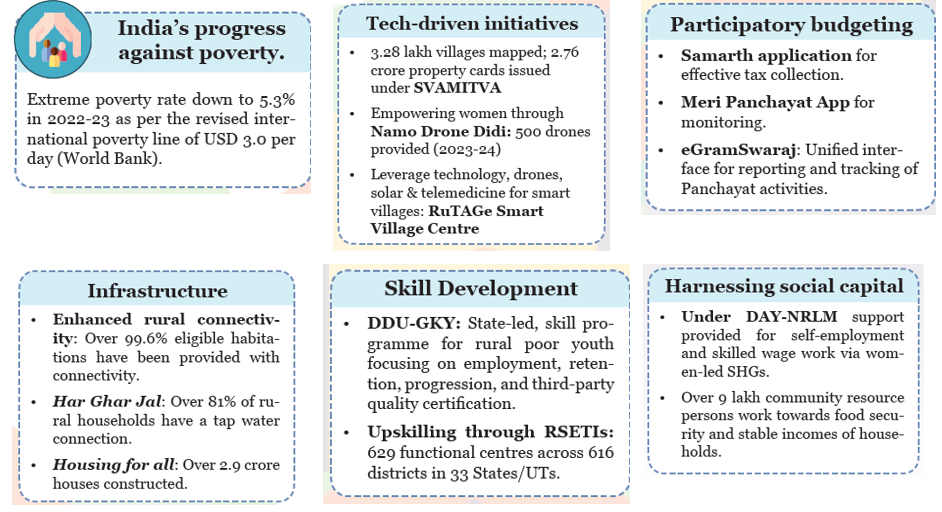
- Extreme poverty in India declined to about 5.3% (2022–23) as per revised World Bank estimates.
- Multidimensional poverty reduced significantly from 55.3% (2005-06) to around 11.28% (2022–23).
- Poverty based on Tendulkar methodology declined sharply to about 2.3% (2023–24).
- State-level disparities in poverty are narrowing due to targeted interventions.
- Inclusive policies have improved access to basic services and opportunities.
3. Social Sector Expenditure and Welfare Expansion
- Social protection coverage increased from 22% (2016) to 64.3% (2025).
- Social sector expenditure grew at a CAGR of ~12% (FY22–FY26).
- Education and health expenditure have shown steady growth.
- Universal electrification, improved water access, and sanitation achievements highlight welfare expansion.
- Government strategy emphasises inclusive development through “Sabka Vikas” model.
4. Rural Economic Transformation
- Rural economy shows strengthening through rising consumption, income, and investment.
- Improved credit access and infrastructure have supported rural growth.
- Decline in MGNREGS demand indicates better employment opportunities outside the scheme.
- Rural unemployment declined alongside diversification of livelihoods.
5. Reform of Rural Employment (MGNREGS to VB-GRAM G)
- MGNREGS provided wage employment and income stability but faced structural inefficiencies.
- Issues included leakages, low completion of 100-day employment, and weak asset outcomes.
- VB-GRAM G Act 2025 increases guaranteed employment to 125 days per household.
- Focus shifts to infrastructure creation, climate resilience, and accountability.
- Enhanced digital monitoring and decentralised planning improve transparency.
6. Community Participation and Decentralised Governance
- Panchayati Raj Institutions (PRIs) play a key role in grassroots governance.
- Participatory approaches such as Gram Sabhas and SHGs drive inclusive development.
- Concept of “Jan Bhagidari” strengthens citizen involvement in development processes.
- Community-led models like Kudumbashree demonstrate effective local governance.
7. Technology-Driven Rural Development
- Digital tools and AI are improving governance, agriculture, and service delivery.
- SVAMITVA scheme provides property rights through drone-based mapping.
- Digital land records and platforms like e-Gram Swaraj enhance transparency.
- Smart village initiatives integrate technology for holistic rural development.
8. Village Commons and Sustainability
- Village commons constitute about 15% of India’s geographical area and support rural livelihoods.
- Degradation of commons due to misuse and encroachment is a major concern.
- Restoration initiatives include Mission Amrit Sarovar and watershed programmes.
- Sustainable management requires community participation and institutional frameworks.
9. Social Capital and Livelihood Promotion
- Social capital through SHGs plays a crucial role in rural transformation.
- DAY-NRLM focuses on self-employment, financial inclusion, and women empowerment.
- Over 10 crore households have been mobilised under SHG networks.
- Community Resource Persons (CRPs) strengthen grassroots implementation.
10. Skill Development and Capacity Building
- Programmes like DDU-GKY and RSETIs enhance employability and entrepreneurship.
- Focus is on demand-driven skilling and sustainable employment.
- Capacity building of Panchayats improves governance and service delivery.
- Training institutions and digital tools strengthen local administrative capabilities.
11. Rural Infrastructure Development
- Infrastructure such as roads, housing, and connectivity drives rural transformation.
- PMGSY has achieved over 99.6% rural connectivity for eligible habitations.
- Infrastructure improves market access, employment, and quality of life.
- Innovations like plastic waste roads promote sustainable development.
Data & Facts
- Extreme poverty: ~5.3% (2022–23, WB)
- Multidimensional poverty: ~11.28% (2022–23)
- Social protection coverage: 64.3% (2025)
- SSE growth: ~12% CAGR (FY22–FY26)
- MGNREGS person-days: 389 crore (FY21) → ~184 crore (FY26)
- Rural unemployment: 3.3% (2020-21) → 2.5% (2023-24)
- PMGSY connectivity: ~99.6% eligible habitations
- SHGs mobilised: ~10 crore households
Concepts
- Social Mobility: Movement of individuals or groups in socio-economic status over time.
- Multidimensional Poverty: Poverty measured across multiple indicators like health, education, and living standards.
- Social Capital: Networks and relationships that enable collective action and economic benefits.
- Village Commons: Shared community resources such as land, water bodies, and forests.
- Decentralisation: Transfer of decision-making powers to local governance institutions.
Analysis
India’s rural development strategy reflects a paradigm shift from welfare delivery to empowerment-driven growth. The integration of community participation, technology, and institutional reforms has strengthened rural resilience and improved socio-economic outcomes.
Poverty reduction achievements indicate effective policy targeting, while initiatives like DAY-NRLM demonstrate the power of social capital. However, challenges such as environmental degradation, migration pressures, and uneven development persist.
The transition from MGNREGS to VB-GRAM G highlights a move towards productivity-oriented employment and infrastructure creation. Sustained progress will depend on strengthening local governance, enhancing skills, and ensuring ecological sustainability alongside economic growth.
One Comment