
Bid Rent Theory
– Explaining Why City Centers Are So Expensive
Let’s begin with a simple question:
“Why is land in Connaught Place (Delhi) or Nariman Point (Mumbai) far more expensive than the land in a suburb like Rohini or Thane?”
The Bid Rent Theory answers these using principles from Urban Economics — particularly from the Concentric Zone Model — to explain why land values vary as we move outward from the city center.
📜 Origin of the Concept
- This theory emerges from the classical economics tradition, combining the ideas of:
- Urban Land Use (from geography)
- Economic Rationality (from economics)
- It employs the concept of Bid Rent Curves to show how different land users compete for space in a city.
🔑 Core Idea: Accessibility vs Land Value
“The more accessible a location is, the more people are willing to pay for it.”
- The city center, also called the Central Business District (CBD), is the most accessible location for most people.
- Therefore, it attracts maximum competition, and in turn, commands the highest land rent.
This forms the basic logic behind the Bid Rent Curve.
📈 What is a Bid Rent Curve?
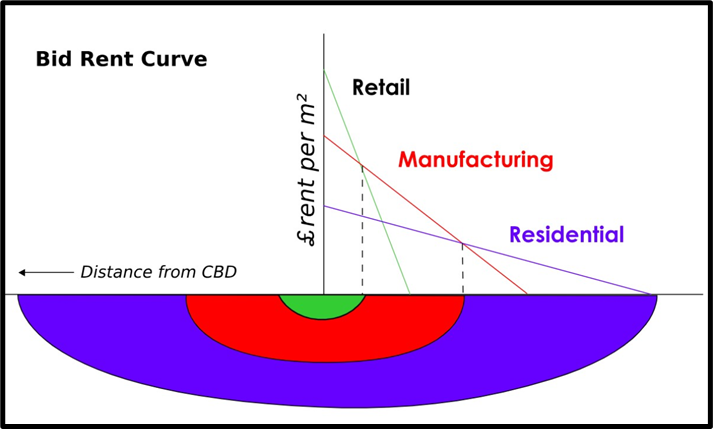
A Bid Rent Curve is a graph that shows how much different land users (like commercial, industrial, and residential) are willing to pay per unit of land at different distances from the city center.
🧭 Let’s Simplify with an Analogy:
Imagine an auction:
- The closer the plot is to the city center, the more valuable it is.
- Commercial businesses (like retail shops) bid the highest, because they need footfall.
- Industrial users bid less — they need space but not necessarily centrality.
- Residential users bid the least — they prefer quiet areas and lower rent.
📌 This hierarchy creates land use zones:
- Core = Commercial
- Mid = Industrial
- Outer = Residential
⚙️ How It Works: Mechanism of the Model
1️⃣ City Center as the Most Accessible Zone
- Everyone wants to be close to the core for ease of:
- Transport
- Customers
- Labor
- Hence, demand is highest, so land rent is highest here.
2️⃣ Land Use Depends on Who Can Pay More
- Land use is determined by economic competition.
- Whoever can gain the most utility from the location is willing to pay more.
🔁 Thus:
- Retail (maximum revenue from centrality) → highest bidder → occupies CBD.
- Factories (need space, moderate centrality) → settle in transition zones.
- Homes (prefer cheap, quiet land) → move outward.
🧠 Conceptual Link with Concentric Zone Model
- In the Concentric Zone Model, each ring develops based on dominant land use.
- Bid Rent Theory explains why each land use settles where it does — based on economic logic of rent-paying capacity.
So, Bid Rent Theory is almost like the “engine” that powers the “structure” of concentric zones.
🔍 Key Assumptions of the Theory
- Single central focal point (usually the CBD)
- Uniform and flat land
- Equal accessibility in all directions
- Rational economic behavior
- Transport cost increases with distance from center
📌 Criticism of Bid Rent Theory
| Critique | Explanation |
|---|---|
| Too theoretical | Real cities don’t always follow perfect models. |
| Ignores physical geography | Hills, rivers, or lakes can distort land use. |
| Assumes single CBD | Modern cities often have multiple business hubs. |
| Doesn’t factor in policy | Government zoning and subsidies alter land value logic. |
🧩 Conclusion
“Urban land use is not just about space, but about value — and value depends on access.”
The Bid Rent Theory helps us decode the economic geography of cities. It brings logic to how land use is arranged, why CBDs are so expensive, and why urban sprawl occurs.