
Biodiversity Hotspots
To understand biodiversity hotspots, imagine the Earth as a huge museum of life. But within this museum, some “galleries” are extraordinarily precious—filled with rare, unique species found nowhere else. These special areas are called Biodiversity Hotspots.
This idea was introduced by Norman Myers, a British biologist, and was later adopted and expanded by Conservation International (CI).
What Exactly Is a Biodiversity Hotspot?
Conservation International defines hotspots using two strict criteria. These criteria ensure that a hotspot is not just rich in biodiversity—it is also at risk.
Criterion 1: Extremely High Endemism
A region must have:
- At least 1,500 species of vascular plants
This is 0.5% of all plant species on Earth. - These species must be endemic (found nowhere else on the planet).
In simple words:
A hotspot must be “irreplaceable,” containing life forms exclusive to that region.
Criterion 2: Extreme Threat
A region must have:
- Lost at least 70% of its original habitat
Meaning:
Only 30% or less of its natural vegetation should remain.
So a hotspot is a paradox:
It is rich but also highly threatened.
How Many Hotspots Exist?
- In 1999, Conservation International identified 25 hotspots.
- Currently, there are 36 hotspots across the world.
- These hotspots cover just 2.5% of Earth’s land area, but they support:
- Over 50% of the world’s plant species (as endemics)
- 43% of all endemics among birds, mammals, reptiles, and amphibians
This means a tiny fraction of Earth’s surface holds a huge portion of the planet’s biological treasure—making them global priorities for conservation.
Recent Additions
- 2011: Forests of East Australia → 35th hotspot
- 2016: North American Coastal Plain → 36th hotspot
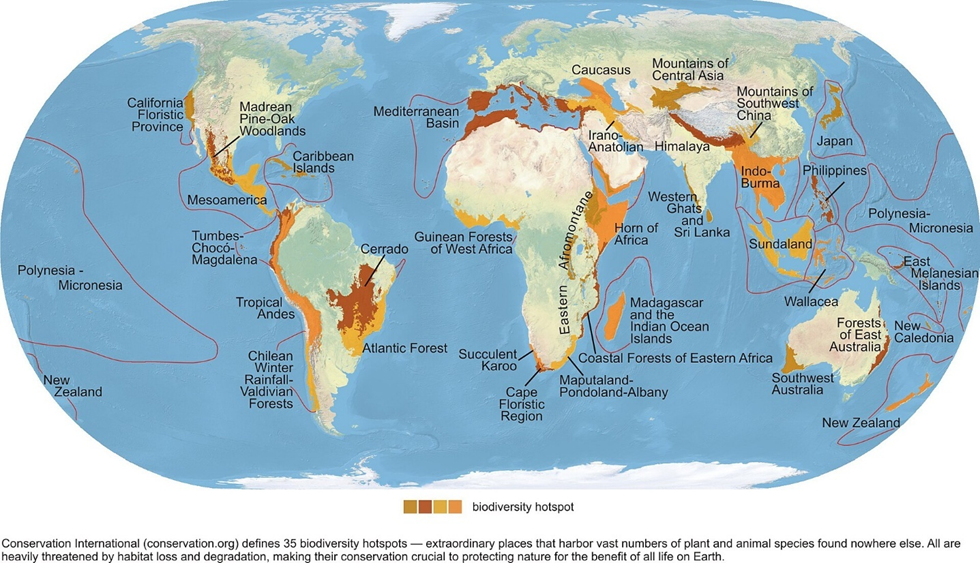
By Conservation International – Own work, CC BY-SA 4.0, via Wikimedia Commons
Hope Spots – The Oceanic Counterpart of Hotspots
While hotspots mainly refer to terrestrial regions, oceans also need special protection.
Hope Spot Network
- A joint initiative of Mission Blue (a global coalition) and IUCN
- These are Marine Protected Areas designated due to:
- high marine biodiversity
- important underwater habitats
- threatened species
Hope Spots in India
- Lakshadweep Islands
- Andaman & Nicobar Islands
These are marine regions with extraordinary coral systems, fish diversity, and significant ecological value.
Biodiversity Hotspots Present in India
India is so biologically rich that four of the world’s 36 hotspots either fully fall within our borders or include portions of India. These are:
1. Himalaya Hotspot
Includes:
- Entire Indian Himalayan region
- Parts of: Pakistan, Nepal, Bhutan, China, and Myanmar
This region is an evolutionary goldmine—home to snow leopards, red pandas, high-altitude medicinal plants, and numerous endemic species.
2. Indo-Burma Hotspot
Includes:
- Entire North-Eastern India
- Andaman group of islands
- Myanmar, Thailand, Vietnam, Laos, Cambodia
- Southern China
This region is known for:
- Rich tropical forests
- High insect and bird endemism
- Iconic species like hoolock gibbons and hornbills
3. Sundaland Hotspot
Includes:
- Nicobar Islands (but not Andaman)
- Indonesia
- Malaysia
- Singapore
- Brunei
- Philippines
The Nicobar Islands share their ecological character with Southeast Asia, not mainland India. This hotspot is famous for orangutans, Komodo dragons, and dense equatorial rainforests.
4. Western Ghats & Sri Lanka Hotspot
This includes:
- The entire Western Ghats mountain chain
- Parts of Sri Lanka
The Western Ghats are India’s own “Amazon” in terms of endemism:
- Over 50% of amphibians here are found nowhere else
- Home to lion-tailed macaque, Nilgiri tahr, and countless endemic plants