
Capital Market
Imagine a situation where a large infrastructure company in India wants to build a new highway or expand its manufacturing facilities. Such projects require huge long-term funds, which cannot always be financed through bank loans alone. At the same time, millions of households across the country have savings that they want to invest to earn returns.
The capital market acts as the bridge between these two groups. It channels savings from investors to businesses and governments that need funds for long-term investment and development. In this way, capital markets play a crucial role in economic growth, industrial expansion, and infrastructure development.
Definition
Capital markets are financial markets where long-term funds are raised and traded through financial instruments such as shares and bonds.
These markets enable companies and governments to mobilize long-term capital from investors.
Key Participants in Capital Market
Capital markets involve two main groups:
1. Suppliers of Funds (Investors)
These are entities that have surplus savings and want to invest them.
Examples include:
- Individual investors (households)
- Mutual funds
- Insurance companies
- Pension funds
- Banks and financial institutions
- Foreign portfolio investors (FPIs)
2. Users of Funds (Borrowers)
These are entities that need capital for investment or expansion.
Examples include:
- Private companies
- Public sector undertakings
- Start-ups
- Government (for infrastructure and development projects)
Major Institutions in the Indian Capital Market
The functioning of capital markets in India is supported by several institutions:
Regulator
- Securities and Exchange Board of India (SEBI)
Regulates the capital market and protects investor interests.
Stock Exchanges
- Bombay Stock Exchange (BSE)
- National Stock Exchange of India (NSE)
These exchanges provide electronic platforms where securities are traded.
Other Institutions
- Reserve Bank of India (RBI) – regulates government securities and parts of the debt market.
- Depositories such as NSDL and CDSL – hold securities in electronic form.
Major Instruments of Capital Market
Capital markets deal mainly with long-term financial instruments.
1. Equity Shares
- Represent ownership in a company
- Shareholders receive dividends and capital appreciation
- Voting rights in company decisions
2. Preference Shares
- Provide fixed dividend
- Priority over equity shareholders in dividend payment
3. Bonds and Debentures
- Debt instruments issued by companies or governments
- Investors receive fixed interest payments
4. Government Securities (G-Secs)
- Issued by the Government of India to finance fiscal deficits and development expenditure.
Structure of Capital Market
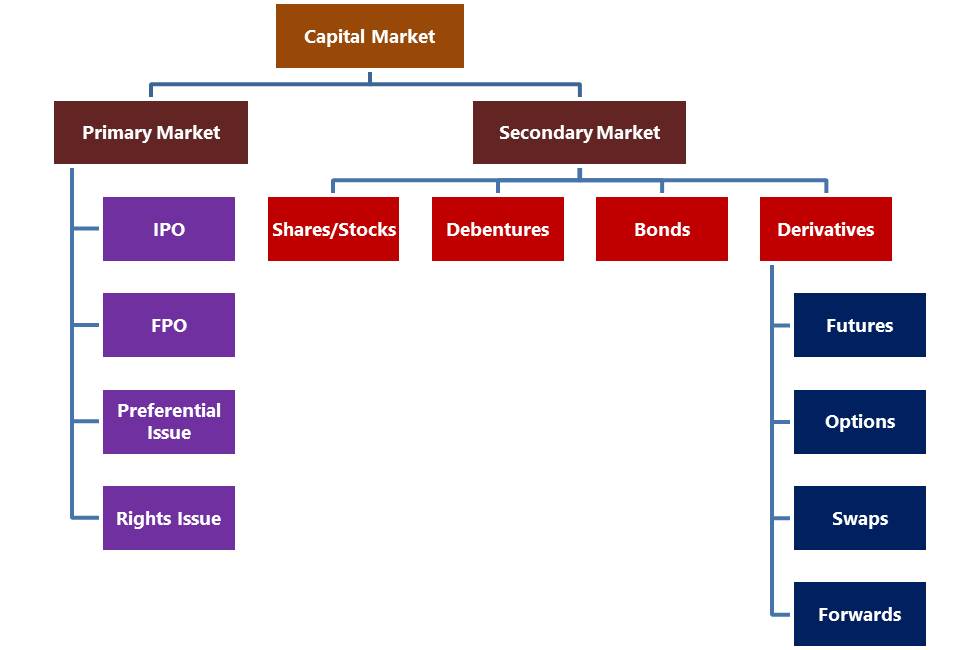
Capital markets are divided into two major segments.
(A) Primary Market
The primary market is where new securities are issued for the first time.
Companies raise fresh capital from investors through → Initial Public Offer (IPO), Follow-on Public Offer (FPO), Rights issue, Private placement
Example:
When a company lists its shares on NSE or BSE for the first time through an IPO, it raises funds directly from investors.
Key Feature → Funds flow from investors to the company.
(B) Secondary Market
The secondary market is where already issued securities are traded among investors.
Example:
An investor who bought shares in an IPO may later sell them to another investor on the stock exchange.
Key characteristics:
- Provides liquidity
- Helps determine market price of securities
- No fresh capital goes to the issuing company
In India, secondary market trading mainly occurs on:
- National Stock Exchange of India
- Bombay Stock Exchange
| Basis | Primary Market | Secondary Market |
|---|---|---|
| Nature | Issue of new securities | Trading of existing securities |
| Purpose | Raising fresh capital | Providing liquidity to investors |
| Flow of Funds | Money goes to issuing company/government | Money exchanged between investors |
| Price Determination | Set by issuer/issue mechanism | Determined by demand and supply |
| Role of Issuer | Direct involvement of issuing company | No involvement of issuing company |
| Examples | IPO, FPO, Rights Issue, Private Placement | Trading on NSE, BSE |
How Capital Market Facilitates Economic Growth
Capital markets perform several critical economic functions.
1. Mobilization of Savings
They convert household savings into productive investment.
2. Capital Formation
Funds are channelled into industries, infrastructure, and businesses.
3. Efficient Allocation of Resources
Investors allocate funds to companies with better performance and growth prospects.
4. Liquidity
Secondary markets allow investors to buy and sell securities easily.
5. Wealth Creation
Long-term investments in equities contribute to capital appreciation and wealth generation.
Importance of Capital Markets
Capital markets are essential for a modern economy because they:
- Promote investment and industrial development
- Support government borrowing for infrastructure
- Enable efficient resource allocation
- Provide investment opportunities to citizens
- Strengthen the financial system
Thus, capital markets act as a crucial mechanism that connects savings with investment, enabling sustainable economic growth.