
Copper
Let us begin with a curious fact: Copper is among the very few metals that nature gifts us in its native, metallic form. That means, unlike iron or aluminium which are almost never found in pure form, copper can be picked up and used directly—as was done in ancient civilizations.
It has played such a crucial role in human advancement that we named an entire age after it—the Chalcolithic Age (Copper Age).
⚙️ Physical Properties of Copper
To understand copper’s significance, let’s quickly look at what makes it so special:
- Malleable: You can hammer it into sheets.
- Ductile: You can draw it into wires.
- Excellent Conductor: Both electrically and thermally—only silver performs better.
That’s why copper is literally the lifeline of electricity and electronics. From the wiring in your charger to the circuits in supercomputers—copper is everywhere.
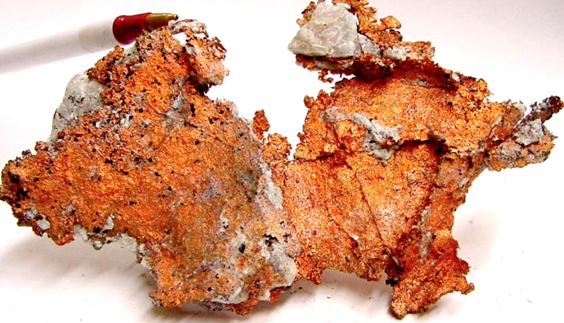
⛏️ Major Copper Minerals (Ores)
Copper is mostly extracted from sulphide ores, with the most common being:
- Chalcopyrite – CuFeS₂
- Bornite – Cu₅FeS₄
You can remember chalcopyrite as the “mainstay” ore for copper worldwide.
🔄 Extraction Processes
Copper is extracted using a combination of:
- Smelting – Heating ores with chemical reducing agents.
- Leaching – Dissolving ore using acids or bacteria (bioleaching).
- Electrolysis – Refining copper to very high purity.
This multi-step process is necessary due to the low concentration of copper in ores.
🔩 Copper Alloys – The Compounds of Civilization
Copper is not only useful on its own—it alloys wonderfully with other metals, producing materials that changed the course of human development:
| Alloy | Composition | Use/Importance |
|---|---|---|
| Stainless Steel | Iron + Nickel + Copper + Chromite | Strong, corrosion-resistant |
| Monel Metal | Copper + Nickel | Corrosion-resistant, used in marine engineering |
| Duralumin | Copper + Aluminium | Lightweight and strong – used in aircraft |
| Brass | Copper + Zinc | Decorative items, musical instruments |
| Bronze | Copper + Tin | Coins, statues, weapons (historically important) |
🧠 Tip: Remember—Bronze came before Iron, but brass shines like gold and is still used in temple bells and instruments.
🏞️ Formation of Copper Deposits: Geological Processes
Copper doesn’t just appear randomly in the Earth’s crust. Its deposits are products of specific geological environments. Let’s understand:
1. Magmatic-Hydrothermal Processes – Porphyry Copper Deposits
- As copper-rich magma intrudes into crustal rocks, it cools and solidifies.
- During cooling, hot fluids carrying copper infiltrate surrounding fractures and cracks, forming deposits.
These are large but low-grade deposits, meaning they have lower copper content but are enormous in size.
🧭 Examples:
- Chuquicamata Mine – Chile (World’s largest open-pit copper mine)
- Bingham Canyon Mine – USA
2. Volcanic-Hosted Massive Sulfide (VHMS) Deposits
- These are marine deposits, formed under the ocean floor during submarine volcanic activity.
- Hot, metal-rich fluids emerge from the Earth’s crust through vents, cool down, and precipitate copper sulphide minerals.
These appear as massive lenses or layers—imagine huge slabs of copper-bearing rocks under the sea.
🧭 Examples:
- Kidd Creek Mine – Canada
- Neves-Corvo Mine – Portugal
3. Sediment-hosted Stratiform Copper Deposits
- These are layered deposits within sedimentary rocks like sandstone or shale.
- Formed when metal-rich fluids percolate through porous sedimentary layers and replace original minerals with copper compounds.
- Typically found in reducing environments—rich in organic matter and low in oxygen.
🧭 Example:
- Zambian Copper Belt – One of Africa’s richest copper zones
💡 Fun Fact: Some of the world’s oldest and richest copper mines are in Zambia and the Democratic Republic of Congo.
🔌 Applications of Copper: More Than Just Wires
Copper is not only industrially vital—it’s biologically and chemically versatile too.
🔧 Industrial Uses:
- Wires and electrical circuits – Because of its superior conductivity.
- Pipes and sheet metal – Due to its malleability and corrosion resistance.
⚗️ Chemical Uses:
- Fehling’s solution – Used in testing sugars in laboratories.
- Water purification – Copper compounds help in removing impurities.
- Agriculture – Fungicides and pest-resistant formulations contain copper.
🧬 Biological Importance:
- Required in enzymatic functions involved in:
- Energy production
- Iron metabolism
- Blood clotting
💍 Even jewelry has a copper connection! Pure gold (24 carats) is too soft—so it’s alloyed with 2 parts silver or copper to make 22-carat gold, which is more durable.
🗺️ Distribution of Copper in India – The Geo-Economic Picture
We now shift from the geology and formation of copper to its distribution, production, and industry structure—key components of economic geography.
📦 Copper Reserves in India: The Resource Base (2020)
India has 1.66 billion tonnes of copper ore reserves, but here’s the catch: copper metal content is only about 12.20 million tonnes—which makes our reserves low-grade and less cost-effective to mine.
Let’s break it down by state:
| State | Ore Reserves (MT) | Share (%) | Major Districts |
|---|---|---|---|
| Rajasthan | 868 | 52.25% | Jhunjhunu (Khetri-Singhana Belt) |
| Madhya Pradesh | 387 | 23.28% | Balaghat (Malanjkhand Mines) |
| Jharkhand | 251 | 15.14% | Singhbhum Belt |
Rajasthan leads in ore reserves, but Madhya Pradesh leads in production.
🏭 Copper Production in India: State-wise Scenario (2022-23)
Now let’s look at actual production, because reserves don’t always translate into output.
| State | Copper Ore (MT) |
| Madhya Pradesh | 2.2 million tonnes |
| Rajasthan | 1.1 million tonnes |
| Jharkhand | 0.1 million tonnes |
| Total | 3.2 million tonnes |
🧠 Note for UPSC: Copper ores in India have very low metal content. This is why India is heavily dependent on imports for refined copper and concentrates.
🏢 Major Copper Industry Players in India
India’s copper industry is dominated by three major players:
1. Hindustan Copper Limited (HCL) – Public Sector Undertaking
- The only vertically integrated copper producer in India.
- Operates mines, smelters, and refineries.
- Key units:
- Malanjkhand Copper Project – Madhya Pradesh
- Khetri Copper Complex – Rajasthan
- Indian Copper Complex – Jharkhand
2. Hindalco Industries – Private Sector
- Part of the Aditya Birla Group.
- Engaged mainly in copper refining and smelting (not mining).
3. Vedanta Ltd – Private Sector
- Operated Sterlite Copper in Tamil Nadu (Thoothukudi), which has been shut down since 2018 due to environmental concerns.
🔎 UPSC Relevance: Remember the distinction between mining (HCL) and refining (Hindalco, Vedanta) for analytical clarity.
🌍 Copper Distribution Across the World
Let’s now move to the global copper scenario, which is vital from both economic dependency and strategic supply chain points of view.
🪨 Global Copper Reserves (2024)
| Country | Share of World Reserves (%) |
| Chile | 19% |
| Peru | 10% |
| Australia | 10% |
| Global Total | ~980 million tonnes |
Chile—a leading exporter with the world’s largest porphyry deposits (e.g., Chuquicamata mine).
⚙️ Global Copper Production (2024)
| Country | Share of World Production (%) |
| Chile | 23% |
| Peru | 11% |
| Democratic Republic of Congo (DRC) | 14% |
| China | 8% |
The DRC, despite being conflict-ridden, is an emerging copper hub due to the Central African Copperbelt.
🔍 Why India Still Imports Copper?
Despite having reserves and production units, India imports copper for the following reasons:
- Low-grade ores → less economically viable.
- High cost of extraction.
- Growing demand in power, telecom, electronics, and green energy sectors (e.g., EVs, solar panels).
- Shutdown of Vedanta’s Sterlite plant → significant dent in domestic production.
📌 UPSC Mains Linkage: This is a classic case of “resource-rich but production-poor” — a common theme in Indian economic geography.