
Cultural Landscapes and Homogeneity vs Diversity
Cultural Landscapes: An Introduction
Imagine standing on a hilltop, looking over a town. You notice buildings, roads, farms, temples, even cemeteries. None of these things are natural. They are all human creations placed upon the natural earth.
This human touch on nature — this “imprint” — is what geographers call the cultural landscape.
One of the pioneers of this idea, Carl Sauer from Berkeley, defined it beautifully:
“Cultural landscape is the visible imprint of human activity on the landscape.”
In simpler words: wherever humans have lived, worked, prayed, or traded, they have left marks on the land.
No place is truly untouched (“pristine”).
Even the oldest villages or cities have layers upon layers — temples rebuilt, fields reorganized, monuments erected — all revealing human values, economies, technologies, and traditions over time.
Similarly, UNESCO defines cultural landscapes as:
“Combined works of nature and man,” which show how societies evolve under environmental and social pressures.
Thus, if you want to read a society’s beliefs, customs, and innovations, you can simply read its landscape — much like reading pages of a history book written on the earth itself.
Components of Cultural Landscapes
To truly understand what makes up a cultural landscape, geographers study six major components. Let’s go through them one by one:
1. Architecture
Think of architecture as a society speaking to the world through stone, wood, and glass.
- A Gothic Cathedral (like the Cologne Cathedral in Germany) with its tall spires pointing towards heaven reflects medieval Christian values — aspiring towards the divine.
- A domed Islamic mosque or an ornate Hindu temple carries the religious and aesthetic ideals of their respective cultures.
Every house, monument, and building is a form that human culture has superimposed on nature.
Analogy:
If Earth were a canvas, architecture would be the brushstrokes of civilizations.
2. Agricultural Patterns
Wherever humans grow food, they reshape the land — and in doing so, they reveal their technology, economy, and traditions.
- Example: The rice terraces of the Philippines.
These are not just farms; they are architectural marvels — staircases to the sky — carved carefully into mountains over centuries to adapt to steep slopes and monsoon rains.
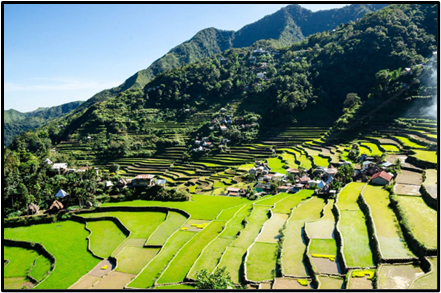
- In Australia, you see vast open ranches, while in Europe, small patchy fields enclosed by hedgerows dominate.
Thus, agricultural patterns show us both environmental adaptation and cultural continuity.
3. Settlement Patterns
How people organize their homes also tells us about their culture.
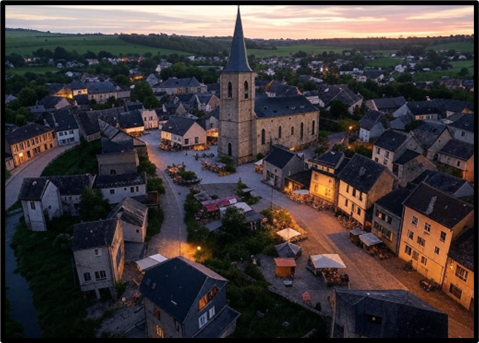
- Clustered (Nucleated) Villages:
Houses are grouped tightly together around a center like a church or marketplace. Common in Europe and parts of India.
(This arrangement saves farmland and strengthens community life.)
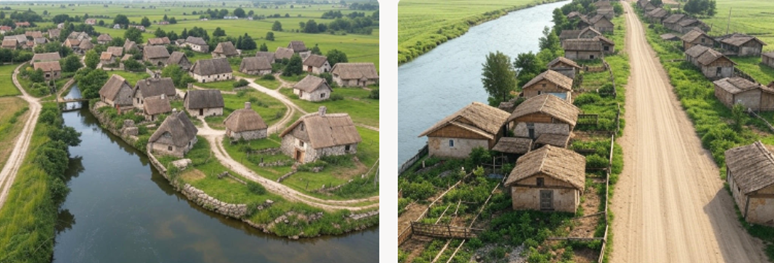
- Linear Villages:
Houses line up along a river or road, with farms stretching out behind them.
(Very common where access to water or roads is crucial.)
Example:
European villages often appear compact, conserving precious farmland, whereas American farmsteads on the Great Plains are widely dispersed due to different historical and economic factors.
4. Transportation Networks
Even the street patterns of a city whisper secrets about its culture:
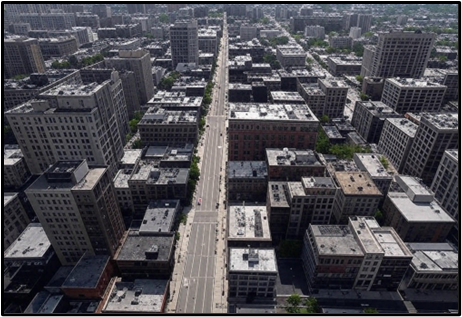
- Grid Pattern (Orthogonal Plan):
Cities like New York or Adelaide have neat, straight roads crossing at right angles — reflecting a mindset of order, planning, and expansion.
- Organic Growth:
In contrast, medieval European towns have narrow, winding streets, formed naturally over time without formal planning — showing historical spontaneity and adaptation to terrain.
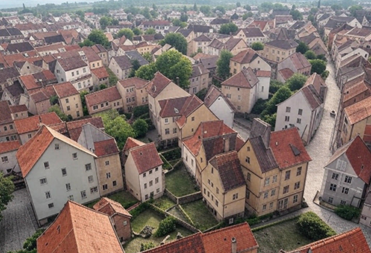
Thus, the way we move across space is deeply shaped by cultural priorities.
5. Monuments and Sites
Some places are more than just physical spaces — they are symbols of collective memory.
- Statues, temples, shrines, cemeteries:
These are anchors that tie a landscape to a society’s history, beliefs, and values.
Examples:
- Taj Mahal in India → A symbol of love and imperial grandeur.
- Eiffel Tower in France → A symbol of modernity and national pride.
- Fushimi Inari Shrine in Japan → A symbol of spiritual devotion.
Monuments create emotional geographies, making landscapes sacred, historical, or symbolic.
6. Land Use
Finally, how land is divided and used reflects both cultural choices and ecological adaptations.
- Cities divide land into urban, rural, industrial, residential, and sacred spaces.
- Traditional practices often showcase sustainability — like terraced farming to prevent soil erosion or irrigation systems designed carefully according to the local climate.
Example:
In Mediterranean regions, vineyard terraces have been maintained for centuries, perfectly adapted to the rocky, dry soil.
By studying these land-use patterns, we understand not only how people lived but how they coexisted with their environment.
Conclusion
Thus, cultural landscapes are not random.
They are rich, layered texts that geographers “read” to understand human societies.
From architecture to agriculture, settlements to street networks, and monuments to land-use patterns — every feature on Earth shaped by humans tells a story of culture, environment, and time.
In a nutshell:
If nature is the stage, then culture writes the script of the landscape.
Homogeneity and Diversity in Cultural Landscapes
After understanding what cultural landscapes are, we must now ask:
Do all landscapes still look different, or are they becoming similar everywhere?
The answer is: Both processes are happening simultaneously.
On one hand, homogeneity (sameness) is spreading because of globalization.
On the other hand, diversity (distinctiveness) is preserved in many places because of local traditions and environmental adaptations.
Let’s understand both clearly.
Homogeneity in Cultural Landscapes
Homogeneity simply means: things start looking the same across different places.
And today, this sameness is largely driven by three forces:
1. Economic Globalization
In a globalized economy, the same brands, services, and products are available everywhere.
- Example:
Walk into a mall in Delhi, Dubai, or Durban — you’ll find McDonald’s, KFC, Starbucks — and often, they look and feel the same.
This phenomenon has been famously described by sociologist George Ritzer as “McDonaldization” —
meaning that societies across the world are adopting the efficiency, predictability, and standardization of the fast-food model.
Analogy:
Just like a “template” you copy-paste again and again, global brands create copy-paste landscapes across the globe.
2. Mass Media and Popular Culture
Movies, music, television, and the internet spread the same cultural references everywhere.
- For instance, Hollywood movies, K-pop music, and American sitcoms influence dress styles, speech, architecture, and even attitudes in different parts of the world.
- Cities across continents now have similar shopping malls, coffee shops, multiplexes — all inspired by a global media-driven lifestyle.
3. Urban Sprawl and Suburbanization
Even in residential areas, suburban landscapes — rows of identical houses, strip malls, highways — have become common, especially around major cities.
Example:
Suburbs of Houston, Melbourne, and Johannesburg often look uncannily similar:
- Same kinds of shopping centers
- Same wide roads and detached houses
- Same parking lots and chain stores
Overall:
This growing sameness — where places lose their unique identity and start to feel interchangeable — is called “placelessness” in human geography.
Thus, globalization tends to erase local distinctions and flatten cultural differences across landscapes.
Diversity in Cultural Landscapes
But this is only half the story.
Despite globalization, many places continue to maintain their distinctive cultural identities.
Diversity remains strong because of two key reasons:
1. Environmental Adaptation
Communities often adapt their lifestyles and building designs to the local environment — and these adaptations create unique landscapes.
- Example 1:
In Japan, Shinto and Buddhist pagodas (like the five-tier pagoda in Kyoto) are made with wooden frames and tiled roofs —
ideal for the local climate and fitting religious symbolism.
These structures are totally different from European cathedrals, showing how culture + environment = distinct architectural styles.
- Example 2:
African mud huts and thatched roofs — built using local soil and native grasses — are perfect for the hot, dry environments.
Thus, design and technology are not randomly copied globally; they often adapt to local needs.
2. Cultural Continuity and Heritage Preservation
Many societies consciously preserve their traditional ways of life and architecture, often protected by laws and UNESCO World Heritage programs.
- Example 1:
Hilltop tea plantations in Munnar, Kerala —
These tea gardens are not just economic structures but part of a colonial-era heritage adapted to tropical, hilly terrain. - Example 2:
Medieval European towns with cobbled streets, market squares, and fortifications
(like in Bruges, Belgium or Rothenburg, Germany) are preserved as historical treasures. - Example 3:
Remote Himalayan villages continue building homes with ancient methods — using stone, wood, and mud — despite modernization pressures.
In these cases, geographic isolation (being remote) and cultural pride (valuing traditions) protect diversity.
Conclusion
Thus, when we look at the world today, two opposite processes are shaping cultural landscapes:
| Homogeneity (Sameness) | Diversity (Uniqueness) |
| Driven by globalization, media, migration | Driven by environmental needs and cultural heritage |
| Example: Starbucks in every major city | Example: Wooden pagodas of Japan |
| Leads to “placelessness” | Preserves “sense of place” |
In short:
- Globalization connects us, making many places look alike.
- Local traditions ground us, keeping many landscapes wonderfully unique.
Final Analogy:
If we imagine the world as a giant garden, globalization plants uniform lawns everywhere — but cultural diversity preserves rare flowers and ancient trees that make the garden truly beautiful.
Homogeneity vs Diversity: Tension and Coexistence in Cultural Landscapes
After seeing how homogeneity (sameness) and diversity (uniqueness) are shaping landscapes, a natural question arises:
Can both forces coexist?
Or will one completely defeat the other?
The reality is — both forces are continuously interacting, sometimes clashing, sometimes blending.
Let’s understand this dynamic clearly:
Modern Landscapes: A Blend of Global and Local
Today, most places do not belong purely to “globalized” or “traditional” categories.
Rather, they are hybrids, containing layers of history and elements of modern globalization.
Example: Istanbul, Turkey
- Walk through Istanbul and you will see:
- Roman aqueducts (remnants of Roman engineering)
- Byzantine churches (Christian architecture of the Eastern Roman Empire)
- Ottoman mosques (Islamic influence after 15th century)
- All these are woven together within the same cityscape.
Thus, Istanbul’s cultural landscape is a palimpsest — an old manuscript where new writings appear over older ones, without fully erasing the past.
UNESCO highlights that cultural landscapes beautifully “illustrate the evolution of human society” — how different cultures and epochs leave their imprint one over another.
Glocalization: Global + Local Adaptation
Sometimes, the global does not simply erase the local — it adapts to it.
This process is called “Glocalization” — a combination of “globalization” and “localization.”
Example: McDonald’s in India
- In most Western countries, McDonald’s core offering is the beef burger.
- But in India — where many Hindus consider cows sacred — McDonald’s does not sell beef.
- Instead, it offers localized options like the Chicken Maharaja Mac (a chicken-based version of the Big Mac).
Thus, a global brand survives by respecting local cultural and religious norms.
Key Point:
Glocalization shows that standardized elements (like fast-food chains) can enter new landscapes but get reinterpreted through local traditions and values.
Importance of Studying Cultural Landscapes
Why should we, as geographers and planners, seriously study cultural landscapes?
There are three major reasons:
1. Understanding Human–Environment Interactions
Cultural landscapes are like history books written on land.
- They record how societies have interacted with their environment across centuries.
- Examples:
- Terraced farming in steep slopes of the Philippines
- Cities built on floodplains adapting to river cycles
- Desert settlements using minimal water for survival
UNESCO stresses that these landscapes show how humans have adapted to natural forces and shaped their surroundings.
Thus, studying them helps us see how environments influence culture, and how culture, in turn, reshapes environments.
2. Heritage Conservation
By identifying and documenting cultural landscapes, we protect heritage.
- Many cultural landscapes are UNESCO World Heritage Sites.
- Their protection involves recognizing → Traditional buildings, Historic fields, Ancient roadways, Sacred sites
Analogy:
Imagine trying to protect an ancient manuscript — unless you understand the script and meaning, you can’t preserve it.
Similarly, without studying the components of a cultural landscape, we cannot conserve its identity.
Thus, cultural landscape studies are the first step toward effective heritage conservation
3. Guiding Sustainable Planning
Modern urban planners increasingly realize:
You cannot build sustainable cities if you erase cultural identity.
- When planners respect cultural landscapes, they can create:
- Cities that grow economically and preserve their soul
- Villages that modernize without losing their traditional essence
Examples:
- Zoning laws that protect historic town centers
- Preserving terraced fields instead of turning them into shopping malls
- Reviving traditional water harvesting systems instead of importing wasteful models
UNESCO notes that many traditional land-uses — such as terrace farming, forest groves, indigenous irrigation — are models of sustainability.
Thus, integrating cultural heritage into planning leads to more sustainable, resilient, and inclusive communities.
Conclusion
In sum:
- Cultural landscapes are physical expressions of a society’s history, values, and environmental adaptations.
- In today’s world, global and local forces coexist — sometimes clashing, often blending through glocalization.
- Studying cultural landscapes is essential for:
- Understanding human–environment relations
- Protecting cultural heritage
- Promoting sustainable, identity-rich development.
Final Analogy:
If we think of cultural landscapes as a fabric — globalization might add new colourful patches, but it is the older, intricate weaves that give the fabric its real depth and meaning.