
Derivatives
To understand derivatives, it helps to first recall a basic principle of financial markets: sometimes investors do not directly trade the asset itself, but rather trade a contract whose value depends on that asset. That is exactly what derivatives are.
Let us explore this concept:
What are Derivatives?
Derivatives are financial instruments whose value is derived from an underlying asset.
The underlying asset may be:
- Stocks (shares)
- Bonds
- Commodities (wheat, gold, crude oil)
- Currencies (USD, INR)
- Interest rates
- Market indices (like Nifty 50 or Sensex)
The key idea is:
A derivative does not represent ownership of the asset itself, but rather a contract whose value changes depending on the price of the underlying asset.
Simple Intuition
Imagine wheat prices may change in the future. Instead of buying wheat today, two parties may sign a contract today about the price of wheat in the future.
That contract itself becomes a tradable financial instrument — this is a derivative.
Thus: Underlying Asset → Price Movement → Value of Derivative
Why Do Derivatives Exist?
Derivatives are widely used for three main purposes:
(1) Hedging (Risk Management)
Used to protect against price fluctuations.
Example:
- A farmer fears that wheat prices may fall.
- A food company fears that wheat prices may rise.
Both can use derivatives to lock a price today and reduce uncertainty.
(2) Speculation
Traders try to earn profits by predicting future price movements.
Example: If an investor believes Nifty will rise, they may buy a derivative linked to Nifty.
(3) Arbitrage
Profiting from price differences between markets.
Major Types of Derivatives
There are four major types of derivatives commonly discussed in financial markets:
- Futures
- Options
- Swaps
- Forwards
Let us examine each.
Futures Contracts
A futures contract is a legally binding agreement between two parties to buy or sell an asset at a predetermined price on a specified future date.
Key Characteristics
- Price is fixed today
- Transaction happens in the future
- Contract is legally binding
- Standardized contracts
- Traded on exchanges
In India, futures trading takes place on exchanges such as:
- National Stock Exchange (NSE)
- Bombay Stock Exchange (BSE)
Example
Suppose:
- A farmer expects to harvest wheat in 3 months.
- The current wheat price = ₹2000 per quintal.
The farmer fears prices may fall.
So, he enters a futures contract to sell wheat at ₹2100 after 3 months.
Now:
| Scenario | Outcome |
|---|---|
| Price falls to ₹1800 | Farmer still sells at ₹2100 |
| Price rises to ₹2300 | Buyer still buys at ₹2100 |
Thus, the price is locked in advance.
Settlement of Futures
Futures contracts can be settled in two ways.
1. Physical Settlement
The actual asset is delivered. Example: Wheat is delivered to the buyer.
2. Cash Settlement
Instead of delivery, the price difference is paid in cash.
Example:
| Agreed price | Market price at expiry | Settlement |
| ₹100 | ₹120 | Buyer receives ₹20 |
Futures contracts are widely used in financial markets. In the stock market, futures contracts are created on financial assets such as stock indices, individual stocks, currencies, and interest rates. These contracts allow traders and investors to take positions on the future movement of market prices without actually buying or selling the underlying asset immediately.
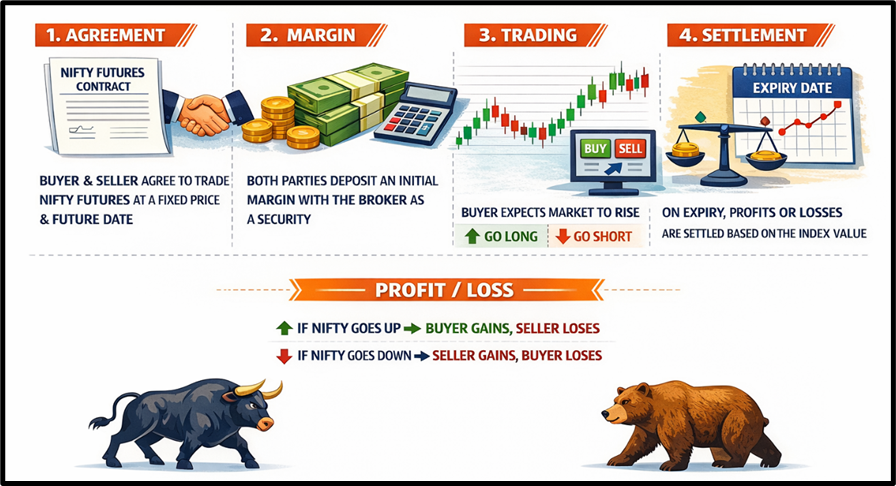
Futures Trading in the Stock Market (Example: NIFTY Futures)
In the stock market, futures contracts are commonly traded on stock indices such as NIFTY 50, which represents the performance of the top 50 companies listed on the National Stock Exchange of India.
Instead of buying or selling individual stocks, traders can enter into a NIFTY futures contract, which allows them to speculate on the future value of the NIFTY index.
Example
Suppose:
- Current NIFTY index level = 20,000
- A trader believes that the market will rise in the next month.
So, the trader buys a NIFTY futures contract at 20,000.
Now consider two possible outcomes at the time of expiry:
| Scenario | NIFTY at Expiry | Result |
| Market rises | 20,500 | Trader gains 500 points |
| Market falls | 19,500 | Trader loses 500 points |
Here, the trader does not buy the actual stocks of the index. Instead, the trader gains or loses money based on the difference between the contract price and the index level at expiry. This is usually settled through cash settlement.
Key Insight
Thus, NIFTY futures allow traders and investors to:
- Speculate on the direction of the stock market
- Hedge against market risk
- Take positions with a relatively small margin instead of full investment
For this reason, index futures such as NIFTY futures are among the most actively traded derivative instruments in India.
Settlement of Futures
Futures contracts on indices such as NIFTY are cash-settled, meaning no physical delivery of shares takes place. Only the difference between the contract price and the final settlement price is paid in cash.
Risk in Futures
Futures trading involves high risk because prices can be volatile and unpredictable. Hence futures markets require margin deposits and regulatory oversight.
Options
An option is a contract that gives the buyer the right, but not the obligation, to buy or sell an asset at a predetermined price.
This phrase is extremely important: Right but not obligation
Participants in Options
There are two parties:
| Party | Role |
| Option Buyer (Holder) | Has the right |
| Option Seller (Writer) | Has the obligation |
The buyer pays a premium for this right.
Types of Options
There are two main types.
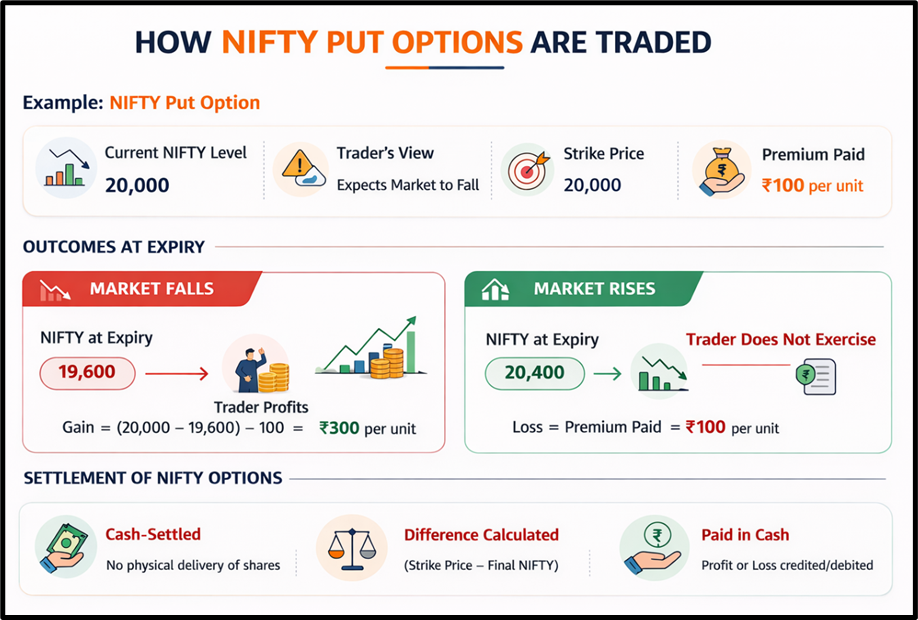
1. Call Option
Gives the right to buy an asset at a strike price. Used when expecting price increase.
2. Put Option
Gives the right to sell an asset at a strike price. Used when expecting price decrease.
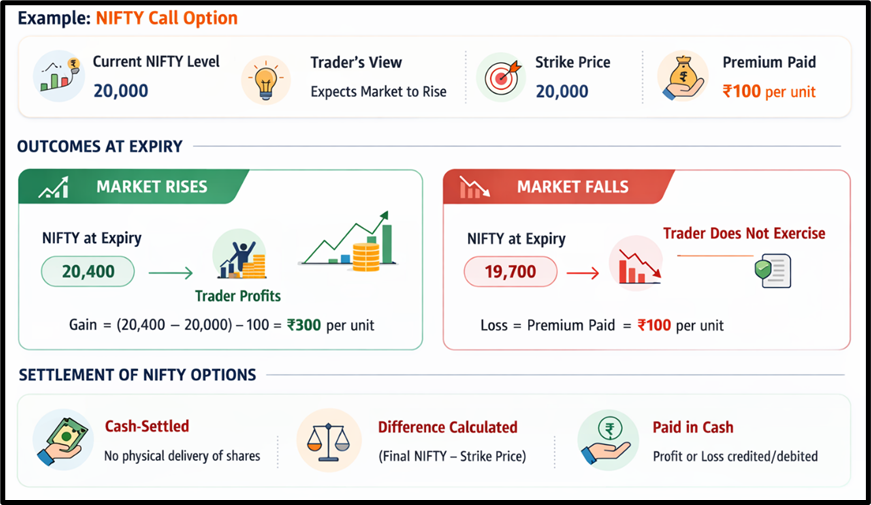
Example: NIFTY Call Option
Suppose:
- Current NIFTY level = 20,000
- A trader believes the market will rise.
The trader buys a NIFTY Call Option with:
- Strike price = 20,000
- Premium paid = ₹100 per unit
Now consider the outcomes at expiry:
| Scenario | NIFTY at Expiry | Result |
| Market rises | 20,400 | Trader profits (gain after premium) |
| Market falls | 19,700 | Trader does not exercise the option and loses only the premium (₹100) |
Here, the trader has the right to buy but is not obligated to do so. Therefore, the maximum loss is limited to the premium paid, while the potential profit can be higher if the market rises significantly.
Settlement of NIFTY Options
Options contracts on indices such as NIFTY are cash-settled. This means that no physical shares are delivered. Instead, the difference between the strike price and the final settlement price is paid in cash.
Key Insight
Thus, NIFTY options allow traders to:
- Bet on the direction of the stock market
- Hedge against market risk
- Take positions with limited downside risk
This makes options one of the most popular derivative instruments in India’s stock market.
Swaps
A swap is a financial contract where two parties exchange cash flows in the future. These cash flows are based on → Interest rates, Currencies and Commodities
Most Common Types
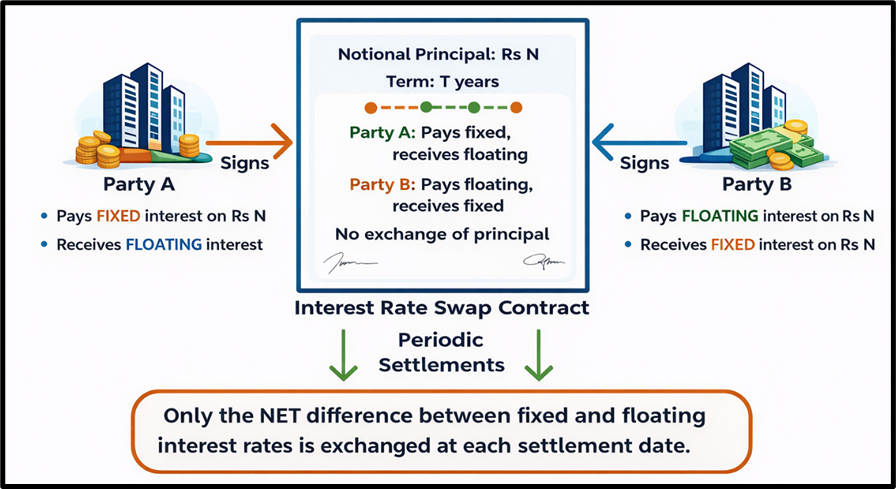
1. Interest Rate Swaps
Two parties exchange fixed and variable interest payments.
Example: A company has a loan with variable interest rate but prefers fixed rate stability.
So, it enters a swap:
| Company pays | Company receives |
| Fixed interest | Variable interest |
This stabilizes their interest cost.
2. Currency Swaps
Two companies exchange payments in different currencies.
Example:
| Indian company needs | US company needs |
| US dollars | Indian rupees |
They swap currency payments. This helps companies manage foreign exchange risk.
Forward Contracts
A forward contract is similar to futures but with some important differences. It is an agreement between two parties to buy or sell an asset at a fixed price on a future date.
However, forwards are:
- Customized contracts
- Traded over-the-counter (OTC)
- Not traded on exchanges
- Usually between two private parties
Example: Farmer and Food Company
Suppose: Current wheat price = ₹20/kg
A farmer and a food processing company agree: Forward price after 6 months = ₹25/kg
Now:
| Future Market Price | Outcome |
| ₹18/kg | Farmer still sells at ₹25 |
| ₹30/kg | Company still buys at ₹25 |
Thus both parties remove uncertainty.
Futures vs Forwards (Key Difference)
| Feature | Futures | Forwards |
|---|---|---|
| Trading place | Exchange | OTC market |
| Contract type | Standardized | Customized |
| Regulation | Highly regulated | Less regulated |
| Liquidity | High | Lower |
| Counterparty risk | Lower | Higher |
Derivatives in Indian Financial Markets
In India, derivatives trading began in 2000.
Major derivative segments exist in:
- Equity derivatives (NSE, BSE)
- Currency derivatives
- Commodity derivatives (MCX, NCDEX)
Regulated by:
- SEBI (Securities and Exchange Board of India)
The NSE derivative market is among the largest in the world in terms of number of contracts traded.