
Ecological Succession and Homeostasis
🌱 Ecological Succession
Imagine a completely barren piece of land—say, a rock surface exposed by a landslide, or a volcanic island formed after an eruption. Over time, this lifeless area starts turning green… little by little… until a full forest stands there.
👉 This gradual, predictable change in the plant and animal community over time is called Ecological Succession.
In short, succession means nature’s way of healing and rebuilding ecosystems.
It happens because of large-scale changes or destruction—either natural (like floods, fires, landslides) or man-made (like deforestation, mining, agriculture).
⚙️ Stages of Ecological Succession
Succession is directional and progressive—that means it moves in one direction, from simple to complex, unstable to stable, young to mature.
Let’s understand the key stages:
- Pioneer Community – These are the first species to settle in the area.
Example: lichens, mosses, or tiny microbes that can survive with almost no soil or nutrients. - Seral Communities (Seres) – As conditions improve, new communities replace the older ones.
Each of these transitional stages is called a seral stage. - Climax Community – The final, stable stage of succession.
It is complex, diverse, balanced, and self-sustaining (e.g., a mature forest).
🌱 Characteristics of Ecological Succession
As succession proceeds:
- Productivity increases – more plants, more photosynthesis.
- Nutrients shift – from reservoirs (like rocks or dead matter) into living organisms.
- Biodiversity increases – more niches and more species interactions.
- Food webs become complex – energy flow becomes more stable and resilient.
And yes, succession happens faster in continental interiors (because seeds and spores reach more easily).
🌄 Primary Succession – Starting from Scratch
This type occurs in areas where no community existed before—literally from zero.
Examples:
- Bare rocks (after a landslide)
- Newly formed volcanic islands
- Sand dunes, glacial moraines, lava flows
Here’s how it unfolds:
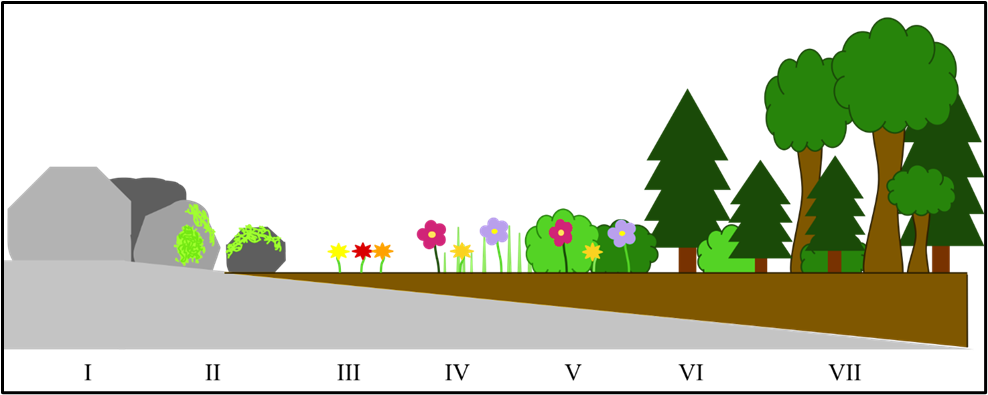
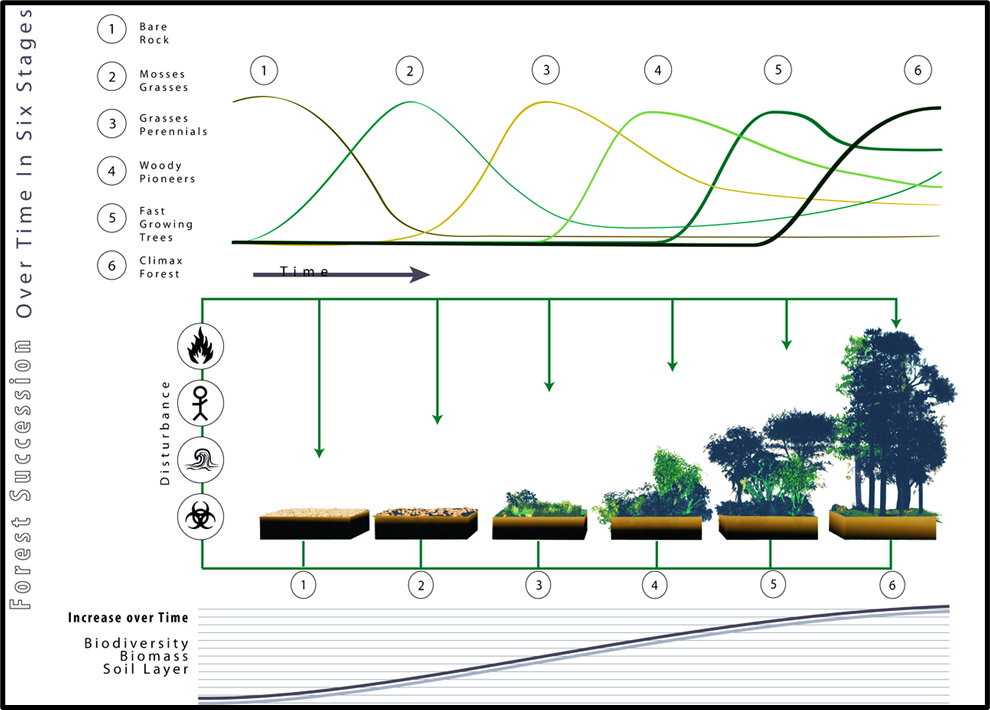
- Pioneer species like lichens, algae, and mosses settle first.
- They are hardy and can survive in harsh, nutrient-poor conditions.
- As they grow, die, and decay, they form small pockets of organic matter (early soil).
- These organic acids break down rocks, releasing nutrients.
- Gradually, soil forms → seeds of grasses and shrubs take root.
- More species arrive → diversity increases → ecosystem becomes richer and more stable.
Over time, the area transforms from bare rock → mosses → grasses → shrubs → trees → forest.
👉 The entire process takes thousands of years, as everything—soil, nutrients, and biodiversity—is built from the ground up.
🌿 Secondary Succession – Restarting After Disturbance
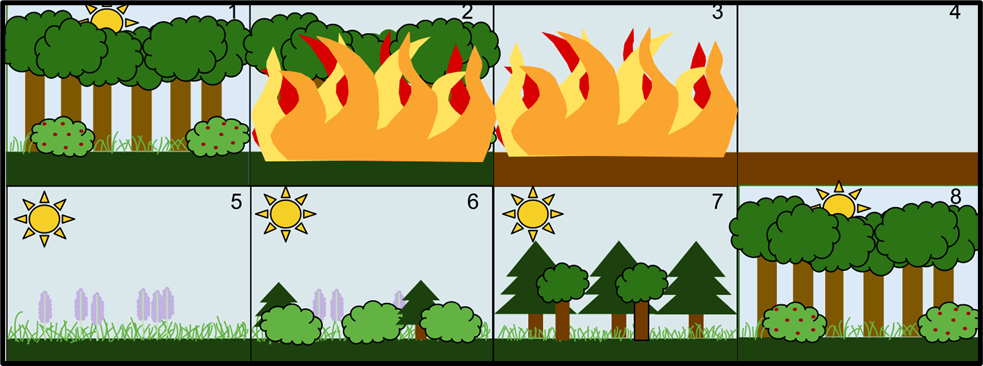
This is succession on previously inhabited land that got disturbed or destroyed.
For example:
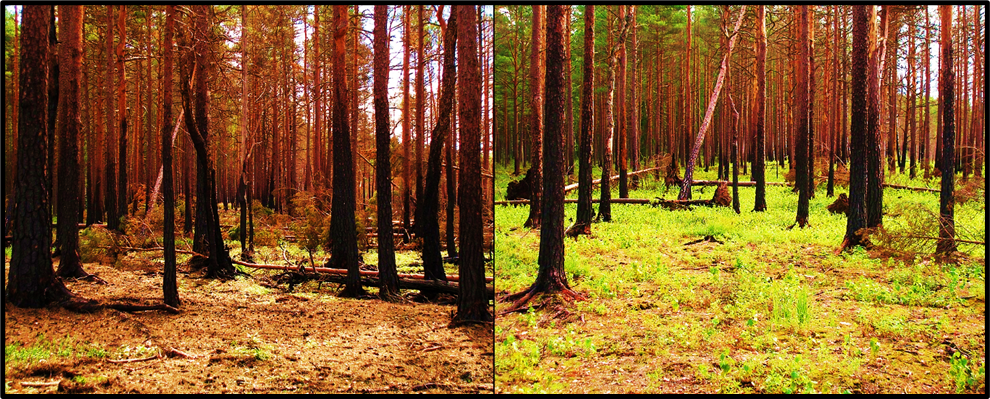
- After forest fires, floods, deforestation, agriculture, or overgrazing.
Here, soil already exists, and some seeds or roots may still be present.
Hence, the recovery is much faster than primary succession.
Sequence:
- Hardy grasses appear first.
- Then herbs and shrubs.
- Gradually, trees grow—brought by wind or animals.
- The land once again becomes a forest—a new climax community.
So, if primary succession builds from zero, secondary succession rebuilds from damage.
🌞 Autotrophic vs. Heterotrophic Succession
- Autotrophic Succession – Dominated by green plants (producers) in early stages.
- Heterotrophic Succession – Dominated by heterotrophs (organisms depending on others for food) in early stages.
Usually, natural ecosystems begin with autotrophic succession, because plants are needed to start the food chain.
🌧️ Autogenic vs. Allogenic Succession
- Autogenic – Changes caused by organisms within the community itself.
(Example: lichens producing acids that erode rocks to form soil.) - Allogenic – Changes brought about by external forces.
(Example: floods, fires, wind, human activities, etc.)
In short:
Autogenic = change from within
Allogenic = change from outside
🌵 Succession in Plants (Based on Habitat)
- Xerarch Succession – Occurs in dry habitats (like bare rocks).
→ Slowly, dry conditions change to moderate moisture → mesic condition. - Hydrarch Succession – Occurs in water bodies (ponds, lakes).
→ Gradually, water bodies get filled with silt and vegetation → turn into land.
Both lead towards a mesic (moderately moist) condition—neither too dry nor too wet.
💧 Succession in Water
In aquatic habitats, the process goes like this:
- Phytoplankton (microscopic plants) colonize first.
- They are replaced by floating angiosperms (like water lilies).
- Then come rooted hydrophytes (plants rooted under water).
- Next, sedges and grasses appear on the edges.
- Finally, trees grow, leading to a forest-type climax.
👉 Over centuries, the pond fills up with soil and organic matter → gradually converts into land.
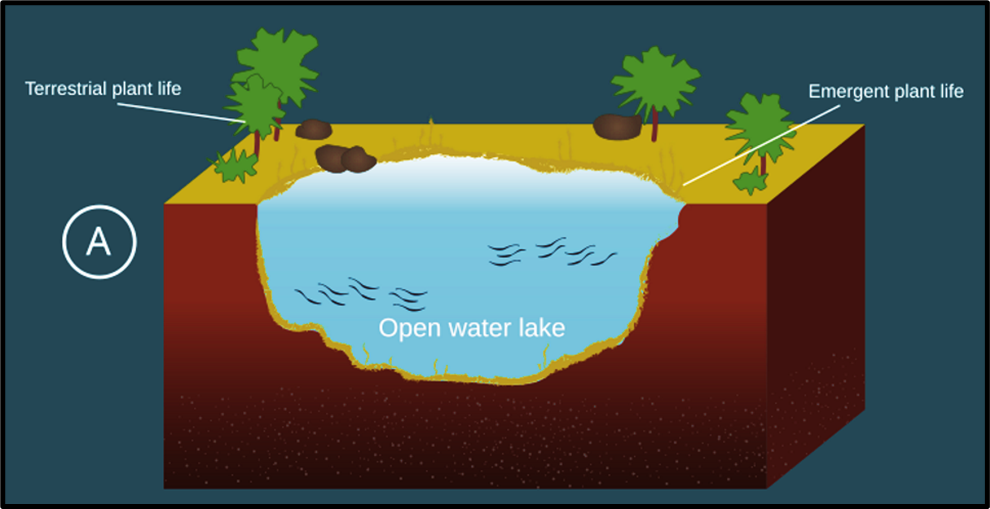
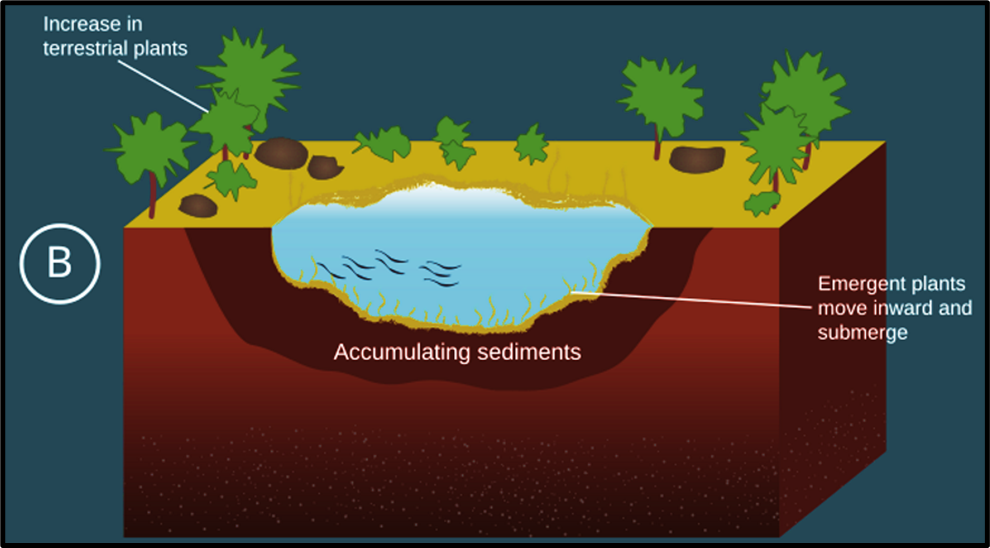
Sediment accumulates as the plants grow and die. Terrestrial plant life increases.
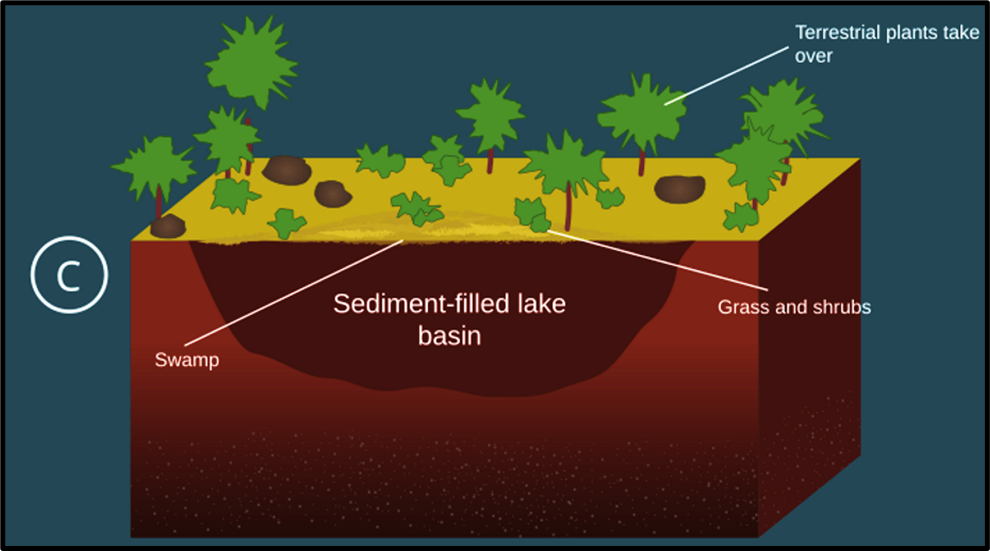
Image Source: Dhrithi Vishwa – Own work, CC BY-SA 4.0, via Wikimedia Commons
🌿 The Big Picture
Whether it starts on land (xerarch) or in water (hydrarch), the end goal of succession is always the same:
Formation of a stable, balanced, and self-sustaining climax community, usually mesic in nature.
That’s nature’s way of saying:
“No matter how disturbed or barren a place becomes, life always finds a way to rebuild and restore balance.”
🔹Homeostasis in Ecosystem
Think of an ecosystem like a well-balanced society — every member (plants, animals, decomposers) has a role, and together they maintain stability.
Even if there’s some disturbance, the system automatically adjusts itself and regains balance.
👉 This self-regulating ability of an ecosystem — its capacity to resist sudden change and maintain internal stability — is called Homeostasis.
The term simply means:
“Homeo” = same, “stasis” = state → maintaining the same state or internal balance.
🌀 Example – Pond Ecosystem
Imagine a pond — full of life: phytoplankton, zooplankton, fishes, etc.
Now suppose:
- The zooplankton population suddenly increases.
- They start eating more phytoplankton (the primary producers).
- Soon, phytoplankton become scarce → less food for zooplankton.
- Many zooplankton die of starvation → reducing their population.
- This allows phytoplankton to grow again.
👉 Over time, the system returns to balance.
This continuous cycle of checks and balances — where an increase in one factor leads to the decrease of another — is called a negative feedback mechanism.
In simple terms:
Nature has its own “auto-correction system.”
🔁 Negative Feedback Mechanism
A negative feedback ensures that no species grows unchecked and that resources don’t collapse.
Example:
If prey increases → predators increase → prey decreases → predators again decline → system balances.
But remember:
The homeostatic capacity of ecosystems is not unlimited.
If the disturbance is too great (like massive deforestation, pollution, or global warming), the system can break down beyond recovery.
🧬 Homeostasis in Living Organisms (Biological Sense)
In biology, homeostasis means maintaining a stable internal environment, even when the external environment changes.
Example:
- When it’s hot, we sweat to cool down.
- When it’s cold, we shiver to generate heat.
This internal control — temperature, water balance, pH, etc. — keeps our cells and organs working optimally.
🔥 How Organisms Maintain Homeostasis (Four Strategies)
Organisms use different survival strategies depending on their capability. Let’s understand these one by one:
1️⃣ Regulate
These are the smart controllers — they maintain internal balance through physiological or behavioural means.
Physiological means
- Humans sweat to cool down.
- Mammals increase metabolism to generate heat.
Behavioural means
- Animals move into the shade during heat.
- Birds fluff up feathers in winter.
This helps maintain:
- Constant body temperature (Thermoregulation)
- Constant osmotic concentration (Osmoregulation)
Who are regulators?
- All birds and mammals, and a few lower vertebrates/invertebrates.
✅ This is why mammals are so successful — they can live from Sahara to Antarctica, since they can control their internal temperature.
🌱 Plants, however, cannot regulate like this, which limits their range.
2️⃣ Conform
These are the followers, not controllers.
They simply conform to their surroundings.
Their internal conditions (like body temperature or osmotic balance) change with the environment.
Examples:
- Most animals and almost all plants.
- Aquatic animals whose body fluid concentration changes with the surrounding water.
Hence, they are called conformers.
⚠️ Why haven’t conformers evolved into regulators?
Because regulation is energy expensive.
Small animals, like shrews or hummingbirds, lose body heat quickly (due to larger surface area relative to volume).
To maintain body heat, they’d need to eat continuously — which isn’t sustainable.
👉 That’s why small animals are rarely found in cold (polar) regions.
3️⃣ Migrate
Some organisms simply move away temporarily from stressful conditions.
They return once favourable conditions resume.
Example:
- Every winter, Siberian migratory birds fly thousands of kilometres to Keoladeo National Park (Bharatpur, Rajasthan) to escape extreme cold.
So, migration is a temporary escape in space.
4️⃣ Suspend
If the organism cannot migrate, it may pause its activities until conditions improve — this is escape in time.
Examples:
🌾 In Plants:
- Seeds and vegetative structures remain dormant during stress, and germinate later.
🦠 In Microorganisms:
- Bacteria, fungi, and lower plants form thick-walled spores to survive adverse conditions.
🐻 In Animals:
- Hibernation – e.g., polar bears sleep through winter.
- Aestivation – e.g., snails and fish go dormant during summer to avoid heat and dryness.
- Diapause – e.g., zooplankton in ponds enter a suspended developmental stage under unfavourable conditions.
🌳 Summarising the Concept
| Strategy | What it Means | Example |
|---|---|---|
| Regulate | Maintain internal conditions actively | Humans sweating, birds thermoregulating |
| Conform | Internal conditions vary with environment | Most plants, aquatic animals |
| Migrate | Move to a favourable habitat temporarily | Siberian birds migrating to India |
| Suspend | Enter dormancy during stress | Hibernating bears, dormant seeds, aestivation in snails |
💡 Essence
- Ecosystem Homeostasis keeps the whole system stable (through negative feedback).
- Biological Homeostasis keeps individual organisms stable (through regulation, migration, or suspension).
Both ensure continuity of life despite change — that’s how nature sustains itself generation after generation.