
Foundation of Monetary Policy
At the very heart of macroeconomic management lies monetary policy. In simple terms, monetary policy is the process through which the Reserve Bank of India (RBI) regulates the money supply and credit conditions in the economy to achieve broad macroeconomic objectives such as:
- Economic growth
- Price stability (control of inflation)
- Financial stability
Think of monetary policy as a control panel in the hands of the central bank. By adjusting key levers—especially interest rates and liquidity-related instruments—the RBI influences how much people borrow, how much they spend, and how actively businesses invest. These changes do not remain isolated; they create ripple effects across employment, inflation, and overall economic growth.
How Monetary Policy Works (The Basic Logic)
When the RBI changes interest rates or liquidity conditions, it directly affects:
- Cost of borrowing for banks
- Loan interest rates for businesses and households
- Spending and investment decisions in the economy
Lower borrowing costs generally encourage people to spend and invest more, while higher borrowing costs tend to discourage excessive spending, helping control inflation.
Classification of Monetary Policy
Broadly, monetary policy can be classified into two types, depending on the economic situation:
- Expansionary Monetary Policy
- Contractionary Monetary Policy
Let us understand both:
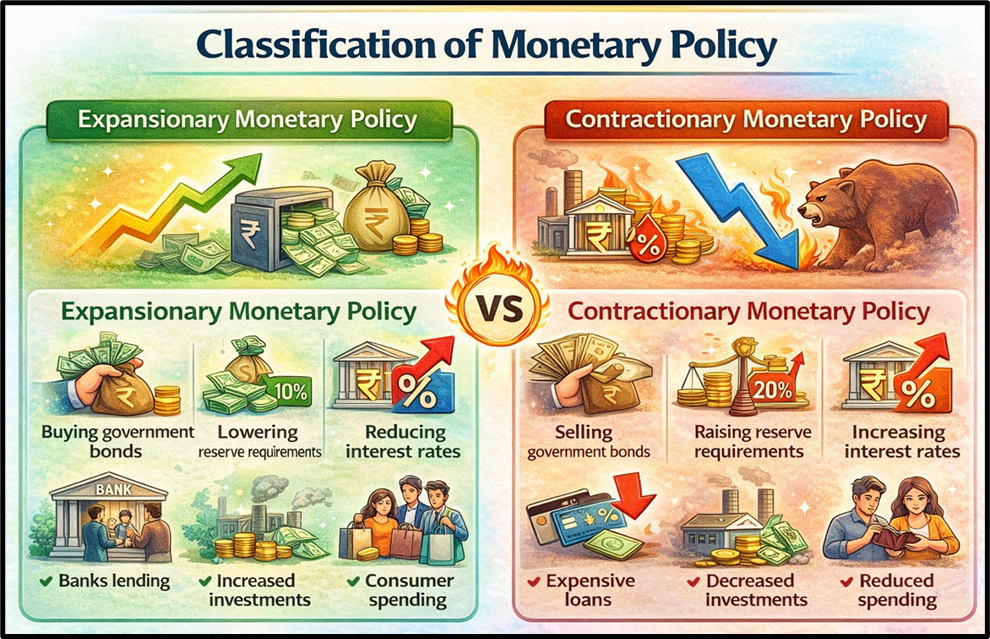
1. Expansionary Monetary Policy
Expansionary monetary policy is adopted when the economy is slow, stagnant, or facing recessionary tendencies.
Objective
- To stimulate economic growth
- To increase employment
- To boost demand and investment
Core Strategy
The RBI increases the money supply and reduces interest rates so that borrowing becomes cheaper and easier.
Major Instruments Used
- Buying government bonds (injects liquidity into the system)
- Lowering reserve requirements for banks
- Reducing the policy interest rate at which RBI lends to commercial banks
Economic Impact
- Banks have more funds to lend
- Businesses invest more in production
- Consumers spend more
- Demand rises → Output rises → Job creation increases
Indian Context: COVID-19 Example
During the COVID-19 pandemic, economic activity had nearly come to a halt. To prevent long-term damage, the RBI adopted an expansionary monetary policy by:
- Cutting interest rates
- Injecting large-scale liquidity into the banking system
The aim was clear: support growth and provide relief to households and businesses struggling during the crisis.
Contractionary Monetary Policy
Contractionary monetary policy is applied when the economy is overheating, typically accompanied by high inflation.
Objective
- To control inflation
- To reduce excess demand
- To ensure macroeconomic stability
Core Strategy
The RBI reduces the money supply and raises interest rates, making borrowing more expensive.
Major Instruments Used
- Selling government bonds (absorbs liquidity)
- Raising reserve requirements for banks
- Increasing the policy interest rate
Economic Impact
- Borrowing becomes costlier
- Spending and investment decline
- Demand cools down
- Inflationary pressures reduce
Practical Illustration
If the economy grows too fast and inflation begins to rise sharply, the RBI may increase interest rates. This discourages excessive borrowing and spending, thereby cooling the economy and restoring price stability.
Goals of Monetary Policy in India
After understanding what monetary policy is and how it operates, the next logical question—Why is monetary policy conducted at all?
In the Indian context, monetary policy is guided by three core goals, which together aim to ensure macroeconomic balance.
1. Controlling Inflation (Price Stability)
Inflation as studied in the earlier sections refers to a sustained increase in the general price level of goods and services in an economy.
When inflation rises uncontrollably, it erodes the purchasing power of money—the same amount of income buys fewer goods and services.
Why Inflation Control Is Crucial
- Hurts fixed-income groups the most
- Creates uncertainty for businesses
- Discourages savings
- Can ultimately slow down economic growth
Hence, controlling inflation is the primary objective of monetary policy in India.
RBI’s Inflation Target
The Reserve Bank of India aims to keep inflation within a target range of 2% to 6%, with:
- 4% as the central target
- ±2% tolerance band
This target is measured using Consumer Price Index (CPI) inflation, as CPI best reflects the cost of living of ordinary households.
How RBI Controls Inflation
If inflation is rising:
- RBI raises interest rates
- Borrowing becomes expensive
- Spending and demand reduce
- Inflationary pressure eases
📌 Illustration:
If RBI believes inflation is exceeding the comfort zone, it tightens monetary policy so that excessive demand in the economy cools down.
2. Promoting Economic Growth
While inflation control is primary, growth cannot be ignored, especially in a developing economy like India.
How Monetary Policy Supports Growth
Economic growth is promoted by:
- Lower interest rates
- Adequate availability of credit
- Encouraging investment and consumption
When borrowing is cheaper:
- Businesses expand production
- New projects are undertaken
- Employment opportunities increase
RBI’s Role
If economic activity is slowing:
- RBI cuts interest rates
- Loans become cheaper
- Investment and spending pick up
- Growth momentum is restored
📌 Example:
During economic slowdowns, accommodative monetary policy encourages firms to invest, generate jobs, and revive demand.
👉 UPSC Insight:
Monetary policy in India follows a “growth-supportive but inflation-sensitive” approach.
3. Maintaining Financial Stability
Monetary policy is not just about inflation and growth—it is also about systemic stability.
What Is Financial Stability?
It means:
- A resilient banking system
- Smooth functioning of financial markets
- Ability to absorb shocks without collapsing
RBI’s Stabilising Role
If the financial system faces stress:
- RBI injects liquidity
- Ensures banks can meet withdrawal demands
- Prevents panic and loss of confidence
📌 Example:
During financial stress or crisis situations, RBI acts as the lender of last resort, supplying liquidity to prevent systemic failure.
Monetary Policy Framework in India
India’s monetary policy is not discretionary or arbitrary—it operates within a clearly defined framework.
Monetary Policy Framework Agreement (MPFA)
The framework is guided by the Monetary Policy Framework Agreement (MPFA) between:
- The Government of India
- The Reserve Bank of India
The MPFA specifies:
- Objectives of monetary policy
- Inflation target
- Instruments to be used
- Decision-making and communication process
Core Focus
- Price stability (inflation targeting)
- Supporting economic growth as a secondary objective
Inflation Targeting in India
Under this framework:
- RBI uses CPI inflation as the nominal anchor
- Target: 4% ± 2%
- Flexibility allows RBI to respond to supply shocks
This system brings → Transparency, Predictability, Accountability in monetary policy
Monetary Policy Committee (MPC)
To institutionalise this framework, India adopted a committee-based decision-making system.
What Is the MPC?
The Monetary Policy Committee is a statutory body responsible for setting policy interest rates.
It was created after → Amendment of the RBI Act in 2016
Composition (6 Members)
- RBI Governor – Chairperson
- RBI Deputy Governor (Monetary Policy)
- One RBI nominee
- Three members nominated by the Government of India
- External members have a 4-year tenure
Decision-Making Process
- Meetings held regularly
- Quorum: minimum 4 members, including Governor or Deputy Governor
- Decisions by majority vote
- In case of a tie, Governor has the casting vote
Binding Nature → Decisions of the MPC are binding on the RBI
This ensures → Institutional credibility, Reduced discretion, Greater transparency
Limitations of Monetary Policy in India
(Why Monetary Policy Is Necessary—but Not Sufficient)
After understanding the tools and framework of monetary policy, a mature economic analysis must ask:
👉 Why doesn’t monetary policy always deliver the desired results?
In India, the effectiveness of monetary policy is constrained by several institutional, structural, and external factors. These limitations are extremely important for UPSC Mains, especially in analytical questions.
1. Limited Scope of Monetary Policy
The Reserve Bank of India primarily controls
→ Supply of money;
→ Cost of money (interest rates)
However, it cannot directly control the demand for money.
Why This Matters
Even if RBI → Cuts interest rates OR, Injects liquidity, People and businesses may still → avoid borrowing (due to uncertainty) or postpone investment decisions
📌 Key Insight:
Low interest rates do not automatically guarantee higher borrowing or spending.
2. Time Lags in Monetary Policy
Monetary policy does not work instantly. There are multiple time lags:
- Recognition lag – identifying the problem
- Decision lag – formulating policy
- Transmission lag – banks adjusting rates
- Impact lag – effect on consumption and investment
Example
A repo rate cut today may take:
- Several months to affect bank lending rates
- Even longer to influence investment and employment
📌 UPSC Line:
Monetary policy is a medium-term stabilisation tool, not a quick-fix solution.
3. Structural Constraints in the Indian Economy
India’s economic structure itself limits policy effectiveness.
Key Structural Issues
- Large informal sector
- Low formal credit penetration
- Dependence on non-institutional sources of finance
Since the informal sector, does not rely on bank credit and is relatively insulated from interest rate changes → A large part of the economy remains outside the influence of monetary policy.
4. Dependence on Fiscal Policy Coordination
Monetary policy works best when fiscal policy is supportive.
Why Coordination Matters
- Expansionary fiscal policy (high government spending) can neutralize tight monetary policy
- Large fiscal deficits can → Push up interest rate, Crowd out private investment
In India, fiscal policy plays a dominant role due to → Developmental spending, Welfare commitments, Infrastructure investment needs
📌 UPSC Perspective:
Monetary policy alone cannot manage growth and inflation without fiscal discipline.
5. Influence of External Factors
India is a globally integrated economy, and several external factors lie outside RBI’s control:
- Global economic slowdowns
- Volatile capital flows
- Crude oil price shocks
- Exchange rate movements
- Global interest rate cycles (e.g., US Fed actions)
These factors can → Fuel inflation, Affect growth, Disturb financial stability
👉 Even a well-calibrated monetary policy may struggle against strong global headwinds.
Relevant Legal & Institutional Framework
The Reserve Bank of India Act, 1934
Implementing Authority: Reserve Bank of India
Key Provisions
- Establishes RBI as India’s central bank
- Legal authority for → Currency issuance, Monetary policy, Foreign exchange management
- Empowers RBI to → Regulate banks, Conduct inspections, Act as lender of last resort
Monetary Policy Framework Agreement (MPFA), 2015
Implementing Authorities → Reserve Bank of India, Government of India
Key Provisions
- Introduced Flexible Inflation Targeting (FIT)
- CPI inflation target → 4% ± 2%
- Accountability clause:
- If inflation target is missed for 3 consecutive quarters, RBI must submit → Reasons, Remedial actions, Timeframe for correction
📌 This ensures rule-based, transparent, and accountable monetary policy.