
Gold
What is Gold?
Gold is a chemical element, denoted by the symbol Au, derived from the Latin word aurum, meaning “shining dawn”. Its atomic number is 79, placing it among the heavier natural elements.
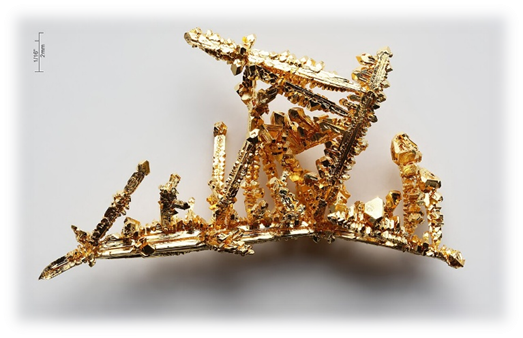
Let’s understand its physical and chemical characteristics in simple terms:
- Free elemental form: Gold often exists in nature in its pure form—unlike many other metals that occur only in compounds. You may find it as tiny nuggets or grains, especially in rocks that contain gold (technically called auriferous rocks) and in veins or alluvial deposits (such as river sands).
- Physical Properties: Gold is
- Dense (heavy for its size)
- Soft and malleable (you can beat it into thin sheets without breaking)
- Ductile (can be drawn into wires)
- Bright yellow and lustrous, which makes it highly appealing for decorative uses
- Chemical Property: It is highly unreactive—gold does not corrode or rust easily. That’s why ancient gold coins, idols, and jewellery survive for centuries without degradation.
🔍 Real-world analogy: Think of gold as the VIP of metals—it doesn’t mingle (react) easily with others, it’s flashy (lustrous), and stays preserved (non-corrosive) no matter how old it gets 😊
Formation of Gold (Geological Processes)
Gold is not created in factories—it’s the result of complex geological processes. Let’s go through the major types of gold deposits, which are the natural sources of gold:
a) Hydrothermal Vein Deposits
- These are among the most common sources of gold.
- Formed when hot fluids, rich in minerals, move through cracks and fractures in rocks.
- As these fluids cool, gold precipitates and accumulates.
- Found in volcanic and tectonic regions where such fluid activity is high.
Imagine boiling water loaded with sugar poured into cracks of a rock. As the water cools, sugar crystals settle in the cracks—replace sugar with gold and you get the idea.
b) Placer Deposits
- These are formed through the erosion and weathering of primary gold sources.
- Gold, being dense, gets washed down into riverbeds, beaches, or deltas and settles there.
- These are secondary deposits and easier to mine.
You might have heard of gold panning in rivers—that’s exactly where placer deposits come in.
c) Carlin-type Deposits
- These are microscopic gold deposits, not visible to the naked eye.
- Found within carbonate rocks like limestone.
- Prominent in certain sedimentary basins.
d) Epithermal Deposits
- Formed by relatively cooler hydrothermal fluids at shallow depths.
- Typically found in volcanic and geothermal areas.
e) Greenstone-hosted Deposits
- These occur in regions with ancient volcanic and sedimentary rocks known as greenstones.
- Common in tectonically active areas—regions that have undergone intense geological movement over time.
Applications of Gold (Industrial and Economic Uses)
Gold is not just ornamental; it is also functional. Because of its unique physical and chemical properties, gold finds use in multiple domains:
🔧 Electronics
- Excellent conductor of electricity and doesn’t corrode.
- Used in connectors, printed circuit boards (PCBs), and high-end components.
🦷 Dentistry
- Gold is biocompatible (safe inside the human body) and durable.
- Used for crowns, bridges, and fillings.
💊 Medicine
- Gold compounds are used to treat diseases like rheumatoid arthritis.
- Gold nanoparticles are emerging in cancer diagnostics and drug delivery.
🚀 Aerospace & Defence
- Gold reflects infrared radiation and is highly corrosion-resistant.
- Used in spacecraft, satellites, and military electronics.
🎨 Decorative Arts
- Gold leaf and dust are used in religious artefacts, artworks, and architecture.
⚗️ Catalysis
- In chemical industries, gold acts as a catalyst—speeding up reactions without getting consumed.
🧬 Nanotechnology
- Due to its nanoscale properties, gold is useful in biosensors, catalysis, and targeted drug delivery.
World’s Gold Reserves and Gold Production
Gold Reserves vs Gold Production – Understand the Distinction
Before we dive into numbers, let’s clarify the difference between reserves and production:
- Gold Reserves refer to economically viable gold quantities still present beneath the Earth’s surface
- Gold Production is the actual extraction of gold in a given year
World’s Gold Reserves (2024)
| Country | Gold Reserves (in thousand tons) | Production | Share % |
| Australia | 12 | 290 | 8.7% |
| Russia | 12 | 310 | 9.4% |
| South Africa | 5 | 100 | 3.0% |
| Indonesia | 3.6 | 100 | 3.0% |
| Canada | 3.2 | 200 | 6.0% |
| China | 3.1 | 380 | 11.5% |
| USA | 3 | 160 | 4.8% |
| Total | 64 TT (Thousand Tons) | 3300 Tons |
- Australia leads globally with 12 TT of reserves, thanks to its stable geology and advanced mining industry.
- Russia follows closely with 12 TT, benefitting from vast and relatively underexploited Siberian deposits.
- South Africa, once a global gold powerhouse, now lags due to depletion and rising extraction costs.
- China is the top producer, despite not having the largest reserves—showing efficient extraction and investment in domestic mining.
- Australia and Russia have a balance between reserves and production.
- The USA and Canada are significant but lag behind due to environmental regulations and higher costs of mining.
Major Gold Mines Around the World
Here, we’ll explore key gold mines—not just by size but by their strategic or economic importance:
| Country | Mine | Significance |
|---|---|---|
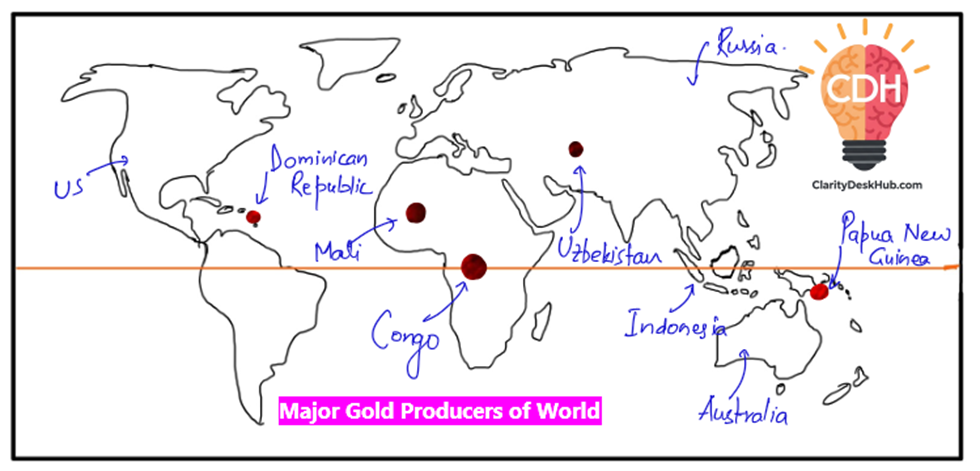
| Uzbekistan | Muruntau Mine | One of the largest open-pit gold mines globally |
| Australia | Kalgoorlie, Boddington | Core of Australia’s gold economy; modern, high-yield mines |
| Indonesia | Grasberg Mine | Among the largest gold-copper mines in the world |
| Russia | Olimpiada Mine | Russia’s largest producer, with reserves over 30 million ounces |
| USA | Carlin Complex, Nevada | Operational since 1965; largest gold-producing region in the USA |
| DR Congo (DRC) | Kibali Mine | Technologically advanced; crucial for African gold economy |
| Dominican Rep. | Pueblo Viejo Mine | Economically valuable, but environmentally controversial |
| Australia | Cadia-Ridgeway Mine | Dual copper-gold mine in New South Wales; vital for diversified output |
🗺️ Insight for exams: Always correlate gold mines with geological settings—e.g., stable cratons in Australia, tectonically active zones in Indonesia, and mineral-rich basins in Russia.
Here, you can draw a simple world map diagram in exams showing major gold producing regions of the world:
India’s Strategic Entry: Mount Celia Gold Project (Western Australia)
- In Nov. 2023, India made a notable step into global gold mining:
- The Mount Celia Gold Project in Western Australia was inaugurated by the Secretary of the Ministry of Steel
- It’s being executed by Legacy Iron Ore Ltd, a subsidiary of NMDC, under the Government of India.
Key Points:
- This marks NMDC’s first-ever gold mining venture.
- This move diversifies India’s mineral portfolio, traditionally dominated by iron ore and steel.
- While located in Australia, it has strategic significance for India’s mineral security and global presence.
💡 UPSC Lens: This is a brilliant case study under “India’s Role in Global Mining” or “Public Sector Diversification in Mineral Exploration”—use it in answers where applicable.
Gold Resources and Production in India
Overview of India’s Gold Resources
India, despite its deep historical and cultural association with gold, is not richly endowed with gold reserves. Our gold resources are modest, and mining is limited by geological and technological constraints.
As of April 1, 2020:
- Primary oreresources: 518.23 million tonnes
- 23.72 million tonnes under Reserve category
- Remaining 494.50 million tonnes under Remaining Resources Category
Annual Production Snapshot: FY 2022–23
- Total primary gold production: 1,433 kg
- This marks a growth of ~2% over the previous year
- But India still imports the majority of its gold, as domestic output is negligible compared to demand
Major Producing States and Their Significance
Let’s now break this down state-wise into two categories: reserves and production.
A. Gold Ore Resources (Metal Content-wise)
| State | % Share of Reserves | Significance |
|---|---|---|
| Bihar | 43% | Huge reserves, largely unexplored |
| Rajasthan | 25% | Potential future mining zone |
| Karnataka | 20% | Traditional leader in production |
| West Bengal | 2.5% | Low-grade reserves |
| Andhra Pradesh | 3% | Historical mining zone |
| Jharkhand | 2% | Minor reserves, important river-based sources |
B. Gold Production (FY 2022–23)
| State | % of Total Production |
| Karnataka | 94% (Mainly from Hutti) |
| Jharkhand | ~1% |
📌 Key Insight: Production does not always reflect reserves. For example, Bihar has the highest reserves, but contributes nothing to production due to lack of infrastructure, regulatory hurdles, and low economic viability at current prices.
State-wise Mining Highlights
Karnataka: The Backbone of Indian Gold Production
- Hutti Gold Mines (Raichur): Only major operational gold mine
- Kolar Gold Fields (KGF):
- Once famous globally, now almost shut down due to resource depletion
- One of the deepest mines in the world before closure
- Dharwad & Hassan: Minor occurrences
🌍 Global Context: Compare KGF with Mponeng Mine, South Africa (depth: ~3.9 km), the deepest gold mine globally—highlighting how gold often lies deep in Earth’s crust, making extraction complex and expensive.
Jharkhand: River Gold & Alluvials
- Subarnarekha River (literally meaning gold-streaked): Contains fine alluvial gold
- Sona Nadi & Sonapat Valley: Important zones for placer gold
🏞️ Analogy: Think of rivers like a gold “conveyor belt”—they pick up tiny gold flakes eroded from rocks and deposit them downstream in the riverbed.
Andhra Pradesh: Ramagiri Gold Field
- Located in Anantapur district
- Known for quartz-gold veins
- Historically significant but now low in output
Kerala: Minor Alluvial Deposits
- Punna Puzha and Chabiyar Puzha river terraces
- Marginal deposits—not of economic mining scale yet