Introduction to Climate Change
When we talk about Climate Change (CC), we are referring to long-term shifts in Earth’s climate system—not just temperature, but also rainfall patterns, snowfall, wind systems, and ocean circulation. These changes occur over hundreds of years and can arise due to natural factors as well as human activities.
Role of Human Activity (Anthropogenic Causes)
While Earth’s climate has always changed naturally, what makes the present phase different is the dominant role of humans since the Industrial Revolution (1800s onwards). Activities such as:
- Burning of fossil fuels (coal, oil, natural gas)
- Deforestation (loss of carbon sinks)
have altered the composition of the global atmosphere by increasing the concentration of greenhouse gases (GHGs). These gases trap heat and intensify the greenhouse effect, leading to a rise in global temperatures.
Global Warming vs Climate Change: Clearing the Confusion
This distinction is extremely important for UPSC.
- Global warming refers specifically to the long-term rise in Earth’s average surface temperature.
- Climate change, on the other hand, is a broader concept.
👉 Global warming is only one aspect of climate change.
Climate change includes:
- Rising sea levels
- Shrinking mountain glaciers
- Accelerated loss of the cryosphere (ice caps of polar and mountain regions)
- Ocean acidification
- Changes in rainfall and wind patterns
Thus, climate change is about system-wide transformation, not just warming.
Climate Change in Earth’s Geological History
It is important to remember that Earth has never had a stable climate.
- The planet has experienced warming phases and cooling phases (glaciations) throughout its evolutionary history.
- However, the current warming trend is unique because:
- It has been rapid
- It has intensified since the late 1970s
- It closely correlates with human-induced GHG emissions
This scientific understanding is based on multiple lines of evidence.
How Do We Know About Past Climate Change Events?
Scientists reconstruct Earth’s past climate using natural archives, also called proxy indicators.
A. Tree Rings (Dendrochronology)
Trees act like natural climate historians.
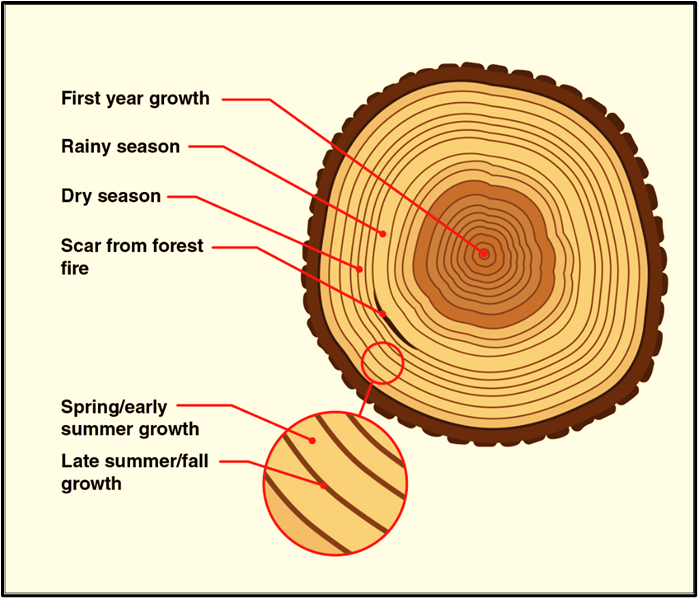
- Each year, a tree forms one light ring (early summer) and one dark ring (late summer).
- Together, these rings represent one year of growth.
What do tree rings tell us?
- Width of rings:
- Wider rings → wet and favourable climate
- Narrow rings → dry or stressed conditions
- Colour and density reflect temperature and moisture availability.
By studying tree rings, scientists can reconstruct climate conditions going back hundreds to thousands of years.
B. Ice Cores from the Cryosphere
Ice cores are among the most powerful climate evidence tools.
→ Extracted by drilling deep into glaciers and polar ice sheets
→ Each layer of ice corresponds to annual snowfall
What information do ice cores contain?
- Trapped air bubbles → past concentrations of GHGs
- Aerosols such as:
- Dust
- Ash
- Pollen
- Sea salts
These particles provide evidence of:
- Past climate conditions
- Volcanic eruptions
- Large-scale environmental changes
Some ice cores allow us to look back hundreds of thousands of years into Earth’s climate history.
Understanding the Greenhouse Effect (Through an Analogy)
To understand the greenhouse effect, let us first recall what a greenhouse is.
A greenhouse is a structure made of transparent materials like glass that allows sunlight to enter but prevents heat from escaping.
How does it work?
- Incoming solar radiation (visible, infrared, ultraviolet) enters through the glass.
- The interior absorbs this energy and warms up.
- The absorbed energy is re-emitted as longer-wavelength infrared radiation (heat).
- Glass does not allow this infrared radiation to escape easily.
- Heat also cannot escape through convection because the structure is enclosed.
As a result, the temperature inside rises—this is the greenhouse effect.
Greenhouse Effect in Earth’s Atmosphere
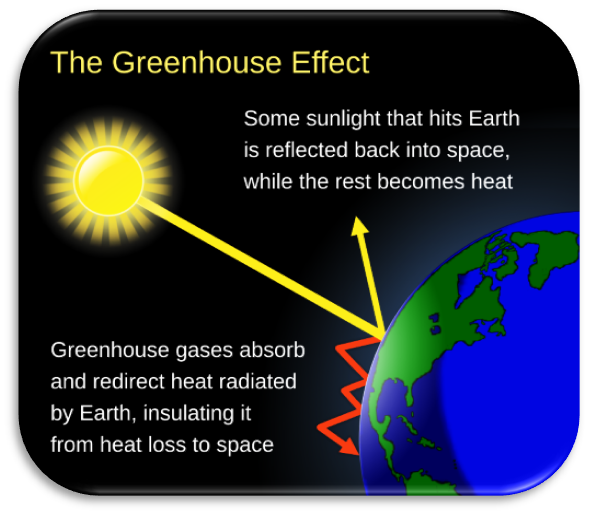
Earth’s atmosphere behaves in a similar way.
- Greenhouse gases allow incoming solar radiation to pass through.
- But they absorb and re-radiate outgoing infrared radiation, trapping heat near the surface.
This process is natural and essential.
Watch this animated video by NASA to have visual clarity.
Importance of the Natural Greenhouse Effect
This is a life-saving phenomenon, not a problem by itself.
- The natural greenhouse effect has existed for millions of years.
- It is primarily caused by:
- Water vapour
- Tiny water droplets
These alone contribute more than 95% of natural greenhouse warming.
Why is it essential?
- Due to the natural greenhouse effect:
- Average global temperature ≈ 15°C
- Without it:
- Average temperature would drop to around –17°C
- Such conditions would make life impossible
👉 The real problem is not the greenhouse effect, but its enhancement due to excess GHGs released by humans.