
Manganese
Let’s begin with a basic understanding—what is manganese?
Imagine a metal that is not as shiny as silver, not as common as iron, but works silently behind the scenes to make your steel stronger and your aluminium cans last longer. That’s manganese for you.
Manganese is a silvery grey or white colored hard and brittle metal. You won’t find it roaming freely in nature; rather, it prefers to be in the company of other minerals—iron, laterite, and other geological friends.
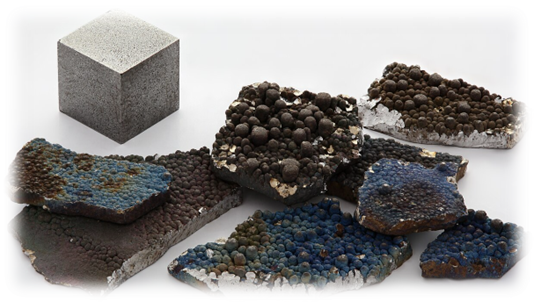
But not all manganese deposits are equally useful. From a commercial perspective, there are four main ores that matter:
| Ore Name | Manganese Content (%) |
| Pyrolusite | 63.2% |
| Manganite | 62.4% |
| Psilomelane | Varies |
| Braunite | Varies |
Note: Pyrolusite and manganite are the most manganese-rich and hence most commercially valuable.
Formation of Manganese: The Geological Story
This can be understood through four major geological processes.
(A) Sedimentary Processes: The ‘Slow and Steady’ Method
Think of oceans or lakes. Over time, manganese oxides and hydroxides precipitate—that is, settle down—from water. These fine particles slowly build up layer by layer.
- Environment: Marine or lacustrine (lake) basins
- Mechanism: Precipitation → Accumulation → Burial → Compaction
- Examples:
- Kalahari Desert, Africa
- Nikopol Region, Ukraine
🧠 Conceptual Clarity: This process is very similar to how sedimentary rocks like limestone are formed—slow deposition over time.
(B) Hydrothermal Processes: The ‘Hot and Fiery’ Route
Now imagine underground hot springs—metal-rich fluids rising up through volcanic activity.
These fluids carry manganese in dissolved form. When they cool down near the Earth’s surface, manganese gets deposited.
- Associated With: Volcanic and intrusive igneous rocks
- Examples:
- Urals, Russia
- Appalachian Mountains, USA
🧠 Why important? Hydrothermal deposits often occur in vein-like structures, which can be rich but localized.
(C) Weathering and Enrichment: Nature’s Recycling Mechanism
This is where surface processes dominate. Here’s how it works:
- Manganese-bearing rocks get weathered.
- Rainwater leaches out manganese.
- It moves and gets re-precipitated as manganese oxides and hydroxides, often with iron oxides.
This leads to the formation of high-grade deposits.
- Example: Again, the Kalahari Desert, Africa—this region comes up repeatedly due to its richness.
🧠 Fun Fact: This process works like how iron pans rust when left outside in the rain—it’s oxidation!
(D) Metamorphic Processes: Under Heat and Pressure
Imagine an already manganese-rich sedimentary rock getting cooked under Earth’s internal heat and pressure. What happens?
- The minerals recrystallize, change their form, and often become more compact and stable.
- This leads to metamorphic manganese deposits.
- Example: Caucasus Mountains, Russia.
🧠 Think of it like turning soft dough (sedimentary rock) into a crispy cookie (metamorphic rock) via baking.
Applications of Manganese: From Mines to Market
Let’s now link this knowledge to real-world utility.
(A) Iron and Steel Industry – The Major Consumer
- Manganese is essential in converting iron ore into iron by removing oxygen and sulphur.
- Then it’s added to steel to improve strength and hardness.
Roughly 90% of total manganese mined goes into the steel industry. That’s huge!
(B) Aluminium Cans – Your Everyday Use Case
- Manganese is added to aluminium alloys to increase corrosion resistance—so your soda can doesn’t rust!
(C) Ferroalloys – The Industrial Backbone
- Ferroalloys are alloys that contain iron.
- Manganese-based ferroalloys account for 41% of global ferroalloy production.
This shows manganese’s critical role in the metal processing industry.
Manganese Ore Distribution in India
Nature of Deposits in India
Let’s first understand how manganese is geologically distributed in India.
Most of India’s manganese ore belongs to metamorphosed sedimentary origins, meaning the original sediments have undergone heat and pressure changes over geological time to form manganese-rich deposits.
There are three key geological types:
| Deposit Type | Locations |
|---|---|
| Gondite Deposits | Madhya Pradesh (Balaghat, Chhindwara) Maharashtra (Bhandara, Nagpur) Gujarat (Panchmahal) Odisha (Sundargarh) |
| Kodurite & Khondolite | Odisha (Koraput) Andhra Pradesh (Srikakulam) |
Reserves and Resources
As of April 1, 2020, India’s total reserves/resources of manganese ore stood at:
✅ 503.62 million tonnes
This is a respectable figure, but still modest on the global scale (we’ll see that shortly).
Production Profile (2022–23)
India produced:
✅ 2827 thousand tonnes of manganese ore in 2022–23
But here’s an important point:
- A large chunk (69%) of this production was low grade(below 35% Manganese)
- Medium grade (35-46% Mn): 22%
- High grade (above 46% Mn): Only 8%
🔍 Observation: This implies India still lacks adequate beneficiation infrastructure to upgrade low-grade ore.
Major Producing States (2022-23)
Here’s a comparative table of reserves vs. actual production:
| State | % Share of Reserves | Production (in ‘000 Tonnes) | % of Total Production |
| Odisha | 34% | 644 | 23% |
| Karnataka | 24% | 345 | 12% |
| Madhya Pradesh | 12% | 856 | 30% |
| Maharashtra | 12% | 751 | 27% |
| Goa | 7% | N/A | – |
| Andhra Pradesh | 6% | 214 | 8% |
| India | 2827 |
🧠 Insight for Mains: Notice the mismatch—Odisha has the highest reserves but not the highest production. Meanwhile, Madhya Pradesh and Maharashtra produces the most, indicating better mining infrastructure or easier access.
Global Distribution of Manganese Ore
Let’s now zoom out to see the global landscape.
World’s Manganese Reserves (2024)
| Country | Reserves (in MT) | % of World Total |
| South Africa | 560 | 33% |
| Australia | 500 | 29% |
| China | 280 | 17% |
| Brazil | 270 | 16% |
| India | 34 | 2% |
| World Total | 1700 MT | 100% |
✅ South Africa is the absolute giant in manganese reserves.
World’s Manganese Production (2024)
| Country | Production (in MT) | % of World Total |
| South Africa | 7.4 | 37% |
| Gabon | 4.6 | 23% |
| USA | 2.8 | 14% |