
Nomadic Herding
Nomadic herding is a type of primitive subsistence agriculture.
The term “primitive” doesn’t mean inferior; it simply reflects that this system has ancient roots and relies on basic tools and natural patterns.
The word “subsistence” here tells us that the herders are not producing for markets—they raise animals mainly to meet their own food and livelihood needs.
This system is migratory by nature: herders move from place to place with their animals in search of pasture and water. Their movement is not random, but guided by seasonal rhythms and environmental conditions.
🐄 What Animals Are Reared—and where?
Different regions support different animals, depending on the climate, vegetation, and terrain. Here’s a simple breakdown:
| Region | Dominant Livestock |
|---|---|
| Tropical Africa | Cattle (due to the presence of open grasslands) |
| Sahara & Asiatic Deserts | Sheep, goats, and camels (adapted to arid climate) |
| Mountains (Tibet, Andes) | Yak, llamas (adapted to cold, high altitudes) |
| Arctic & Sub-Arctic | Reindeer (survive in tundra conditions) |
📌 Analogy: Think of these animals as the “companions” of nomads—like a portable economy. Wherever the herders go, their livelihood travels with them.
🌍 Where is Pastoral Nomadism Found?
Nomadic herding is not random; it is geographically patterned.
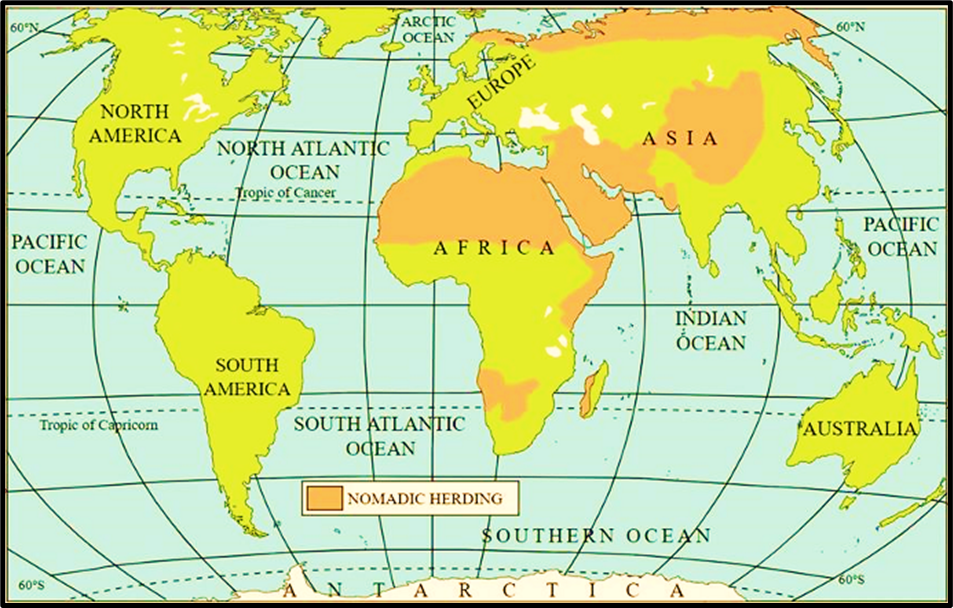
Whittlesey identified three main global regions where pastoral nomadism is concentrated:
✅ Core Region:
- From North Africa’s Atlantic coast → through Arabian Peninsula → into Mongolia and Central China.
- This belt includes deserts and semi-arid regions.
✅ Tundra Region of Eurasia:
- The far north of Europe and Asia (Russia, Siberia).
- This region sees reindeer-based nomadism.
✅ Isolated Zones in the Southern Hemisphere:
- South-west Africa and Madagascar.
- These are relatively small but significant pockets of nomadic herding.
🏔️ What is Transhumance?
A special form of nomadic herding is known as transhumance.
This is a seasonal migration between highland and lowland pastures.
During summers, herders move upward to mountain pastures (which are cooler and lush).
During winters, they return downward to plains (to escape the cold and snow).
📌 Example from India:
In the Himalayas, communities like the Gujjars, Bakarwals, Gaddis, and Bhotiyas practice transhumance.
- In summer: they go to high-altitude pastures.
- In winter: they descend to lowland areas.
🔁 This cyclical movement is a sustainable response to climatic variation—making best use of resources at different elevations and seasons.
🗺️ Why is Nomadic Herding Declining?
Unfortunately, the number of pastoral nomads is decreasing, and there’s a clear reason for this:
Imposition of political boundaries.
- Modern nation-states have fixed borders.
- Nomadic routes that once crossed vast areas now cut across countries.
- Customs posts, permits, fences, and national policies make free movement difficult.
- Also, with urbanisation and development, pastoral lands are shrinking.
📌 You can think of this like a person whose home lies in two states, but now, a wall has been built across the living room—movement is no longer free or easy.
🧭 Conclusion:
To summarise, Nomadic Herding is:
- An ancient, mobile, and self-sufficient system of agriculture,
- Based on seasonal movement of people and livestock,
- Practised in harsh and fragile environments like deserts, tundras, and mountains,
- Declining due to modern political and economic pressures.
This system is not only an economic activity but also a way of life, deeply woven with culture, tradition, and survival instincts.