
Plastic Pollution
Let us begin with a very simple idea: Plastic itself is not the villain.
The mismanagement of plastic is the real problem. And when this mismanaged plastic accumulates in the environment, we call it plastic pollution.
What Is Plastic Pollution?
Plastic pollution means the accumulation of plastic objects and particles—like bottles, bags, or microplastic fragments—in the environment in such a quantity that they start harming humans, wildlife, and ecosystems.
To understand the scale:
- Around 270 million tonnes of plastic is produced globally every year.
- But plastic waste generated is even more—275 million tonnes annually.
- Of this, almost 8–12 million tonnes enter the oceans every year.
Scientists have found plastic even in the stomachs of animals living 10 km deep in the oceans—meaning no part of Earth is untouched by plastic pollution.
Microplastics, Microbeads, and Nanoplastics
Now, plastics do not remain large forever. They break into smaller and smaller particles, and that is where the real danger lies.
A. Microplastics
Definition:
Microplastics are tiny fragments of plastic less than 5 mm but more than 1 micrometre in size.
To imagine this:
A microplastic particle can be smaller than a grain of sand or even thinner than a human hair.
Sources of Microplastics
Microplastics come from:
- Breakdown of larger plastics
- Cosmetics and personal care products
- Industrial scrubbers
- Microfibers released from synthetic clothes
- Virgin plastic pellets used in manufacturing
Microplastics have now been detected even in groundwater.
A study estimated that an average human consumes at least 50,000 microplastic particles per year through food.
For tiny marine organisms, swallowing microplastics leads to starvation and disrupts the marine food web.
B. Microbeads
Microbeads are a special category of microplastics:
Size: >0.1 micrometre and <5 mm
They are intentionally added to:
→ Toothpaste (cooling crystals)
→ Face scrubs
→ Cleansers
→ Cosmetics
But remember:
90% of microbead pollution actually comes from regular plastic waste that is not recycled, not from cosmetic microbeads alone.
WHO’s View on Microplastics in Drinking Water
The WHO’s first assessment says:
- Microplastics larger than 150 micrometres are unlikely to be absorbed by the human body.
- But smaller particles (nano-size) may be absorbed more easily.
So currently, WHO states:
Microplastics in drinking water do not pose a proven health risk… yet.
Microplastics Detected in Human Blood
For the first time, scientists have found microplastics in human blood. Detected plastics include:
→ PET
→ Polystyrene
→ Polyethylene
These particles:
- Can travel inside the bloodstream
- May lodge in organs
- Can attach to red blood cells, reducing their efficiency in carrying oxygen
- Have even been found in the placentas of pregnant women
This is a deeply concerning finding as it shows plastic has truly entered the human biological system.
C. Nanoplastics
Nanoplastics are even smaller:
Less than 1,000 nanometres (1 micrometre).
Because of their ultra-small size, they can:
→ Cross physiological barriers
→ Enter cells
→ Travel through organisms easily
Types of Nanoplastics
1. Primary Nanoplastics
Intentionally produced for:
→ Cosmetics
→ Washing powders
→ Research and diagnostics
2. Secondary Nanoplastics
Formed from the breakdown of larger plastics in rivers, oceans and soil.
Nanoplastics in the Food Chain
Studies show:
→ Plants absorb nanoplastics through roots.
→ Leaves accumulate these particles.
→ Fish and mammals show highest concentrations in the liver, suggesting it is a primary target organ.
This means nanoplastics can move up the human food web, ultimately reaching us.
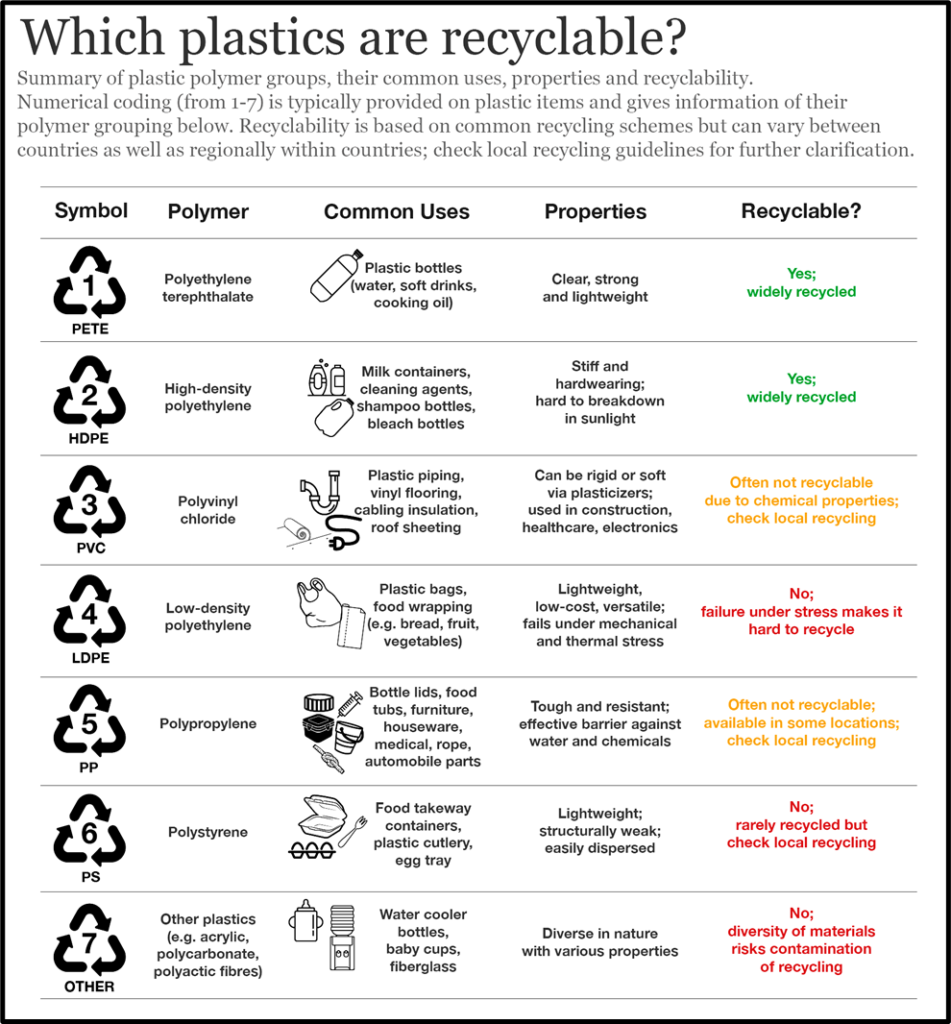
Major Plastics in Use
Let us understand three very common types of plastics.
A. PET (Polyethylene Terephthalate)
- Chemical name: Polyester
- Clear, strong, lightweight plastic
- Used for: soft drink bottles, water bottles, oils, juices
- Completely recyclable
- Identified by the #1 recycling code
B. Polyethylene (PE / Polythene)
- Most widely used plastic
- Produced from ethylene (C₂H₄)
- Used for: carry bags, films, bottles, containers
- Properties: low strength but high ductility and impact resistance
- Not biodegradable (but certain bacteria can degrade it)
C. Polystyrene (PS)
- Made from monomer styrene
- Clear, hard plastic used for:
- Food packaging
- Laboratory ware
- Appliances
- Electronics
- Toys
- Gardening pots
Effects of Plastic Waste
Now let us look at the real consequences.
A. Impact on Health and Life
- Chemicals used in plastics are often carcinogenic.
- Many plastics disrupt the endocrine system → leading to reproductive, developmental, neurological issues.
- Dioxin, a toxic by-product, can be passed through breast milk.
- Burning plastics releases Polycyclic Aromatic Hydrocarbons (PAHs) → cause cancers, respiratory illness.
- Animals ingest plastic thinking it is food and die of starvation or choking.
- Microplastics disturb soil quality, water purity, and ecosystem nutrient flows.
- Toxic chemicals travel through the food chain, ultimately affecting humans.
B. Impact on the Environment
Plastic impacts the environment at every stage—from production to disposal.
During Production
Releases harmful chemicals like:
- Sulfur oxides
- Nitrous oxides
- Methanol
- Ethylene oxide
- VOCs (volatile organic compounds)
Burning PVC releases dioxins and furans—both highly toxic.
Dioxins
Known as part of the “dirty dozen” persistent organic pollutants (POPs).
They include:
- Polychlorinated dibenzo-p-dioxins (PCDDs)
- Polychlorinated dibenzofurans (PCDFs)
Extremely toxic, persistent, and bioaccumulative.
Vinyl Chloride
- A colourless gas used to produce PVC.
- PVC itself is not carcinogenic, but vinyl chloride is.
- Found near factories, in tobacco smoke, and during plastic combustion.
- Linked to cancers of the liver, brain, lungs, and blood (leukaemia).
Chemical Leaching into Food
Different plastics leach harmful substances:
- Polycarbonate → Bisphenol A (BPA)
- Polystyrene → Styrene
- PVC → Vinyl chloride
These chemicals are associated with:
→ Infertility
→ Obesity
→ heart disease
→ Diabetes
→ Cancer
Environmental Dysfunction
- Plastic bags choke drains → urban flooding
- Plastic blocks soil pores → reduces groundwater recharge
- Microplastics alter soil microbes → weakens soil fertility
Plastic Waste Management Rules (PWMR)
When we study India’s environmental regulations, the Plastic Waste Management (PWM) Rules form a central pillar—because they try to address not just the waste after we generate it, but also the responsibility of those who create and profit from plastic.
Let’s understand the evolution of these rules:
Plastic Waste Management Rules, 2016
Think of the 2016 rules as India’s baseline framework for plastic management.
These rules introduced several transformative ideas:
(A) Responsibility on Plastic Waste Generators
Anyone who generates plastic waste—households, institutions, markets—must:
- Reduce generation of plastic waste
- Avoid littering
- Segregate waste at the source
- Hand over segregated waste to authorised collectors
This shifts us from “government will manage waste” to “everyone is responsible.”
(B) Extended Producer Responsibility (EPR)
This is the heart of the 2016 Rules.
Producers, Importers, and Brand Owners (PIBOs) must take responsibility for managing both:
→ Pre-consumer waste (e.g., scrap generated during manufacturing)
→ Post-consumer waste (waste generated after the product is used)
The logic is simple:
If you profit from plastic, you must manage its waste.
(C) Increase in Thickness of Plastic Bags and Sheets
- Carry bags: 40 → 50 microns
- Plastic sheets: Minimum 50 microns
Why?
Thicker plastic is less likely to become litter and more recyclable.
(D) Applicability Expanded to Rural Areas
Earlier, the rules were mostly urban-centric.
Now the jurisdiction covers:
- Rural areas as well, with Gram Panchayats made responsible for implementation.
This is crucial because plastic consumption in rural India has risen sharply.
(E) Segregation at Source
Large and small generators must segregate waste into:
→ Wet
→ Dry
→ Hazardous
This enables efficient recycling and prevents mixing.
Plastic Waste Management Amendment Rules, 2018
By 2018, a major concern emerged: Multi-Layered Plastics (MLP)—chips packets, biscuit wrappers, etc.
(A) Phasing Out of Problematic MLP
MLP must be phased out only if it is:
→ non-recyclable
→ non-energy recoverable
→ Has no alternate use
This refined definition avoided confusion and ensured realistic implementation.
(B) Centralised Registration System
The CPCB must create a single national portal for registering:
→ Producers
→ Importers
→ Brand owners
This prevents duplication, leakages, and fake registrations across states.
(C) Streamlining EPR
The aim was to simplify how PIBOs register and comply, making EPR enforcement smoother.
Plastic Waste Management Amendment Rules, 2021
This amendment is famous for one major step: banning certain single-use plastics (SUPs).
(A) Ban on Identified Single-Use Plastics
By 1st July 2022, the following were prohibited: Manufacture, Import, Stocking, Distribution, Sale, Use
Items included:
Polystyrene and Expanded Polystyrene products + other low-utility, high-litter items.
(B) Strengthening EPR for Plastic Packaging
Plastic packaging waste (not part of the SUP ban) must be:
→ Collected
→ Recycled
→ Managed sustainably
This is legally enforceable.
(C) Increase in Thickness of Plastic Carry Bags
To discourage litter and encourage reuse:
- 50 → 75 microns (from 30 Sept 2021)
- 75 → 120 microns (from 31 Dec 2022)
Thicker = costlier = less usage + more recyclability.
Plastic Waste Management (Amendment) Rules, 2022
Here, India introduced EPR Guidelines for the first time.
(A) Mandatory EPR Targets
PIBOs must meet targets for:
→ Recycling
→ Reuse of rigid plastics
→ Use of recycled plastic content
India is slowly building a circular economy around plastics.
(B) Environmental Compensation
If a producer fails to meet EPR targets:
→ They must pay environmental compensation
→ Based on the polluter pays principle
This ensures accountability regardless of intent.
(C) Strengthening the Circular Economy
The guidelines create a market-like system for:
→ Plastic credits
→ Recycled content certification
→ Reuse models
Plastic Waste Management (Amendment) Rules, 2024
This amendment focuses on definitions, clarity, and expanding the scope of regulated entities.
(A) Biodegradable Plastics Redefined
Biodegradable plastics must:
→ Degrade through biological processes
→ In specific environments like soil and landfills
→ Not leave microplastics behind
This stops companies from misusing the “biodegradable” label.
(B) Microplastics Defined
Microplastics = Solid, water-insoluble plastic particles of size:
1 micron → 1,000 microns
These have become a major pollutant in rivers, oceans, and even human bodies.
(C) Microplastics Testing
The rules acknowledge that:
- No specific chemical test has been prescribed yet
- No threshold level of microplastic elimination has been defined
This indicates that testing standards are still evolving.
(D) Expanded Definition of “Importer”
Now includes imports of:
→ Packaging
→ Carry bags
→ Sheets
→ Raw materials
→ Intermediate materials
Earlier, it covered only finished plastic packaging products.
(E) Inclusive Definition of “Manufacturer”
Now covers:
→ Producers of plastic raw materials
→ Compostable plastics
→ Biodegradable plastics
This reflects the diversified nature of the plastic manufacturing ecosystem.
(F) Extended Scope of “Producer”
Producers now include those involved in:
→ Manufacturing intermediate materials used in packaging
→ Contract manufacturing for brand owners
This plugs earlier loopholes.
(G) Certification Requirement
Manufacturers of:
→ Compostable plastic products
→ Biodegradable plastic products
…must obtain a CPCB certificate before marketing or selling.
This ensures transparency and prevents greenwashing.
Conclusion
Across these amendments—from 2016 to 2024—we see a clear progression:
- 2016 → Basic framework + EPR introduced
- 2018 → Focus on MLP and central registration
- 2021 → Crackdown on single-use plastics
- 2022 → EPR targets + environmental compensation
- 2024 → Scientific clarity + expanded definitions + certification
Together, these rules push India toward a circular, accountable, and environmentally responsible plastic economy.
NITI Aayog Report: “Alternative Products and Technologies to Plastics”
This report in 2022 pushes a systematic approach to reduce dependency on plastics.
Major Findings
- India produces 3.47 million tonnes of plastic waste annually.
- Per capita waste increased from 700 g → 2,500 g in 5 years.
Highest per capita plastic waste: Goa, Delhi, Kerala
Lowest per capita: Nagaland, Sikkim, Tripura
India collects only 60% of its plastic waste.
40% remains in the environment.
Globally:
- 97–99% of plastics come from fossil fuels
- Only a small fraction comes from bio-based plastics
Key Recommendations
- Strengthen EPR
Ensure proper labelling and tracking of compostable/biodegradable plastics. - Develop Biodegradable Additives
For polyolefins like: Polypropylene and Polyethylene - Use Bio-Plastics
Made from Vegetable oils, starches and other organic resources - Increase Transparency
Companies must disclose:
→ Waste generated
→ Waste collected
→ Waste recycled
This reduces greenwashing.
Alternatives to Plastics
These materials offer safer, sustainable replacements:
A. Glass: Ideal for food and liquid storage; durable and recyclable.
B. Bagasse: Made from sugarcane pulp; fully compostable.
C. Bioplastics: Plant-based; suitable for packaging.
D. Natural Textiles: Cotton, wool, hemp.
E. Edible Seaweed Cups: Seaweed grows extremely fast; can replace cups and packaging.
F. Algae-blended EVA: Turns pollutants like ammonia and phosphates into usable plant biomass.
G. Compostable Plastics: Break down into CO₂, water, inorganic compounds and biomass without toxic residue. Example: BASF’s Ecoflex
Plastic Waste in Road Construction
A remarkable Indian innovation:
Polyblend
- Fine powder of recycled plastic can be mixed with bitumen
- Enhances:
- Water repellence
- Road durability (life increases threefold)
India has already built thousands of kilometres of plastic roads.
Global Initiatives Against Plastic Pollution
A. Global Partnership on Plastic Pollution and Marine Litter (GPML)
- Launched at Rio+20 (2012)
- Based on Manila Declaration
- Focus: prevent marine pollution from land-based activities
B. GloLitter Partnerships Project
- Partnership between Norway, IMO, and FAO
- Helps developing nations reduce marine litter
C. MARPOL Convention
- Global treaty by IMO
- Prevents pollution from ships: oil, sewage, garbage, NOx, SOx
D. Plastics Pact
- Brings together governments, businesses, NGOs
- Goal: reduce → reuse → recycle plastics
- India is the first Asian country to launch a Plastics Pact.
E. Un-Plastic Collective
- Voluntary initiative co-founded by:
- UNEP
- CII
- WWF-India
- Encourages businesses to reduce plastic footprint