
Principles of Ecology
Ecology isn’t static — ecosystems evolve and change continuously.
Certain scientific principles govern this evolution — how life adapts, varies, evolves, and sometimes goes extinct.
Let’s explore these one by one.
🦎 Adaptation
— “The Art of Survival”
In nature, every organism faces challenges — heat, cold, salinity, lack of water, predators, etc.
To survive, it develops certain features or behaviors that help it live comfortably in its environment.
That’s called Adaptation — any structural, physiological, or behavioral change that helps an organism survive better.
Types of Adaptations:
(a) Morphological Adaptation
→ Change in body structure or external appearance.
Examples:
- In deserts, plants have:
- Thick cuticles → reduce water loss.
- Sunken stomata → minimize transpiration.
- No leaves (as in Opuntia cactus); instead, leaves become spines and stem becomes green and flat to do photosynthesis.
- Mammals in cold regions have shorter ears and limbs → minimize heat loss (Allen’s Rule).
Conversely, elephants have large ears to lose heat, since they can’t sweat. - Hyperthermophiles (like Archaebacteria) thrive in 60°C+ — in hot springs or deep-sea vents.
👉 Nature designs the body according to the environment — not the other way around!
(b) Physiological Adaptation
→ Change in internal functioning of the body.
Example:
- In the deserts of North America, Kangaroo rats survive without drinking water.
- They produce metabolic water (from fat oxidation).
- They concentrate urine so that very little water is wasted.
- When humans go to high altitudes, we start breathing faster due to low oxygen.
Over time, our body acclimatises — produces more RBCs, adjusts hemoglobin, and increases breathing rate.
This short-term physiological adjustment is called Acclimatisation.
(c) Behavioural Adaptation
→ Change in habits or actions to deal with the environment.
Example:
- Desert lizards cannot control body temperature internally like mammals.
They bask in sunlight to warm up and hide in shade to cool down. - Some animals migrate or burrow underground during extreme heat or cold.
🪴 Special Case — Halophytes
Now, some plants grow where others can’t — in salty coastal areas or mangroves.
Such plants are called Halophytes — they show extraordinary adaptations to survive high salinity.
⚙️ Adaptations in Halophytes (Example: Rhizophora, Avicennia)
- Special Root Systems:
- Prop roots → come down from branches (for support & respiration).
- Stilt roots → arise from stem base near soil.
- Pneumatophores (air roots) → grow upward from mud for breathing.
- Vivipary (unique reproduction):
- Seeds germinate on the parent tree itself before falling, avoiding saline soil.
- Salt Management:
- Cellular sequestration: Salts stored in vacuoles or cell walls.
- Tissue partitioning: Salts concentrated in older leaves which later drop.
- Root exclusion: Roots prevent salt entry.
- Salt excretion: Glands on leaves remove salt actively.
- Altered Flowering:
- Flowering during rainy season to reduce salt stress.
👉 These are the “superheroes” of the plant world 😊— they turn adversity into strength!
🧬 Variation — The Basis of Evolution
No two individuals, even within a species, are exactly the same.
These differences — in color, height, resistance, or traits — are called Variations.
Sources of Variation:
- Genetic changes — addition/deletion of genes.
- Mutations — random changes in DNA.
- Environmental factors — climate, geography, etc.
👉 Example: Differences in skin color, hair type, or blood group among humans — all show variation within species.
Why is variation important?
Because it gives options for survival — if the environment changes, some variants might adapt better.
Adaptive Radiation
— “One Ancestor, Many Forms”
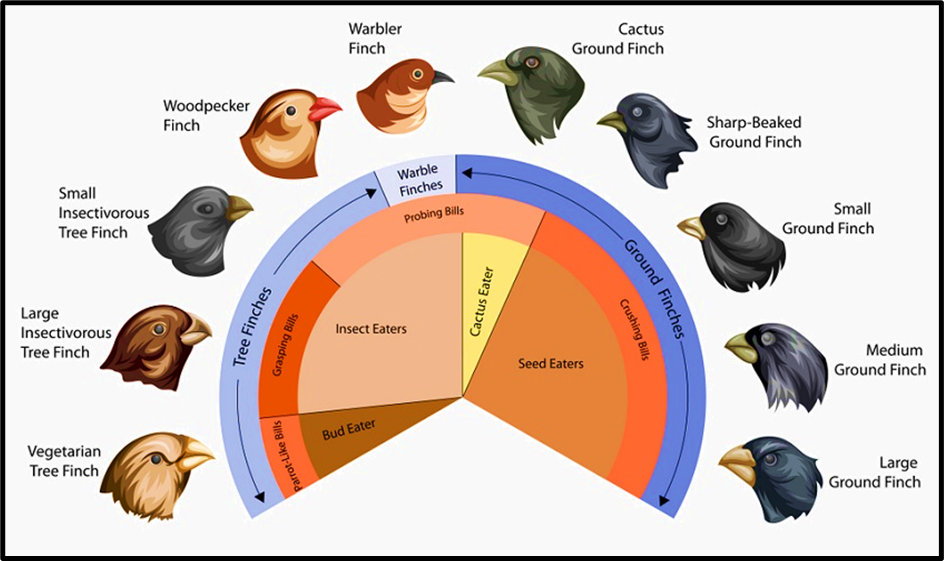
Imagine one ancestral species entering a new environment with many “empty niches” (unoccupied roles).
Different groups adapt to fill different roles → leading to diversification.
That’s Adaptive Radiation — when one ancestral species evolves into many new species to exploit new habitats or resources.
Example:
Darwin’s finches on Galápagos Islands — all descended from one ancestor but developed different beak shapes based on their feeding habits (seeds, insects, flowers, etc.).
👉 It’s evolution “branching out” to fill new opportunities.
🐅 Speciation — Formation of New Species
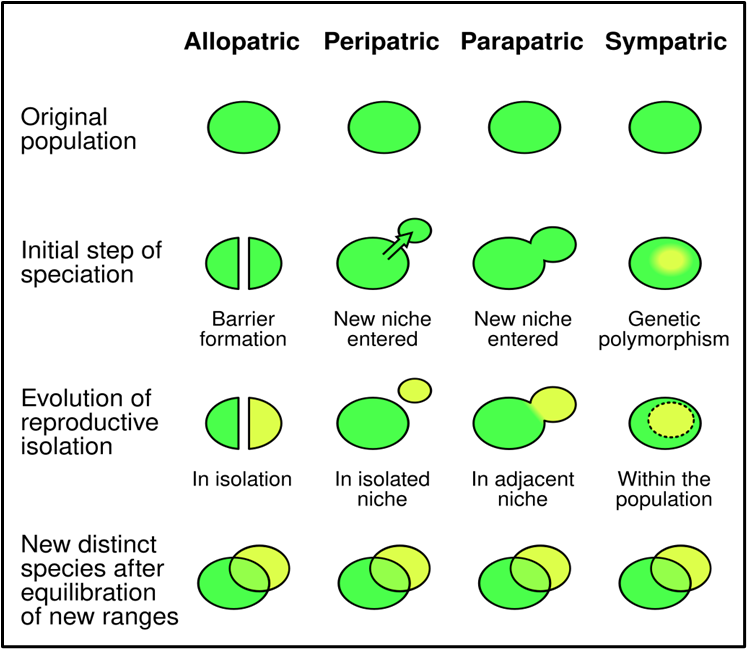
Speciation = the process by which new species evolve from existing ones.
It’s driven by evolutionary forces like mutation, natural selection, and isolation.
Let’s understand the types 👇
Allopatric Speciation (Geographic Speciation)
- Populations of a species become geographically isolated (mountains, rivers, oceans).
- Over time, due to genetic drift and different environmental pressures, they evolve separately.
- Even if the barrier is later removed, they can no longer interbreed.
Example:
Masai giraffes are separated by the Gregory Rift (Tanzania–Kenya) — they’ve remained isolated and genetically distinct for 1000+ years.
Peripatric Speciation
- Peripatric speciation occurs when a small population becomes isolated at the edge (or periphery) of a larger population’s geographic range.
- Mechanism: small peripheral population becomes isolated from the main group and, due to genetic drift and strong natural selection in its new environment, rapidly evolves into a new species.
Parapatric Speciation
- Populations are partially separated — limited gene flow.
- Over time, genetic differences accumulate → forming distinct species.
- Example: populations living along a mountain slope where altitude gradually changes.
Sympatric Speciation
- Occurs without physical barriers — within the same area.
- Happens due to disruptive selection — different groups specialize in different ecological niches, food, or mating preferences.
- Gradually, reproductive isolation develops → new species form.
Example:
Insects feeding on different host plants in the same area may evolve into separate species.
Hybridization
- When two different species mate, they produce hybrids.
Example: Horse × Donkey = Mule. - Sometimes, hybrids themselves become a new species (if they can reproduce and adapt).
In Summary
| Type | Isolation Type | Population Size | Example | Key Process |
|---|---|---|---|---|
| Allopatric | Large-scale geographical barrier | Large | Masai giraffes separated by Rift Valley | Geographic isolation |
| Peripatric | Small peripheral population at edge | Small | Island finches, subway mosquitoes | Founder effect + drift |
| Parapatric | Partial isolation across gradient | Moderate | Mountain slope populations | Limited gene flow |
| Sympatric | No physical isolation | Large, same area | Insects feeding on different host plants | Niche specialization |
| Hybridization | Cross between two species | — | Horse × Donkey → Mule | Hybrid speciation |
🧬 Mutation and Recombination
Mutation:
A change in the DNA sequence — like a spelling error in the genetic code.
It introduces new traits that may be beneficial or harmful.
Recombination:
During meiosis and fertilisation, genes get reshuffled → producing new combinations every generation.
This is why even siblings aren’t identical.
Together, mutation + recombination = genetic diversity, the raw material for natural selection to act upon.
🌿 Natural Selection
— “Nature’s Quality Control”
This is the central pillar of Darwin’s Theory of Evolution.
Charles Darwin and Alfred Wallace proposed that:
Nature “selects” the individuals best suited to the environment.
Let’s simplify 👇
- Every population has variations.
- Some variations help survival better (e.g., camouflage, drought resistance).
- These individuals survive longer, reproduce more, and pass on their beneficial genes.
- Over generations, such traits become common in the population.
This is Natural Selection — nature choosing the “fittest.”
👉 So, evolution is not about “strongest survives,” but “most adaptable survives.”
🧠 Evolution
— The Grand Process
Evolution is the long-term change in organisms over generations, driven by:
- Variation
- Adaptation
- Natural selection
- Speciation
Darwin and Wallace proposed this in 1859 (“Theory of Natural Selection”).
Later, genetics refined it — forming the Neo-Darwinism theory, combining Darwin’s ideas + Mendel’s genetics.
☠️ Extinction
— The Other Side of Evolution
If evolution is about emergence of species, extinction is about their disappearance.
Why does extinction happen?
- Environmental changes (climate shift, volcanic eruptions, etc.)
- Competition with other species
- Failure to adapt quickly
When a species can’t cope with changing conditions — it disappears forever.
🔺 Today, we are living through the 6th Mass Extinction — the Anthropogenic Extinction.
It’s human-induced — driven by deforestation, pollution, overexploitation, and climate change.
🌎 Summary Table
| Concept | Meaning | Example |
|---|---|---|
| Adaptation | Traits helping survival | Kangaroo rat, cactus |
| Variation | Differences within species | Skin color, blood type |
| Adaptive Radiation | One ancestor → many forms | Darwin’s finches |
| Speciation | Formation of new species | Masai giraffes (Allopatric) |
| Mutation | DNA change creating new genes | Sickle-cell mutation |
| Natural Selection | Nature favors best-suited traits | Camouflaged moths in industry |
| Evolution | Gradual change → new species | From reptiles → birds |
| Extinction | Permanent loss of species | Dodo, Woolly mammoth |