
Terrestrial Ecosystems or Biomes
First, understand the core idea —
The biosphere (the life-supporting zone of the Earth) can be divided into two broad parts:
- Terrestrial – land-based ecosystems
- Aquatic – water-based ecosystems
Now, the terrestrial portion is divided into large natural regions called Biomes.
Think of a biome as a “continent-scale ecosystem” — a massive natural zone where climate, vegetation, soil, and animal life show a particular pattern.
👉 No two biomes are alike — because each has a distinct climate, soil type, vegetation, and animal community.
So, if someone asks, “Why are there pine trees in Canada but not in Africa?” — the answer lies in their different biomes.
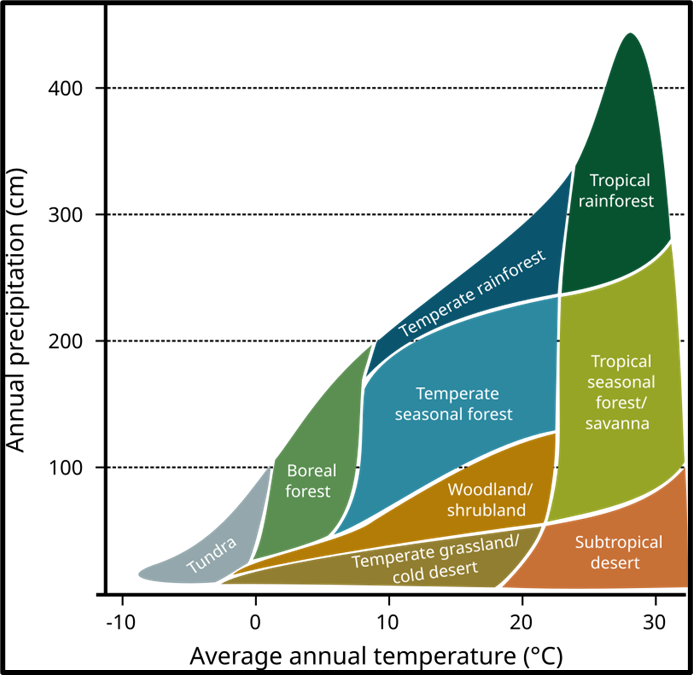
By Navarras – Own work, CC0, via Wikimedia Commons
🗺️ Major Terrestrial Biomes
Biomes are classified mainly on climate, especially temperature and precipitation.
Here are the major ones you should remember:
| Major Biome Type | Examples |
|---|---|
| Tundra | Arctic & Alpine Tundra |
| Forest | Taiga, Temperate Deciduous, Temperate Rainforest, Sub-tropical Deciduous, Mediterranean, Tropical Deciduous, Tropical Rainforest |
| Grassland | Steppe (Temperate Grassland), Savanna (Tropical Wet & Dry) |
| Desert | Tropical & Mid-latitude Deserts |
Now, let’s explore each biome — from the coldest to the warmest.
❄️ Tundra Biome
“Tundra” means treeless plain.
It’s found in the Arctic regions and on high mountain tops (Alpine Tundra).
📍Location:
- Arctic Tundra – Near the North Pole
- Alpine Tundra – Above the tree line in high mountains like the Himalayas, Andes, Alps
🧊 Key Feature: Permafrost
- The ground here remains permanently frozen (below 0°C for at least two consecutive years).
- Because of this, trees cannot grow — roots can’t penetrate frozen soil.
🌿 Vegetation:
- Only mosses, lichens, and small shrubs like Arctic willow survive.
- On coastal lowlands, you’ll find reindeer moss — food for reindeer.
🐻 Animal Life:
- Adapted to extreme cold — thick fur, small ears/tails to minimize heat loss.
- Examples: Reindeer, Arctic fox, Musk ox, Polar bear, Arctic hare.
- Insects have very short life cycles — active only during short summers.
- Reptiles and amphibians are absent — they can’t tolerate freezing.
🧬 Lifespan:
Some species like Arctic willow can live for 150–300 years — growth is slow, but survival is long.
Read More about Tundra Climate here
🌲 Taiga or Boreal Biome
As you move slightly south from the tundra, temperature rises just enough for trees to grow — but still harsh.
This gives us the Taiga, also known as the Boreal forest.
🌍 Location:
- Sub-Arctic regions — e.g., Canada, Russia, Scandinavia.
🌿 Vegetation:
- Evergreen coniferous forests — pine, spruce, fir.
- Conifers have needle-like leaves and waxy coatings to prevent water loss.
🌱 Productivity:
- Lowest among all forests — because:
- Weather is too cold.
- Soils are thin and nutrient-poor, called Podzols.
- Decomposition is slow, so humus content is low and soil becomes acidic.
🧪 Podzols — Soil of Boreal Forests
Let’s understand this technically.
- Thin topsoil, over a sandy or loamy base.
- Leaching (downward movement of nutrients) is heavy → nutrients lost to lower layers.
- Soil is acidic (low pH) because basic elements are washed away.
- Hence, poor for agriculture — mostly used for grazing or forestry.
🦊 Animals:
- Siberian tiger, bear, wolf, lynx, red fox, wolverine.
- Amphibians like Rana and Hyla also exist but are few.
Read More About Taiga Climate here
🌳 Temperate Deciduous Biome (North-Western Europe – British Type)
Now, as we move to milder regions (moderate temperature + adequate rainfall) — we get deciduous forests.
🌿 Vegetation:
- Trees shed leaves in winter to protect from frost — this is an adaptation.
- Species: Oak, Elm, Ash, Beech, Birch, Poplar.
- Shedding begins in autumn, regrowth starts in spring.
🌱 Soil:
- Podzolic but deeper than taiga — more fertile due to faster decomposition.
🌧️ Temperate Rainforest Biome
📍 Location:
- Found in small patches — mainly along the northwestern coast of North America (from Northern California to Southern Alaska).
- Also in Southern Chile, New Zealand, Australia.
🌿 Vegetation:
- Large conifers: Douglas fir, Western red cedar, Sitka spruce, Mountain hemlock.
- Mosses and lichens are abundant, often growing as epiphytes (plants growing harmlessly on other plants).
🌴 Sub-Tropical Deciduous Biome (Eastern China, SE USA)
- Climate supports luxuriant vegetation — both evergreen broad-leaved and deciduous trees.
- On highlands, pines and cypresses dominate.
- Growth is perennial (year-round) since there’s no extreme dry or cold season.
🌾 Steppe or Temperate Grassland Biome
📍 Location:
- Interiors of continents — e.g., Eurasian steppes, North American prairies.
🌿 Features:
- Treeless plains dominated by short, nutritious grasses.
- As rainfall increases northward, wooded steppes emerge.
- Animal diversity is limited but includes grazing herbivores.
Read more about Steppe Climate here
🌿 Temperate Deciduous Biome (Mediterranean Climate)
☀️ Climate:
- Hot, dry summers and mild, wet winters.
- Plants must tolerate drought, heat, and fire.
🌿 Vegetation:
- Xerophytic (drought-tolerant) plants.
- Small, broad leaves; short, widely spaced trees (often evergreen oaks).
- Fire-resistant species — regenerate quickly after burns.
Read More about Mediterranean Climate here.
🌳 Tropical Deciduous Biome (Monsoon Climate)
📍 Location:
- India, parts of Africa, Southeast Asia.
🌿 Vegetation:
- Also called Dry Deciduous or Drought-Deciduous Forests.
- Dominant species: Teak, Sal, Neem, Bamboo, Shisham, Sandalwood, Khair, Mulberry.
- Trees shed leaves in dry season to conserve water.
Read more about this climate here.
🐘 Savanna or Tropical Wet and Dry Biome
🌍 Location:
- Found between tropical rainforests and deserts — e.g., Africa, Brazil, India (some parts).
🌿 Features:
- Tall grasses with scattered trees like Acacia.
- Trees are deciduous and umbrella-shaped — to reduce transpiration and withstand wind.
- Some trees have thick trunks that store water.
🦓 Fauna:
- Extremely rich in wildlife — lions, elephants, giraffes, zebras, antelopes, birds, reptiles.
Read more about this here.
🔥 Managed Fires and the Savanna
Interestingly, fire is not always destructive here.
- Controlled burning rejuvenates grasslands — promotes fresh, nutritious regrowth.
- Helps control ticks and thorny shrubs.
- Ecologically, such fires are carbon-neutral —
the CO₂ released during burning is reabsorbed by new grass in the next growth cycle.
🌴 Tropical Rainforest Biome — The Lungs of the Earth
Let’s begin with an image in your mind:
Imagine standing in a forest so dense that sunlight struggles to touch the ground. It’s hot, humid, and alive — filled with insects, birds, animals, and the sound of constant rain.
That’s your Tropical Rainforest Biome — the most productive and biodiverse ecosystem on Earth.
🌦️ Climate and Vegetation
- These forests grow in regions where temperature is high throughout the year (around 25–27°C) and rainfall is abundant (200–400 cm annually).
- Because of this warm and wet climate, trees remain evergreen — they never shed all leaves together.
- Common trees: Mahogany, Ebony, Dyewoods, and many other hardwood species.
- In brackish waters (mix of sea and river water), Mangrove forests thrive — they are crucial for coastal protection
🌿 Layered Vegetation — The Canopy System
Now, a fascinating feature:
Since sunlight is limited near the forest floor, all plants compete to reach it.
This creates a multi-layered structure:
- Emergent Layer – tallest trees rising above the rest.
- Canopy Layer – dense roof formed by the majority of trees; blocks sunlight.
- Understory Layer – smaller trees and shrubs growing in filtered light.
- Forest Floor – dark, damp, with little vegetation but rich in decomposing matter.
Among these, you’ll find epiphytes — plants like orchids or ferns that grow harmlessly on other trees to reach sunlight.
They don’t steal nutrients from the host; instead, they absorb moisture and minerals from air and rain.
This relationship is a form of commensalism — the epiphyte benefits while the host remains unaffected.
🌍 Significance of Tropical Rainforests
Let’s understand why these forests are literally the heartbeat of our planet:
🫁 Oxygen Factory
They produce about 20% of Earth’s oxygen, earning them the title “Lungs of the Earth.”
🌳 Carbon Sink
They absorb nearly 2 billion tonnes of CO₂ annually, helping to slow global warming.
☔ Rain Makers
Through evapotranspiration, they recycle 50–75% of their own rainfall.
So, the rainforest makes its own rain!
🏞️ Source of Rivers
The great rivers — Amazon, Congo, Mekong — all originate from these forests.
🧬 Biodiversity Hotspot
Home to over 30 million species — half of the world’s wildlife and two-thirds of its plants.
☕ Commercial Importance
Ideal for crops like coffee, cocoa, palm oil, rubber — all need 100–200 cm rainfall.
👥 Indigenous Communities
Several tribal groups have lived here for millennia, practicing slash-and-burn (shifting) cultivation and using forest resources for food, shelter, and medicine.
🌦️ Rainforest and Climate Regulation
- These forests constantly exchange water and energy with the atmosphere, influencing local and regional climates.
- Moisture released by rivers into oceans helps regulate ocean currents, which in turn affect global weather patterns.
🇧🇷 The Amazon Rainforest — A Global Treasure
🌊 The Amazon Basin:
- Produces 20% of the world’s fresh water that flows into oceans.
- Returns 75% of moisture to the moving air masses — thus, most of South America (except Chile, blocked by the Andes) gets rainfall because of the Amazon!
🔥 Threats to the Amazon Rainforest
Let’s now understand the crisis part of the story — how humans and climate change are pushing this vital ecosystem towards collapse.
(a) Frequent Fires and Droughts
- Normally, rainforests are too moist to catch fire.
- But mega-droughts (linked to El Niño and Atlantic Ocean warming) have made the forest fire-prone.
- These fires dry out the forest, destroy the canopy, and make the ecosystem vulnerable.
(b) Slash and Burn Agriculture
- Farmers cut vegetation, let it dry, and burn it to clear land for farming.
- This process repeats for years — each time reducing forest fertility.
(c) Political and Economic Factors
- In Brazil, policies under Jair Bolsonaro weakened forest protection agencies.
- Illegal land grabbers burn forests for timber, cattle ranching, palm oil, and soybean cultivation.
🌎 Global Consequences of Amazon Fires
(a) Carbon Sink to Carbon Source
- The Amazon usually absorbs 2 billion tonnes of CO₂ annually.
- Due to fires, it now releases CO₂, worsening global warming.
(b) Prolonged Droughts
- Fewer trees → less evapotranspiration → fewer clouds → longer dry seasons.
A deadly cycle begins.
(c) Pollution
- Forest fires produce:
- 15% of global greenhouse gas (GHG) emissions
- 30% of carbon monoxide (CO)
- 10% of methane (CH₄)
- 85% of soot emissions
These further heats the planet, making forests drier and weaker.
(d) Transformation into Grasslands
- When fires and droughts persist, nutrient-poor soils cannot support trees.
- Gradually, the forest turns into tropical savanna — a lower-productivity ecosystem.
This point is critical — scientists warn that once a tipping point is reached, the forest will die back, losing its capacity to recover.
🔥 Fires: Destructive for Some, Essential for Others
Here’s an interesting contrast.
While tropical rainforests are fire-sensitive, many other ecosystems depend on fire for renewal:
- Taiga forests of Siberia and Canada
- African savannas
- Australian eucalyptus forests
- Californian coniferous forests
- Mediterranean scrublands
Here, periodic small fires:
- Clear dead vegetation
- Trigger germination of seeds
- Maintain open landscapes
Examples:
- Douglas fir survives due to thick bark.
- Lodgepole pine cones open only in fire’s heat.
- Australian grass tree seeds open with smoke.
So, controlled fires = natural rejuvenation,
but uncontrolled mega-fires = ecological collapse.
⚠️ Other Human Threats
🏭 Plantations and Resource Extraction
- Palm oil, coffee, cocoa, sugarcane, and rubber plantations have cleared nearly half of equatorial forests.
- Oil extraction in countries like Ecuador and Venezuela has caused massive destruction.
💀 Effects of Destroying Rainforests
(a) Soil Degradation
- Rainforest soil is poor in nutrients — most nutrients are stored in vegetation itself.
- Once trees are cut, nutrient cycling stops, and heavy rains wash away the topsoil.
(b) Droughts and Famine
- Less vegetation → less rainfall → prolonged droughts → food scarcity.
(c) Commercial Crop Failure
- Crops like coffee and cocoa depend on rainforest humidity — once the forest goes, even these crops will fail.
(d) Loss of Indigenous Communities
- Logging and oil companies often displace local tribes, bringing diseases and violence.
- Centuries-old cultures vanish with the forests.
🏜️ Desert Biome — The Land of Extremes
After lush rainforests, let’s move to the other extreme of nature — the Desert Biome.
It’s the exact opposite of the rainforest — little water, sparse vegetation, and extreme temperatures.
🌡️ Climate
- Rainfall: less than 25 cm per year
- Temperature: can be extremely hot during the day and cold at night due to absence of clouds.
🌵 Vegetation
The vegetation is xerophytic — meaning drought-resistant.
Plants are adapted to save water and survive heat.
🌿 Characteristics:
- Cacti, thorny bushes, dwarf acacias, and wiry grasses dominate.
- Seeds have thick coverings — they remain dormant until rain arrives.
- Roots are long and spread widely — to absorb every drop of moisture.
- Leaves are reduced to spines or are waxy, hairy, or needle-like — reducing transpiration (water loss).
- Plants are widely spaced — to reduce competition for water.
🦎 Fauna and Adaptations
- Animals are nocturnal — active at night to escape heat.
- Many get water from metabolic processes or food.
- Common examples: camels, jerboas, snakes, lizards, scorpions.
Summary Table
| Biome | Climate (Temp & Rainfall) | Soil | Vegetation (Flora) | Fauna | Key Features |
|---|---|---|---|---|---|
| Tundra | Very cold, dry; <25 cm rain | Permafrost | Mosses, lichens, dwarf shrubs | Reindeer, Arctic fox, polar bear | Treeless plain; short summer; low biodiversity |
| Taiga (Boreal) | Cold, sub-Arctic; moderate rain | Podzols (acidic, poor) | Conifers – pine, spruce, fir | Bear, wolf, lynx, tiger | Evergreen forest; slow decomposition; poor soils |
| Temperate Deciduous | Moderate temp & rainfall | Podzolic, fertile | Broad-leaved trees – oak, beech, elm | Deer, fox, birds | Trees shed leaves in winter; rich humus |
| Temperate Rainforest | Cool, very wet | Moist deep soil | Tall conifers, mosses, lichens (epiphytes) | Elk, black bear | Small global extent; lush evergreen forest |
| Sub-Tropical Deciduous | Warm, humid year-round | Fertile | Mixed evergreen & deciduous; pines, cypress | Diverse species | No distinct dry/cold season; luxuriant growth |
| Steppe (Temperate Grassland) | Semi-arid; 25–75 cm rain | Chernozem, rich humus | Short nutritious grasses | Bison, antelope | Treeless plains; grazing lands; continental interiors |
| Mediterranean | Hot dry summers, mild wet winters | Thin, rocky | Xerophytes, olive, evergreen oak | Goat, sheep | Fire-prone; drought-tolerant shrubs |
| Tropical Deciduous (Monsoon) | Hot summers, distinct wet/dry | Red/black soils | Teak, sal, neem, bamboo | Elephant, tiger, deer | Trees shed in dry season; most widespread in India |
| Savanna (Tropical Wet & Dry) | Wet & dry seasons; 75–125 cm rain | Lateritic | Tall grasses, acacia, baobab | Lion, zebra, giraffe | Grassland with scattered trees; fire-tolerant; rich wildlife |
| Tropical Rainforest | Hot, humid; 200–400 cm rain | Lateritic, leached | Dense evergreen; mahogany, ebony; layered canopy | Insects, monkeys, jaguar | Highest biodiversity; “Lungs of Earth”; carbon sink |
| Desert | <25 cm rain; extreme temps | Sandy, saline | Cacti, thorny bushes, acacia | Camel, lizard, snake | Xerophytic plants; nocturnal animals; water scarcity |