
Tungsten
Let us begin with a very basic but crucial understanding—Tungsten, also called Wolfram, is a metal. But this is not your ordinary metal. In the family of elements, Tungsten stands out like a unique character—dense, tough, yet brittle.
Appearance & Physical Nature
- Tungsten has a greyish-white to steel-grey appearance—shiny, but not flashy.
- It is extremely dense, almost as dense as uranium and gold.
- This means if you hold a block of tungsten in one hand and a block of lead in the other (same size), tungsten will feel much heavier.
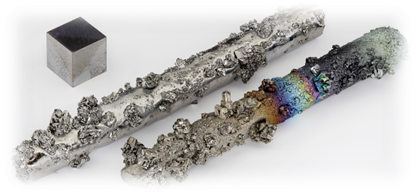
But despite this heaviness, Tungsten is inherently brittle. This means if you try to hammer or bend it—it doesn’t cooperate easily. It may even crack. So, it’s not the kind of metal you can shape around casually.
Melting & Boiling Points: Tungsten Breaks Records
If there were a “Heat Resistance Championship” among metals, Tungsten would be a gold medalist! 😊
- It has the highest melting point among all metals: about 3422°C.
- Its boiling point is also extraordinarily high—around 5930°C.
In simple words: Tungsten doesn’t melt or evaporate easily, which makes it an ideal candidate for high-temperature environments.
Major Ores of Tungsten
Just like we get sugar from sugarcane, metals are extracted from ores—and for tungsten, the most important ones are:
These ores are mined and then processed to extract tungsten.
How is Tungsten Formed? (Geological Processes)
Let’s now explore how nature creates tungsten deposits. There are three major geological processes behind it:
1. Magmatic-Hydrothermal Processes
- Think of granitic intrusions—where molten magma cools and solidifies underground.
- During this cooling, certain fluids rich in tungsten seep into surrounding rocks and form tungsten-rich veins.
- If these fluids interact with carbonate rocks, they form skarn deposits—which are also rich in tungsten.
2. Sedimentary and Metamorphic Processes
- Over long periods, sedimentary layers like black shales and phosphorites can accumulate traces of tungsten.
- Later, metamorphism (due to heat and pressure) can transform these into tungsten-bearing metamorphic rocks.
3. Weathering Processes
- In regions where tungsten-bearing rocks are exposed to air, water, and climate, weathering breaks them down.
- The heavier particles, including tungsten minerals, accumulate in river beds, forming placer deposits.
Applications of Tungsten: Where Do We Use It?
Now that we’ve understood its origin, let’s see why Tungsten is so important industrially.
1. Alloy Formation
- Tungsten is like a strong team player. It alloys easily with metals like chromium, nickel, molybdenum, titanium.
- The resulting alloys are:
- Hard
- Resistant to heat
- Corrosion-resistant (even against acids)
This makes them ideal for cutting tools, heat shields, and military applications.
2. High-Temperature Applications
- Due to its high melting point, tungsten is used in:
- Incandescent bulb filaments
- X-ray tubes
- Gas tungsten arc welding (electrodes)
3. Steel Reinforcement
- Adding tungsten to steel improves its hardness, toughness, and tensile strength.
- It also imparts a self-hardening property, which means the steel hardens as it cools—perfect for making cutting tools and wear-resistant equipment.
4. Tungsten Carbide: The Industrial Star
- When tungsten is combined with carbon and heated to around 2200°C, it forms Tungsten Carbide.
- This compound is incredibly hard and durable.
- It is used in:
- Metalworking tools
- Mining equipment
- Petroleum drilling
Basically, wherever you need something that won’t break or wear out easily—Tungsten Carbide is the go-to material.
5. Thermo-emission Applications
- Tungsten is also prized in electronics and physics because it has:
- High electron emissivity (it can release electrons easily when heated)
- Exceptional thermal and chemical stability
This makes it ideal for use in cathodes, emitters, and radiation shielding devices.
Distribution of Tungsten: India and the World
Now that we understand what tungsten is, how it’s formed, and what it’s used for, the natural next question is:
“Where is tungsten actually found?”
Let’s start with India, then we’ll look at the global picture.
🇮🇳 Tungsten in India: A Glimpse of Our Reserves
✅ Major Deposits
India doesn’t have vast reserves like China, but we do have some significant occurrences. The main type of ore we find in India is Wolframite, and it is usually associated with quartz veins.
Key Locations:
- Degana – Rajasthan
- Chendapathar – West Bengal
These two locations are considered the primary sites for tungsten ores in the country.
📊 Total Tungsten Resources in India (2020)
- Estimated to be around 89.43 million tonnes.
- However, actual production is almost negligible. In fact, during 2022–23, India did not produce any tungsten ore or concentrate.
Think about it: Despite having reserves, India is dependent on imports. This raises concerns for strategic mineral security, especially since tungsten is critical for defense and high-tech industries.
📌 State-Wise Tungsten Reserves in India (2020)
Let’s look at the state-wise distribution—very useful for both mains answers and map-based prelims questions.
| State | Share of India’s Tungsten Reserves | Notable Region |
|---|---|---|
| Karnataka | 41% | Kolar Gold Fields |
| Rajasthan | 27% | Degana (Nagaur district) |
| Andhra Pradesh | 17% | East Godavari district |
| Maharashtra | 11% | Sakoli Basin, near Nagpur |
| Others | Minor Reserves | Haryana, Tamil Nadu, Uttarakhand, West Bengal |
This distribution shows that while reserves are spread across several states, over 85% is concentrated in Karnataka, Rajasthan, and Andhra Pradesh.
🌍 Tungsten Across the World (2024)
Let’s now take a global perspective. Who controls the world’s tungsten?
🌐 World’s Tungsten Reserves (in million tons)
| Country | Reserves |
| China | 2400 |
| Russia | 400 |
| Australia | 570 |
| World Total | >4600 |
🌐 World’s Tungsten Production (in million tons)
| Country | Production |
| China | 67 |
| Vietnam | 3.4 |
| Russia | 2.0 |
| Total | 81 |
✍️ Note: China alone produces more than 70% of the world’s tungsten, making it the undisputed global leader in this strategic resource.
Critical Insights & Implications
- Tungsten is not just a commercial metal—it is strategically important, used in:
- Defense
- Aerospace
- Nuclear shielding
- Hard metal tools
- India’s lack of domestic production despite having reserves is a key concern.
- The dependency on China is similar to the situation we see with rare earths and lithium—raising the need for:
- Exploration
- Processing capacity building
- Strategic stockpiles