
Types of Trade Agreement
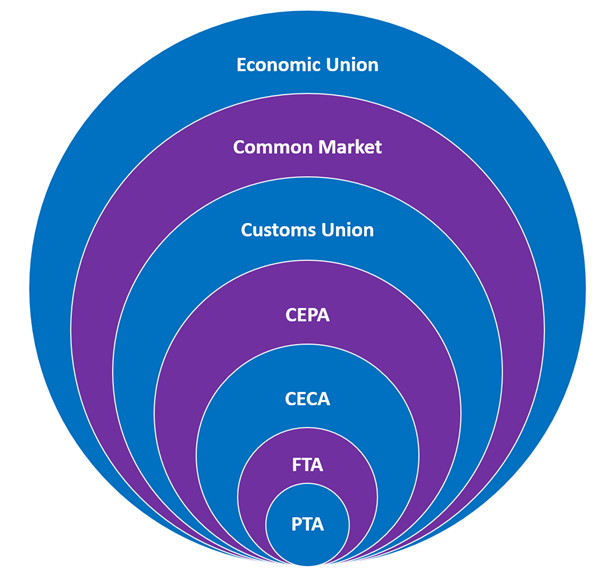
To understand Types of Trade Agreements, it is useful to see them as different levels of economic integration between countries. As countries cooperate economically, the depth of integration increases step-by-step—from limited tariff concessions to almost complete economic unification.
Let us examine these agreements in a logical progression from the least integrated to the most integrated form.
Preferential Trade Agreement (PTA)
A Preferential Trade Agreement (PTA) is the most basic and limited form of trade agreement between countries.
Core Idea
Countries agree to give preferential tariff treatment to certain selected goods or services.
This means:
- Tariffs are reduced but not completely eliminated.
- The concession is limited only to specific items.
Positive List Approach
PTAs follow a positive list approach.
This means:
- Only those products specifically mentioned in the agreement receive tariff benefits.
- Everything else continues to face normal tariffs.
So, the agreement explicitly lists what is included.
Example
India has a Preferential Trade Agreement with Afghanistan.
Key Characteristics
- Limited scope
- Tariff reduction on selected products
- Early stage of trade cooperation
Think of PTA as “testing the waters of trade cooperation.”
Free Trade Agreement (FTA)
A Free Trade Agreement (FTA) is a more advanced and comprehensive form of trade agreement.
Core Idea
Countries agree to eliminate or significantly reduce trade barriers between them.
These barriers include:
- Tariffs
- Import quotas
- Non-tariff barriers (such as regulations, standards, licensing requirements)
The aim is to allow goods and services to move more freely between the participating countries.
Negative List Approach
FTAs usually use a negative list approach.
This means:
- All products and services are included in free trade
- Except those specifically excluded
So instead of listing what is included, it lists what is excluded.
Example
India has signed several FTAs. One important example is the India–Sri Lanka Free Trade Agreement.
Key Characteristics
- Wider coverage than PTA
- Significant tariff elimination
- Trade liberalization for most goods and services
Thus, compared to PTA, an FTA represents deeper trade liberalization.
CECA/ CEPA
CECA → Comprehensive Economic Cooperation Agreement
CEPA → Comprehensive Economic Partnership Agreement
These agreements represent an even broader and deeper level of economic cooperation.
Core Idea
Unlike PTA or FTA, these agreements go beyond trade in goods and cover multiple dimensions of economic cooperation.
They include areas such as:
- Trade in goods
- Trade in services
- Investment
- Intellectual Property Rights (IPR)
- Customs cooperation
- Regulatory standards
- Trade facilitation
- Economic cooperation in various sectors
CECA vs CEPA
Both are similar, but:
- CEPA is generally considered more comprehensive than CECA.
- CEPA often includes deeper commitments in services, investment, and economic integration.
Examples
CECA
- India–Singapore CECA
- India–Malaysia CECA
CEPA
- India–South Korea CEPA
- India–Japan CEPA
Key Characteristics
- Trade + services + investment
- Broader economic integration
- Institutional cooperation mechanisms
Thus, CECA/CEPA represent multi-dimensional economic engagement between countries.
Customs Union
A Customs Union represents a higher level of economic integration.
Core Idea
Countries agree on two major things:
- Elimination of internal trade barriers
Trade among member countries becomes free. - Common External Tariff (CET)
All member countries impose the same tariff on imports from non-member countries.
This creates a unified external trade policy.
Why CET Matters
Without CET, countries could bypass tariffs by importing goods through the member with the lowest tariff and then moving them internally.
A common external tariff prevents such trade diversion.
Example
MERCOSUR (Southern Common Market) in South America is an example of a customs union.
Key Characteristics
- Free trade among members
- Common external tariff for outsiders
- Coordinated trade policy
Common Market
A Common Market represents deeper integration than a customs union.
Core Idea
In addition to free trade and a common external tariff, member countries allow the free movement of factors of production.
This includes → Goods, Services, Capital and Labour
Thus, businesses and workers can operate freely across borders within the member countries.
Additional Features
Common markets also require:
- Harmonization of regulations
- Standardization of policies
- Removal of administrative barriers
Example
The European Union (EU) is one of the most prominent examples of a Common Market.
Key Characteristics
- Free movement of goods
- Free movement of services
- Free movement of capital
- Free movement of labour
This creates a single integrated economic space.
Economic Union
An Economic Union represents the highest and deepest level of economic integration.
Core Idea
An Economic Union combines:
- Customs Union
- Common Market
- Coordinated economic policies
Member countries integrate their macroeconomic policies, including → Monetary policy, Fiscal policy, financial regulations and Economic planning
Many economic unions also adopt a common currency.
Example
The European Union (EU) represents an advanced stage of economic integration. Within it, the Eurozone countries share a common currency (Euro).
Key Characteristics
- Common market
- Common external tariff
- Policy coordination
- Often a shared currency
At this stage, national economies begin to function almost like a single economic system.
Evolution of Trade Agreements (Conceptual Ladder)
To visualize the progression:
| Level | Agreement Type | Key Feature |
|---|---|---|
| 1 | Preferential Trade Agreement (PTA) | Tariff reduction on selected items |
| 2 | Free Trade Agreement (FTA) | Removal of tariffs on most goods/services |
| 3 | CECA / CEPA | Trade + services + investment + cooperation |
| 4 | Customs Union | Free internal trade + common external tariff |
| 5 | Common Market | Free movement of goods, services, capital, labour |
| 6 | Economic Union | Integrated economic policies + possible common currency |
Conceptual Insight
The central idea behind all these agreements is economic integration.
As countries move from PTA → FTA → CECA/CEPA → Customs Union → Common Market → Economic Union, the degree of economic cooperation continuously deepens.
In other words:
Trade cooperation → Economic integration → Policy integration