
Urban Sprawl
Let’s begin by visualising a city. The core of the city is densely packed — lots of buildings, lots of people, high land value. Now imagine the city slowly expanding outward — like ink spreading on a blotting paper.
This outward expansion of a city — especially in a low-density manner, where buildings are spaced out, and the land used was earlier rural or undeveloped — is what we call Urban Sprawl.
📌 Definition:
Urban Sprawl refers to low-density residential and commercial development on undeveloped or rural land, typically at the outskirts of cities.
A common misconception is to treat Urbanisation and Urban Sprawl as the same. While they are related, Urban Sprawl specifically highlights unplanned, scattered, horizontal growth — as opposed to planned urban expansion.
For example, if Delhi expands with planned townships like Dwarka or Rohini, that’s urban expansion. But if people begin settling beyond Ghaziabad or Gurgaon in low-density, unregulated colonies, that’s urban sprawl.
Causes of Urban Sprawl: Why Does It Happen?
Let’s now understand what drives this phenomenon — a set of push and pull factors, largely rooted in economics, demography, policy, and lifestyle choices.
(i) Lower Land Rates
Land is cheaper in the periphery of cities. So, naturally, builders and individuals prefer these areas to buy large plots at a fraction of the price.
(ii) Improved Infrastructure
As governments expand roads, flyovers, electricity grids, and telecommunication networks, even distant areas become well-connected. This makes commuting easier, supporting dispersed settlement.
Think of metro rail expansion — people don’t mind living farther if they can reach the city center quickly.
(iii) Rise in Standard of Living
People now earn more. The middle class and especially the upper-middle class can afford personal vehicles and longer commutes, enabling them to settle in far-flung localities with better living conditions.
(iv) Lack of Urban Planning
When cities do not plan for growth proactively — with zonal regulations and public housing — people begin settling wherever they find space. This spontaneous and unregulated growth leads to sprawl.
(v) Lower House Tax Rates
Municipal taxes are often higher within city limits. People prefer outskirts where property taxes are lower, further incentivising migration to peri-urban areas.
(vi) Population Growth
With rising population, especially in urban centres, the core city becomes congested. New migrants or even old residents begin exploring less crowded zones.
(vii) Consumer Preferences
Today’s urban dweller, especially from higher income groups, demands → Bigger houses, More bedrooms, Personal lawns or balconies.
Such housing needs cannot be fulfilled in the city centre — hence the outward movement.
Effects of Urban Sprawl: The Cost We Pay
Urban sprawl is not just physical growth. It has deep economic, environmental, and social impacts. Let understand:
(i) Increase in Public Expenditure
As cities expand, governments must build new roads, water supply systems, sewage lines, etc. But these come at a cost — and the taxpayer pays for it.
(ii) Increased Traffic
With homes located farther from workplaces, personal vehicle uses increases, resulting in:
- Traffic congestion,
- Longer commute times.
(iii) Health Issues
Air pollution from vehicular emissions increases. Also, dependency on vehicles reduces physical activity, leading to → Obesity, Diabetes, Cardiovascular issues.
(iv) Environmental Issues
- Deforestation: Land cleared for housing and roads.
- Loss of biodiversity: Wildlife is displaced.
- Habitat fragmentation: Animal movement becomes restricted.
(v) Impact on Social Lives
In low-density suburbs, houses are far apart, and neighbours are not in close proximity. This reduces:
- Social interactions,
- Community bonding,
- And eventually social capital — the invisible glue that holds a society together.
Conclusion: Urban Sprawl – A Challenge of Our Times
In summary, urban sprawl is like a double-edged sword. While it offers comfort, space, and affordability, it comes with hidden costs — to our environment, public finances, health, and social cohesion.
As future policymakers, it is your responsibility to balance growth with planning — promoting sustainable urbanisation, not sprawl.
Patterns of Urban Sprawl: The Various Ways a City Can Spread
Now that we understand what urban sprawl is and why it happens, the next question is — how does it physically manifest on the ground?
Urban sprawl doesn’t follow a single formula. It takes different shapes and directions, influenced by land value, infrastructure, topography, and socio-economic dynamics.
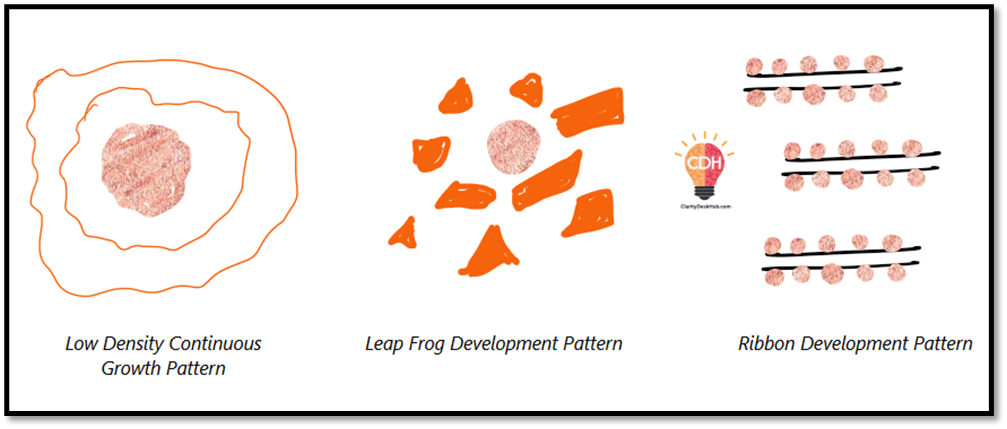
Let’s now study the three key patterns of urban sprawl, one by one.
1. Low-Density Continuous Growth Pattern
As the name suggests, this is unbroken, low-density expansion — the city slowly spreads in all directions, like ripples from a stone thrown into water.
📌 Key Features:
- Development happens continuously, not in patches.
- It typically surrounds the urban core.
- Also called horizontal growth — it occupies large areas of land, pushing the city’s boundaries outward.
📌 Effects:
- Waste of land resources: Productive agricultural land or forest land is lost to urban use.
- Increased development costs: The farther you build, the more it costs to lay roads, pipelines, electricity, and sewage systems.
- Higher travel time & energy use: Commuting from distant suburbs increases fuel consumption, traffic load, and time wastage.
2. Leapfrog Development Pattern
This one is a bit unusual — instead of spreading smoothly, the development “jumps over” certain land parcels.
📌 What happens here?
- Certain pockets of land are left undeveloped, while construction happens beyond them — forming a discontinuous, patchy growth pattern.
📌 Why does it occur?
- Land prices in inner regions may be too high.
- Certain areas may have poor law and order or unattractive living conditions.
- Distant areas may offer better living standards, affordability, or opportunity for social mobility.
📌 Effects:
- Unplanned and spontaneous growth — it’s not governed by master plans or zoning regulations.
- Creates incompatible land uses — for example, residential areas may spring up near factories or waste dumps, harming quality of life.
🧠 Example: You’ll often see this on the outskirts of Indian metro cities — pockets of vacant farmland surrounded by fancy townships and malls.
3. Ribbon Development Pattern
Now picture a road or a railway line, and imagine settlements coming up only along that line, like beads on a string — this is ribbon development.
📌 Key Characteristics:
- Follows linear infrastructure — roads, highways, railway tracks.
- Interstices (spaces between these built-up ribbons) remain undeveloped.
- It is often spontaneous and unregulated — driven by ease of access to transport.
📌 Effects:
- Good transport access for residents — proximity to main roads makes commuting easier.
- But also leads to:
- Traffic noise and congestion,
- Safety issues, especially for children,
- Stretching of services like electricity and water supply — becomes inefficient.
- Aesthetically, it creates a scattered and chaotic urban form.
📌 Important Note:
- Ribbon development is seen as the inverse of planned growth.
- It is an organic form of expansion — driven by market forces, not by planners.
✅ In Summary:
| Pattern | Key Feature | Major Effects |
|---|---|---|
| Low-Density Continuous Growth | Spreads uniformly in all directions | Land wastage, higher costs, energy consumption |
| Leapfrog Development | Skips over land parcels; discontinuous patches | Unplanned growth, mismatched land uses |
| Ribbon Development | Follows roads/rails; leaves spaces in-between | Good access but leads to noise, danger, visual chaos |
🔚 Final Thought
Each pattern of urban sprawl tells a story — not just about land, but about society, economics, planning, and lifestyle aspirations. Understanding these patterns helps you critically assess whether a city’s expansion is efficient, inclusive, and sustainable — or merely chaotic and costly.