
India and Indonesia Relations
Introduction: The Maritime Neighbour
Indonesia is India’s largest neighbour that most Indians never think of as a neighbour. At their closest point, India’s Andaman and Nicobar Islands lie roughly 90 nautical miles from Indonesia’s Aceh province — the two countries share a maritime boundary and sit astride the Strait of Malacca, through which the bulk of India’s eastward trade passes.
Indonesia is also the largest economy in ASEAN, the world’s largest Muslim-majority democracy, and the fourth most populous country on earth. That combination — proximity, scale and democratic character — makes it the natural anchor of India’s Act East Policy, and the two are increasingly described as maritime neighbours rather than distant partners.
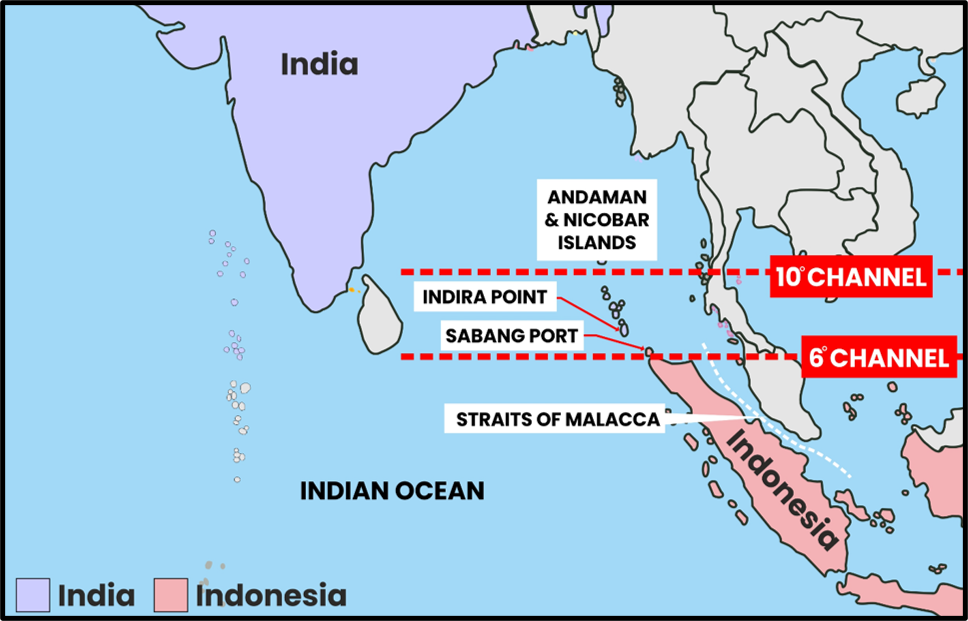
| The Key Drivers at a Glance Geography: a shared maritime boundary; the Andaman and Nicobar Islands sit at the mouth of the Malacca Strait. Scale: ASEAN’s largest economy and its most populous state — the pivot of any Act East strategy. Sea lanes: the Malacca, Sunda and Lombok straits, through which a large share of India’s trade and energy flows. Balance: a shared interest in a rules-based Indo-Pacific and in avoiding a China-dominated regional order. |
Historical Background
Contact is ancient. Indian traders, and later Hindu and Buddhist influences, shaped the Indonesian archipelago for centuries — visible today in the Prambanan and Borobudur temple complexes, in the Ramayana and Mahabharata traditions of Javanese and Balinese culture, and in the Sanskrit roots of the Indonesian language.
In the modern era, the two were founding partners of the post-colonial world. India supported Indonesian independence against Dutch rule, convening the Asian Relations Conference (1947) and the Conference on Indonesia (1949). Nehru and Sukarno were architects of the Bandung Conference (1955) and of the Non-Aligned Movement, and the two signed a Treaty of Friendship in 1951.
Ties cooled during the Cold War, as Indonesia under Sukarno drew closer to China and Pakistan, and later under Suharto aligned with the West while India leaned toward the Soviet Union. The relationship was rebuilt after 1991, when India’s Look East Policy and Indonesia’s post-Suharto democratic transition removed the old obstacles.
Evolution of the Partnership
| Year | Milestone |
| 1951 | Treaty of Friendship; Nehru–Sukarno partnership in the Bandung and NAM era |
| 1991 | India’s Look East Policy reopens engagement after the Cold War freeze |
| 2005 | Strategic Partnership established during President Yudhoyono’s visit |
| 2018 | Elevated to a Comprehensive Strategic Partnership; Shared Vision on Maritime Cooperation in the Indo-Pacific |
| 2025 | President Prabowo Subianto is Chief Guest at India’s Republic Day |
| 2026 | PM Modi’s state visit to Indonesia (6–8 July); around 20 agreements signed, including a major defence package |
Significance of the Relationship
- For India: Indonesia is the gateway to ASEAN and the guardian of the Malacca chokepoint; it is a partner in securing sea lanes, a large market, and a fellow democracy whose moderate Islamic tradition matters to India’s outreach in the Muslim world.
- For Indonesia: India offers a large and growing market, defence technology at competitive cost, and a partner that helps it avoid over-dependence on China while preserving its own non-aligned tradition of a ‘free and active’ foreign policy.
- For the region: as the two largest democracies of the Indo-Pacific littoral, their convergence strengthens the case for a rules-based maritime order and for ASEAN centrality.
Areas of Cooperation
Defence and Maritime Security
- Defence has become the fastest-moving strand. The July 2026 summit produced a defence package reported at around US$630 million, under which Indonesia is to acquire India’s BrahMos supersonic cruise missiles and Astra air-to-air missiles — making it the second Southeast Asian country after the Philippines to induct BrahMos.
- This marks a shift in India’s position from a security partner to a supplier of advanced military technology, and is a significant marker for India’s defence-export ambitions.
- The two navies conduct the coordinated patrol IND-INDO CORPAT along the international maritime boundary line, alongside the Samudra Shakti naval exercise and the Garuda Shakti army exercise.
- A Defence Cooperation Agreement (2018) and the Shared Vision on Maritime Cooperation in the Indo-Pacific provide the framework.
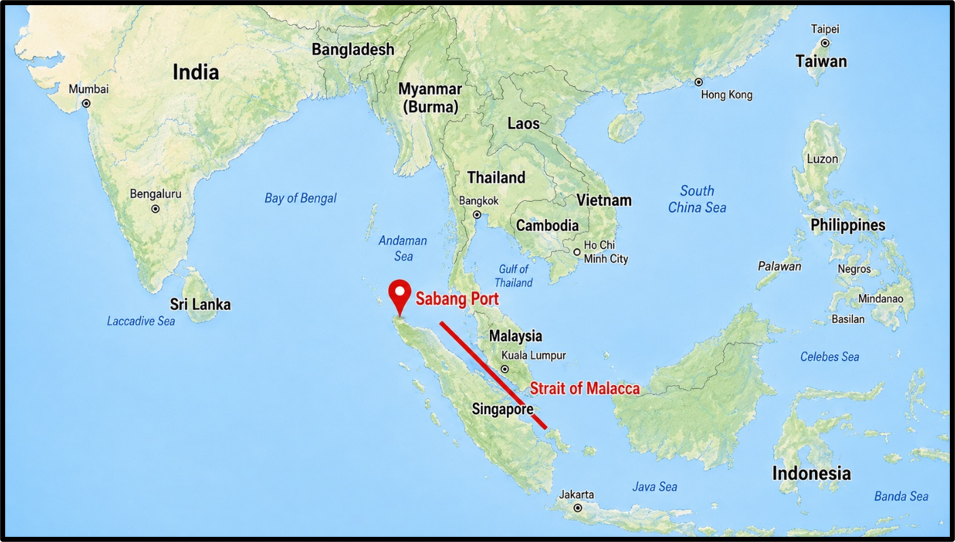
Connectivity — the Sabang Port Project
The two have agreed to jointly develop Sabang Port at the northern tip of Sumatra. Sabang sits at the western entrance to the Malacca Strait and lies close to India’s Andaman and Nicobar Command — giving the project a strategic significance well beyond its commercial value, and complementing India’s own Great Nicobar development.
Connectivity also runs through the Andaman and Nicobar Islands–Aceh maritime link and proposals to improve direct shipping and air connectivity.
Economic and Trade Cooperation
- Indonesia is India’s second-largest trading partner in ASEAN after Singapore, with merchandise trade of about US$24.8 billion in FY2026. The balance is heavily tilted in Indonesia’s favour — India’s deficit stood at roughly US$15.8 billion, though it has narrowed from about US$18.8 billion.
- Trade basket: coal accounts for roughly 30% of India’s imports from Indonesia and palm oil about 19% — Indonesia supplies around 40% of India’s palm oil. India exports refined petroleum products, commercial vehicles, telecommunications equipment, agricultural commodities, steel, plastics and bovine meat.
- Investment: around a hundred Indian companies and joint ventures operate in Indonesia, in sectors from textiles and automobiles to banking and infrastructure.
- Both sides are pressing for an accelerated review of the ASEAN–India Trade in Goods Agreement (AITIGA) to address tariff and non-tariff barriers and the lopsided balance.
Digital and Technology Cooperation
The most distinctive recent development is the export of India’s digital public infrastructure. Indonesia has launched the Indonesia Open Network (ION), built on the architecture of India’s ONDC, alongside progress towards cross-border QR-code payments linking the two payment systems.
Cooperation also extends to critical minerals — Indonesia is the world’s largest nickel producer — as well as health, agriculture and disaster management.
Cultural and People-to-People Ties
Shared civilisational heritage remains a living asset: Indian epics in Javanese and Balinese performance traditions, restoration cooperation on temple complexes, and Indonesia’s participation in Project Mausam. Yoga, Ayurveda and the ICCR cultural centre in Jakarta anchor the soft-power dimension, supported by a sizeable Indian-origin community.
Issues and Challenges
| Challenge | Explanation |
| Lopsided trade | A deficit of roughly US$15.8 billion driven by coal and palm oil; Indian exports to Indonesia have contracted sharply since FY2023 |
| The China factor | Indonesia is deeply tied to China through trade and BRI infrastructure, and guards its non-aligned ‘free and active’ tradition |
| Strategic caution | Jakarta avoids formal alignment, is not a Quad participant, and prefers ASEAN-centred mechanisms to minilaterals |
| Implementation lag | Sabang and other connectivity projects have moved slowly from announcement to execution |
| Palm oil and trade friction | Indian duty changes on edible oils periodically strain the commercial relationship |
| Domestic sensitivities | Indonesian public opinion on issues affecting Muslims occasionally complicates India’s outreach |
Way Forward
- Deliver on Sabang: convert the agreement into visible construction, linking it to Andaman and Nicobar infrastructure.
- Rebalance trade: press the AITIGA review, diversify the basket beyond coal and palm oil, and expand pharmaceutical and IT-services access.
- Institutionalise defence: follow the BrahMos and Astra package with maintenance, training and co-production so the sale becomes a lasting partnership.
- Scale digital cooperation: use ION and cross-border payments as a template for exporting India’s digital public infrastructure across ASEAN.
- Respect strategic autonomy: engage Jakarta bilaterally and through ASEAN rather than pressing it toward bloc alignment.
- Deepen the maritime habit: expand CORPAT and Samudra Shakti, and cooperate on marine security, fisheries and the blue economy.
Conclusion
India and Indonesia are maritime neighbours who spent the Cold War acting like strangers. The relationship’s recovery has been steady rather than spectacular — Strategic Partnership in 2005, Comprehensive Strategic Partnership in 2018 — but the 2026 summit marked a genuine change of gear, moving it from declaratory warmth to hard cooperation in defence technology, port infrastructure and digital systems.
The constraint is structural: Indonesia’s tradition of a ‘free and active’ foreign policy means it will not align, and its economic dependence on China is deep. India’s realistic objective is therefore not to recruit Indonesia but to become indispensable to it — as a defence supplier, a digital partner and a co-guarantor of the sea lanes both depend on.